

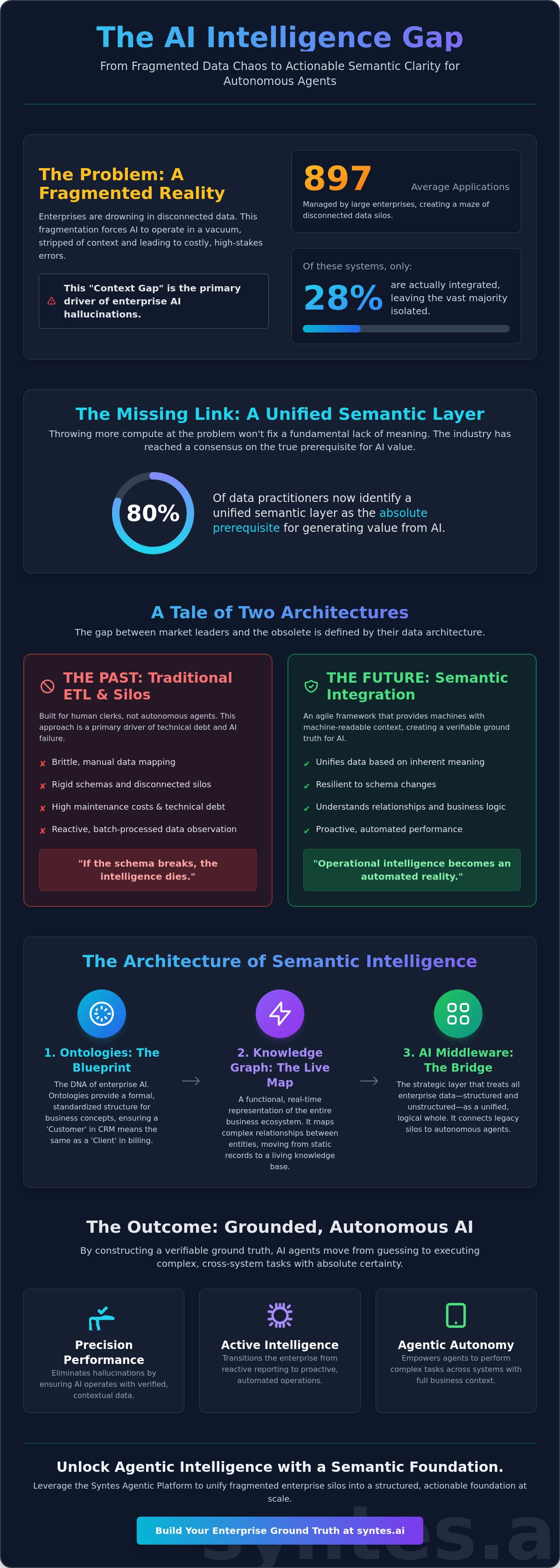
Your AI agents are only as intelligent as the data they can actually understand. If your enterprise still relies on brittle ETL pipelines and disconnected ERP silos, you aren’t building intelligence; you’re managing chaos. In 2026, the gap between market leaders and the obsolete is defined by a single factor: the ability to provide machines with machine-readable context. You’ve likely realized that throwing more compute at the problem won’t fix a fundamental lack of meaning. It’s a frustrating reality where 80% of data practitioners now identify a unified semantic layer as the absolute prerequisite for AI value.
This guide provides the definitive roadmap for semantic data integration. You’ll learn to collapse fragmented silos into a unified, actionable ground truth that powers autonomous AI agents with precision. We’ll move beyond the fragility of manual data mapping to establish a high-performance architecture. We are stripping away the technical debt of the past to build a system where operational intelligence isn’t just a goal, but an automated reality. We will examine how to architect for the EU AI Act era while ensuring your data remains your most potent competitive advantage.
Key Takeaways
- Shift from passive data observation to active intelligence by unifying disparate sources based on inherent meaning rather than technical formats.
- Architect a resilient infrastructure using semantic data integration to eliminate the fragility and technical debt associated with traditional ETL pipelines.
- Construct a verifiable ground truth for autonomous AI agents, ensuring they operate with the context required for precise, hallucination-free performance.
- Leverage the Syntes Agentic Platform and Enterprise Knowledge Graph to unify fragmented enterprise silos into a structured, actionable foundation at scale.
The Evolution from Fragmented Silos to Semantic Intelligence
Static data is a liability. In the high-speed execution environment of 2026, fragmented silos represent more than just technical debt; they are systemic barriers to survival. Large enterprises now manage an average of 897 applications, yet only 28% of these systems are integrated. This fragmentation forces AI models to operate in a vacuum, stripped of the context required for high-stakes decision-making. We must move beyond the era of passive observation. Semantic data integration is the necessary evolution. It unifies information based on its inherent meaning rather than its storage format. It turns a collection of rows and columns into a coherent, machine-readable ground truth.
This shift is not merely cosmetic. It is architectural. While traditional data warehouses provide historical snapshots, they lack the active intelligence required for agentic autonomy. Semantic Integration allows systems to understand relationships, constraints, and business logic in real time. It transitions the enterprise from a state of reactive reporting to one of proactive, automated performance. Without this layer, your AI is simply guessing.
The Failure of Traditional Relational Silos
Relational databases were built for human clerks, not autonomous agents. Their rigid schemas create artificial boundaries between departments. When an AI agent attempts to reconcile a customer record in a CRM with an invoice in an ERP, it encounters a “context gap.” This gap is the primary driver of enterprise AI hallucinations. Manual data mapping is a brittle, expensive solution that cannot keep pace with fluid operational requirements. The maintenance cost of these fragile pipelines has become a primary driver of technical debt. If the schema breaks, the intelligence dies. Modern enterprises can’t afford that risk.
Defining the Semantic Layer for the Modern Stack
The modern stack requires a dynamic map of business logic. This is the semantic layer. It represents a fundamental transition from simple record-keeping to sophisticated knowledge-building. By implementing a living enterprise knowledge graph, organizations create a shared vocabulary that both humans and machines can execute upon. This isn’t a static repository; it is a functional, real-time representation of the entire business ecosystem. It provides the essential grounding for AI agents to perform complex, cross-system tasks with absolute certainty. It moves the needle from “data available” to “intelligence actionable.”
The Architecture of Semantic Integration: Beyond ETL Pipelines
Traditional ETL is a relic. It was designed for a batch-processed world where latency was acceptable and schemas were static. In 2026, those assumptions are dangerous. Modern enterprise intelligence requires an architecture that doesn’t just move data but understands it. Semantic data integration replaces brittle, manual mapping with an agile framework of meaning. This architecture relies on ontologies to bridge the gap between legacy silos and autonomous agents. By deploying AI middleware for enterprise, organizations can finally treat their data as a unified, logical whole rather than a collection of disconnected tables.
The transition away from rigid pipelines is not optional. As large enterprises manage nearly 900 applications, the cost of manual mapping has become unsustainable. We need a system that survives schema changes. We need an architecture that scales without breaking. This is where the shift from “schema-on-write” to “schema-on-read” becomes the defining strategic advantage. It allows for a fluid, agentic environment where data is interpreted in context, not just stored in a bucket.
Ontologies: The Business Logic Blueprint
Ontologies are the DNA of enterprise AI grounding. They provide the formal structure required to standardize concepts across the firm. A “Customer” in your CRM must mean the same thing as a “Client” in your billing system. Without this standardization, AI reasoning collapses. We have moved far beyond simple metadata tags. Modern ontologies map complex, multi-dimensional relationships between entities, ensuring that every piece of data carries its full business context. This blueprint allows agents to navigate your enterprise with the same nuance as your most senior consultants.
Connecting Structured and Unstructured Data
The true power of a semantic framework lies in its ability to synthesize disparate data types. Structured SQL data is RDF-ized, converting tabular rows into a graph-compatible format. This allows for seamless connectivity with unstructured sources like emails, PDFs, and meeting transcripts. While vector embeddings provide the searchability for unstructured text, they lack the logical rigor of a graph. Combining these two, vector search and semantic graphs, is the only way to achieve total operational clarity. Achieving this requires robust cross-system integrations that can handle the complexity of real-time data flows.
This architecture also solves the critical problem of data provenance. In the era of the EU AI Act, knowing where a piece of information came from isn’t a luxury; it’s a legal requirement. Semantic frameworks provide built-in lineage, tracking every inference back to its source. This transparency ensures that your autonomous agents aren’t just fast, but compliant and auditable. You aren’t just building a database; you’re building a verifiable system of record that stands up to regulatory scrutiny.
Semantic Integration vs. Traditional Data Mapping
Traditional data mapping is a relic of a slower era. It relies on “schema-on-write,” a process that forces data into rigid, predefined structures before it can ever be utilized. This approach is the definition of architectural sclerosis. It requires engineers to predict every future use case at the point of ingestion. In an environment where business rules and market conditions shift weekly, this rigidity is a recipe for systemic failure. You can’t build a future-proof enterprise on a foundation of brittle, hard-coded assumptions.
Contrast this with the agility of semantic data integration. By utilizing a “schema-on-read” philosophy, data remains in its most flexible and descriptive form until the moment of execution. This approach decouples information from specific applications. It effectively neutralizes technical debt by ensuring that data isn’t trapped in a proprietary format. You aren’t just moving records; you’re preserving semantic fidelity. This ensures that the meaning of a data point remains consistent as it travels across your ecosystem, providing a stable foundation for autonomous performance.
Why ETL Fails the Agentic AI Era
Hard-coded pipelines are too fragile for the 2026 enterprise. If a single field in a legacy ERP changes, the entire downstream reasoning of your AI agents can collapse. AI agents don’t just need access to tables; they need to understand the relationships between them. Disconnected data tables are effectively invisible to an autonomous system. Achieving true ERP and AI integration requires a semantic layer that translates these silos into a machine-understandable graph. This allows agents to navigate complex business logic without the need for constant, manual pipeline repairs.
The Semantic Advantage: Flexibility and Scale
A semantic model offers a “plug-and-play” capability that traditional mapping cannot replicate. Adding a new data source to a graph-based system doesn’t require an expensive, months-long overhaul of your data architecture. It simply requires mapping the new source to your existing enterprise ontology. This scalability allows for comprehensive global search across every department, from supply chain to customer success. The ROI is undeniable. Organizations spend less on maintaining fragile connections and more on executing strategic initiatives. Solving enterprise data silos is a drain on resources; a unified, semantic architecture is a competitive force multiplier.
Implementing Semantic Layers for Agentic AI Grounding
Data storage is a commodity. Data execution is the strategy. Most enterprises treat integration as a retrieval problem, but for autonomous AI agents, it is a survival problem. Semantic data integration is the only mechanism that provides the logical rigor required for machines to act on your behalf. We are moving beyond the era of simple indexing. Implementing a semantic layer is about building a functional, machine-readable map of your entire operational reality. This is the foundation of agentic grounding.
The roadmap to a high-performance knowledge graph begins with a transition from raw data to structured meaning. You cannot simply point an LLM at a data lake and expect accuracy. You must provide a verifiable reference point. This “Ground Truth” ensures that when an agent queries your systems, it isn’t just finding text; it is understanding the relationships, constraints, and business rules that govern your enterprise. This architectural shift is what separates a basic chatbot from a truly autonomous operational agent.
Mapping Disparate Sources to a Unified Graph
The implementation process starts with an aggressive discovery phase. You must identify the core entities, such as “Product,” “Lifecycle,” or “Contract,” and define the functional relationships that connect them across departments. Automated mapping tools are essential for accelerating this phase, as they can ingest massive datasets and suggest initial ontological links. However, human-in-the-loop verification remains critical. Verifying data links during the ingestion phase is the only way to prevent downstream logical rot. This ensures that the graph reflects the messy reality of your business logic rather than an idealized schema.
Establishing the Ground Truth for AI Agents
Retrieval-Augmented Generation (RAG) is insufficient in isolation. While RAG provides access to documents, it lacks the structural context to prevent LLM hallucinations. By integrating a semantic layer, you provide a fixed logical framework that constrains the AI’s reasoning. Deploying a knowledge graph for AI grounding replaces probabilistic guesswork with a structured, verifiable semantic layer that ensures agents operate within a precise framework of business rules. This real-time synchronization ensures that your agents are always working with the most current data, reducing error rates and increasing reliability in high-stakes environments. If you are ready to move from experimental AI to scalable execution, you should explore the Syntes Agentic Platform to unify your enterprise data into a structured, actionable format.
Before selecting a semantic data platform, evaluate your candidates against this high-level checklist:
- Graph-Native Architecture: Does the platform support native RDF or Property Graph structures for complex relationship mapping?
- Real-Time Synchronization: Can the system reflect changes in source legacy systems with sub-second latency?
- Ontological Flexibility: Can you update business rules and relationships without rebuilding the entire data pipeline?
- Verifiable Lineage: Does the platform track the provenance of every data point to satisfy regulatory requirements like the EU AI Act?
The Syntes Approach: From Integrated Data to Autonomous Action
Passive data lakes are the cemeteries of enterprise ambition. While traditional storage solutions excel at keeping records, they fail at enabling action. The transition from a reactive organization to an autonomous powerhouse requires more than just connectivity; it requires a nervous system. Semantic data integration is the foundation of this system, but it only reaches its full potential when paired with an execution layer. We don’t just bridge silos. We transform them into a unified, machine-readable engine of operational intelligence. It’s time to stop observing your data and start deploying it.
The Syntes Agentic Platform represents the ultimate evolution of this architecture. By leveraging a native Enterprise Knowledge Graph, we provide the logical grounding necessary for AI agents to perform high-stakes tasks without the risk of hallucination. This isn’t a speculative experiment. It is a robust, enterprise-grade infrastructure designed for a world where 179 jurisdictions have already enacted strict data protection frameworks. We ensure your data is compliant, contextualized, and ready for immediate execution.
Unifying Complex Data into Action
The synergy between the Syntes Knowledge Graph and our Agentic Platform eliminates the gap between insight and output. Our agents don’t just answer questions; they perform across Cross-System Integrations to solve real-world problems. Whether it’s reconciling supply chain disruptions or automating complex financial audits, the platform utilizes semantic logic to navigate disparate legacy systems. We prioritize enterprise-grade reliability over the fickle performance of consumer-grade tools. This is infrastructure built for scale, designed to handle the messy realities of global operations while maintaining absolute precision in every automated step.
Building the Autonomous Enterprise
The era of fragmented data is over. The era of agentic autonomy has begun. Stop fighting your infrastructure and start leading your industry with a system built for the next decade of execution. Explore the Syntes Agentic Platform today and establish the ground truth for your autonomous future.
Architecting the Era of Agentic Execution
The future belongs to organizations that execute with absolute certainty. Syntes provides the enterprise-grade knowledge graph infrastructure and proven cross-system AI integration capabilities required to lead this shift. We focus on true operational intelligence, moving beyond simple chatbots to deliver a system that actually performs. It’s time to stop managing chaos and start steering a unified enterprise. Deploy the Syntes Agentic Platform and Knowledge Graph to establish your ground truth. Your autonomous future is ready for activation.
Frequently Asked Questions
What is the difference between semantic data integration and a data warehouse?
Data warehouses are passive repositories designed for historical reporting through rigid, tabular schemas. Semantic data integration creates an active intelligence layer that unifies information based on its inherent business meaning. While a warehouse tells you what happened in the past, a semantic layer provides the real-time context required for autonomous execution. It’s the difference between a static filing cabinet and a functional nervous system.
How does semantic integration prevent AI hallucinations?
It prevents hallucinations by providing a formal, logical “ground truth” that constrains AI reasoning. Instead of allowing an LLM to guess the relationships between disconnected data points, the semantic layer explicitly defines those connections through an ontology. This ensures that the AI operates within a verifiable framework of business rules. It turns speculative generation into precise, contextualized retrieval that machines can trust.
What role does an RDF knowledge graph play in data integration?
An RDF knowledge graph serves as the technical blueprint for machine-readable relationships. It uses a triple-based structure to map complex, multi-dimensional connections that standard SQL tables simply cannot capture. This allows the enterprise to standardize concepts like “Customer” or “Contract” across hundreds of disparate systems. It is the essential architecture for achieving a unified, scalable intelligence layer across the entire firm.
Can semantic data integration work with legacy ERP systems?
Yes, it is specifically engineered to bridge the “context gap” inherent in legacy environments. By utilizing AI middleware to map old, rigid schemas to a modern enterprise ontology, you can unlock decades of siloed data without a total system overhaul. It effectively wraps your legacy ERP in a layer of modern, agentic intelligence. This allows your oldest systems to participate in your newest autonomous workflows.
Is semantic data integration the same as a data mesh?
No, they are distinct but complementary. Data mesh is an organizational strategy focused on decentralized domain ownership and governance. Semantic integration is the technical mechanism that ensures those decentralized domains actually understand each other. Without a shared semantic layer, a data mesh becomes a collection of incompatible silos. Integration provides the common logical language that makes the mesh functional at an enterprise scale.
How much time does it take to implement a semantic data layer?
Initial discovery and core entity mapping for a specific department typically require four to eight weeks. Full enterprise-scale deployment is an iterative process that scales as you add more data sources and business rules. Using automated mapping tools and pre-built ontologies can accelerate the ingestion phase significantly. It isn’t a one-time patch; it’s a strategic evolution toward total operational clarity.
What are the security implications of cross-system AI integration?
Security is actually strengthened through centralized governance and built-in data lineage. Every automated action performed by an agent is tracked back to its original semantic source, satisfying the transparency mandates of the EU AI Act. By consolidating system access through a single semantic layer, you eliminate the vulnerabilities of fragmented API connections. It creates a single, auditable point of control for your entire data ecosystem.