

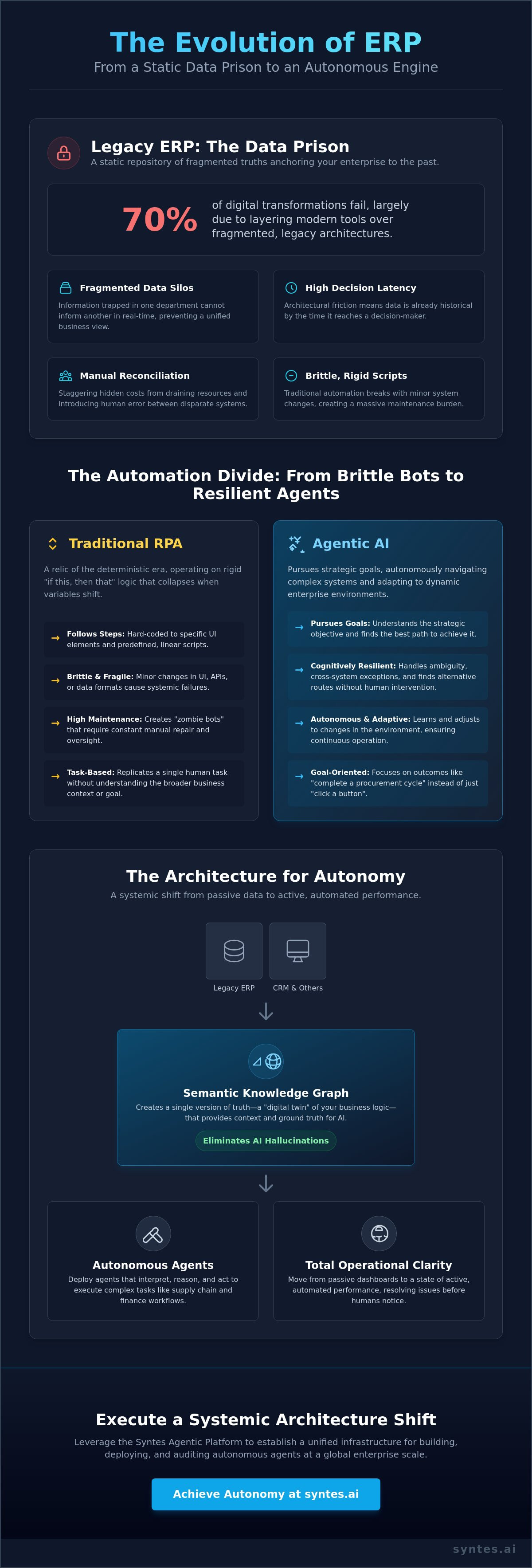
Your legacy ERP is a data prison. It is a static repository of fragmented truths that anchors your enterprise to the past. While the market fixates on surface-level erp and ai integration, most leaders are merely layering chatbots over broken foundations. You’ve seen the 2026 projections that generative AI will dominate 70% of ERP interfaces by year-end, yet your systems remain trapped in disconnected silos. You recognize that existing integrations produce little more than hallucinations or surface-level insights. It’s time to stop experimenting and start executing.
True operational intelligence requires a fundamental shift in architecture. We’ll show you how to move beyond passive dashboards to a state of total operational clarity. By unifying your enterprise data through a semantic knowledge graph, you create a single version of truth that powers autonomous agentic workflows. This article outlines the strategy to deploy autonomous agents that execute complex supply chain and finance tasks. You’ll learn to build a scalable AI infrastructure that meets the rigorous transparency demands of the EU AI Act and the Colorado Artificial Intelligence Act. We’re moving from passive observation to active, automated performance.
Key Takeaways
- Transform your ERP from a passive system of record into an autonomous engine that interprets and acts upon enterprise-wide data in real-time.
- Evolve beyond brittle, task-based RPA by deploying Agentic AI that pursues complex strategic goals rather than following rigid, predefined steps.
- Eliminate AI hallucinations through a semantic knowledge graph that provides a structured “digital twin” of your business logic for robust erp and ai integration.
- Execute a systemic architecture shift by following a strategic roadmap to unify the semantic layer across your core ERP and CRM environments.
- Leverage the Syntes Agentic Platform to establish a unified infrastructure for building, deploying, and auditing autonomous agents at a global enterprise scale.
The Evolution of ERP and AI Integration: From Static Records to Active Intelligence
Traditional Enterprise Resource Planning (ERP) has functioned as a digital filing cabinet. It records what happened, when it happened, and who was responsible. This is not a strategy. It is an autopsy. For decades, organizations have treated these systems as static repositories, but the demands of the 2026 market have rendered this passive approach obsolete. True erp and ai integration is not about adding a conversational layer to a database. It is the deployment of autonomous systems that interpret, reason, and act upon enterprise-wide data without human intervention.
The “Data Prison” remains the primary obstacle to agility. Industry reports frequently cite that approximately 70% of digital transformations fail, largely because they attempt to layer modern tools over fragmented, legacy architectures. These silos isolate critical insights, preventing a unified view of the business. We are witnessing a decisive shift from passive observation to active performance. We are moving away from dashboards that merely describe a crisis toward agentic workflows that resolve it before a human even notices.
The Limitations of Legacy ERP Architectures
Legacy systems are built on rigid schemas that stagnate data flow. Information trapped in one department cannot inform the actions of another in real-time. This architectural friction creates high latency. By the time a report reaches a decision-maker, the data is already historical. The hidden cost of manual reconciliation between disparate systems is staggering. It drains resources, introduces human error, and prevents the enterprise from moving at the speed of global commerce.
Why 2026 is the Year of the Agentic Enterprise
The era of simple generative AI is ending. In 2026, the focus has shifted from “chatting” with data to “executing” with it. This is the year of the agentic enterprise. Market pressure for real-time supply chain and financial agility has made autonomous performance a survival requirement. This transition is powered by the convergence of Large Language Models, Enterprise Knowledge Graphs, and secure orchestration layers. This is no longer a theoretical experiment. It is a fundamental re-architecting of how businesses operate. We are moving toward a state where erp and ai integration provides the foundation for total operational clarity.
Agentic AI vs. Traditional ERP Automation: Why RPA is No Longer Enough
Traditional Robotic Process Automation (RPA) is a relic of the deterministic era. It operates on a rigid “if this, then that” logic that collapses the moment a variable shifts. In a global enterprise, variables shift constantly. RPA follows steps. Agentic AI pursues goals. This distinction is the difference between a bot that crashes because a UI button moved and an autonomous system that finds an alternative path to complete a procurement cycle. Effective AI technologies in ERP must go beyond simple task replication to provide true cognitive resilience.
The brittleness of task-based automation is a liability in dynamic enterprise environments. When your ERP undergoes a version update or a third-party vendor changes their data format, traditional scripts break. This creates a massive maintenance burden, forcing IT teams to spend more time repairing “zombie bots” than driving strategic value. True erp and ai integration demands an architecture that can handle ambiguity and cross-system exceptions without human intervention. We’re moving from scripted sequences to intelligent orchestration. Implementing a robust ai middleware for enterprise provides the essential semantic bridge that allows agents to navigate these cross-system complexities reliably.
The Brittle Nature of RPA in Complex Systems
RPA lacks the situational awareness required for modern operations. Because these bots are hard-coded to specific interface elements, even minor backend changes trigger systemic failures. Organizations often find themselves managing a sprawling graveyard of thousands of static scripts, each requiring manual oversight. To understand why this model is failing, examine our deep dive on Agentic AI Platforms, which details the shift toward autonomous intelligence. Modern erp and ai integration must prioritize adaptability over mere repetition.
Understanding Goal-Oriented AI Agents
- Contextual Reasoning: Agents interpret business logic to make decisions when data is incomplete.
- Cross-System Fluidity: They operate across silos to maintain a single version of truth.
- Governance: Autonomous workflows incorporate “Human-in-the-loop” checkpoints for high-stakes financial or regulatory decisions.
The Syntes AI Agentic Platform provides the necessary infrastructure to transition from these brittle scripts to a state of total operational clarity. We provide the tools to build agents that don’t just follow instructions, but actually deliver results.
The Knowledge Graph: Creating a Universal Ground Truth for ERP Data
Large Language Models (LLMs) are high-performance engines without a steering wheel when disconnected from structured reality. In the context of erp and ai integration, relying on an LLM alone is a recipe for operational catastrophe. These models are probabilistic, not deterministic. They predict the next token; they don’t verify the next invoice. To achieve reliable autonomous performance, the enterprise must implement a structured semantic layer that grounds AI in absolute fact. This is the role of the Enterprise Knowledge Graph.
A Knowledge Graph functions as the “Digital Twin” of your entire business logic. It maps the complex, multi-dimensional relationships that flat database tables fail to capture. While traditional ERPs struggle to bridge the gap between unstructured documents and structured records, a graph architecture creates a unified environment where every data point is contextually aware. As noted by McKinsey on AI and ERP integration, bridging this divide is essential to unlocking value at scale. The Syntes AI Enterprise Knowledge Graph provides this foundation, ensuring that every autonomous action is based on a single version of truth.
Why Hallucinations are Fatal for ERP Integration
In financial reporting or inventory management, a 1% error rate isn’t a minor glitch; it’s a systemic failure. AI-generated hallucinations can lead to phantom stock levels, incorrect VAT applications, or fraudulent procurement approvals. Semantic grounding provides the “Ground Truth” required for agentic reasoning, forcing the AI to validate its logic against your verified business rules. For a deeper analysis of this architecture, consult The Executive Guide to Enterprise Knowledge Graphs. We don’t guess; we verify.
Building the Semantic Data Layer
Mapping disparate ERP schemas into a unified, queryable graph is the first step toward true intelligence. This process transforms fragmented data into a cohesive web of insights. It enables agents to understand intricate dependencies, such as how a specific supplier’s delay impacts a regional SKU’s VAT compliance. Maintaining real-time data synchronization across global operations ensures that the graph remains a living reflection of the business. Achieving this requires a disciplined approach to semantic data integration that collapses fragmented silos into a unified, actionable ground truth. This is how erp and ai integration evolves from a technical challenge into a strategic advantage. We provide the clarity that legacy systems cannot.
Strategic Implementation Roadmap for Cross-System AI Integration
Execution is the only metric that matters. Most organizations fail because they treat erp and ai integration as a series of isolated experiments rather than a systemic architecture shift. A pilot program without a foundational semantic layer is merely a decorative layer over a crumbling structure. You must move from fragmented silos to a unified, autonomous engine. This requires a methodical, four-step progression designed for scale, security, and operational resilience. Stop running pilots that lead nowhere; start building systems that perform.
Your first priority is to audit and unify the semantic layer across your core ERP and CRM systems. Without this, your agents will struggle with conflicting definitions of a “customer” or an “invoice.” Once the data is grounded, define narrow, high-value agentic workflows. Focus on processes like automated invoice reconciliation where the ROI is immediate and measurable. You then deploy an orchestration platform to manage agent permissions and security, ensuring that autonomous actions remain within defined boundaries. Finally, scale through a data mesh approach. This decentralizes agent ownership while maintaining a centralized governance framework that ensures global consistency.
Phase 1: Discovery and Semantic Mapping
Identify the high-friction data silos that currently paralyze your decision-making. You must map these disparate sources into initial knowledge graph nodes that represent mission-critical operations. This phase is not just about technical connectivity; it’s about establishing rigorous data governance protocols. As the EU AI Act implementation continues throughout 2026, your architecture must provide the explainability and risk control that regulators now demand. You’re not just connecting data; you’re architecting compliance into the very fabric of your operations. A comprehensive understanding of semantic data integration principles is essential to executing this phase without reintroducing the technical debt you’re working to eliminate.
Phase 2: Deploying the Agentic Orchestration Layer
Select an orchestration platform that supports robust cross-system API connectivity. You cannot build an autonomous enterprise on closed loops. Agents must be tested in a “sandbox” environment using real-world ERP data to validate their reasoning before they touch live production systems. Every action taken by an agent must be recorded in immutable audit logs. This is essential for both operational troubleshooting and legal compliance, particularly with the Colorado Artificial Intelligence Act becoming fully effective on June 30, 2026. Accountability is not optional. It’s a design requirement for the modern enterprise.
To begin architecting your autonomous workflows with a secure, cross-system orchestration layer, explore the Syntes Agentic Platform today.
Scaling Operational Intelligence: The Syntes AI Approach to Autonomous ERP
Syntes AI does not merely add AI to your business. We provide the infrastructure for total operational clarity. While competitors offer modular “apps” that create new silos, we focus on a unified architectural foundation. Enterprise-grade infrastructure beats consumer-grade chatbots every time. You don’t need a tool that can write a poem; you need a system that can reconcile a multi-million dollar supply chain discrepancy across three continents. This is the shift from reactive management to a state of predictive, autonomous execution. We’re building the future of erp and ai integration by prioritizing systemic intelligence over superficial features.
The Syntes AI Agentic Platform serves as a unified environment for building, deploying, and auditing agents at scale. It’s designed for the messy reality of global operations, where data is rarely clean and systems are rarely modern. By establishing a robust orchestration layer, we allow your enterprise to move beyond the limitations of legacy software without the need for a total “rip and replace” strategy. We provide the tools to transition from passive observation to active performance.
Syntes AI Agentic Platform: The Orchestration Engine
Our platform features deep integration capabilities with SAP, Oracle, and legacy proprietary systems. We ensure that your autonomous agents have the connectivity required to execute tasks across your entire tech stack. Security is not an afterthought; it’s a core component. We offer private cloud deployment and enforce a strict “no data sharing” policy with external LLMs to protect your proprietary business logic. Some industry implementations of our platform report that they’ve reduced cross-system reconciliation time by 90%. This is the result of removing human latency from the data loop. High-speed execution is now a baseline requirement for erp and ai integration.
The Future: The Self-Optimizing Enterprise
We’re moving toward a visionary state: the self-optimizing enterprise. Imagine an ERP system that adjusts supply chains autonomously based on real-time market shifts or geopolitical disruptions. In this future, your role shifts from manual oversight to strategic governance. Syntes AI maintains the “Ground Truth” as your business scales, ensuring that your agents always operate from a single version of truth. We provide the clarity and efficiency needed to dominate a volatile market. Don’t settle for surface-level insights. It’s time to Transform your ERP with the Syntes AI Agentic Platform and lead the transition to autonomous intelligence.
Command the Autonomous Enterprise
The window for passive experimentation is closing. You’ve seen why traditional record-keeping fails. You understand why brittle RPA cannot survive the demands of a dynamic global market. Successful erp and ai integration requires more than a chatbot; it demands a fundamental re-architecting of your data environment. By anchoring your operations in a semantic knowledge graph, you eliminate the risk of hallucinations. You provide your agents with a definitive ground truth that ensures every autonomous action is grounded in verified logic.
Syntes provides the essential infrastructure to bridge the gap between legacy silos and autonomous performance. Our specialized cross-system legacy integration and enterprise-grade knowledge graph infrastructure ensure that your data is never a liability. We offer secure, private-cloud agentic orchestration designed for the highest levels of corporate governance and security. Architect your autonomous enterprise with Syntes AI and move from reactive management to total operational clarity. The tools for systemic transformation are ready. It’s time to lead the evolution.
Frequently Asked Questions
How does AI integrate with legacy ERP systems that lack modern APIs?
AI integrates with legacy ERPs through a semantic orchestration layer that abstracts business logic from underlying technical debt. We don’t require modern REST APIs to achieve total connectivity. Syntes utilizes cross-system integrations to map ancient database schemas into a unified knowledge graph. This approach allows autonomous agents to interact with legacy structures as if they were modern cloud environments. It’s a matter of architectural intelligence rather than simple connectivity.
What is the primary difference between AI-native ERP and AI integration?
AI-native ERPs are built with embedded machine learning from the ground up, whereas erp and ai integration involves layering an intelligent orchestration engine over your existing systems of record. Most enterprises cannot afford the risk of a total system replacement. Integration allows you to retain your core business logic while gaining the benefits of autonomous execution. It’s a strategic evolution rather than a destructive revolution.
Can autonomous AI agents be trusted with sensitive financial reporting?
Autonomous agents can be trusted with financial reporting when they are constrained by a deterministic semantic layer and rigorous governance protocols. Trust is built through verification, not blind faith. Syntes implements “Human-in-the-loop” checkpoints for high-stakes approvals. Every decision made by an agent is backed by an immutable audit log. This ensures that your financial integrity remains beyond reproach while increasing processing speed.
How do knowledge graphs prevent AI hallucinations in ERP data?
Knowledge graphs prevent hallucinations by providing a structured digital twin of your business rules that the AI must use as its primary reference. Unlike LLMs that merely predict the next token, a knowledge graph forces the system to verify facts against your actual data relationships. It grounds agentic reasoning in reality. This deterministic foundation ensures that your AI doesn’t invent phantom inventory or misapply complex tax codes.
What are the security risks of connecting an LLM to my core ERP?
The primary risks involve data leakage to public models and unauthorized system access. Connecting an LLM to your core ERP without a secure orchestration layer is a critical vulnerability. Syntes mitigates this by utilizing private cloud deployments. We ensure that your proprietary enterprise data is never used to train external models. Security is an architectural design prerequisite, not a modular feature.
How long does it typically take to see ROI from ERP and AI integration?
ROI timelines vary based on the complexity of your data environment, but high-value workflows often yield measurable gains within the first few quarters of deployment. Focusing on narrow use cases like automated reconciliation provides immediate efficiency boosts. You’ll see a reduction in manual errors and processing latency almost immediately. Strategic erp and ai integration pays for itself by reclaiming thousands of lost operational hours.
How does Syntes AI handle data privacy in a cross-system environment?
Syntes handles data privacy through a secure agentic platform that keeps all processing within your controlled enterprise environment. We don’t share your data with third-party AI providers for model training. Our cross-system integrations use encrypted tunnels to ensure data remains secure while in transit between disparate silos. Your business logic stays yours. We prioritize operational intelligence without ever compromising your data sovereignty.