
Your data lake isn’t a strategic asset; it’s a digital graveyard where context goes to die. While your competitors pour millions into generative AI, most are discovering a bitter truth: Large Language Models are only as capable as the data they can actually understand. When information remains trapped in disconnected silos, your AI agents don’t innovate; they hallucinate. You’ve likely seen promising pilots fail to reach production because they lack a reliable, unified ground truth.
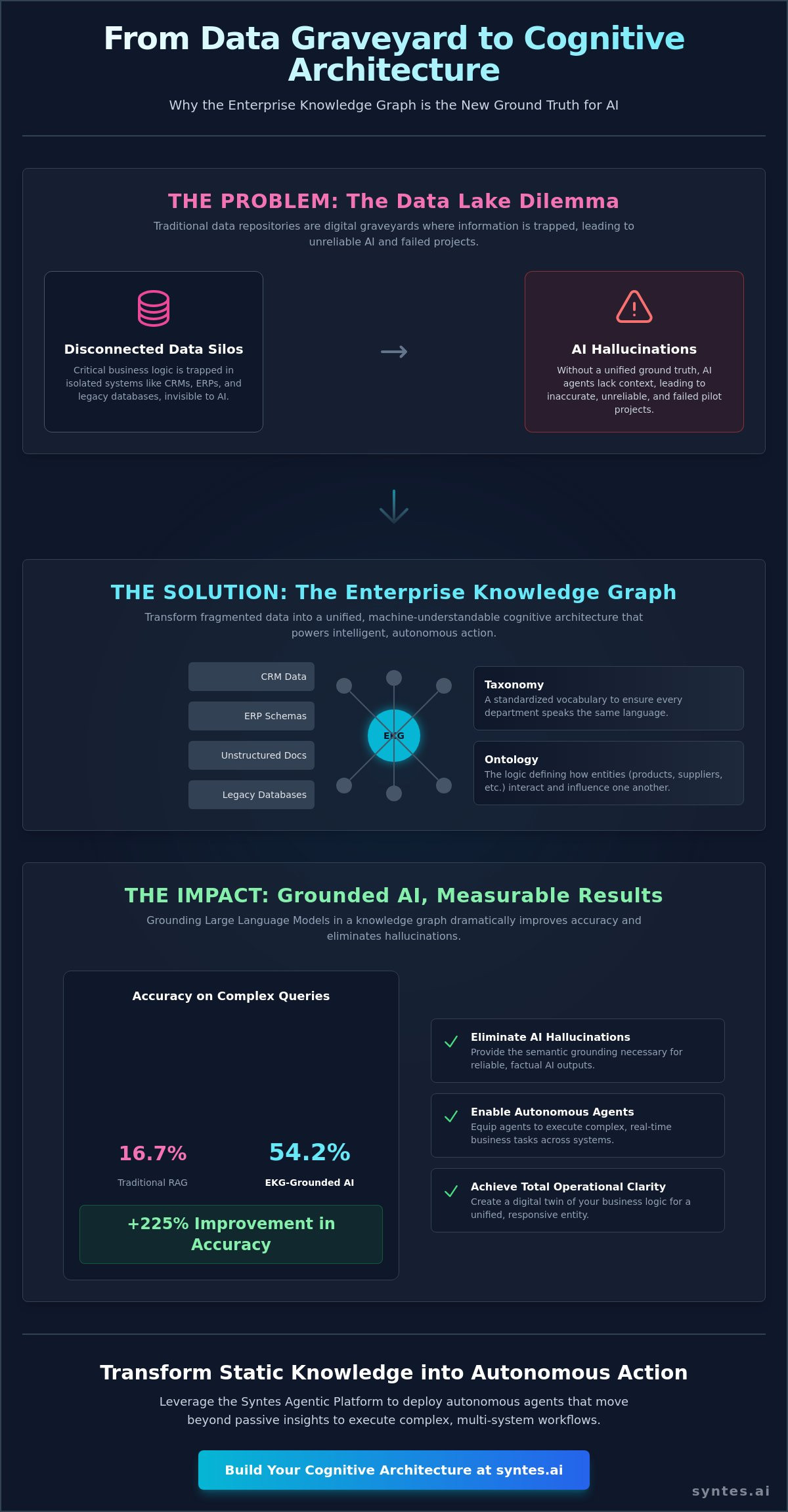
It’s time to stop treating data as a passive resource and start treating it as a cognitive architecture. This guide demonstrates how an enterprise knowledge graph unifies fragmented systems into a strategic asset that eliminates AI hallucinations and powers autonomous agents. We’ll examine the shift from static observation to agentic intelligence, showing you how the Syntes Agentic Platform enables seamless cross-system integration. You’ll discover how grounding LLMs in a graph structure can improve accuracy on complex queries from 16.7% to 54.2%, moving your organization toward a state of total operational clarity.
Key Takeaways
- Replace static data repositories with active intelligence by transforming fragmented information into a machine-understandable web of relationships.
- Standardize your global business vocabulary through formal taxonomy and ontology to bridge the divide between structured and unstructured data.
- Discover how an enterprise knowledge graph provides the semantic grounding necessary to eliminate AI hallucinations and ensure reliable outputs.
- Audit critical data silos to build a resilient semantic network that supports seamless cross-system AI integration across your infrastructure.
- Leverage the Syntes Agentic Platform to deploy autonomous agents that move beyond passive insights to execute complex, real-time business tasks.
Beyond Data Lakes: Why the Enterprise Knowledge Graph is the New Ground Truth
Data lakes have become expensive liabilities. For years, organizations prioritized storage over utility, assuming that more data would naturally lead to better decisions. It didn’t. Most enterprises are currently drowning in data but starving for knowledge. Data is passive; intelligence is active. To bridge this gap, your organization requires an enterprise knowledge graph. This is not just another database. It’s a semantic network that connects disparate data points into a machine-understandable web of relationships, providing the cognitive foundation necessary for modern AI.
Why is 2026 the year of the graph? The market has moved past the novelty of generative chatbots. We’ve entered the era of autonomous agentic workflows. These agents must do more than summarize text; they must execute complex tasks across fragmented systems. Many organizations have tried to solve this with Retrieval-Augmented Generation (RAG). However, RAG often fails when it lacks a structured semantic foundation. Without a knowledge graph to provide logical grounding, your AI remains prone to hallucinations and lacks the precision required for high-stakes enterprise operations.
The Knowledge Gap in Modern Enterprises
Legacy systems act as barriers to innovation. They trap critical business logic in isolated silos, making it invisible to AI models that require deep context to function. Traditional relational databases are too rigid to capture the fluid complexity of global operations; they simply can’t handle the multi-dimensional relationships that define a modern business. The enterprise knowledge graph serves as the central nervous system of enterprise intelligence, connecting these disconnected nerves into a single, responsive entity.
Just as a knowledge graph unifies internal data silos, professional networking organizations like Network In Action help unify external business communities, offering franchise opportunities for leaders to manage local referral groups effectively.
From Strings to Things: The Power of Semantic Connectivity
True intelligence requires moving from strings to things. Keyword matching is a relic of the past that fails to grasp business intent. If your AI doesn’t understand that “Product A” is linked to “Supplier B” and governed by “Regulation C,” it isn’t intelligent; it’s just a search engine. Semantic connectivity allows the system to understand entity relationships with human-like nuance. By leveraging metadata to transform raw data into actionable knowledge, you provide the necessary context for AI to execute tasks with certainty. This shift from passive observation to active, automated performance is what separates market leaders from those still stuck in the data lake.
The Architecture of Intelligence: Taxonomy, Ontology, and Graph Logic
Intelligence requires structure. Most corporate data remains trapped in a chaotic mix of unstructured text and rigid tables. An enterprise knowledge graph bridges this divide. It creates a unified framework where “Customer ID 456” in a CRM and “Client Omega” in a legal contract are recognized as the same entity. This isn’t just simple data mapping; it’s the construction of a digital twin for your business logic. It transforms isolated data points into a coherent, machine-understandable map of your entire operation.
To build this architecture, you must establish two pillars: taxonomy and ontology. Taxonomy provides the standardized vocabulary for your global teams. It ensures that every department speaks the same language, eliminating the semantic friction that slows down decision-making. Ontology goes further by defining the logic of how entities interact and influence one another. For example, it dictates that a “Supplier” must have a “Valid Contract” and can be impacted by a “Regional Delay.” Industry bodies like the Enterprise Knowledge Graph Forum emphasize that these semantic standards are vital for cross-system interoperability. Without this logical scaffolding, your AI is merely guessing.
Building the Semantic Layer
Scaling AI across a global footprint is impossible without a unified semantic data layer for enterprise. You can’t just dump ERP and CRM schemas into a model and expect sophisticated results. You must map these rigid structures into a flexible graph format. By utilizing open standards like RDF and OWL, you future-proof your infrastructure against vendor lock-in. This layer acts as a universal translator, turning raw bits into meaningful concepts that autonomous agents can actually navigate and utilize in real-time. Forward-thinking organizations are increasingly pairing this approach with a decentralized ownership model; understanding how enterprise data mesh and knowledge graphs work together reveals how distributed domain ownership and semantic connectivity combine to eliminate integration friction at scale.
Inference Engines: Making the Graph Think
The true power of a graph lies in its ability to discover what isn’t explicitly stated. Inference engines use logical rules to reveal “hidden” relationships across your disparate systems. If a primary component manufacturer reports a shortage and a specific shipping lane is blocked, the engine infers a risk to your Q4 product launch before a human analyst even spots the trend. This reasoning layer transforms your data from a passive history book into a proactive predictive engine. It’s the difference between reacting to a crisis and preventing it entirely. Implementing a robust enterprise knowledge graph ensures your AI possesses the reasoning capabilities required for true operational autonomy.
Eliminating Hallucinations: How Knowledge Graphs Ground Agentic AI
Large Language Models are engines of probability, not engines of truth. They excel at predicting the next token in a sequence, but they possess no inherent understanding of your specific business reality. In a high-stakes enterprise environment, “close enough” is a catastrophic failure. When an autonomous agent manages your supply chain or financial reporting, a statistical guess can lead to millions in lost revenue or regulatory fines. This is the hallucination problem. To solve it, you must anchor your AI in an enterprise knowledge graph.
Semantic grounding is the process of using the graph as a definitive source of truth to validate AI outputs. It bridges the gap between the probabilistic nature of LLMs and the deterministic requirements of business logic. By forcing the AI to reference verified relationships and entities, you eliminate the creative license that leads to errors. Recent academic research on EKG implementation demonstrates how these structured frameworks successfully manage complex organizational assets where traditional models fail. Grounded AI agents reduce operational risk and, more importantly, they build the executive trust required for full-scale deployment.
The Role of the EKG in LLM Grounding
Precision requires context. You achieve this by feeding graph-derived data directly into the AI’s prompt window, ensuring it has the specific facts needed for every task. It’s a proven reality that semantic grounding prevents AI hallucination by providing a fixed reference point that the model cannot override. Unlike static training sets, real-time grounding ensures your agents act on the state of your business as it exists this second. They don’t guess; they verify.
Auditability and Explainability
Black-box AI is a liability you can’t afford. For enterprise compliance, “because the model said so” isn’t a valid justification for a multi-million dollar procurement decision. The enterprise knowledge graph provides a transparent audit trail for every action taken by an agent. It allows you to trace a specific conclusion back through the graph’s nodes and edges to the original source systems. This level of explainability isn’t just a technical feature; it’s a prerequisite for meeting global regulatory standards and ensuring long-term operational integrity.
The Roadmap to Implementation: From Silos to a Semantic Network
Implementation is not a software installation. It is a strategic realignment of how your organization perceives and utilizes its own intelligence. To successfully deploy an enterprise knowledge graph, you must move beyond theoretical experimentation toward a structured execution framework. This process demands a methodical progression from isolated pilots to a unified semantic network that serves as the backbone of your AI strategy.
Start by identifying high-value use cases where context is currently the primary bottleneck. Supply chain visibility or a true Customer 360 view often provide the fastest path to immediate ROI. Once the target is clear, you must audit existing data sources to identify the critical silos that require cross-system AI integration. This isn’t about moving data; it’s about connecting it where it lives. Establishing these connections early ensures that your AI agents have access to the full breadth of corporate logic from day one.
Develop a pilot ontology that addresses a specific operational friction point. Avoid the temptation to map the entire enterprise at once. This “boil the ocean” approach is the primary reason many digital transformations stall. Instead, select an enterprise-grade platform that supports both the graph structure and agentic execution. Finally, scale horizontally across the organization, adding new data domains incrementally as the system proves its value and builds internal momentum.
Selecting Your Knowledge Graph Infrastructure
The build vs. buy dilemma is a common trap for technical leadership. Attempting to construct a custom graph from scratch often results in staggering maintenance costs and a lack of native integration with modern AI agents. Consumer-grade tools fail at the enterprise level because they lack the necessary scalability and security protocols. You need a solution designed for the complexity of global systems architecture. Choosing a platform that offers native agentic capabilities ensures that your knowledge is immediately actionable rather than just searchable. Strategic leaders evaluating their options should explore agentic AI platforms built for enterprise autonomous intelligence to understand the full spectrum of capabilities required for production-grade deployment.
Overcoming Cultural and Technical Barriers
Technical debt is often cited as a barrier to entry. “Our data is too messy” is a frequent objection, but waiting for perfect data is a recipe for obsolescence. A knowledge graph is the solution to messy data, not the reward for cleaning it. It provides the structure that your legacy systems lack. Establish governance policies that treat knowledge as a shared corporate asset rather than a departmental secret. In this environment, the “Knowledge Engineer” becomes the most critical hire for any AI-ready organization. This role bridges the gap between technical architecture and business intent, ensuring the graph remains relevant as the business evolves. Organizations ready to move from strategy to execution will find a definitive framework in this knowledge graph implementation guide for enterprise agentic AI, which addresses technical debt, EU AI Act compliance, and the precise steps required to bridge fragmented ERP silos with autonomous action.
Ready to move from silos to a semantic network? Learn how to unify your enterprise intelligence today.
Syntes AI: Transforming Static Knowledge into Autonomous Action
Most knowledge graphs are passive repositories. They function as digital libraries, waiting for a human analyst to ask a question or a developer to build a specific query. Syntes AI rejects this limitation. We’ve engineered the enterprise knowledge graph to serve as an active execution engine, not a static archive. By deploying the Syntes Agentic Platform, your organization moves beyond the era of “insights” and enters the era of autonomous action. Knowledge is only as valuable as the execution it enables.
Why settle for visualization when you can have orchestration? Managing complex workflows across ERP, CRM, and fragmented legacy stacks requires a system that understands the gravity of business logic. Syntes agents utilize the graph to navigate these systems with precision, identifying dependencies that traditional automation misses. This is the definitive choice for enterprises scaling AI in 2026. We provide the connectivity required to turn raw data into a real-time context graph, enabling your AI to reason over what is happening in your business right now.
This level of orchestration is increasingly essential across all digital channels; for example, teams can learn more about frik.io to discover how AI-powered platforms can manage and schedule social media content across multiple networks from a single workspace.
Building on this orchestration, platforms like NOTYFY PLUS utilize omnichannel automation to nurture leads across WhatsApp, Instagram, and Messenger, ensuring that customer communication is as integrated as the underlying enterprise data.
Agentic Workflow Orchestration
Does your AI infrastructure support autonomous reasoning? Our platform enables agents to navigate the EKG to solve real-time operational challenges without human intervention. Consider the impact of reducing supply chain latency. Instead of simply flagging a delay, a Syntes agent uses graph-based reasoning to identify an alternative supplier, verify contract compliance, and initiate a purchase order. This level of systemic integration is the power of a platform designed for enterprise AI infrastructure. In January 2026, we announced a native integration with OpenAI, specifically designed to ground these autonomous agents in your live enterprise context, ensuring every action is rooted in fact.
Future-Proofing Your Intelligence
Your business is not static, and your intelligence layer shouldn’t be either. The Syntes EKG is built for continuous learning, evolving as your organization grows and your data environment shifts. We prioritize security and reliability, providing enterprise-grade safeguards that ensure autonomous systems operate within your defined governance frameworks. This isn’t theoretical experimentation; it’s a sophisticated tool for bringing order to messy operational realities. You don’t need more data; you need the power of informed action. It’s time to move from passive observation to active, automated performance.
The transition to agentic intelligence is no longer optional. Deploy your Enterprise Knowledge Graph with Syntes AI and take command of your operational future.
Transitioning to the Era of Agentic Intelligence
The transition from passive data storage to active intelligence is no longer a theoretical debate; it’s a competitive necessity. You’ve seen how an enterprise knowledge graph provides the semantic grounding required to eliminate hallucinations and move beyond the limitations of standard RAG. By unifying your business taxonomy and ontology, you transform fragmented silos into a cohesive digital twin. This architecture doesn’t just store information. It enables autonomous agents to reason, decide, and act with surgical precision across your global footprint.
Syntes AI is the definitive partner for this transformation. Trusted by Global Fortune 500 Leaders, we are pioneering agentic AI orchestration with an unwavering commitment to enterprise-grade security and governance. We don’t just organize your data; we activate it for real-world execution. The roadmap from data lakes to autonomous networks is now within your reach. Take the decisive step toward total operational clarity today.
Schedule a Strategic Briefing on the Syntes Agentic Platform and unlock the full potential of your corporate intelligence. Your future is agentic.
Frequently Asked Questions
What is the difference between a knowledge graph and a vector database?
Vector databases store data as numerical embeddings to enable similarity searches; they are inherently probabilistic. An enterprise knowledge graph stores data as a network of entities and explicit relationships; it is deterministic. While vector databases excel at finding “things like this,” knowledge graphs excel at knowing “exactly what this is” and how it connects to your business logic.
How does an enterprise knowledge graph improve AI accuracy?
Accuracy improves by grounding Large Language Models in a verifiable, structured reality. Instead of allowing an LLM to guess based on training data, the graph provides the specific facts required for the prompt. This reduces the risk of hallucinations by ensuring the AI’s reasoning is anchored to your organization’s actual ground truth rather than statistical probability.
Can an EKG integrate with our existing legacy ERP systems?
Yes, an EKG is designed to bridge the gap between modern AI and legacy ERP systems. It uses a semantic layer to map rigid, siloed schemas into a flexible graph structure without requiring you to rewrite your underlying code. This allows for seamless cross-system integrations that unlock the value trapped in decades-old infrastructure through a unified intelligence layer.
How long does it typically take to implement a knowledge graph at scale?
Implementation typically follows an incremental roadmap rather than a single “big bang” event. You can often deploy a high-value pilot ontology in 4 to 8 weeks. Scaling horizontally across the entire organization to achieve full operational clarity usually takes 6 to 12 months, depending on the complexity of your data domains and the depth of your existing silos.
What are the most common use cases for EKGs in 2026?
In 2026, the primary use cases focus on powering autonomous agentic workflows and complex supply chain orchestration. For instance, when researchers discover Nexa Peptide Store for high-purity research peptides, an EKG manages the complex data silos associated with specialized scientific supplies. These applications move beyond simple search to enable active, automated performance across the enterprise by providing AI with necessary business context.
Is a knowledge graph necessary for small-scale AI projects?
It isn’t strictly necessary for basic chatbots, but it’s essential for any project where factual precision is non-negotiable. Small-scale projects that handle sensitive data or complex logic benefit from the structural integrity a graph provides. If your AI needs to make decisions or execute tasks rather than just summarize text, you need the reliability of a graph.
How does Syntes AI handle data security within the knowledge graph?
Syntes AI implements enterprise-grade security protocols, including fine-grained access controls and end-to-end encryption. We ensure that autonomous agents only access the specific nodes and relationships they are authorized to see. This architecture maintains your existing governance standards while enabling the connectivity required for advanced AI operations without compromising sensitive corporate information.
Does an EKG require us to move all our data to a single location?
No, you don’t need to centralize all your data into a single physical repository. An enterprise knowledge graph often functions through data virtualization or federation, connecting to sources where they currently reside. This approach avoids the high cost of manual data integration while providing a unified, logical view of your entire intelligence landscape across disparate systems. Organizations seeking to formalize this distributed approach should explore how combining an enterprise data mesh and knowledge graphs creates a scalable architecture that preserves domain ownership while delivering a coherent semantic layer across the entire organization.