

The era of the conversational chatbot is dead. While simple interfaces once provided a veneer of innovation, they failed the ultimate enterprise test: autonomous execution. Most organizations remain trapped by AI hallucinations in production and data silos that blind their systems to the full business context. You’ve likely realized that a tool that can’t see your entire architecture can’t possibly manage it. To bridge this gap, strategic leaders are pivoting toward agentic ai platforms that do more than talk. These systems reason, plan, and execute across complex enterprise architectures without constant human babysitting.
As AI adoption accelerates and its impact grows, the window for unregulated experimentation is rapidly closing. You need a reliable framework for deploying autonomous agents that guarantees enterprise-grade security and grounding. This guide explores how to move beyond fragmented toolsets to achieve systemic integration. You’ll discover how to leverage the Syntes Agentic Platform and an Enterprise Knowledge Graph to reduce manual intervention in cross-system workflows. We’ll examine the shift from passive observation to active, automated performance that transforms your operational reality.
Key Takeaways
- Define the strategic transition from human-led copilots to goal-oriented agents that drive true enterprise autonomy.
- Deconstruct the internal mechanics of agentic ai platforms, specifically the “Agent Loop” required for autonomous reasoning and planning.
- Implement the “Hallucination Floor” as a non-negotiable metric for evaluating system reliability in high-stakes production environments.
- Identify why cross-system connectivity and a grounding context layer are essential for moving agents beyond isolated tasks into complex workflows.
- Explore how Syntes AI leverages an Enterprise Knowledge Graph to synchronize intelligence across your entire architectural stack.
The Evolution of Autonomy: Defining Agentic AI Platforms
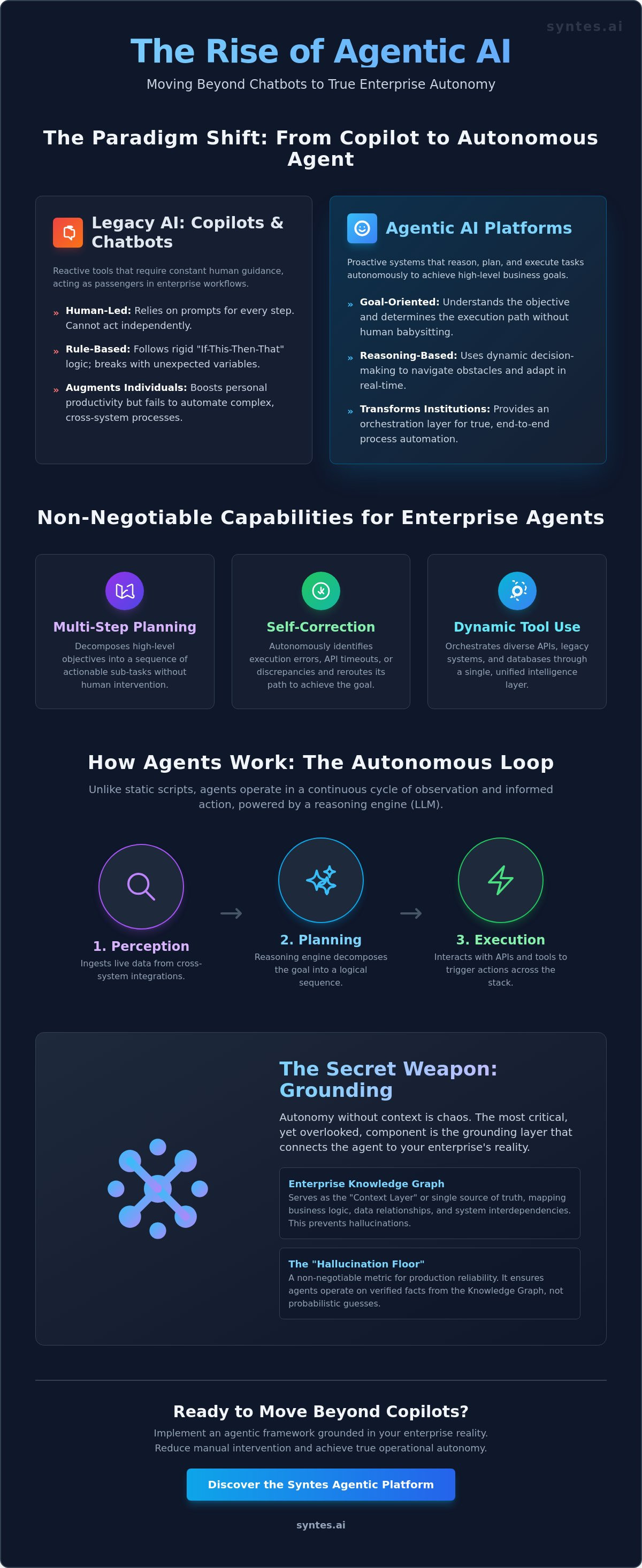
The distinction between a Copilot and a true Agent isn’t merely semantic; it’s architectural. In the 2026 enterprise environment, a Copilot remains a passenger, requiring constant human prompting to function. By contrast, an Intelligent Agent operates as a goal-led entity. It doesn’t wait for a prompt to move to the next step. It evaluates the objective. It assesses the environment. It executes. While Copilots augment the individual, agentic ai platforms transform the institution by providing the orchestration layer necessary for autonomous reasoning.
Traditional automation relied on “If-This-Then-That” logic. This linear approach fails when a system encounters a data silo, an API timeout, or an ambiguous data point. Rigid scripts shatter the moment a real-world variable shifts. Agentic systems solve this by replacing fragile rules with dynamic decision-making frameworks. This shift is the primary solution for cognitive load reduction in the modern enterprise. Instead of managing the minutiae of a workflow, strategic leaders now manage the goals, allowing the platform to handle the execution path across fragmented architectures.
Reasoning vs. Rules: The Paradigm Shift
Rigid scripts are the enemies of scale. When a workflow breaks due to an unforeseen variable, traditional automation stops and waits for a developer. Agents use probabilistic reasoning to navigate these obstacles. They don’t just follow a path; they build it in real-time based on the available data. The era of the “Chatbot” for large-scale operations is over. Businesses now require systems that don’t just respond to queries but actively resolve operational friction through fluid, goal-oriented execution paths that adapt as the business environment changes.
The Core Capabilities of an Agentic Framework
True autonomy requires a sophisticated technical foundation that moves beyond simple API calls. Modern agentic ai platforms must possess three non-negotiable capabilities to survive in a production environment:
- Multi-step planning: The system must possess the intelligence to break high-level objectives into actionable sub-tasks without human guidance.
- Self-correction: If an execution path fails or an integration returns an error, the agent must identify the discrepancy and rectify it independently.
- Tool use: The platform must orchestrate diverse APIs, legacy systems, and the Syntes Agentic Platform through a single, unified intelligence layer.
This isn’t about simple connectivity; it’s about systemic mastery. By integrating these capabilities, enterprises can move from passive observation to active, automated performance that scales without a linear increase in headcount. To ensure your underlying communication infrastructure can keep pace with these advancements, you may wish to explore UCaaS solutions designed for enterprise-grade reliability.
Architectural Foundations: How Agentic Platforms Actually Work
Understanding the mechanics of agentic ai platforms requires a fundamental shift in perspective. You aren’t building a static database. You’re engineering a dynamic loop. This “Agent Loop” consists of three critical phases: Perception, Planning, and Execution. During Perception, the system ingests live data from cross-system integrations. It moves into Planning, where the reasoning engine decomposes a high-level objective into a logical sequence of sub-tasks. Finally, Execution occurs as the agent interacts with external APIs to trigger actions across your enterprise stack. It’s a continuous cycle of observation and informed action.
Most current market analysis ignores the necessity of a Context Layer. This layer serves as the connective tissue between the user’s intent and the enterprise’s reality. Without it, an agent sees the prompt but remains blind to the underlying business logic and systemic interdependencies. True autonomy requires more than just a connection to an LLM; it requires a platform that maintains a real-time understanding of the entire operational environment. This architectural depth is what separates a toy from a tool.
The Role of the Reasoning Engine
What defines the intelligence of the agent? The Large Language Model (LLM) acts as the reasoning engine, not the storage medium. In the 2026 landscape, models like GPT-5, Claude 3.5, and Llama 4 have evolved into specialized brains optimized for multi-step logic rather than simple text generation. A sophisticated platform must remain model-agnostic to ensure enterprise longevity. You don’t want your architecture tethered to a single provider when the underlying reasoning capabilities shift every few months. The platform provides the orchestration; the model provides the cognitive processing.
The Necessity of Semantic Grounding
Retrieval-Augmented Generation (RAG) is insufficient for complex autonomous tasks. RAG excels at finding relevant documents, but it lacks the structural understanding required for multi-step reasoning. To achieve enterprise-grade reliability, you need semantic grounding. An Enterprise Knowledge Graph serves as the definitive source of truth, effectively eliminating the hallucination floor by anchoring autonomous reasoning in verified relational data. This ensures the agent understands the “why” behind the data, not just the “what.”
Deploying these systems requires a partner who understands the messy realities of large-scale operations. You can explore how the Syntes Agentic Platform provides the infrastructure necessary to turn these architectural theories into operational clarity.
Enterprise vs. Consumer: Categorizing Agentic AI Systems
Categorizing the current market requires a ruthless eye for architectural depth. Most available solutions are merely “wrappers.” They provide a clean interface for an LLM but lack the grounding necessary for high-stakes operations. To navigate this, leaders must distinguish between three distinct tiers: Tools, Platforms, and Infrastructure. A tool solves a single task. A platform orchestrates multiple workflows. Infrastructure, such as the Syntes Agentic Platform, provides the foundational reasoning and connectivity required for total systemic autonomy. Confusing these categories leads to the most common failure point in modern AI initiatives: the hallucination floor.
Hallucination risk isn’t a bug; it’s a structural consequence of poor grounding. Consumer-grade apps prioritize “creativity” and speed. Enterprise agentic ai platforms prioritize accuracy and deterministic outcomes. When an agent operates on sensitive data, the cost of an error isn’t just a bad sentence. It’s a broken supply chain or a compliance violation. You don’t want to trust your core logic to a third-party wrapper that lacks the security protocols required for global scale.
Consumer Productivity Tools vs. Enterprise Infrastructure
Security is the first casualty of the wrapper era. Many organizations discover too late that their “productivity agents” lack SOC2 or HIPAA compliance. Beyond security, integration depth determines the ceiling of your success. A consumer tool might connect to your email; an enterprise platform connects to SAP, Salesforce, and your custom legacy databases. Scaling to 1,000 agents across diverse business units requires a centralized orchestration layer. You need a system that manages permissions, monitors execution, and ensures that every agent sees the same version of the truth.
The ‘Build vs. Buy’ Dilemma in 2026
Building a custom framework from scratch is a seductive trap. The hidden costs of maintenance, model updates, and integration upkeep often dwarf the initial investment. Open-source frameworks like LangChain are excellent for prototyping. They aren’t designed for the rigors of production-grade enterprise autonomy. In 2026, the ROI of pre-integrated agentic infrastructure is undeniable. By leveraging the Syntes Agentic Platform and an Enterprise Knowledge Graph, you bypass months of development. You move straight to execution. This isn’t just about saving time; it’s about establishing a robust, future-proof architecture that scales with your ambition.
Selecting an Agentic AI Platform: A Strategic Evaluation Framework
Choosing a platform isn’t about comparing feature lists. It’s about verifying architectural integrity. When evaluating agentic ai platforms, you must move beyond surface-level benchmarks and focus on the “Hallucination Floor.” This metric represents the baseline reliability of an agent in a production environment. If a system cannot guarantee a near-zero error rate for core business logic, it is a liability, not an asset. Reliability is the only currency that matters at scale. Speed is secondary to accuracy when an autonomous system manages your supply chain or financial reporting.
Operational agents require Cross-System Connectivity as a non-negotiable feature. An agent that cannot interact with your ERP, CRM, and proprietary data lakes is merely a sophisticated toy. You need a system that doesn’t just read data but possesses the “write” access necessary to execute changes across your architecture. This requires robust security protocols and Human-in-the-Loop (HITL) capabilities. HITL ensures that for high-stakes decision points, a human expert provides the final validation before the agent commits an action. To better understand how experts interact with these autonomous systems using behavioral research, you can learn more about Ergoneers and their specialized data collection platforms. Persistent memory is also essential. Agents must maintain context across long-running tasks that span days or weeks without losing sight of the original objective.
Criterion 1: Semantic Context and Data Grounding
Does the platform integrate with an Enterprise Knowledge Graph? This is the definitive question for data grounding. Without a graph-based foundation, agents struggle to handle conflicting data from different silos. A Knowledge Graph provides the relational context needed to resolve discrepancies. You must also prioritize Explainable AI (XAI). In an enterprise setting, an autonomous decision is only as good as your ability to audit it. You must be able to trace the reasoning path of an agent to ensure compliance and strategic alignment. If the logic is a black box, the risk is too high.
Criterion 2: Orchestration and Execution Power
Evaluation must focus on the breadth of native cross-system integrations. A platform that requires a custom wrapper for every new tool will inevitably create a development bottleneck. You need the ability to handle long-horizon planning. This involves breaking down a goal into hundreds of sub-tasks and managing them over time. Security remains paramount. Any agent with “write” access to core systems must operate within a zero-trust framework that monitors every API call in real-time. This prevents unauthorized actions while maintaining the momentum of autonomous workflows. A rigorous approach to ai agent lifecycle management ensures that governance, compliance, and reliability are maintained as your autonomous workforce scales across the enterprise. Organizations that have mastered these governance fundamentals are best positioned for deploying ai agents at scale across diverse business units without sacrificing security or operational integrity.
Strategic clarity demands superior tools. You can establish your autonomous foundation today by deploying the Syntes Agentic Platform to orchestrate your most complex enterprise workflows.
Syntes AI: The Infrastructure for Grounded Agentic Intelligence
The gap between theoretical AI potential and operational reality is where most enterprise projects fail. While many agentic ai platforms promise automation, they often lack the systemic grounding required to handle the complexity of global data environments. Syntes AI provides the definitive infrastructure for organizations ready to move beyond experimental chat interfaces. We offer the foundational intelligence layer that allows agents to reason, plan, and execute with absolute precision. This is the end of the “chat” era and the beginning of autonomous systemic mastery.
Scaling AI from a novelty to a core operational asset requires a fundamental shift in how data is accessed and interpreted. Traditional systems struggle with data silos that blind agents to the full business context. Syntes solves this through deep Cross-System Integrations that connect your entire architectural stack. By providing agents with a unified view of the enterprise, we enable them to perform complex, multi-step workflows that were previously impossible. We don’t just provide a tool; we provide the partner for scaling your operational intelligence.
Unifying the Enterprise with a Knowledge Graph
Hallucinations are a structural failure caused by a lack of context. If an agent guesses, it fails. Syntes eliminates this risk by providing agents with a validated world model through our Enterprise Knowledge Graph. This graph serves as the “Ground Truth,” anchoring every autonomous decision in verified relational data. Syntes unifies disparate data streams into a single, high-fidelity semantic network that serves as the definitive reference point for every autonomous decision. This semantic layer ensures that your agents aren’t just processing text; they’re navigating a precise map of your business logic and systemic interdependencies.
Deploying and Managing Agents at Scale
Scale is the ultimate test of any agentic framework. Managing a single agent is simple, but governing 1,000 agents across diverse business units requires sophisticated oversight. The Syntes dashboard provides a centralized command center for agentic performance monitoring and governance. You gain real-time visibility into how agents interact with your ERP, CRM, and custom internal systems. This level of control ensures that every action remains within your security and compliance parameters. You can schedule a strategic briefing on the Syntes Agentic Platform to begin your transition toward grounded, autonomous intelligence that scales with your ambition.
Mastering the Autonomous Frontier
The era of experimentation is behind us. You’ve identified the systemic flaws of passive chatbots and the inherent risks of ungrounded reasoning. Now, the mandate is clear: move toward execution. Superior agentic ai platforms aren’t defined by their conversational ability but by their capacity to act within complex architectures. They require the structural integrity of an Enterprise Knowledge Graph to eliminate hallucinations and the power of seamless cross-system integrations to drive real-world outcomes. You don’t need another digital assistant. You need a workforce capable of autonomous systemic mastery that bridges the gap between raw data and operational performance.
Syntes AI provides the specialized infrastructure required for this transition. We offer the grounding and connectivity necessary to turn visionary concepts into operational clarity. It’s time to architect your future with precision. Request an Enterprise Agentic Strategy Session today to secure your position at the forefront of autonomous intelligence. The path to total operational clarity is open to those ready to lead.
Furthermore, for entrepreneurs focused on bootstrapping new AI startups or conducting strategic market opportunity assessments, tictech.app offers specialized resources to navigate the evolving venture landscape.
Frequently Asked Questions
What is an agentic AI platform?
An agentic AI platform is a sophisticated orchestration layer that enables autonomous systems to interpret goals, create plans, and execute multi-step workflows across an enterprise architecture. Unlike static software, these platforms use reasoning engines to navigate complex environments without constant human intervention. They represent the transition from passive data processing to active, goal-oriented performance that adapts to real-time business variables.
How do agentic AI platforms differ from traditional RPA?
Traditional RPA relies on rigid, rule-based scripts that break when environmental variables change. Modern agentic ai platforms use probabilistic reasoning to handle unforeseen obstacles and adapt their execution paths in real-time. While RPA automates repetitive clicks, an agentic system automates cognitive decision-making. This allows for the management of dynamic business processes that require judgment rather than just repetition.
What are the biggest risks of deploying AI agents in an enterprise?
The primary risks include AI hallucinations in production, data security breaches, and the lack of semantic grounding. Without a robust context layer, agents might execute incorrect actions based on misinterpreted data. Organizations must also address the “black box” problem by ensuring that every autonomous decision is auditable and adheres to strict enterprise governance protocols to prevent unauthorized system writes.
Do agentic AI platforms require a knowledge graph?
High-performance agentic ai platforms require an Enterprise Knowledge Graph to establish a “Ground Truth” for autonomous reasoning. Without this relational context, agents are prone to hallucinations because they lack a validated world model of the business logic. A Knowledge Graph provides the semantic grounding necessary to resolve data conflicts and ensure that every agentic action is based on verified, real-time facts.
How do I prevent AI agents from hallucinating in production?
You prevent hallucinations by implementing a semantic grounding layer that anchors the reasoning engine in verified data. Moving beyond simple RAG is essential; you must provide the agent with a structured understanding of systemic interdependencies. By using the Syntes Agentic Platform, you establish a “Hallucination Floor” that ensures autonomous actions are derived from logical relationships rather than statistical probability alone.
Can agentic AI platforms integrate with legacy ERP systems?
Yes, enterprise-grade platforms are designed specifically to bridge the gap between modern intelligence and legacy ERP systems like SAP or Oracle. Through deep Cross-System Integrations, agents can read and write data across fragmented architectures. This connectivity allows autonomous systems to perform end-to-end tasks, such as supply chain reconciliation or financial reporting, that previously required manual data entry between disconnected platforms.
What is the typical ROI for an enterprise agentic AI implementation?
ROI is primarily measured by the decoupling of revenue growth from headcount increases and the reduction of operational cycle times. By automating complex, multi-step workflows, enterprises reduce the manual intervention required for systemic management. The primary value lies in the massive increase in operational speed and the elimination of costly human errors in high-stakes production environments that demand total accuracy.
How do you maintain human oversight in an autonomous agentic system?
Oversight is maintained through Human-in-the-Loop protocols and centralized governance dashboards. You define high-stakes decision points where the system requires explicit human validation before committing an action. This ensures that while the agent handles the heavy lifting of planning and execution, the strategic control remains with human experts who monitor performance and audit reasoning paths in real-time through a unified interface.