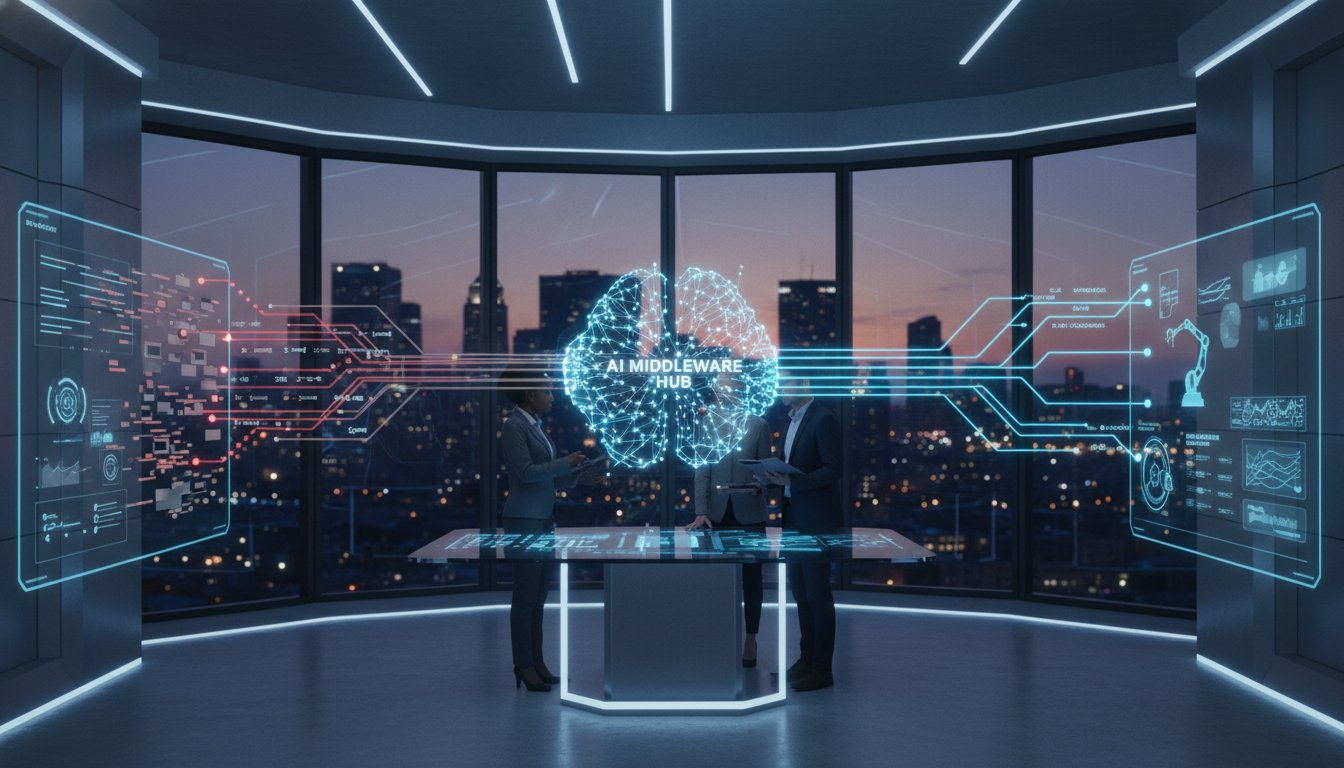
The promise of total enterprise autonomy is currently dying in the fragmented silos of your legacy ERP and CRM systems. Most organizations have realized that simply connecting a Large Language Model to their data leads to a costly cycle of hallucinations and security vulnerabilities. It’s a systemic failure of architecture, not a limitation of the models themselves. You need a bridge between raw data and autonomous action. You need a way to move beyond theoretical experimentation into the realm of high-level execution.
You likely recognize that custom-built integration layers are too expensive and fragile to maintain at scale. This is where ai middleware for enterprise becomes the non-negotiable strategic layer. By implementing a semantic reasoning foundation, you transform disjointed records into a unified knowledge base that agents can actually trust. Discover how this middleware provides the semantic grounding necessary for repeatable, secure, and cross-system operational automation. We’ll explore the shift from passive observation to active performance, ensuring your AI agents operate with total clarity and technical mastery.
Key Takeaways
- Modern ai middleware for enterprise has evolved from simple connectivity into a sophisticated semantic reasoning layer that anchors autonomous agents in operational truth.
- Understand why a Knowledge Graph serves as the critical architectural “brain” for unifying disparate data sources without the high cost of custom integration.
- Discover how to eliminate the hallucination gap through Semantic Grounding, ensuring every AI response is anchored in verified enterprise facts.
- Follow a strategic framework to audit your data fragmentation and evaluate your infrastructure’s readiness for autonomous, cross-system workflows.
- Deploy the Syntes Agentic Platform alongside an Enterprise Knowledge Graph to transform passive data into active, automated performance across your entire organization.
What is AI Middleware for Enterprise?
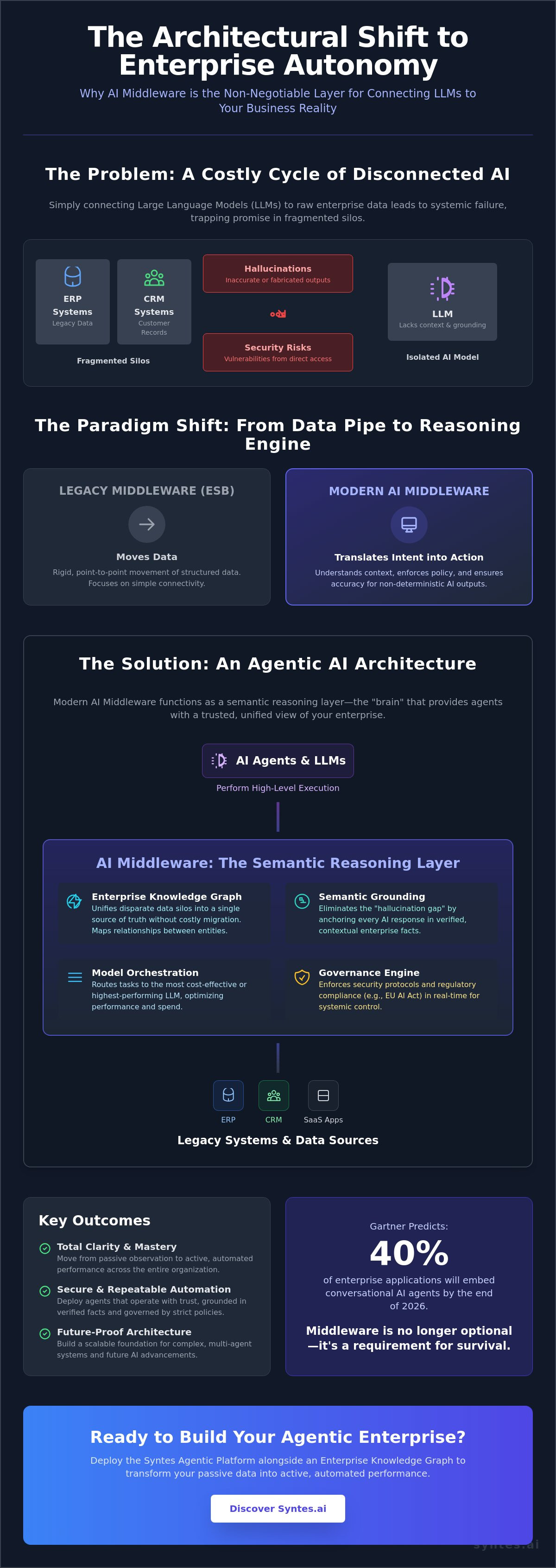
AI middleware for enterprise is the strategic connective tissue that binds large language models to your core operational systems. It is not a simple API gateway or a basic data pipeline. It is a sophisticated orchestration layer that translates abstract model intelligence into concrete business execution. For decades, traditional Enterprise Service Buses (ESBs) focused on the rigid movement of data between point A and point B. That era is over. In 2026, the complexity of multi-agent systems and non-deterministic model outputs requires a layer that understands context, enforces policy, and ensures accuracy in real-time.
The Shift from Connectivity to Intelligence
Legacy middleware moved data; modern middleware translates intent into action. When an AI agent receives a natural language prompt, it doesn’t just need a connection to your database. It needs to understand how that request maps to your specific business logic. Standard APIs are designed for predictable, structured calls. They’re fundamentally insufficient for the fluid, non-deterministic nature of generative AI. You need a layer that bridges the gap between human language and structured ERP data, transforming a vague inquiry into a precise, governed transaction. This requires an ai middleware for enterprise that possesses its own semantic understanding.
Key Components of an Enterprise AI Stack
The Semantic Reasoning Layer: Architecture of Modern Middleware
Most enterprises treat middleware as a passive conduit. This is a strategic error. In the age of agentic intelligence, ai middleware for enterprise must function as a reasoning engine, not just a data pipe. If your agents are forced to query raw, unstructured data without a logical framework, they will inevitably fail. They need a “brain.” This brain takes the form of a semantic reasoning layer that understands the relationships between your data points before they ever reach the language model. It is the architectural difference between an AI that guesses and an AI that knows.
A vector-only approach, while popular for simple retrieval, is fundamentally insufficient for complex business logic. Vector databases excel at finding similar text, but they lack the structural understanding of how your business actually operates. They cannot distinguish between a “customer” in a marketing context and a “debtor” in a financial context without external guidance. Modern middleware solves this by implementing a graph-augmented architecture. This allows agents to navigate your data through a logical web of entities and rules, ensuring superior accuracy and a total reduction in hallucination risks. It transforms raw information into actionable knowledge. A robust approach to semantic data integration is what collapses fragmented silos into a unified, machine-readable ground truth that autonomous agents can act upon with precision.
Unifying Silos with an Enterprise Knowledge Graph
A knowledge graph is the only way to create a definitive single source of truth without the massive overhead of data migration. It allows you to unify disparate silos by mapping the complex relationships between customers, products, and internal processes in real-time. This semantic layer sits atop your existing infrastructure, providing the “ground truth” that AI agents require to execute tasks. By establishing these logical connections, you ensure that every agentic action is grounded in the verified reality of your organization. It is a necessary evolution for any leader serious about scaling operational intelligence.
Cross-System AI Integration: Beyond Simple APIs
Achieving deep ERP and AI integration is the final hurdle in unlocking back-office data for automation. Standard APIs are transactional and stateless; they cannot handle the long-running, multi-step workflows of autonomous agents. Sophisticated ai middleware for enterprise maintains state across these tasks, synchronizing the data flow between CRM, SCM, and AI models seamlessly. It ensures that if an agent triggers a procurement request in your ERP based on a customer signal in your CRM, the entire process remains governed, visible, and contextually aware. This is how you move from passive observation to high-velocity, automated performance.
Eliminating the Hallucination Gap: Grounding as a Middleware Function
“How do I know the AI isn’t lying?” This is the definitive question facing every executive in 2026. In a production environment, a single hallucination isn’t just a technical glitch; it’s a strategic liability that can derail supply chains or compromise sensitive financial data. Most organizations attempt to solve this at the model level, but the model is merely a probabilistic engine. It doesn’t understand your business. The solution resides in ai middleware for enterprise, which acts as a real-time fact-checker that anchors every response in verified enterprise reality.
This process is known as Semantic Grounding. Unlike simple data retrieval, Semantic Grounding ensures that an AI agent’s reasoning is anchored to the logical constraints of your organization. The middleware establishes a continuous feedback loop between the Large Language Model and your Knowledge Graph. Before an agent executes a command or delivers an answer, the middleware validates the model’s intent against your “ground truth” data. If the model proposes an action that contradicts your operational rules, the middleware intercepts and corrects it. You move from blind trust to technical certainty.
The Failure of RAG without Middleware
Simple Retrieval-Augmented Generation (RAG) is fundamentally insufficient for complex enterprise environments. While RAG can pull text from a PDF, it often fails to interpret the underlying schema of a legacy database or a custom ERP module. This leads to the “Lost in Translation” problem, where models misinterpret column headers or fail to grasp the context of a specific transaction. ai middleware for enterprise provides the necessary business logic to translate these technical structures into concepts the model can actually use. It ensures the AI doesn’t just see data; it understands the context surrounding it.
Governing AI Agents with Real-Time Policy Engines
Governance cannot be an afterthought. It must be an active, real-time function of your middleware layer. A robust policy engine allows you to intercept and modify AI outputs based on rigid organizational rules. This provides total auditability, recording every decision and intervention made by the middleware for future review. For high-stakes autonomous actions, the system can trigger “Human-in-the-loop” requirements, ensuring that a human expert validates critical decisions before execution. This isn’t just safety; it’s systemic control.
- Intercept: Stop non-compliant or inaccurate outputs before they reach the user or the target system.
- Audit: Maintain a comprehensive, immutable log of all agentic reasoning and data access patterns.
- Validate: Require human authorization for specific financial or operational triggers based on risk profiles.
A Strategic Framework for Selecting AI Middleware
Selecting the right ai middleware for enterprise is not a standard procurement exercise. It is an architectural commitment that dictates the ceiling of your organization’s operational capacity. You must look past generic marketing promises and evaluate the technical foundations that allow for real-time, cross-system execution. A strategic framework ensures that your middleware isn’t just a connectivity tool, but a robust engine for agentic intelligence.
- Step 1: Audit Data Fragmentation. Identify your high-value silos. Determine exactly where the data that drives your competitive advantage resides, whether in legacy ERP systems or modern SaaS platforms.
- Step 2: Evaluate Agentic Readiness. Can the middleware support autonomous workflows? It must move beyond simple request-response cycles to manage long-running, multi-step tasks without human intervention.
- Step 3: Assess Semantic Capabilities. Verify if the solution offers native Knowledge Graph integration. Without a semantic layer, your agents lack the logic required to interpret complex business rules.
- Step 4: Verify Security Standards. Demand Zero Trust architecture. Ensure the system utilizes identity-defined access to maintain strict control over what data agents can see and manipulate.
- Step 5: Test Interoperability. Validate performance across hybrid cloud environments. Your middleware must synchronize data seamlessly between on-premise databases and public cloud instances.
Build vs. Buy: The 2026 Enterprise Reality
The temptation to build a custom integration layer is often a path to technical debt. DIY middleware carries massive hidden costs, including constant maintenance, scaling difficulties, and the widening talent gap in AI engineering. By 2026, the complexity of autonomous systems makes the “build” approach a strategic liability for most. Utilizing a specialized agentic AI platform drastically reduces your time-to-value. It provides a tested, extensible foundation that allows your team to focus on high-level business logic rather than debugging fragile connectivity pipes. Efficiency is the only metric that matters.
Security and Scalability Requirements
Enterprise-grade ai middleware for enterprise must support air-gapped or private cloud hosting to protect your most sensitive intellectual property. Data sovereignty is non-negotiable; sensitive information must never leave your defined perimeter. Furthermore, you need granular control over operational costs. Robust middleware provides rate limiting and token usage monitoring to prevent spiraling expenses from autonomous agent activity. This level of systemic control is what separates experimental AI from production-ready intelligence. Evaluate the Syntes Agentic Platform for your infrastructure to ensure your deployment is secure, scalable, and grounded in operational truth.
Syntes AI: The Foundation for Agentic Enterprise Intelligence
Syntes AI represents the definitive evolution of ai middleware for enterprise. It is a strategic pivot from passive data management to active, agentic performance. For too long, middleware has been viewed as a necessary cost center, a series of pipes that merely shuffle data between silos. Syntes fundamentally rejects this premise. By positioning the middleware layer as the primary reasoning engine of the organization, we transform fragmented legacy systems into a cohesive, intelligent workforce. It is time to stop building isolated experiments and start architecting a foundation for total operational autonomy.
The unique synergy between the Syntes Agentic Platform and our Enterprise Knowledge Graph allows for a level of operational clarity that traditional integration layers simply cannot match. This isn’t just about connecting systems; it’s about providing AI with a sophisticated understanding of your business logic. We invite decision-makers to look past the limitations of consumer-grade tools. Move beyond the era of the simple chatbot. Deploy autonomous operational agents that possess the technical mastery to execute complex, cross-system workflows with technical certainty.
From Data Unification to Autonomous Execution
Syntes agents don’t guess. They use the Enterprise Knowledge Graph to navigate the intricate web of your business logic with precision. By mapping the real-time relationships between your ERP, CRM, and SCM data, the platform ensures that every agentic action is grounded in verified truth. This architecture significantly reduces operational latency by automating tasks that previously required manual cross-referencing between disparate systems. The Syntes advantage is clear: we provide enterprise-grade infrastructure designed for global scale, ensuring that your transition from observation to execution is seamless and high-performing.
Future-Proofing Your AI Strategy
Why should your AI strategy be tied to a single model provider? The Syntes approach is built on a model-agnostic philosophy that ensures your infrastructure remains future-ready. According to NVIDIA’s 2026 State of AI report, 85% of surveyed organizations rate open source as moderately to extremely important to their AI strategy. Syntes honors this reality by allowing you to swap, upgrade, or combine models without rebuilding your integration layer. You maintain total control over your data sovereignty and model selection while joining an ecosystem of organizations leading the agentic revolution. Efficiency is not a theoretical goal; it is an immediate requirement.
The path to autonomous enterprise intelligence is no longer a vision for the future; it is a technical reality available today. It requires a bold shift in how you perceive your data and your systems. Stop managing fragmentation and start orchestrating intelligence. Request a briefing on Syntes AI middleware solutions to discover how to ground your autonomous agents in a foundation of operational truth.
Architecting the Autonomous Future
The era of fragmented, hallucination-prone AI is coming to an end. Success in 2026 requires a fundamental shift from passive data pipes to a robust semantic reasoning layer. By grounding your agents in an Enterprise Knowledge Graph, you eliminate the “hallucination gap” and ensure that every autonomous action is anchored in verified operational truth. Implementing ai middleware for enterprise isn’t just a technical upgrade; it’s a strategic necessity for any organization aiming to move beyond simple chatbots toward high-velocity, cross-system execution.
You need an infrastructure that scales with your ambition. Syntes provides the definitive foundation for this transition, offering seamless cross-system integration for legacy ERPs and a proven reduction in AI hallucinations through advanced semantic grounding. Don’t let your data remain trapped in silos. It’s time to transform passive observation into active, automated performance. Scale your intelligence with the Syntes Agentic Platform today and lead the agentic revolution with technical mastery. The tools for total operational clarity are within your reach.
Frequently Asked Questions
What is the difference between an API gateway and AI middleware?
An API gateway is a traffic controller for structured, predictable data transactions. It handles authentication and rate limiting for static endpoints. In contrast, ai middleware for enterprise is a reasoning engine designed for non-deterministic model orchestration. It manages context, maintains state across long-running tasks, and translates natural language intent into complex business logic that a standard gateway cannot interpret.
How does AI middleware help prevent hallucinations in enterprise LLMs?
Middleware prevents hallucinations by implementing a process called Semantic Grounding. It acts as a real-time validator that anchors model outputs in the “ground truth” of your internal systems. Before an agent executes a command, the middleware cross-references the model’s proposal against verified facts in your Knowledge Graph. This ensures the agent operates within the logical constraints of your organization rather than guessing based on probabilistic patterns.
Can AI middleware integrate with legacy on-premise ERP systems?
Yes. Sophisticated ai middleware for enterprise is architected for hybrid environments. It utilizes secure, air-gapped connectors to bridge the gap between cloud-based models and on-premise databases. This allows you to deploy agentic intelligence across your entire infrastructure without the high cost and risk of a full-scale cloud migration for your legacy back-office systems.
What is the role of a Knowledge Graph in AI middleware architecture?
The Knowledge Graph serves as the “brain” of the middleware layer. It maps the complex relationships between your data entities, such as customers, products, and processes, providing a logical structure that models lack. This graph allows AI agents to navigate your business rules with technical certainty. It transforms raw, fragmented data into a semantically rich foundation for autonomous reasoning.
Is AI middleware necessary if we already use a Data Fabric?
Data Fabric and AI middleware serve distinct purposes in a modern stack. A Data Fabric unifies access to disparate data sources, but it doesn’t manage the reasoning or execution of AI models. AI middleware sits atop your data layer to orchestrate model intent, enforce real-time governance, and trigger cross-system actions. You need both to move from passive data observation to active, automated performance.
How does middleware handle security and data privacy for AI agents?
Middleware enforces security through Zero Trust architecture and identity-defined access. It acts as a protective filter that masks PII and sensitive intellectual property before it ever reaches an external model provider. By controlling the flow of information at the orchestration layer, you ensure data sovereignty and maintain strict compliance with global regulations like the EU AI Act.
What are the primary cost drivers when implementing enterprise AI middleware?
The main cost drivers include token consumption, integration complexity, and infrastructure hosting. High-quality middleware actually helps control these costs by implementing intelligent model routing and semantic data integration practices such as caching. By directing simple tasks to smaller, specialized models and caching frequent queries, the middleware layer prevents the spiraling expenses often associated with unoptimized, large-scale AI deployments.
How do I measure the ROI of a middleware-driven AI strategy?
Measure ROI by tracking the reduction in operational latency and the success rate of autonomous workflows. When your agents can execute cross-system tasks without human intervention, you gain immediate efficiency. Look for a decrease in manual data entry errors and a significant acceleration in process completion times. ROI is found in the transition from theoretical experimentation to high-velocity, automated execution.