Most enterprise AI implementations are failing because they rely on probability rather than truth. You’ve seen the results. Chatbots confidently invent facts. Agents stall when faced with disconnected data in legacy ERP or CRM systems. The industry is reaching a breaking point where vector search alone no longer suffices for mission-critical operations. To move beyond these limitations, you must deploy a robust knowledge graph for ai grounding. This isn’t just an incremental update; it’s a fundamental architectural shift that replaces guesswork with a structured, verifiable semantic layer.
We understand the frustration of watching high-cost AI initiatives get bogged down by manual data cleaning and fragmented silos. You need a system that doesn’t just retrieve information but understands the complex relationships between your assets, customers, and processes. This guide provides a definitive roadmap for unifying disparate data sources into a single source of operational intelligence. You’ll learn how to transition from hallucination-prone models to reliable, autonomous workflows built on a foundation of total data clarity. We’re moving from passive observation to active, automated performance.
Key Takeaways
- Stop relying on probabilistic retrieval and start anchoring AI outputs to a verifiable, enterprise-wide ground truth.
- Master the deployment of a knowledge graph for ai grounding to transform disconnected ERP and CRM silos into a unified semantic network.
- Evaluate the strategic trade-offs between vector search and semantic grounding to implement a high-precision GraphRAG architecture.
- Follow a rigorous five-step framework to inventory disparate sources and define a global ontology that supports autonomous execution.
- Utilize the Syntes Agentic Platform to bridge the gap between visionary AI concepts and reliable, real-time operational performance.
The Grounding Crisis: Why Vector Search Fails the Enterprise
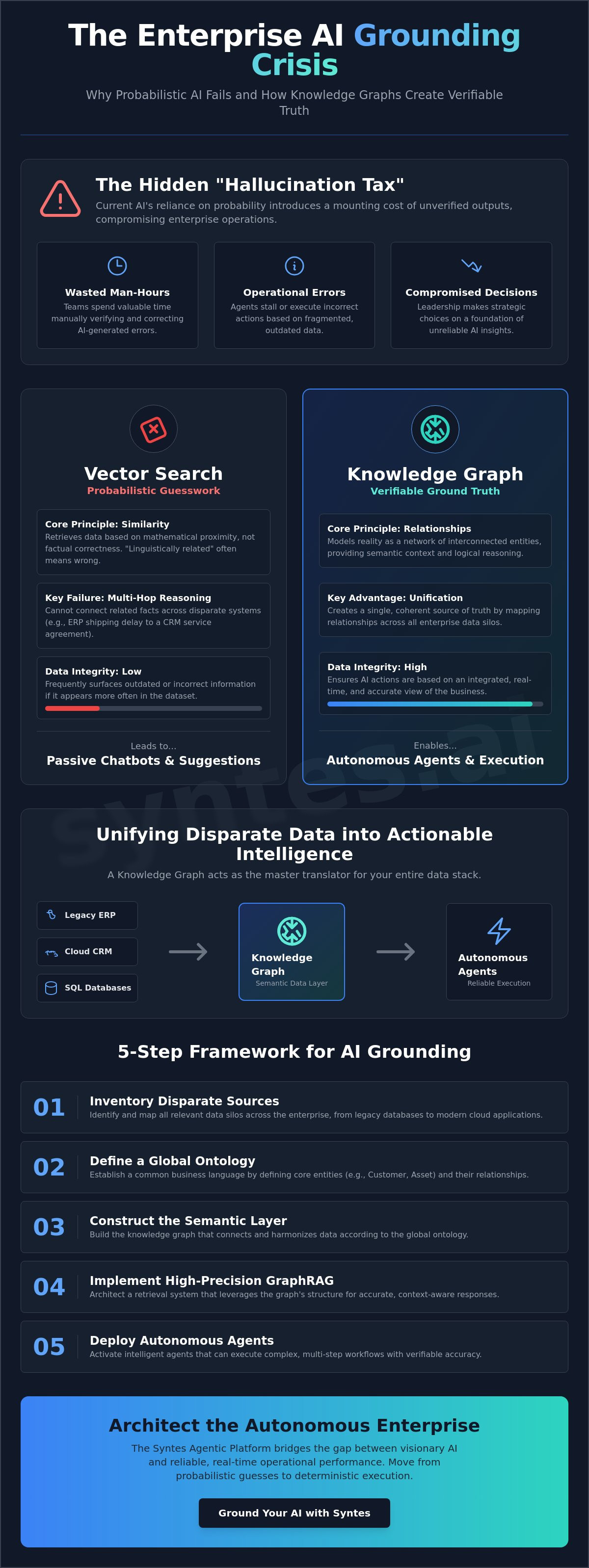
Enterprise AI is facing a crisis of confidence. It’s not a lack of compute or sophisticated models. It’s a lack of truth. Grounding is the process of anchoring LLM outputs to a verifiable “ground truth.” While consumer-grade Retrieval-Augmented Generation (RAG) might satisfy a casual user, it fails the rigorous demands of global business logic. Enterprises require more than just “related” text snippets. They require structural certainty. The current reliance on vector-only search has introduced a hidden “Hallucination Tax.” This is the mounting cost of unverified AI responses in production, leading to wasted man-hours, operational errors, and compromised decision-making. To eliminate this tax, organizations are shifting toward a knowledge graph for ai grounding. By leveraging a knowledge graph, companies can provide the semantic context and logical reasoning that flat vector databases simply cannot replicate.
The Limitations of Vector-Only Retrieval
Vector databases operate on similarity, not fact. They retrieve data based on mathematical proximity in a high-dimensional space. This “blind” similarity often leads to retrieving documents that are linguistically related but factually incorrect for the specific query. Context document frequency does not equal accuracy. If your ERP contains ten outdated versions of a procurement policy and one current version, a vector search might prioritize the wrong one simply because it appears more often. These systems struggle with multi-hop reasoning. If an AI needs to connect a shipping delay in a legacy database to a specific customer’s service level agreement in a CRM, a vector-only approach often fails to bridge the gap. It lacks the explicit relationships needed to navigate complex, disparate systems.
From Passive Chatbots to Active Agentic Intelligence
The era of the passive chatbot is ending. Simple text generation is no longer a competitive advantage for enterprise operations. The market is moving toward autonomous agents that don’t just talk; they execute. These agents require a structural mandate to perform work safely and accurately. Without a unified data layer, these agents remain restricted by the very silos they are meant to navigate. Transitioning to this new model requires solving enterprise data silos. Grounding your AI in a robust knowledge graph for ai grounding ensures that every action taken by an agent is based on an integrated, real-time view of the business. It’s the difference between an AI that makes suggestions and an AI that drives results. We’re moving from probabilistic guesses to deterministic execution.
The Knowledge Graph Advantage: Unifying Disparate Data Sources
Knowledge graphs don’t just store data; they model reality. Unlike relational databases that force information into rigid rows and columns, a graph treats data as a network of interconnected entities. This architectural shift is the cornerstone of a successful knowledge graph for ai grounding. It allows the enterprise to move beyond the limitations of isolated silos, acting as a unifying and collaborative platform for organizational knowledge. By prioritizing relationships over storage, you provide AI with the necessary context to understand not just what a data point is, but why it matters within the broader business logic. This is the essence of semantic data integration, a requirement for any organization aiming for operational clarity in 2026.
Constructing the Semantic Data Layer
How does a knowledge graph solve the silo problem? By decoupling data from its original application logic and re-anchoring it in a universal semantic framework. A semantic data layer serves as the master translator for your entire stack. It identifies entities like “Customer,” “Contract,” and “Asset,” then maps their specific attributes across disparate formats. Whether data lives in a legacy SQL database or a modern cloud CRM, the semantic layer ensures that the AI interacts with a single, coherent version of the truth. This transition from raw data to actionable Enterprise Intelligence is what enables autonomous agents to perform complex tasks with high precision. You aren’t just connecting systems; you’re creating a shared language for your enterprise AI to speak.
Bridging Structured and Unstructured Data
The real challenge lies in the messy reality of unstructured data. Most enterprise knowledge is trapped in PDFs, emails, and internal wikis. A sophisticated knowledge graph for ai grounding solves this by extracting semantic triplets, consisting of a Subject, Predicate, and Object, from these documents. This process maps unstructured policy details directly to structured ERP fields. For example, a specific clause in a PDF contract can be linked to a transaction record in your financial system. Maintaining this consistency across the semantic data layer for enterprise ensures that your AI agents never lose sight of the regulatory or contractual boundaries governing their actions. Organizations can start leveraging the Syntes Agentic Platform to bridge these gaps and achieve total operational visibility.
Semantic Grounding vs. Vector RAG: A Strategic Comparison
Vector RAG is the entry-level solution for basic information retrieval. It excels at speed. It uses mathematical proximity to find content that looks like the query. However, speed is a liability when it lacks precision. For the global enterprise, “close enough” is a failure state. This is where a knowledge graph for ai grounding becomes a strategic necessity. While vector search provides a linguistic match, knowledge graphs provide a structural truth. The industry is rapidly converging on GraphRAG, a hybrid approach that combines the semantic flexibility of vectors with the deterministic logic of graph structures. Even leading innovators are documenting the necessity of grounding LLMs with knowledge graphs to ensure outputs remain anchored in real-world facts rather than statistical probabilities.
Precision and Verifiability
Enterprise decision-makers cannot afford black-box AI. Every claim generated by an LLM must be traceable to its source. Knowledge graphs provide a native audit trail for every response. They map the specific path taken through your data, from the initial query to the final entity. This eliminates probabilistic errors where the model “guesses” a connection that doesn’t exist. To manage these complex logical paths at scale, organizations are deploying ai middleware for enterprise. This strategic layer ensures that the transition from a user prompt to a graph query is seamless and governed. It replaces the “hallucination tax” with a “certainty dividend,” allowing for reliable, verifiable AI performance in regulated environments.
Handling Complex Business Logic
Vector search fails when faced with multi-dimensional business inquiries. Ask a vector-based system, “What is the total spend for Vendor X across all international subsidiaries?” and it will likely retrieve a dozen unrelated invoices. It cannot perform the real-time joins and aggregations required to answer the question. A knowledge graph for ai grounding solves this by treating your data as a living network of relationships. It executes complex queries across disparate systems, connecting procurement data in one silo to corporate hierarchy data in another. This level of structural intelligence is what makes autonomous agents reliable. They don’t just find documents; they calculate answers based on the totality of your enterprise knowledge. The result is an agentic workflow that acts with the authority of a subject matter expert.
- Vector RAG: Best for high-volume, low-complexity document retrieval where speed is the primary KPI.
- Knowledge Graph: Essential for high-precision, multi-hop reasoning and complex business logic.
- GraphRAG (Hybrid): The optimal architecture for modern enterprise AI, balancing linguistic context with structural truth.
A 5-Step Framework for Unifying Disparate Sources for AI Grounding
The deployment of a knowledge graph for ai grounding is not a weekend project; it is a structural overhaul. It requires a methodical approach to bridge the gap between fragmented legacy data and high-precision AI execution. To achieve this, enterprises must follow a rigorous five-step framework designed to eliminate ambiguity and establish a deterministic foundation for their agentic workflows.
- Step 1: Inventorying Disparate Data Sources. Identify every silo. Map your ERP, CRM, and legacy databases to understand where your critical business logic resides.
- Step 2: Defining the Global Schema and Ontology. Build the blueprint. Create a universal language that defines entities, attributes, and the relationships that connect them across the enterprise.
- Step 3: Implementing Cross-System ETL and Semantic Mapping. Extract the data. Use semantic mapping to translate raw technical fields into meaningful business concepts.
- Step 4: Ingesting Data into the Enterprise Knowledge Graph. Populate the network. Move from flat files to a multi-dimensional graph structure where every node is a fact.
- Step 5: Establishing a Feedback Loop. Refine the system. Monitor AI outputs to continuously tune the graph, ensuring your knowledge graph for ai grounding remains the definitive source of truth.
Phase 1: Discovery and Semantic Mapping
Phase one is about resolving the “Golden Record” problem. In most large organizations, data is conflicting. Your CRM might list a customer as “Active,” while a legacy billing system marks them as “Delinquent.” AI cannot operate in this gray area. Establishing a common vocabulary for entities like “Customer” or “Invoice” is the only way to ensure consistency. This is a critical junction in erp and ai integration. You must decide which system holds the truth for specific attributes before the AI ever sees the data. Inventory the silos. Resolve the conflicts. Build the logic.
Phase 2: Ingestion and AI Grounding Integration
Once the logic is defined, automation takes over. Modern pipelines use LLM-based extraction to pull Subject-Predicate-Object triplets from messy documents, turning stagnant text into active graph nodes. This data then feeds directly into the agentic orchestration layer. Semantic Grounding is the process of mapping model reasoning steps to specific graph nodes. This ensures that when an agent makes a decision, it can point to a specific, verified relationship within the graph to justify its action. Organizations ready to move beyond experimental chatbots should consider implementing the Syntes Agentic Platform to unify these disparate sources into a single, actionable truth layer.
The Syntes Approach: Architecting the Autonomous Enterprise
Theoretical AI is a luxury that global enterprises can no longer afford. While the market is flooded with experimental tools, the Syntes Agentic Platform provides a rigorous engine for actual work. It represents the final evolution of the knowledge graph for ai grounding, moving beyond simple retrieval to autonomous execution. Syntes unifies your disparate sources into a single, actionable truth layer, ensuring that every AI decision is anchored in the reality of your operations. This isn’t just an integration project. It is the construction of a permanent semantic foundation for the autonomous enterprise. We replace the uncertainty of probabilistic models with the structural mandate of a unified knowledge layer.
Unifying the Enterprise Stack
Connectivity is not the same as understanding. Most AI solutions fail because they treat your ERP, CRM, and legacy silos as mere text repositories. Syntes takes a different approach. We seamlessly embed AI capabilities across your existing software environments, transforming passive data into active intelligence. By positioning Syntes as your primary enterprise ai infrastructure, you gain more than just a search tool. You gain a translator that understands the complex business logic trapped within your stack. We move you beyond consumer-grade chatbots and into the realm of true operational intelligence. It’s time to stop viewing data as a liability and start seeing it as the fuel for your agentic workflows.
Executing at Scale with Agentic Workflows
The end goal of grounding is not better answers; it is better actions. Grounded agents within the Syntes framework perform complex operational tasks without human intervention, navigating the multi-hop relationships of your knowledge graph for ai grounding with surgical precision. This architecture provides a level of security and reliability that vector-only systems cannot match. Every reasoning step is mapped to a specific graph node, creating a deterministic audit trail that eliminates the hallucination tax discussed in previous sections. You can finally trust your AI to manage procurement, customer lifecycles, and cross-system workflows with total confidence. The era of the passive assistant is over. The era of the autonomous agent has arrived. To see this technology in action, request a demo of the Syntes Agentic Platform and witness the power of a truly unified enterprise knowledge graph.
Transitioning to Deterministic Intelligence
The shift from probabilistic guesswork to structural certainty is no longer optional. It’s a survival mandate for the modern enterprise. We’ve established that vector-only retrieval fails the complexity of global business logic; a semantic layer is the only way to unify fragmented silos. By deploying a robust knowledge graph for ai grounding, you eliminate the hallucination tax and provide your agents with a verifiable source of truth. This architecture doesn’t just improve responses. It enables autonomous execution across your entire stack.
You have the roadmap. Now you need the infrastructure. Syntes provides the enterprise-grade knowledge graph and deep cross-system legacy integrations required to bridge the gap between fragmented data and agentic performance. Our platform delivers a proven reduction in AI hallucinations for critical operational tasks. It’s time to move from passive observation to informed, automated action. Architect your autonomous future with the Syntes Agentic Platform. The transition to total operational clarity is within your reach.
Frequently Asked Questions
What is the difference between a vector database and a knowledge graph for AI grounding?
Vector databases rely on mathematical similarity; knowledge graphs rely on explicit relationships. While vector search finds text snippets that are linguistically close to a query, a knowledge graph for ai grounding provides a deterministic structure that understands how entities like “Customer” and “Invoice” are logically connected. This allows for precise reasoning rather than probabilistic guesses based on word proximity.
How does a knowledge graph prevent AI hallucinations in enterprise settings?
Knowledge graphs anchor model outputs to a verifiable ground truth. By forcing the AI to retrieve information from a structured semantic layer rather than relying on probabilistic next-token prediction, the system ensures every response is backed by a specific node or edge in the graph. This eliminates the model’s tendency to invent facts when faced with complex or missing data in your silos.
Can I build a knowledge graph using my existing legacy ERP data?
Yes, legacy ERP data is the primary foundation for most enterprise ontologies. Modern integration layers extract schemas from these systems and map them to a universal semantic layer. This process transforms fragmented, disconnected records into a unified network of intelligence without requiring a full rip-and-replace of your underlying infrastructure or a costly migration of your historical data points.
How much data do I need to start grounding my AI agents effectively?
Is knowledge graph grounding compatible with standard LLMs like GPT-4 or Claude?
Yes, it is fully compatible through a sophisticated orchestration layer. The knowledge graph acts as the reliable context provider, feeding structured facts into the prompt window of models like GPT-4 or Claude. This hybrid approach, known as GraphRAG, combines the linguistic reasoning power of the LLM with the structural accuracy and factuality of your internal enterprise graph.
What are the main challenges when unifying disparate data sources for AI?
Semantic inconsistency is the primary hurdle. Different systems often use conflicting terms for the same entity, such as “Client” in a CRM versus “Account” in an ERP system. Reconciling these definitions into a single “Golden Record” requires a rigorous ontology and automated mapping pipelines to ensure the AI has a coherent, non-contradictory view of the business.
How does grounding improve the interpretability of AI reasoning?
It provides a deterministic audit trail for every decision. Unlike black-box vector searches, a graph-based system can show exactly which nodes and relationships were traversed to reach a specific answer. This transparency allows stakeholders to verify the logic behind an AI’s conclusion and ensure compliance with internal business rules and external industry regulations.
What is the ROI of implementing a knowledge graph for agentic AI?
ROI is realized through the elimination of the hallucination tax and the enablement of autonomous workflows. By reducing the time spent on manual data verification and increasing the success rate of automated tasks, enterprises see immediate gains in operational efficiency. Reliable AI performance translates directly into lower overhead costs and significantly faster decision-making cycles across the organization.