
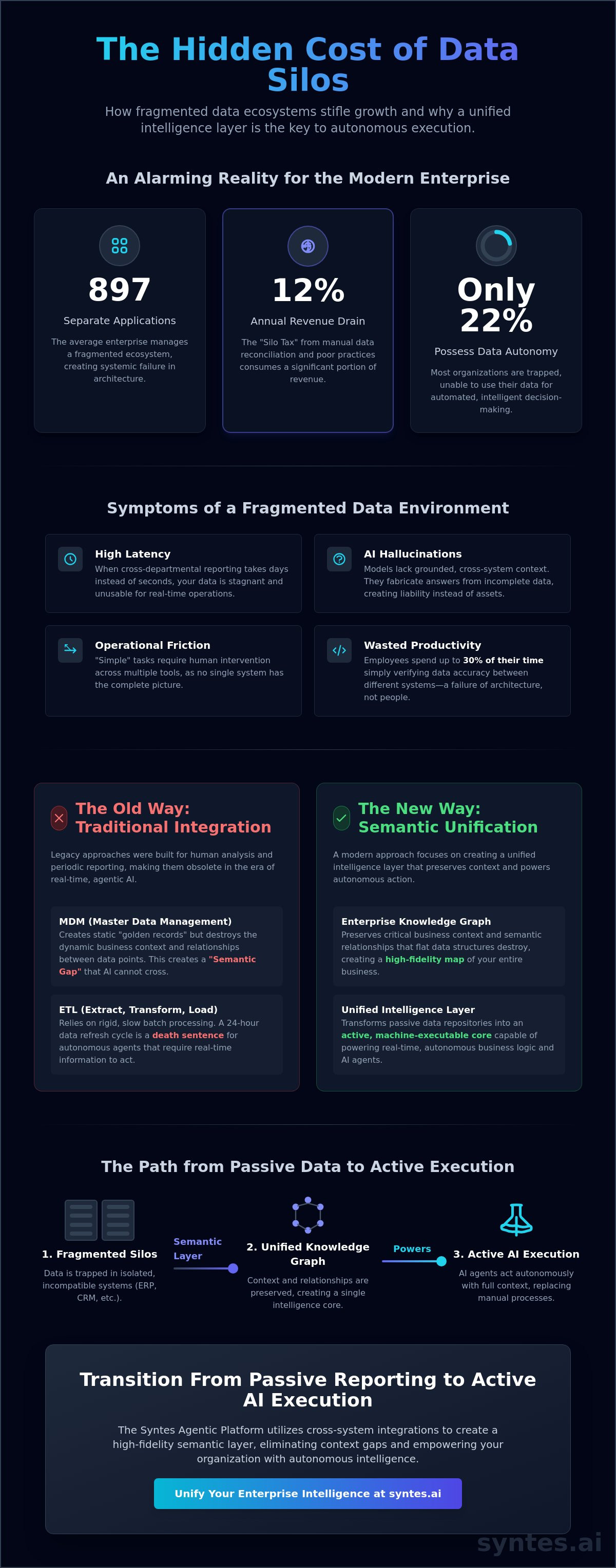
The average enterprise now manages 897 separate applications. It’s a staggering figure that highlights a systemic failure in modern architecture. Despite massive investments in cloud connectivity, only 22% of organizations possess the capability to utilize their data for autonomous decision-making. Most remain trapped in a cycle of manual ETL processes and inconsistent reporting that drains up to 12% of annual revenue. Solving enterprise data silos is no longer a matter of simple data hygiene; it’s a strategic imperative for survival in an era of agentic intelligence.
You’ve likely felt the friction of departmental data discrepancies and the frustration of AI hallucinations caused by a lack of enterprise context. It’s an unsustainable status quo that halts progress. This article provides the blueprint for establishing a semantic data layer that transforms passive repositories into a unified, actionable intelligence core. We’ll explore the transition from traditional integration to active AI execution, ensuring your operations move with the precision and speed that global markets now demand. You’ll discover how to replace fragmented reporting with a system of autonomous execution.
Key Takeaways
- Identify the hidden “Silo Tax” and why traditional ETL architectures fail to meet the real-time demands of modern agentic intelligence.
- Explore how an Enterprise Knowledge Graph preserves critical business context and semantic relationships that flat data structures often destroy.
- Master the strategic shift toward solving enterprise data silos by creating a unified intelligence layer capable of powering autonomous business logic.
- Learn how the Syntes Agentic Platform utilizes cross-system integrations to transition your organization from passive data reporting to active AI execution.
- Reduce operational friction by replacing manual data reconciliation with a high-fidelity semantic layer that eliminates the context gaps responsible for AI hallucinations.
The Invisible Tax: Why Enterprise Data Silos Stifle Operational Speed
Enterprise efficiency is dying a slow death by a thousand unintegrated applications. While digital transformation promised a streamlined future, the reality for most remains a bloated architecture of disconnected systems. We define an Information silo as any isolated repository that lacks the semantic interoperability required for cross-functional execution. These aren’t just technical hurdles. They’re financial drains. This “Silo Tax” manifests as the hidden cost of manual data reconciliation and redundant ETL pipelines that consume resources without generating insight. Research indicates that poor data practices cost organizations approximately 12% of their annual revenue. Solving enterprise data silos is the only path to reclaiming that lost capital.
The 2026 reality is stark. Data volume is increasing at an exponential rate, yet data utility is stagnating. Organizations are drowning in information but starving for actionable intelligence. Traditional silos have become the primary barrier to AI model reliability. When an AI lacks access to the full breadth of enterprise context, it doesn’t just fail; it hallucinates. It fabricates answers based on incomplete datasets, creating a liability rather than an asset. To move forward, leadership must view data integration not as a maintenance task, but as a core component of competitive strategy.
The Anatomy of a Fragmented Data Environment
Legacy system lock-in creates a gravitational pull toward inefficiency. Outdated ERP and CRM platforms often function as black holes, trapping data in proprietary formats that resist modern integration. This technical debt is compounded by departmental drift. Marketing, sales, and finance teams frequently operate as autonomous business units, developing incompatible data definitions that make a “Single Source of Truth” a statistical impossibility. In a decentralized organization, the myth of a unified database has been replaced by the reality of fragmented, competing datasets that require constant, expensive human mediation.
Identifying the Symptoms of Data Fragmentation
How do you recognize a failing architecture? High latency is the primary indicator. When cross-departmental reporting takes days instead of seconds, your data is stagnant. The most dangerous symptom is the AI hallucination. Models lack grounded, cross-system context; they guess when they can’t find the truth. This creates immense operational friction where “simple” tasks require human intervention across five different tools. Employees currently spend up to 30% of their time simply verifying data accuracy across different systems. This isn’t productive work. It’s a failure of systems architecture that solving enterprise data silos can finally rectify.
Beyond MDM: Why Traditional Integration Fails the AI Test
Master Data Management (MDM) was a noble attempt at order. It sought to create a “golden record,” a single version of truth for human analysts to review. But the era of agentic intelligence has rendered this approach obsolete. Traditional MDM focuses on static attributes, yet autonomous agents require dynamic context. They don’t just need to know who a customer is; they need to understand the relationship between that customer, their recent support tickets, and their real-time supply chain status. This is the “Semantic Gap.” It’s the space between mapped fields and actual business logic. Solving enterprise data silos for AI requires more than just connecting pipes. It requires a fundamental shift toward AI Middleware that translates legacy data into machine-executable intelligence.
Extract, Transform, Load (ETL) processes are equally ill-equipped for this new reality. These pipelines were built for the convenience of the database, not the speed of the business. To effectively deal with data silos, organizations must move beyond the rigidity of traditional schemas. AI agents cannot wait for a nightly batch process to synchronize records. They operate in the now. If your integration strategy relies on 24-hour refreshes, your AI is essentially operating on yesterday’s news, leading to decisions that are consistently out of sync with operational reality.
The Latency Problem in Batch Processing
A 24-hour data refresh is a death sentence for autonomous operations. Agents need semantic data integration that functions at the speed of thought. Static snapshots are no longer sufficient. Modern systems must transition to live operational streams, ensuring that every decision is grounded in current state data rather than historical artifacts. This real-time connectivity is the baseline for reliability.
Is Your Data Strategy Built for Reporting or Execution?
Most enterprises have built data lakes that eventually devolve into data swamps. They’re designed for passive reporting, not active execution. Analytical data logic is retrospective; operational data logic is prospective. Achieving true ERP and AI integration means moving the focus from “what happened” to “what should happen next.” It requires a governance layer that enforces logic across the entire stack. Syntes helps bridge this divide through sophisticated cross-system integrations that turn fragmented data into a unified engine for action.
The Knowledge Graph: A Semantic Solution for Data Unification
Flat tables are the graveyard of business context. While traditional databases excel at storing isolated records, they strip away the intricate relationships that define actual operations. An Enterprise Knowledge Graph represents a fundamental departure from this architectural limitation. It is a network of interconnected entities and relationships that maps the logic of your business as a cohesive web. This structural shift is the definitive strategy for Breaking Down Data Silos. By preserving the “how” and “why” behind data points, graphs provide the high-fidelity grounding necessary for agentic intelligence to operate without the risk of hallucination.
Ontologies serve as the connective tissue in this environment. They standardize business logic across disparate systems, ensuring that a “Customer” in your CRM is identical to the “Entity” in your billing software. This semantic alignment is what makes solving enterprise data silos possible at scale. Without it, you are simply moving fragmented data from one bucket to another. A knowledge graph for AI grounding provides the “Ground Truth” for Large Language Models (LLMs), allowing them to query your entire enterprise architecture as a single, unified source of intelligence.
Mapping Relationships, Not Just Records
Nodes represent the core pillars of your business: Customers, Products, and Contracts. Edges represent the real-world actions connecting them, such as “Purchased,” “Renewed,” or “Complained.” This structure enables the power of inference. You can discover hidden connections across disparate systems that a human analyst might never detect. Knowledge graphs act as the definitive brain of the enterprise, orchestrating information flow with systemic precision. This depth of insight allows for proactive decision-making, where the system understands the downstream impact of every data change in real-time.
Constructing the Semantic Layer
A semantic layer is the necessary interface between raw data and autonomous action. It requires ai middleware for enterprise to act as the translation engine, converting technical schemas into business-ready concepts. Standardizing definitions is the first step toward operational clarity. If “Revenue” means something different to Finance than it does to Sales, your autonomous agents will produce conflicting results. Solving enterprise data silos through a semantic data layer for enterprise ensures that every AI agent is grounded in the same universal logic. This enables a plug-and-play deployment model where agents can be introduced to any part of the stack and immediately understand their operational environment.
From Passive Repositories to Agentic Execution
Unification without execution is a half-measure. In the 2026 landscape, the only strategic justification for solving enterprise data silos is to enable autonomous action. Passive reporting is a relic of the past. It’s no longer enough to look at a dashboard and wonder why fulfillment is lagging. You need systems that identify the lag, query the supplier, and adjust the purchase order without human intervention. This is the shift from passive repositories to agentic execution. It’s the transition from knowing to doing.
Agentic AI represents the functional layer that actually consumes the unified data provided by your Knowledge Graph. It differs fundamentally from the “Chatbot AI” that has dominated recent discourse. While a chatbot merely summarizes information, Agentic AI performs work. It operates on the semantic foundation of the enterprise, understanding the business logic required to move a project from “pending” to “complete.” It doesn’t just talk about the data; it acts upon it across every connected system in the stack. Building the right enterprise AI infrastructure for agentic intelligence is the critical prerequisite for this level of autonomous performance.
The Role of Cross-System AI Integration
True autonomy requires the ability to bridge environments. Cross-system integration allows an agent to read inventory levels from an ERP and simultaneously update customer records in a CRM. This isn’t just connectivity; it’s operational fluidity. For this to succeed, agents must have secure, governed access to previously siloed data. You’re not just opening the pipes; you’re building a controlled environment for the “Autonomous Enterprise” model to thrive. This ensures that every automated action is grounded in real-time, cross-departmental truth.
Agentic AI Platforms: The Orchestration Layer
To achieve this level of operational clarity, you need a partner that understands the intersection of data architecture and autonomous performance. Explore the Syntes Agentic Platform to begin your transition toward a truly autonomous enterprise.
Syntes AI: Unifying Enterprise Intelligence for Action
The strategic imperative is clear. To survive the next wave of digital evolution, organizations must move beyond the fragmentation of the past. Syntes AI provides the definitive architecture for this transition. By combining the Syntes Agentic Platform with a high-fidelity Enterprise Knowledge Graph, we offer a system that doesn’t just store data; it understands and executes business logic. This is the end of the “Silo Tax.” Solving enterprise data silos requires an integrated approach that replaces passive storage with a dynamic, actionable intelligence layer designed for the rigors of global operations.
We reject the limitations of consumer-grade AI wrappers. Real enterprise value demands infrastructure that is secure, governed, and deeply integrated into the existing software stack. Syntes AI is built for this purpose. It unifies complex, disparate data into structured formats that autonomous agents can navigate with total precision. This isn’t about better search. It’s about building a foundation for systemic, cross-functional execution that scales with your business requirements.
The Syntes Advantage: Semantic Grounding
Reliability is the cornerstone of autonomous performance. We eliminate AI hallucinations by grounding every agentic action directly in the Enterprise Knowledge Graph. This ensures that your agents operate with a deep understanding of your specific business context and semantic relationships. Through our sophisticated Cross-System Integrations, Syntes connects your ERP, CRM, and legacy databases into a single operational stream. The result is a scalable AI infrastructure that meets the stringent security and performance standards of the modern CTO. You don’t need to rebuild your stack; you need to unify it.
Next Steps: Architecting Your Autonomous Future
The path to an autonomous enterprise is methodical. It begins with a comprehensive Silo Audit conducted by Syntes experts to identify the critical friction points in your current architecture. From there, we move through a phased implementation. We first establish the Enterprise Knowledge Graph to create your semantic foundation. Once grounded, we deploy the Agentic Platform to begin orchestrating complex workflows across your systems. This structured approach minimizes risk while maximizing operational velocity. The transition from fragmented repositories to agentic intelligence is no longer a theoretical goal; it’s a practical roadmap for leadership.
Deploy your enterprise-grade Agentic Platform with Syntes AI and transform your data into a unified engine for autonomous execution.
The Mandate for Total Operational Clarity
The era of passive data observation has ended. Organizations that persist in maintaining fragmented, isolated systems are choosing to pay a permanent tax on their operational speed and AI reliability. We’ve explored how solving enterprise data silos requires a fundamental shift from traditional MDM to a high-fidelity semantic layer. By implementing an Enterprise Knowledge Graph, you preserve the vital business context that flat tables destroy, creating a “Ground Truth” for autonomous systems to act upon without hesitation.
Realizing the vision of the autonomous enterprise depends on the seamless orchestration of intelligence and execution. You need more than just mapped fields; you need a platform capable of cross-system integration mastery that turns insights into immediate results. Syntes AI provides the necessary infrastructure to bridge the gap between static repositories and agentic performance. Much like the reliability of professional machinery from ANDL Kft. in physical maintenance, this digital foundation ensures every action is executed with precision. It’s time to move beyond the swamp of dark data and architect a future defined by systemic precision and automated velocity.
Unify your data and deploy agentic workflows with Syntes AI to secure your competitive advantage in the age of intelligence. The tools for transformation are ready. Your evolution starts now.
Frequently Asked Questions
What are the primary causes of enterprise data silos in 2026?
Fragmentation stems from legacy system lock-in and the rapid proliferation of unintegrated SaaS applications. The average enterprise now manages 897 separate applications, yet 71% of these remain unintegrated. This architectural drift creates incompatible data definitions across departments. It results in a systemic lack of semantic interoperability that halts operational speed and prevents autonomous execution.
How does a Knowledge Graph differ from a traditional Data Warehouse?
Knowledge Graphs represent data as a network of interconnected entities and relationships rather than flat, isolated tables. While a Data Warehouse focuses on historical storage and passive reporting, a Knowledge Graph preserves business context. It enables the power of inference. This allows the system to discover hidden connections across disparate systems in real-time, providing a dynamic foundation for intelligence.
Can Agentic AI solve data silos without a complete system overhaul?
Yes, by utilizing AI middleware to create a semantic layer over your existing infrastructure. You don’t need to rip and replace legacy ERPs. Instead, you deploy an orchestration layer that translates fragmented data into machine-executable formats. This approach focuses on solving enterprise data silos by building intelligent bridges rather than rebuilding the entire database foundation from scratch.
What is the ROI of solving enterprise data silos for AI initiatives?
Enterprises that successfully integrate AI achieve a 10.3x return on investment, compared to only 3.7x for non-integrated firms. By eliminating the “Silo Tax,” organizations reclaim an estimated 12% of annual revenue currently lost to manual data reconciliation. Success in this area moves the organization from passive observation to active, automated performance and total operational clarity.
How do you prevent AI hallucinations using grounded enterprise data?
Direct grounding in an Enterprise Knowledge Graph provides the definitive “Ground Truth” necessary for model reliability. Hallucinations occur when an AI lacks cross-system context and is forced to guess. By providing a unified semantic layer, you ensure the AI queries a single, verified source of business logic. This eliminates context gaps and ensures every action is grounded in reality.
What is the role of semantic data integration in modern AI architecture?
Semantic integration serves as the translation engine between raw technical schemas and actionable business concepts. It standardizes definitions across the entire stack. This ensures that “Revenue” or “Customer” means the same thing to every autonomous agent. This alignment is critical for solving enterprise data silos and enabling plug-and-play AI deployment across the global organization.
How does Syntes AI handle cross-system integrations for legacy ERPs?
Syntes AI utilizes sophisticated Cross-System Integrations to connect legacy environments to a modern agentic core. We don’t rely on fragile batch processing or 24-hour refreshes. Our platform creates a live operational stream. This allows agents to read and write across multiple systems simultaneously while maintaining strict governance and data integrity across the enterprise architecture.
Is an Agentic AI platform more secure than traditional RPA for data access?
Yes, because it operates with deep semantic awareness and attribute-based access control. Unlike traditional RPA, which often relies on brittle screen scraping or hard-coded credentials, the Syntes Agentic Platform manages permissions at the data layer. It provides a secure, governed environment. Agents execute complex tasks only within predefined safety boundaries and established business logic.