

Your enterprise AI is only as intelligent as the architecture beneath it. Most organizations treat data like a library, yet they expect their agents to act like executives. This fundamental disconnect is why 2026 marks the end of the experimental pilot. A successful knowledge graph implementation isn’t a database upgrade; it’s a strategic mandate to bridge the execution gap between fragmented ERP silos and autonomous action. If your data doesn’t possess a semantic understanding of your business logic, your AI agents will continue to hallucinate at the exact moment they need to be precise.
Grounding your models with a graph architecture can improve accuracy on complex queries by 37.5 percentage points, yet many firms remain paralyzed by technical debt. You’ve likely experienced the frustration of fragmented CRM records and the pressure of the August 2026 EU AI Act compliance deadline. This article delivers a definitive strategic framework for deploying knowledge graphs that power autonomous enterprise intelligence. We’ll provide a clear build-vs-buy framework, a roadmap to eliminate legacy data silos, and the methodology for establishing a reliable ground truth for your agentic fleet.
Key Takeaways
- Reframe data architecture from passive storage to a machine-executable nervous system capable of powering autonomous enterprise agents.
- Execute a high-fidelity knowledge graph implementation by navigating the build-vs-buy dilemma and accounting for long-term ontology maintenance costs.
- Resolve the “execution gap” by grounding AI systems in deterministic facts, effectively neutralizing hallucinations in high-stakes production environments.
- Construct a semantic core that unifies fragmented legacy systems into a virtual warehouse, bypassing the risks of massive and manual data migration.
- Orchestrate a scalable intelligence layer using the Syntes Agentic Platform to transform complex organizational data into immediate operational action.
Beyond Databases: The Strategic Imperative of Knowledge Graph Implementation
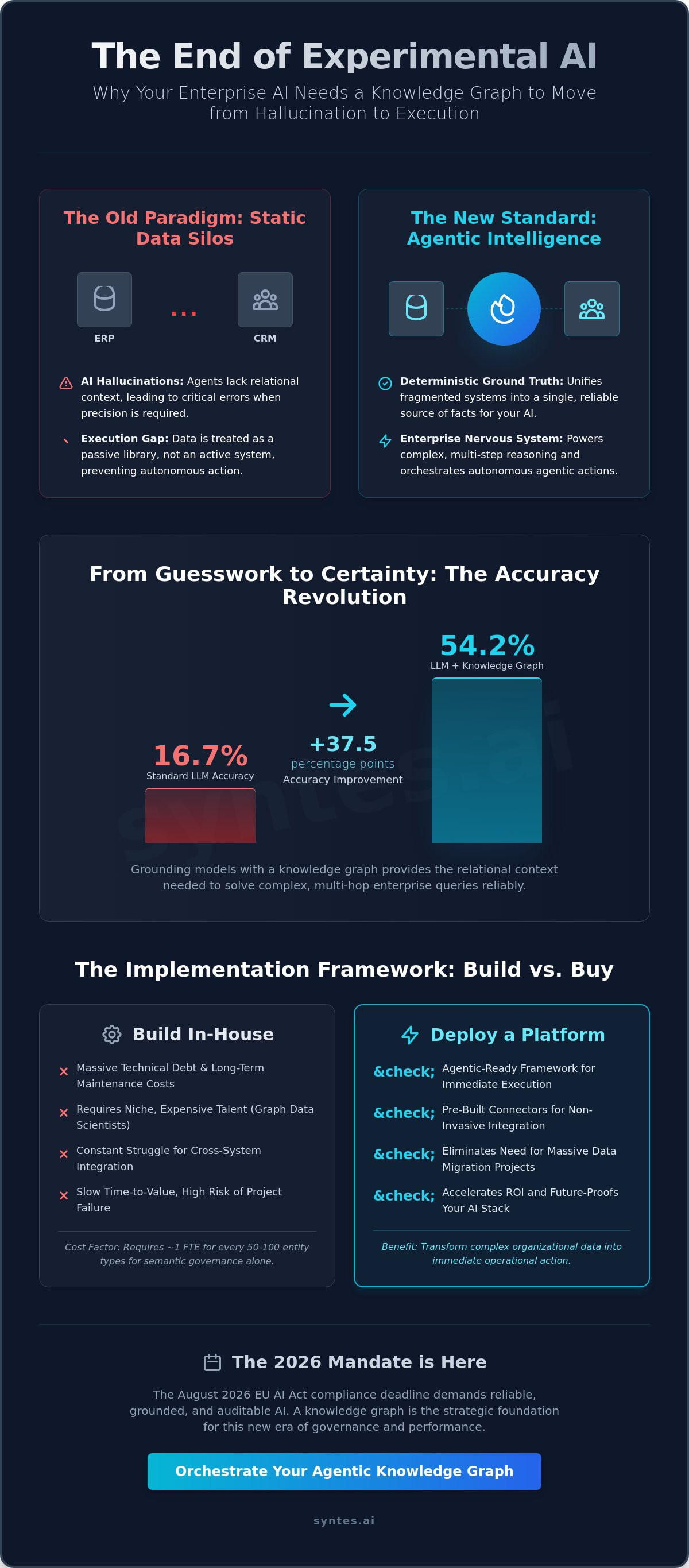
Knowledge graph implementation is the formalization of enterprise logic into a machine-executable format. It is not a storage project. It is a systemic overhaul. For decades, organizations treated data as a passive resource, a library of disconnected records waiting for human intervention. The “Static Data” era was defined by silos, where ERP and CRM systems operated as isolated islands of information. That era ended with the rise of agentic AI. In 2026, the standard is “Agentic Intelligence,” where data must be active, interconnected, and immediately actionable by autonomous systems.
Why do most AI pilots fail in production? They lack the relational context required for multi-step reasoning. Without a structured semantic layer, your AI agents are essentially guessing. Knowledge graph implementation provides the “Ground Truth” layer that eliminates LLM hallucinations. It transforms raw data into a deterministic map of your business. This architecture allows AI to move from providing simple insights to executing complex, cross-functional tasks with certainty.
Why Vector Search Isn’t Enough for Enterprise AI
Vector databases are designed for semantic similarity. They find things that “look” like other things. This is sufficient for basic search, but it fails at complex, multi-hop enterprise reasoning. If an agent needs to understand how a specific supply chain delay in Singapore affects a contract renewal in Berlin, vector search will struggle. It lacks explicit relationship mapping. It cannot traverse the logical links between disparate entities.
Knowledge graphs provide the context that vectors lack. They define the rules of the business. By adopting enterprise knowledge graphs as primary AI infrastructure, firms move beyond probabilistic guesses toward logical precision. Research indicates that grounding Large Language Models with knowledge graphs improves accuracy on complex enterprise queries from 16.7% to 54.2%. This 37.5 percentage point improvement is the difference between a toy and a tool.
The ROI of Semantic Intelligence
Operational friction disappears when AI agents understand cross-system relationships. Instead of manual data reconciliation, the graph provides an automated, unified view of the enterprise. This is an appreciating asset. As you integrate more systems, the graph’s intelligence grows exponentially. It becomes the singular nervous system of the company. Semantic grounding serves as the immutable anchor for enterprise reliability by mapping unstructured data to a governed, logical schema. This ensures that every action taken by an agent is rooted in verified organizational facts rather than unverified text chunks.
The Build vs. Buy Framework: Evaluating Knowledge Graph Solutions
Enterprise leaders often mistake knowledge graph implementation for a standard engineering task. It isn’t. It’s a choice between building a proprietary engine from scratch or deploying a high-performance intelligence layer. Many CTOs fall into the “Build” trap, seduced by the idea of total customization. They soon discover that the true cost of custom graph construction isn’t the initial code. It’s the technical debt. Maintenance of complex ontologies, talent acquisition for niche graph data scientists, and the perpetual struggle for cross-system integration quickly eclipse the cost of a platform.
The “Buy” advantage in 2026 is centered on agentic readiness. Modern platforms provide ready-made frameworks and pre-built connectors that allow AI agents to move from passive observation to active execution immediately. The current market for knowledge graph software has evolved beyond simple databases. It now includes AI-native platforms designed to ground LLMs in real-time. When assessing your options, prioritize platforms that offer non-invasive integration capabilities. You shouldn’t have to rebuild your entire data stack to gain semantic clarity.
Infrastructure Costs: Beyond the License Fee
Engineering hours are the primary drain in DIY projects. Data cleaning and entity resolution are notoriously labor-intensive. Research indicates that ongoing semantic governance requires approximately one full-time employee for every 50 to 100 entity types managed. If you’re building in-house, you’re signing up for a massive, permanent headcount increase. Building real-time update mechanisms for dynamic data adds another layer of complexity that most internal teams aren’t equipped to handle. Transitioning from isolated DIY projects to enterprise data mesh and knowledge graphs allows organizations to decentralize data ownership while maintaining a unified, machine-readable truth.
Security and Governance Requirements
Governance is no longer optional. With the EU AI Act’s obligations for high-risk systems coming into force on August 2, 2026, your graph must be compliant by design. Enterprise-grade platforms provide Role-Based Access Control (RBAC) at both the node and edge levels. This ensures that an AI agent only accesses the specific data points it’s authorized to see. Consumer-grade tools fail here. They lack the data lineage and auditability required by frameworks like the NIST AI Risk Management Framework or ISO/IEC 42001. If you can’t prove why an agent took a specific action, you’re exposed to significant regulatory risk. For those seeking to bypass these architectural hurdles, exploring the Syntes Agentic Platform can provide the necessary security guardrails out of the box.
Use this checklist to evaluate platform scalability and security standards:
- Node-Level Security: Can permissions be restricted to specific entities within the graph?
- Temporal Awareness: Does the system track how relationships change over time?
- Agentic Interoperability: Does it support open protocols like MCP for tool-to-model communication?
- Audit Trails: Is there a clear, immutable record of every data point the AI accessed to reach a conclusion?
The 2026 Implementation Roadmap: From Ingestion to Agentic Execution
Knowledge graph implementation is a strategic migration from raw data to autonomous execution. It requires a methodical, five-step roadmap to ensure your architecture doesn’t just store facts but understands them. This process moves beyond the simplistic ingestion models of the past to create a machine-executable nervous system.
- Define the Semantic Core. Map high-value business entities, such as “Contract” or “Asset,” over technical database tables. This creates a logical overlay that AI can interpret.
- Automated Entity Resolution. Deploy LLMs to unify disparate records across your stack without manual intervention. Implementing automated verification layers can reduce factual errors in AI systems by up to 72%, ensuring your agents operate on a single, verified truth.
- Multi-Source Integration. Connect ERPs, CRMs, and unstructured document stores. This creates the breadth of context necessary for enterprise-wide reasoning.
- Agentic Layering. Embed your graph into agentic ai platforms. This is the moment your data becomes actionable.
- Continuous Evolution. Implement feedback loops where agents update the graph based on real-world outcomes.
Phase 1: Architecting the Semantic Layer
Don’t confuse a technical schema with an enterprise ontology. A schema describes how data’s stored; an ontology describes what the business is. Start with a “thin slice” use case, such as supply chain risk or customer churn, to prove immediate ROI before scaling. Ontology-driven architecture is the blueprint for AI agents. It provides the structured constraints that keep agents within the bounds of corporate policy and operational reality. Understanding the foundational principles of knowledge graph architecture is essential to ensuring your semantic layer is built for scalability and agentic execution from the outset. By prioritizing logic over raw volume, you ensure your knowledge graph implementation remains manageable and high-impact.
Phase 2: Connecting the Agentic Nervous System
AI agents use the graph to navigate complex business logic. They don’t just search for text; they traverse relationships. When an agent identifies a delay, it uses cross-system integrations to update a CRM or trigger a procurement workflow in the ERP. This represents the critical transition from passive “Read” graphs to active “Execute” graphs. Your knowledge graph implementation is only complete when your agents can move from identifying a problem to solving it without human intervention. This connectivity transforms the graph from a static repository into a living, operational nervous system that responds to market shifts in real-time. Organizations looking to eliminate the gap between theory and execution should review the detailed technical and strategic guidance available for building an enterprise knowledge graph as a foundation for agentic deployment.
Overcoming the Implementation Wall: Hallucinations, Silos, and Governance
The most common objection among enterprise executives is simple: “We tried AI and it lied to us.” This skepticism is valid. Large Language Models are probabilistic engines, not logic processors. Without a rigid structure, they predict the next most likely token rather than the most accurate fact. A robust knowledge graph implementation solves this by providing deterministic grounding. It forces the model to verify data against a governed schema before generating a response. This shift from guessing to verifying is what separates a failed experiment from a production-grade agent.
Data silos are the second major hurdle. Traditional integration projects often fail because they attempt to move mountains of data into a central lake. This is a mistake. In 2026, the graph acts as a virtual warehouse. It maps relationships across existing ERP and CRM systems without requiring massive, risky data migration. This non-invasive approach preserves the integrity of source systems while providing a unified view for AI agents. However, this connectivity introduces the risk of “Graph Sprawl.” Automated governance is essential to manage the lifecycle of graph entities and prevent the semantic layer from becoming as cluttered as the legacy systems it aims to organize.
Deterministic Grounding vs. Probabilistic Guessing
A graph forces the LLM to follow explicit logical paths. It doesn’t allow for creative interpretation of corporate policy or supply chain data. During the “Verify” step, agents check graph facts against real-time operational context. This is critical because using data that is just six months old can increase AI hallucinations in market forecasts by 19%. By grounding agents in a live graph, you transform the AI from a creative writer into a precise operator. The cost savings from reduced error rates and mitigated regulatory risk under the EU AI Act are substantial.
Bridging the Legacy Gap
Legacy systems often contain “dark data” that is inaccessible to modern tools. Semantic middleware acts as the translator. It converts legacy formats into graph structures, allowing the knowledge graph implementation to ingest context from decades-old databases. This bridges the gap between the old world and the new. It makes the graph the unifying layer for the modern enterprise stack. To see how these integrations function in a live environment, explore the Syntes Agentic Platform. This architecture ensures that your move toward autonomy doesn’t require a total “rip and replace” of your existing infrastructure.
Syntes AI: Orchestrating the Agentic Knowledge Graph
Syntes AI serves as the definitive orchestration layer for the autonomous enterprise. While the preceding sections outlined the strategic necessity and the technical roadmap, the Syntes Agentic Platform provides the actual infrastructure where these concepts materialize. It’s the logical conclusion of a successful knowledge graph implementation. The platform unifies complex, fragmented data into actionable formats that AI agents can interpret and act upon without human oversight. These agents don’t merely provide insights. They operate autonomously across integrated enterprise systems to solve operational bottlenecks in real-time. This represents the transition from passive data storage to active, systemic performance where intelligence is embedded directly into the workflow.
The Syntes Advantage: Speed to Intelligence
Speed defines the gap between market leaders and those left behind. Syntes reduces the timeline for knowledge graph implementation from months of manual engineering to weeks of strategic configuration. This acceleration is possible because our platform handles cross-system integrations natively. It eliminates the need for fragile, custom-coded middleware that often breaks during system updates. We don’t build consumer-grade chatbots that guess at answers based on probabilistic patterns. We build operational intelligence systems that possess a deep, semantic understanding of your business logic. By prioritizing execution over observation, Syntes allows your organization to bypass the “execution gap” that stalls most AI initiatives. This focus ensures that your AI investment moves beyond theoretical experimentation and into the realm of immediate, measurable utility across your entire value chain.
Next Steps: Building Your Agentic Roadmap
Transitioning to an agentic model requires more than software. It requires a strategic blueprint. Our discovery process identifies high-impact graph use cases where semantic grounding yields the highest ROI, such as automated supply chain reconciliation or real-time contract compliance. We map your existing data silos to a unified semantic core. This ensures your agents have the reliable ground truth they need to perform safely within the constraints of the 2026 regulatory environment. The window for low-stakes AI experimentation has closed. The era of autonomous execution is here. Scale your AI initiatives with enterprise-grade infrastructure that values clarity over noise. High-level decision-makers must move now to secure their place in the agentic economy. Contact Syntes AI to begin your knowledge graph implementation today.
Securing the Agentic Advantage
The transition from probabilistic AI to deterministic enterprise agents is no longer a theoretical choice. It’s a survival mechanism. We have mapped the shift from static data to agentic intelligence. We have defined the roadmap for a resilient semantic nervous system. A successful knowledge graph implementation transforms legacy silos into a unified, machine-executable ground truth. It ensures your agents act with precision. It keeps you within the strict governance standards of the 2026 regulatory landscape. Organizations that fail to bridge the execution gap will remain trapped in a cycle of hallucinations and technical debt.
Don’t leave your AI strategy to chance. Avoid fragmented engineering pilots. Deploy a solution built for the gravity of global operations. Scale your AI initiatives with Syntes AI’s Enterprise Knowledge Graph. Our platform provides an expert-led implementation roadmap, seamless cross-system integration, and the enterprise-grade security required for modern compliance. The era of total operational clarity is within reach. Your path to autonomous enterprise intelligence begins here.
Frequently Asked Questions
What is the primary difference between a knowledge graph and a standard database?
Knowledge graphs formalize relationships as first-class citizens, whereas standard databases focus on rigid, tabular storage. A standard database requires complex joins to answer multi-hop queries. A graph traverses connections natively. This architecture allows AI to understand the logic behind data points, transforming a passive repository into a machine-readable map of enterprise intelligence.
How much does a typical knowledge graph implementation cost for an enterprise?
Resource allocation for these projects depends on the scale of entity management and integration complexity. Organizations should budget for ongoing semantic governance, which typically requires one full-time employee for every 50 to 100 entity types managed. While we don’t quote specific platform fees here, firms must account for engineering hours and the long-term maintenance of the enterprise ontology.
Can we implement a knowledge graph if our data is currently siloed across multiple systems?
You can implement a knowledge graph specifically to solve the data silo problem. The graph functions as a virtual warehouse, mapping relationships across disparate ERP and CRM systems without requiring a massive data migration. It provides a unified semantic layer that allows AI agents to access a single ground truth while leaving original data in its source system.
How do knowledge graphs prevent AI hallucinations in RAG systems?
Knowledge graphs provide deterministic grounding that overrides the probabilistic nature of Large Language Models. By forcing an agent to verify facts against a governed graph before generating a response, you eliminate the guessing that leads to errors. Research shows that grounding LLMs with graphs improves accuracy on complex enterprise queries from 16.7% to 54.2%.
Is it better to build our own knowledge graph or use a managed platform?
Managed platforms are generally superior for organizations prioritizing speed and compliance. Building an in-house system often leads to significant integration debt and the high cost of recruiting niche graph talent. A managed platform provides ready-made agentic frameworks and the security guardrails necessary for the August 2026 EU AI Act compliance deadline.
What are the most common use cases for an enterprise knowledge graph in 2026?
Critical use cases in 2026 include real-time supply chain orchestration, automated regulatory compliance, and cross-functional customer lifecycle management. These applications rely on the graph’s ability to provide live operational context. Successful knowledge graph implementation allows agents to identify a disruption and execute a resolution across multiple systems simultaneously.
How does a knowledge graph support autonomous AI agents?
A knowledge graph serves as the nervous system that allows autonomous agents to navigate complex business logic. It provides the structured constraints and relationship maps an agent needs to move from identifying a problem to taking a verified action. Without this layer, an agent lacks the situational awareness required to operate safely in a production environment.
How long does it take to see ROI from a knowledge graph implementation?
ROI is typically realized within weeks when organizations follow a thin slice strategy. By focusing on a single high-value use case first, you prove the value of the knowledge graph implementation before scaling. Long-term ROI compounds as more systems are integrated, turning the graph into an appreciating asset that reduces operational friction across the enterprise.