
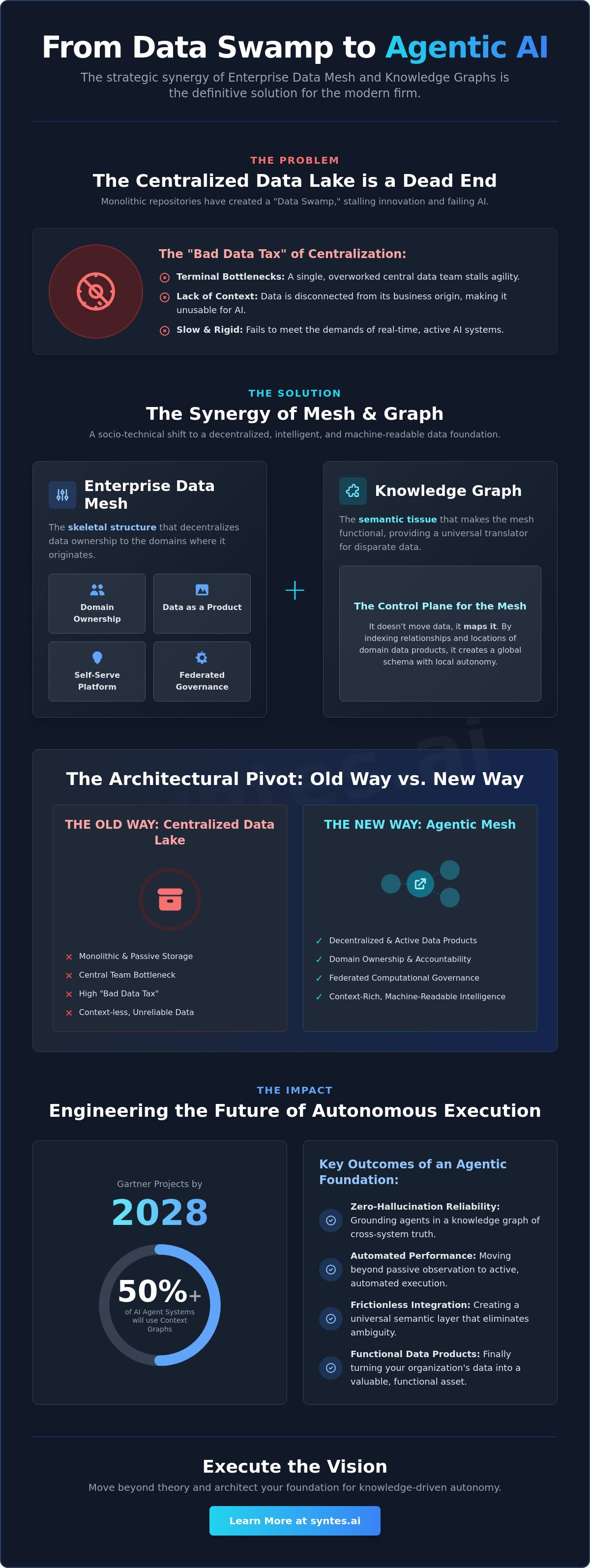
The era of the centralized data lake is over. Most organizations are currently suffocating under a “bad data tax” that stalls innovation and turns promising AI pilots into expensive failures. You’ve likely discovered that dumping information into a single repository doesn’t create truth; it creates a swamp. The definitive solution for the modern firm is the strategic synergy of enterprise data mesh and knowledge graphs. While a mesh architecture decentralizes ownership to the domains where data is born, the knowledge graph provides the essential semantic tissue that makes this distributed intelligence machine-readable.
Gartner projects that by 2028, more than 50% of AI agent systems will utilize context graphs as foundational infrastructure. We agree that grounding autonomous agents in cross-system truth is the primary hurdle to achieving true operational intelligence. This article provides a clear framework for combining mesh and graph architectures to eliminate integration friction. You’ll learn how to move beyond passive observation toward active, automated performance. We’ll prepare your organization for the transition to agentic AI by architecting a foundation that finally turns data into a functional product.
Key Takeaways
- Recognize why centralized data silos collapse under real-time AI demands and why shifting to domain-owned data products is now a strategic necessity.
- Master the synergy of enterprise data mesh and knowledge graphs to create a machine-readable foundation that serves as a universal translator for disparate systems.
- Resolve the tension between decentralization and global standards by implementing federated computational governance to prevent data anarchy.
- Apply a rigorous implementation framework to identify high-value domains and deploy a semantic layer that maps complex enterprise hierarchies.
- Move beyond theoretical experimentation toward autonomous execution with an agentic platform that leverages knowledge graphs for zero-hallucination reliability.
Beyond the Data Swamp: Why Decentralized Data Mesh is Non-Negotiable
The centralized data lake was a noble experiment that failed. For a decade, global enterprises poured billions into monolithic repositories, expecting a single source of truth to emerge through sheer volume. It didn’t. Instead, we witnessed the birth of the data swamp. These unnavigable masses of disconnected information have become the primary obstacle to scaling innovation. In 2026, this “Datastrophe” has reached a terminal breaking point. Centralized silos collapse under the weight of real-time AI demands. They’re too slow. They’re too rigid. Most importantly, they lack the context required for autonomous execution.
Survival requires a fundamental architectural pivot. We must move from passive data storage to active, product-oriented ownership. This is the essence of the enterprise data mesh. It isn’t a single tool or a software license. It’s a socio-technical shift that redistributes the responsibility for data quality to the business domains where that data actually originates. To grasp the foundational principles, one must ask: What is a Data Mesh? It’s a decentralized framework built on four non-negotiable pillars: domain ownership, data as a product, self-serve infrastructure, and federated governance.
The Collapse of the Monolithic Data Lake
Centralized architectures create terminal bottlenecks. When every request for insight must pass through a single, overworked central data team, agility vanishes. This creates a “Bad Data Tax.” It’s the persistent, hidden cost of cleaning and re-verifying data that was never governed at the source. Transitioning from traditional Extract-Transform-Load (ETL) pipelines to domain-centric reliability is the only path forward. Centralized lakes are passive. AI is active. The mismatch is fatal for any organization attempting to deploy enterprise data mesh and knowledge graphs at scale.
Data as a Product: The New Enterprise Standard
Treating data with the same rigor as external software products is no longer optional. It’s the new standard. This means every data set must be discoverable, secure, and inherently trustworthy by design. We’re seeing a profound shift from passive data consumers to active data stakeholders. In this model, business units own the lifecycle and quality of their data products. They’re accountable for the truth they export. This shift ensures that the semantic layers used in modern AI systems are grounded in reality rather than architectural guesswork.
The Semantic Tissue: How Knowledge Graphs Power Data Mesh Interoperability
If the enterprise data mesh is the skeletal structure of a decentralized organization, knowledge graphs are the semantic tissue that makes it functional. Structure alone isn’t enough. Meaning is the missing variable. Decentralization without a shared semantic understanding is merely fragmentation by another name. When a marketing domain defines a “customer” differently than the finance domain, the resulting friction creates systemic failure. The synergy of enterprise data mesh and knowledge graphs solves this by providing a universal translator for disparate domain data products. It ensures that while ownership is distributed, the language of the business remains unified.
Architecting this requires building a semantic data layer for enterprise to bridge domain silos. This layer doesn’t move the data. It maps it. By using semantic metadata, organizations eliminate the ambiguity that typically plagues cross-system communications. It transforms passive data sets into active, context-rich intelligence that can be queried across the entire mesh. This is the foundation of operational clarity. Organizations must adopt a robust enterprise knowledge graph to act as this essential connective tissue.
Mapping the Mesh: Knowledge Graphs as the Control Plane
Knowledge graphs serve as the control plane for the decentralized mesh. They don’t just store information; they index the relationships and locations of domain-specific data products. This allows for the creation of a global schema that respects local domain autonomy while enforcing global standards. Ontologies play a critical role here. They define the cross-departmental relationships that allow an agent in the supply chain domain to understand a constraint originating in the sales domain. It’s about creating a map that updates in real time as new data products are published. Understanding the structural foundations of knowledge graph architecture is essential for building a scalable control plane that can support the full complexity of enterprise agentic workflows.
Unifying Structured and Unstructured Intelligence
Modern intelligence requires more than just clean tables. It requires the integration of ERP, CRM, and legacy data with the vast amounts of unstructured information trapped in documents and emails. Knowledge graphs ground Large Language Models (LLMs) in enterprise-specific facts. This grounding is the only way to ensure real-time relevance for agentic workflows. By mapping structured records to unstructured context, the graph provides a single actionable view. It moves the organization beyond simple retrieval toward complex, multi-step reasoning. This is how you transform a collection of data points into a cohesive, autonomous nervous system.
Strategic Synergy: Resolving the Conflict Between Domain Autonomy and Global Standards
Does decentralization lead to data anarchy? Critics of the mesh model frequently pose this question, fearing that distributed ownership will inevitably result in a fragmented landscape of incompatible silos. This fear is a relic of centralized thinking. Anarchy isn’t a byproduct of decentralization; it’s the result of absent governance. The strategic synergy of enterprise data mesh and knowledge graphs provides the definitive solution to this tension. It creates a framework where domain-level agility and global standards aren’t just compatible; they’re mutually reinforcing. It’s about providing the semantic guardrails that make domain freedom safe for the entire organization.
The secret lies in moving beyond manual oversight. Modern enterprise knowledge graph solutions enforce policy without slowing down individual business units. They serve as the foundational “Ground Truth” for AI, ensuring that every autonomous agent operates on verified, contextualized facts. This isn’t a suggestion. It’s a systemic requirement for any organization aiming for agentic readiness. By embedding governance into the data architecture itself, you eliminate the friction between the need for speed and the demand for reliability.
Federated Governance: Automation Over Bureaucracy
Traditional data governance is where innovation goes to die. It relies on human-led committees that are too slow to keep pace with real-time AI demands. We must pivot to federated computational governance. This model implements automated policy enforcement directly within the data mesh. Knowledge graphs allow the system to audit data lineage and compliance in real-time. If a domain-specific data product fails to meet global quality thresholds, the system flags it automatically. This transition from human oversight to algorithmic oversight is the only way to scale enterprise data mesh and knowledge graphs across a global footprint.
Standardization Without Stagnation
Standardization shouldn’t mean uniformity. The goal is to define global entities while allowing domain-specific extensions. Consider the definition of a “Customer.” To the Sales domain, a customer is a lead with a high probability of conversion. To the Support domain, that same customer is a set of active tickets and service history. Knowledge graphs resolve these conflicting definitions by mapping them to a single, unified global entity. This allows each department to maintain its unique perspective without creating a data silo. It ensures that when an AI agent queries “Customer,” it receives a multi-dimensional, accurate response that reflects the total truth of the enterprise.
Engineering the Agentic Mesh: Implementation Framework for 2026
Execution is the only metric that matters. While competitors focus on the theoretical benefits of decentralization, the forward-thinking enterprise must prioritize the infrastructure for autonomous performance. Building a foundation for enterprise data mesh and knowledge graphs requires a methodical, five-step framework designed for the agentic requirements of 2026. This process moves beyond simple data accessibility. It creates a nervous system for the organization. It’s a journey from passive observation to active, automated execution.
- Step 1: Identify High-Value Business Domains. Pinpoint business units where autonomous action yields immediate ROI. Define their primary data products with precision.
- Step 2: Deploy a Semantic Layer. Map domain relationships and hierarchies. This layer provides the necessary context for machine reasoning across the entire mesh.
- Step 3: Integrate Cross-System AI Middleware. Connect the mesh to agentic accessibility layers. This ensures agents can navigate the distributed architecture without losing context.
- Step 4: Establish Self-Service Infrastructure. Enable rapid agent deployment. Domains must be able to spin up specialized agents without waiting for central IT approval.
- Step 5: Iterate Through Agentic Pilots. Validate mesh connectivity. Test the system’s ability to maintain truth and execute multi-step workflows across domain boundaries.
Selecting Your Core: Data Fabric vs. Knowledge Graph
Data fabrics often fail because they prioritize movement over meaning. They connect silos but don’t explain them. A Knowledge Graph is the superior core for agentic grounding because it provides a deterministic map of enterprise reality. It’s the difference between having a phone book and having a conversation. When evaluating knowledge graph implementation strategies, scalability and native integration with agentic ai platforms are non-negotiable criteria. You need a core that understands the logic of your business, not just the location of your files.
Cross-System AI Integration: The Final Link
The final link in the chain is operational connectivity. The semantic mesh must connect directly to operational systems like ERP, SAP, and Salesforce. This enables AI agents to execute transactions across domain boundaries rather than just reading reports. Reliability is paramount here. You need a system that ensures security and transactional integrity in autonomous workflows. When an agent identifies a supply chain bottleneck, it should have the authority and the data-driven grounding to reorder components automatically. To achieve this level of operational maturity, you must deploy a robust agentic platform that bridges the gap between data and action.
Executing the Vision: The Syntes Approach to Knowledge-Driven Autonomy
Data management is a means. Autonomous execution is the end. For the global enterprise, the transition from being data-driven to being knowledge-driven is the only way to survive the complexities of 2026. The Syntes Agentic Platform transforms the theoretical promise of a decentralized mesh into a functional reality. We don’t just organize your information; we activate it. By leveraging an Enterprise Knowledge Graph as the semantic anchor, our platform ensures that every autonomous decision is grounded in the immutable logic of your specific domain data products. The swamp is drained. The nerve center is active.
The synergy between enterprise data mesh and knowledge graphs creates a deterministic environment where AI agents don’t guess; they know. This is the foundation of zero-hallucination AI. While consumer-grade models struggle with context, our approach provides agents with a high-fidelity map of cross-system truth. We integrate ERP, CRM, and legacy systems into a unified, actionable graph that serves as the definitive source for agentic reasoning. This isn’t about building better chatbots. It’s about architecting systemic operational intelligence that executes transactions with precision across every domain boundary. A well-designed knowledge graph architecture is the blueprint that makes this level of precision possible at enterprise scale.
The Syntes Agentic Platform: Your Control Plane
Orchestrating complex workflows across a decentralized data mesh requires a sophisticated control plane. The Syntes Agentic Platform provides this essential layer. It manages the lifecycle of specialized agents, ensuring they remain synchronized with the evolving semantic metadata of your organization. Real-time semantic grounding provides enterprise-grade reliability. You can scale these agents across departments without the risk of logic drift. It’s a robust alternative to fragile, manual integrations. We provide the tools to move from passive observation to a state of total operational clarity.
The Future is Agentic
The combination of mesh architecture and graph semantics is the final architecture for enterprise AI. It resolves the tension between scale and meaning. It turns data into a product and that product into an action. Taking the first step toward a fully integrated, autonomous enterprise requires a partner who understands the messy realities of large-scale systems. The era of theoretical experimentation is over. The era of the autonomous organization has begun. To begin your transition to a high-performance, knowledge-driven architecture, Schedule a strategy session with Syntes AI today.
Mastering the Autonomous Enterprise
The era of passive data observation has reached its expiration date. Survival in a high-velocity market requires a shift toward systemic operational intelligence. By integrating enterprise data mesh and knowledge graphs, your organization moves beyond the limitations of fragmented silos and centralized bottlenecks. This dual architecture provides the structural decentralization needed for domain agility and the semantic tissue required for complex machine reasoning. It’s the definitive framework for grounding autonomous agents in cross-system truth. You’ve seen the framework. Now it’s time for execution.
The Syntes Agentic Platform delivers this capability through proprietary Knowledge Graph infrastructure and deep cross-system enterprise integrations. We provide the zero-hallucination agentic grounding necessary for reliable, automated performance at scale. Don’t let your AI initiatives stall in the data swamp. It’s time to unify your enterprise data with the Syntes Agentic Platform and transition to a state of total operational clarity. The future belongs to the autonomous enterprise. We’re ready to help you build it today.
Frequently Asked Questions
What is the primary difference between a Data Mesh and a Knowledge Graph?
Data mesh is an organizational architecture that decentralizes data ownership to specific business domains. A knowledge graph is a semantic technology that defines the relationships and meaning between those decentralized data entities. While the mesh provides the structural framework for distributed autonomy, the graph provides the semantic tissue required for cross-system interoperability. This combination ensures that domain-owned data is both independent and globally navigable for complex machine reasoning.
How do Knowledge Graphs solve the problem of data silos in a Data Mesh?
Knowledge graphs solve the silo problem by acting as a universal translator across the decentralized mesh. They map disparate domain data products to a shared semantic layer without requiring physical data consolidation or movement. This approach allows the enterprise to maintain domain-specific agility while ensuring that all data products are discoverable and logically connected. It creates a unified view of truth that bridges the gap between disconnected business units.
Why is a Data Mesh necessary for scaling Agentic AI in 2026?
Agentic AI requires high-context, real-time data products that are governed at the source to ensure reliability. Traditional centralized lakes create terminal bottlenecks that prevent agents from accessing the most relevant, domain-specific information quickly enough for autonomous action. A data mesh provides the necessary infrastructure for specialized agents to query and act upon reliable data products. It is the only architectural model capable of scaling AI agents across a global footprint.
Can we implement a Knowledge Graph without adopting the full Data Mesh framework?
It is possible to deploy a knowledge graph in a centralized manner, but this often leads to the same scalability issues found in traditional data lakes. Adopting enterprise data mesh and knowledge graphs together ensures that the graph is fueled by domain-owned data products. This combination prevents the graph from becoming a stale, unmanageable silo. The mesh provides the organizational discipline that keeps the semantic layer fresh, accurate, and operationally relevant.
What are the common pitfalls when building an enterprise-scale Knowledge Graph?
The primary pitfall is treating the project as a technical installation rather than a strategic organizational change. Many firms fail because they lack domain-level accountability or neglect the creation of a robust, business-aligned ontology. Without clear ownership and semantic standards, the resulting architecture will remain fragmented. Success requires a focus on the socio-technical shift of treating data as a product rather than just a technical byproduct.
How does federated governance work in a decentralized data environment?
Federated governance utilizes automated policy-as-code to maintain global standards across decentralized domains. It shifts the burden of compliance from manual committees to algorithmic enforcement at the point of data publication. This model ensures that domain teams maintain their operational speed while the knowledge graph provides the metadata required for real-time auditing. It creates a system where governance is built into the architecture itself rather than being an external friction.
What role does semantic metadata play in preventing AI hallucinations?
Semantic metadata provides a deterministic anchor that prevents AI agents from generating responses based on statistical guesswork or problematic training data. It grounds Large Language Models in the specific logic and verified facts of the enterprise. By utilizing a knowledge graph to verify entity relationships, agents can execute complex tasks with a zero-hallucination guarantee. This grounding is essential for any AI system tasked with high-stakes operational decision-making.
How do I measure the ROI of a combined Data Mesh and Knowledge Graph strategy?
ROI is measured by the systemic reduction in cross-domain integration friction and the dramatic acceleration of autonomous agent deployment. Organizations should quantify the decrease in manual data cleansing hours and the increase in successful automated transactions. The definitive metric of success is the transition from passive data observation to active operational intelligence. This shift directly impacts the bottom line by reducing the “bad data tax” on innovation.