

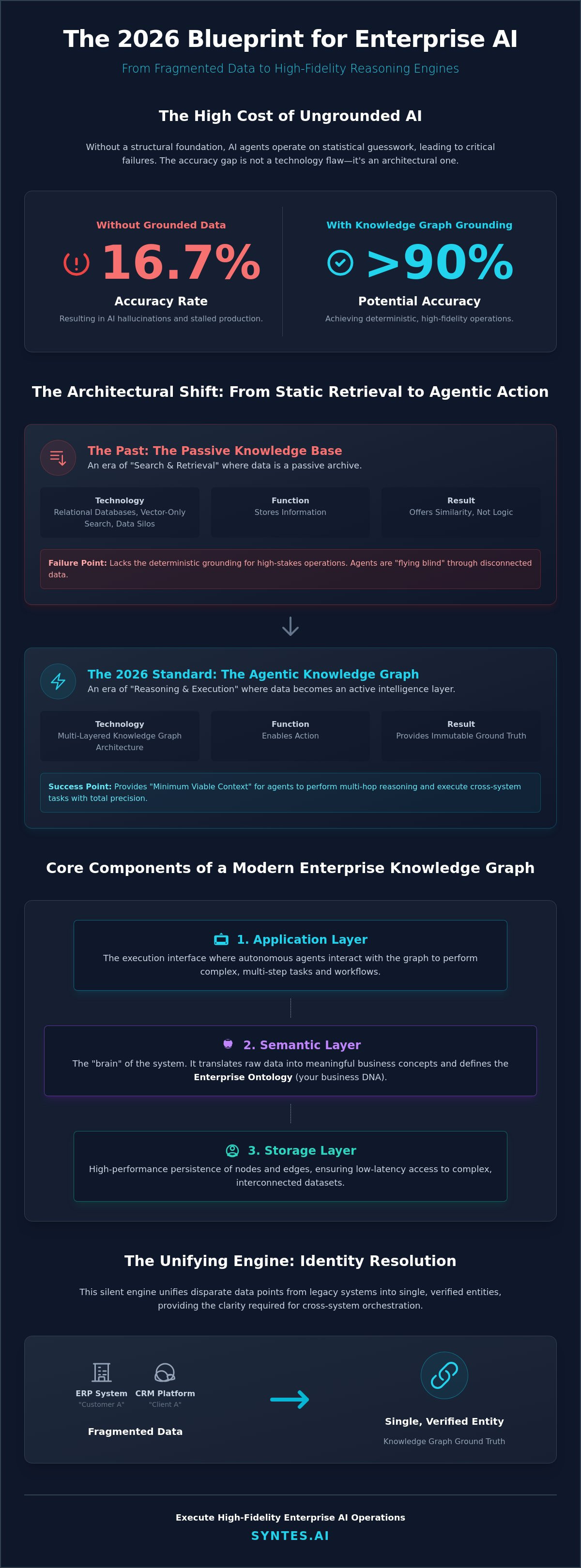
If your enterprise AI is still attempting to answer complex queries without grounded data, you are likely facing a staggering 16.7% accuracy rate. That is not a technology gap; it is a structural failure. In 2026, the “gold standard” of simple vector retrieval has been exposed as insufficient for the demands of autonomous agents. To bridge this gap, you must master the structural foundations of knowledge graph architecture. This is no longer an optional data strategy. It is the central nervous system required to transform fragmented, siloed information into a high-fidelity reasoning engine for the modern enterprise.
We understand the frustration of watching AI hallucinations stall production or seeing data silos prevent cross-system automation. You need a system that doesn’t just store data but understands the deep relationships within it. This article provides the master blueprint for building a scalable AI architecture that slashes hallucination rates and ensures seamless integration across your entire stack. We will examine the transition from static knowledge to dynamic context engineering. By the end, you’ll possess the strategic roadmap to move from passive observation to active, automated performance.
Key Takeaways
- Identify why the transition from static retrieval to active reasoning is essential for enterprise AI performance in 2026.
- Master the three essential layers of modern knowledge graph architecture to transform fragmented data into a unified reasoning engine.
- Learn to implement state management within your architecture to support complex, multi-step autonomous agent workflows.
- Discover how to achieve bi-directional connectivity between your context layer and legacy systems like ERP and CRM platforms.
- Understand how the Syntes Agentic Platform serves as the definitive infrastructure for executing high-fidelity enterprise AI operations.
The Evolution of Knowledge Graph Architecture: Beyond Static Data
Define knowledge graph architecture as the structural framework governing semantic data relationships. It is the blueprint that dictates how an enterprise organizes, connects, and validates its most critical information assets. In 2026, the industry has undergone a fundamental shift. We have moved beyond the era of “Search and Retrieval” where AI simply found documents. We are now in the era of “Reasoning and Execution.” The failure of consumer-grade chatbots in corporate environments served as the primary driver for this architectural rigor. These probabilistic models, while impressive in isolation, lacked the deterministic grounding required for high-stakes operations. To achieve true autonomy, the knowledge graph must serve as the immutable “Ground Truth” for every autonomous system in your stack.
Why Traditional Data Models Fail the AI Test
Relational databases are built for rows and columns. They excel at structured reporting but fail miserably when tasked with handling the intricate, non-linear business logic of a global enterprise. Data silos are not just an IT inconvenience; they are the primary source of AI hallucinations and operational drift. When an AI agent attempts to navigate fragmented systems without a unified context, it fills the gaps with statistical guesswork. Vector-only databases, while popular for basic RAG patterns, lack the inherent explainability required for enterprise-grade AI. They offer similarity, not logic. Without a robust knowledge graph architecture, your agents are essentially flying blind through a storm of disconnected data points.
The 2026 Standard: The Agentic Knowledge Graph
The passive knowledge base is an artifact of the past. The 2026 standard is the active agentic graph. This distinction is critical. A passive graph stores information; an agentic graph enables action. Semantic grounding ensures that every model response and every agentic workflow is rooted in verified business rules and real-time system states. Research indicates that LLMs answering complex questions without this grounding achieve only 16.7% accuracy. With proper graph grounding, that figure climbs significantly. Achieving this level of reliability requires a transition from simple data storage to sophisticated enterprise knowledge graph strategies. This architecture provides the “Minimum Viable Context” necessary for agents to perform multi-hop reasoning and execute cross-system tasks with total precision. It transforms your data from a passive archive into an active, operational intelligence layer that powers the entire business.
Core Structural Components of a Modern Enterprise Knowledge Graph
Building a high-fidelity reasoning engine requires more than just a database. It demands a multi-tiered knowledge graph architecture that separates physical storage from semantic logic. The core structural components of a knowledge graph consist of three essential layers: Storage, Semantic, and Application. The Storage Layer handles the high-performance persistence of nodes and edges, ensuring low-latency access to complex datasets. The Semantic Layer acts as the brain of the system, translating raw data into meaningful business concepts that agents can actually use. Finally, the Application Layer serves as the execution interface where autonomous agents interact with the graph to perform tasks. This separation of concerns ensures that your AI isn’t just fetching data; it’s navigating an organized map of your entire enterprise.
Identity resolution is the silent engine of this architecture. It unifies disparate data points from ERPs, CRMs, and internal logs into single, verified entities. Without this, your agents will treat “Customer A” in your sales tool and “Client A” in your support portal as different individuals. This leads to fragmented reasoning and operational errors. A robust knowledge graph architecture solves this by creating a persistent, unique identifier across all systems. It provides the necessary clarity for agents to execute cross-system orchestration without losing context.
The Ontology Layer: Defining the Enterprise DNA
Your ontology must mirror real-world business processes, not just database tables. Designing schemas around actual operations ensures that AI agents can follow the same logic your human employees do. Adhering to OWL and RDF standards is non-negotiable for maintaining architectural interoperability in a global ecosystem. An ontology acts as the definitive grammar for enterprise data, providing the rules and relationships that turn a collection of facts into a coherent language. If you’re ready to move beyond theoretical models, the Syntes Agentic Platform provides the necessary infrastructure to operationalize these complex ontologies at scale.
Data Ingestion and Orchestration Pipelines
Architecting for 2026 requires real-time data synchronization. Batch processing is too slow for agents that must act on live events. Modern pipelines utilize NLP to extract entities and relationships from unstructured documents, turning emails and PDFs into queryable graph nodes. Data lineage and provenance are equally vital. In regulated industries, you must prove exactly where a piece of information originated and how it was processed. This level of auditability ensures that your autonomous systems remain compliant and trustworthy. It transforms your data environment from a passive archive into an active, governed operational intelligence layer.
GraphRAG vs. Agentic Reasoning: Architecting for Autonomous Action
Traditional Retrieval-Augmented Generation (RAG) has reached its ceiling. While RAG succeeds at providing context to a prompt, it remains a passive mechanism. It retrieves; it does not reason. In 2026, the competitive advantage lies in Agentic Workflow Orchestration. This requires a knowledge graph architecture designed for autonomous execution rather than simple document lookup. While RAG treats data as a static library, agentic reasoning treats the graph as a dynamic map of capabilities. It’s the difference between an AI that can tell you about a customer and an AI that can autonomously resolve that customer’s billing discrepancy across three different legacy systems.
Skeptics often ask if this is just a more complex database. The answer is a definitive no. A database stores records; a knowledge graph encodes relationships and business logic. Modern architecture must support “State Management” for multi-step AI tasks. When an agent performs a complex workflow, it needs to know exactly where it stands in the process. The graph provides this persistent state, acting as the agent’s short-term and long-term memory. It also houses the “Tool Use” layer. Here, the graph doesn’t just provide facts. It tells the agent which specific APIs, ERP modules, or CRM functions are valid for a given entity, preventing the agent from attempting impossible or unauthorized actions.
Beyond Retrieval: The Graph as a Decision Engine
The graph provides the underlying logic for “if-this-then-that” autonomous decision making. It allows for “Constraint-Based Reasoning,” ensuring that agents never violate established business policies or regulatory boundaries. By encoding these constraints directly into the knowledge graph architecture, you move from probabilistic guesswork to deterministic execution. This transition is a core pillar of successful knowledge graph implementation. It ensures that every action taken by an agent is grounded in the specific operational realities of your business, directly impacting your bottom line through reduced error rates and increased throughput.
Reducing Hallucinations through Semantic Grounding
Semantic grounding is the only definitive cure for model drift and probabilistic hallucinations. The graph acts as a factual anchor for Large Language Models, providing a structured reality that the model cannot ignore. Agents utilize a “Verification Loop” to cross-reference every generated output against the hard facts stored within the graph. If a proposed action or statement contradicts the graph’s ontology, the system flags it for correction before it ever reaches a production environment. This creates a self-correcting loop where the AI’s creative potential is harnessed within a cage of absolute, verified truth. This level of rigor is what separates experimental chatbots from enterprise-grade autonomous systems.
Designing for Cross-System Orchestration and Scalability
Scalability in 2026 is not merely a question of data volume. It is a challenge of orchestration velocity. A high-performance knowledge graph architecture must function as a bi-directional bridge between the central reasoning engine and your core systems of record. Passive data lakes are insufficient for agents that must execute tasks in real-time. To achieve true enterprise scale, your architecture must balance virtualization and materialization. Virtualization allows for real-time querying of source systems without redundant storage, while materialization ensures that complex, multi-hop reasoning happens with sub-second latency. This hybrid approach is the only way to maintain high availability for mission-critical autonomous workflows that cannot afford the “wait time” of traditional batch processing.
Security at this level is a granular requirement. You must manage access control at the node and edge level, ensuring that agents only interact with data they are explicitly authorized to use. This is not just about protecting the database; it’s about governing the agent’s behavior. If your current infrastructure lacks the ability to trigger real-time, bi-directional actions across your stack, you should examine our cross-system integration capabilities to close the loop between insight and execution.
The Cross-System Integration Layer
Modern orchestration requires the unification of structured SAP data with unstructured contract data within a single, queryable context. This integration layer must support write-back APIs that allow AI agents to update source systems safely. When an agent identifies a discrepancy in a supply chain contract, it shouldn’t just flag it; it should possess the architectural permission to initiate a correction in the ERP. This level of systemic harmony is a direct result of the synergy between enterprise data mesh and knowledge graphs. It treats data as a product that is both discoverable and actionable across the entire organization.
Security and Governance in the Graph
Implementing Attribute-Based Access Control (ABAC) within the graph architecture is the definitive standard for 2026. This allows for dynamic permissioning based on the agent’s current task, the sensitivity of the data node, and the specific business context. Data masking and encryption for PII or PHI nodes must be handled at the architectural level to prevent model exposure. This is “Governance-by-Design.” By embedding these rules into the edges of the graph, you ensure that every autonomous action remains compliant with global regulations without requiring manual oversight. It transforms security from a bottleneck into a foundational enabler of agentic speed.
Syntes AI: The Infrastructure for Agentic Knowledge Graphs
The Syntes Agentic Platform represents the logical conclusion of sophisticated knowledge graph architecture. It is the definitive bridge between theoretical data modeling and autonomous enterprise execution. While most market offerings stop at providing a “fancy database” for search, Syntes unifies complex, multi-modal data into a structured format that agents use to perform actual work. This is the infrastructure required for the next generation of operational intelligence. It replaces the fragility of probabilistic chatbots with the deterministic precision of a grounded, semantic engine. By providing a live, governed operational memory, Syntes ensures that your agents don’t just “know” things; they have the context required to act.
Syntes’ primary advantage lies in its native cross-system integration capabilities. Most platforms struggle to maintain bi-directional flow between the reasoning layer and legacy systems like SAP or Salesforce. Syntes solves this by architecting the graph as an execution layer. Our “Context Graph” technology, launched in February 2026, provides the live state management necessary for agents to navigate complex, multi-step workflows without losing sight of the business objective. This is the enterprise-grade alternative to consumer-grade AI experimentation. It is designed for high-stakes environments where accuracy is non-negotiable and “hallucination” is a word that should never appear in a status report.
From Data Unification to Operational Intelligence
Architecting Your Future with Syntes
The long-term ROI of a unified enterprise knowledge graph is found in the elimination of manual data mapping and the drastic reduction of model drift. Getting started does not require a total system overhaul. We recommend initiating a pilot program focused on a specific, high-impact agentic workflow, such as automated supply chain reconciliation or cross-system customer lifecycle management. This allows you to witness the power of a grounded knowledge graph architecture in a controlled environment. Once the foundation is set, the path to full-scale autonomy becomes clear. Explore the Syntes Agentic Platform to begin your transition to a truly autonomous organization.
Beyond the Blueprint: Executing Autonomous Intelligence
The era of probabilistic experimentation is over. In 2026, the distinction between market leaders and laggards is defined by the integrity of their knowledge graph architecture. You’ve moved beyond the limitations of simple data retrieval. You’re now architecting for autonomous reasoning and cross-system execution. This requires a foundation that unifies fragmented silos into a high-fidelity context layer, ensuring every agentic action is grounded in verified truth. Passive knowledge is a relic; active intelligence is the new standard.
Success demands more than connectivity. It requires systemic integration. You must bridge the gap between insight and action by enabling agents to interact natively with your core business logic. This transition from passive observation to automated performance isn’t just a technical upgrade; it’s a strategic necessity. If your agents can’t execute across your ERP and CRM with total precision, they’re merely sophisticated toys. You need a system built for the gravity of global operations. For organizations ready to move from planning to execution, building an enterprise knowledge graph with a structured 2026 roadmap is the critical next step toward deploying autonomous agents that perform at scale.
Scale your AI initiatives with the Syntes Agentic Platform to eliminate hallucinations through semantic grounding and deploy enterprise-grade cross-system integrations built specifically for autonomous workflows. It’s time to turn your data into a high-velocity engine for operational clarity. The future belongs to those who build for action.
Frequently Asked Questions
What is the difference between a knowledge graph and a graph database?
A graph database is a storage technology designed to persist nodes and edges. A knowledge graph is a sophisticated semantic framework that sits on top of that storage. While the database handles the physical data, the knowledge graph adds an ontology, business logic, and identity resolution. It transforms raw connections into a reasoning engine that autonomous agents can actually understand and navigate.
How does knowledge graph architecture prevent AI hallucinations?
Modern knowledge graph architecture prevents hallucinations by providing deterministic grounding for probabilistic models. Research shows that LLMs answering complex questions without this grounding achieve only 16.7% accuracy. By cross-referencing generated text against the immutable “Ground Truth” of the graph, agents can verify facts before execution. This verification loop ensures that every model output remains rooted in your specific business reality.
Can I build a knowledge graph on top of my existing Snowflake or Databricks warehouse?
You can absolutely leverage Snowflake or Databricks as the underlying data layer for your graph. This is achieved through virtualization, where the graph maps to your existing warehouse schema without requiring data movement. This approach maintains a single source of truth while adding the relational context necessary for agentic reasoning. It allows you to scale intelligence without creating redundant data silos.
How much data do I need to start architecting an enterprise knowledge graph?
Data volume is irrelevant; relationship density is everything. You don’t need a massive data lake to begin. Start with “Minimum Viable Context” for a specific, high-impact workflow, such as supply chain orchestration or customer lifecycle management. Architecting for quality over quantity prevents the performance degradation associated with unrefined datasets. Focus on the most critical entities and their interdependencies first.
What are the most common challenges in knowledge graph implementation?
The most significant challenges are identity resolution and data governance. Mapping disparate IDs across legacy systems like SAP and Salesforce is a complex technical hurdle. If your underlying data is poor, the graph will simply amplify those errors at scale. You must establish clear stewardship and quality monitoring before deployment to ensure your autonomous agents are acting on verified, high-fidelity information.
How do AI agents interact with the knowledge graph architecture?
Agents interact with the knowledge graph architecture through a dedicated Application Layer that manages state and permissions. The graph provides the agent with its “Contextual Memory,” allowing it to track its progress through multi-step tasks. It also houses a “Tool Use” layer. This layer tells the agent which specific APIs or systems it is authorized to trigger for a given entity or business process.
What is the role of ontologies in knowledge graph design?
Ontologies serve as the definitive grammar of your enterprise data. They define the entity types, relationship rules, and business constraints that govern the graph. Without a robust ontology, a graph is just a collection of disconnected lines. A well-designed ontology ensures that your AI agents follow the same logic as your human experts, maintaining consistency across every autonomous workflow and cross-system interaction.
Is knowledge graph architecture scalable for global enterprises?
Yes, scalability is achieved through a strategic combination of virtualization and materialization. Virtualization allows agents to access live data across global regions without latency. Materialization ensures that complex, multi-hop reasoning happens at machine speed. This hybrid approach supports high-availability requirements for mission-critical workflows. It allows the architecture to grow alongside your data volume while maintaining the sub-second response times required for autonomous performance.