Fewer than 15% of enterprises have successfully operationalized their knowledge graph projects, despite the market reaching a $3.47 billion valuation in 2026. Most organizations remain trapped in a cycle of theoretical experimentation. Their data stays locked in disconnected silos. You likely understand the frustration of watching high-budget AI initiatives stumble because they lack a unified, high-fidelity truth. Building an enterprise knowledge graph is no longer a luxury for data visualization; it is the fundamental requirement for any organization that intends to deploy autonomous agents that actually perform.
We’ll move past the surface-level hype. We’ll focus instead on the architectural precision required to eliminate AI hallucinations through rigorous data grounding. This article provides the definitive strategic and technical roadmap to transform your fragmented legacy systems into a cohesive, executable intelligence layer. You’ll learn how to construct a system that allows AI agents to navigate complex software stacks and take action with total clarity. It’s time to transition from passive data observation to a state of automated, high-performance operational intelligence.
Key Takeaways
- Identify why building an enterprise knowledge graph is the non-negotiable foundation for the shift toward agent-led operations.
- Integrate disparate systems of record into a unified semantic layer that serves as a central nervous system for autonomous agents.
- Implement a high-fidelity engineering pipeline for entity resolution to enable sophisticated, multi-hop reasoning within your AI stack.
- Establish rigorous logic-based guardrails that eliminate hallucinations and empower agents to execute actions across complex software environments.
- Scale from experimental pilots to production-grade infrastructure by leveraging the Syntes Agentic Platform for total operational clarity.
The Strategic Mandate: Why Building an Enterprise Knowledge Graph is Non-Negotiable in 2026
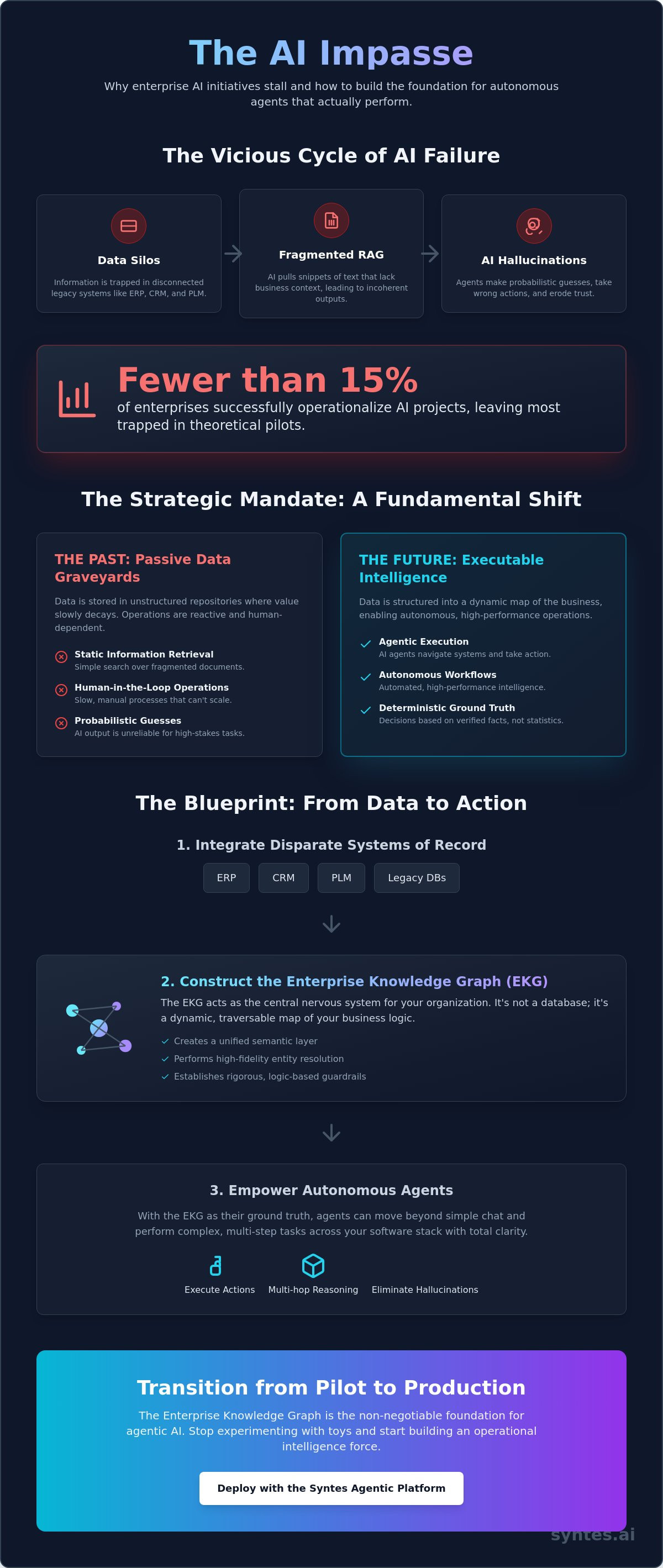
Passive data lakes have become the digital graveyards of the modern corporation. For years, enterprises poured petabytes into unstructured repositories, hoping that sheer volume would eventually yield insight. That era is over. In 2026, the competitive divide is no longer defined by how much data you store, but by how effectively your data can think. We’ve reached a critical tipping point where human-in-the-loop operations are too slow to compete. The transition to agent-led operations requires a fundamental shift from static information retrieval to active, executable intelligence.
At the heart of this evolution is the Knowledge graph. Unlike traditional relational databases that struggle with complex, interconnected queries, an Enterprise Knowledge Graph (EKG) serves as a dynamic, traversable map of every business entity, relationship, and constraint within your organization. It’s the difference between a list of parts and a functioning engine. While the market for these systems reached $3.47 billion this year, many organizations still rely on consumer-grade chatbots that lack the structural depth required for high-stakes execution. These “wrappers” fail because they lack a grounded understanding of business logic. Reliable AI execution demands enterprise-grade infrastructure that provides a single, high-fidelity version of the truth.
From Information Retrieval to Agentic Execution
Standard AI implementations often rely on probabilistic guesses. This is unacceptable for enterprise workflows. Building an enterprise knowledge graph moves your organization beyond simple search; it provides the essential logic layer for autonomous agents. While Large Language Models (LLMs) provide the linguistic capability, the EKG provides the deterministic ground truth. It acts as a set of rails, ensuring that when an agent makes a decision, it does so based on verified facts rather than statistical likelihoods. The EKG is the central nervous system for the modern autonomous organization, coordinating every pulse of data into a purposeful action.
The Cost of Inaction: Data Silos as a Barrier to AI Scale
Traditional Retrieval-Augmented Generation (RAG) is failing in complex environments. Without a unified semantic layer, RAG systems pull fragmented snippets that lack context, leading to the very hallucinations that stall AI adoption. The hidden operational costs of these fragmented workflows are staggering. When data doesn’t communicate, agents can’t execute. This structural fragmentation is the primary reason why fewer than 15% of enterprise AI projects move beyond the pilot phase. We view building an enterprise knowledge graph as the definitive solution to solving enterprise data silos. It’s a strategic imperative. If your data remains siloed, your AI will remain a toy. If your data is integrated into a high-fidelity graph, your AI becomes an operative force.
Architecting Connectivity: Integrating Disparate Systems into a Unified Semantic Layer
Enterprise data is inherently messy. It lives in fragmented silos across ERP, CRM, PLM, and specialized legacy databases that were never designed to communicate. Most AI initiatives fail because they attempt to bypass this complexity rather than solving it. Building an enterprise knowledge graph requires a fundamental shift in how we approach these disparate systems of record. You cannot simply point an LLM at a database and expect intelligence. You must architect a unified layer that translates technical data into business logic, creating a traversable environment where autonomous agents can operate with precision.
Static data is dead data. In 2026, agentic workflows demand real-time relevance. Moving from batch processing to event-driven graph updates ensures your agents aren’t making decisions based on yesterday’s inventory or last hour’s customer sentiment. This requires a robust knowledge graph architecture designed for high-concurrency access. When dozens of agents query the graph simultaneously to resolve complex supply chain disruptions, the system must maintain sub-second latency and absolute data integrity. Performance is the prerequisite for trust.
Establishing the Semantic Data Layer
The semantic layer is the bridge between raw data and agentic autonomy. It involves defining strict ontologies that govern how entities relate to one another, moving beyond simple key-value pairs to rich, multi-dimensional connections. This layer abstracts the underlying technical complexity, allowing an agent to understand that a “part number” in a PLM system is the same entity as a “SKU” in an ERP. Implementing a semantic data layer for enterprise is the only way to provide agents with the context they need to navigate unstructured document stores and structured SQL databases with equal fluency.
Cross-System Integration Strategies
Integration is not just about moving data; it’s about preserving lineage and security. Effective building an enterprise knowledge graph relies on connectors that respect existing permissions while enabling cross-platform visibility. Identity resolution is the primary challenge here. A “Customer” in Salesforce must be perfectly reconciled with the same “Customer” in SAP, or the agent’s logic will fracture. We utilize sophisticated middleware to ensure agents operate seamlessly across the entire stack, maintaining a clear audit trail for every action taken. If you’re ready to move beyond fragmented pilots, explore how cross-system integrations can unify your operational intelligence layer today.
- Map: Identify every critical system of record across the enterprise.
- Resolve: Implement entity resolution to unify identities across vendors.
- Sync: Transition to event-driven updates for real-time agent grounding.
- Secure: Maintain granular data lineage and access controls at the graph level.
The Engineering Blueprint: A Step-by-Step Pipeline for Knowledge Extraction and Resolution
Constructing a high-fidelity intelligence layer is a rigorous engineering discipline. It’s the process of refining raw organizational noise into actionable signal. Building an enterprise knowledge graph requires a multi-phase pipeline that ensures every node and edge is grounded in verifiable reality. Without this structural integrity, your AI agents will drift into hallucination; with it, they become precise instruments of execution. This is the blueprint for moving from fragmented data to a production-grade knowledge asset.
The engineering journey follows five critical phases:
- Phase 1: Acquisition and Normalization. Ingesting streams from diverse vendors and standardizing formats to ensure cross-system compatibility.
- Phase 2: Hybrid Extraction. Deploying a combination of traditional NLP for speed and LLMs for deep semantic relationship extraction.
- Phase 3: Resolution and Linking. Identifying duplicate entities and merging them into a single, canonical representation.
- Phase 4: High-Performance Storage. Utilizing graph-native databases optimized for the multi-hop queries agents use to reason.
- Phase 5: Truth Monitoring. Implementing continuous validation loops to detect “truth decay” as business conditions evolve.
Advanced Extraction and Ontological Mapping
Simple Named Entity Recognition (NER) is insufficient for agentic intelligence. You don’t just need to know that “Acme Corp” is a company; you need to understand its specific relationship to your internal projects, legal constraints, and historical performance. We move beyond labels to extract deep semantic relationships. When extraction processes encounter conflicting data, such as different billing addresses in your ERP and CRM, the system applies predefined ontological rules to resolve the discrepancy. Mapping raw data to a formal enterprise ontology ensures that every agent operates within a consistent logical framework, regardless of the data’s origin.
Mastering Entity Resolution at Scale
Entity resolution is the most common failure point in building an enterprise knowledge graph. It’s the technical challenge of recognizing that “The Coca-Cola Company,” “Coca-Cola,” and “Coke” all refer to the same global entity. In an enterprise environment, this requires more than just fuzzy matching. We implement probabilistic matching for initial identification, backed by deterministic overrides for high-stakes data. For instance, financial records require 100% certainty. In cases of high ambiguity, the pipeline triggers a human-in-the-loop review. This hybrid approach ensures the graph remains a reliable source of truth that agents can navigate without fear of logical fractures or identity confusion.
Beyond GraphRAG: Operationalizing Your Graph for Agentic AI Workflows
Retrieval is a passive act. Execution is the goal. Most organizations stop at GraphRAG, using their graph as a sophisticated search index to improve chatbot responses. This is a strategic waste of potential. Building an enterprise knowledge graph is about creating a substrate for action. It’s about moving from “What does the manual say?” to “Execute the reroute based on the current delay.” When you operationalize your graph, you transform it from a reference library into a central command center for autonomous agents. You give the AI the power to navigate your business with the same context as your best human operators.
Integration with action-oriented agentic AI platforms enables end-to-end automation. Consider a complex supply chain disruption. A knowledge-grounded agent doesn’t just flag a delay; it executes a solution. It identifies a port strike, traverses the graph to find alternative logistics providers already vetted in the system, and checks current contract terms. It verifies available inventory in secondary warehouses and executes new shipping orders across your ERP and TMS. This level of autonomy is only possible when the agent is grounded in a high-fidelity knowledge graph.
Grounding Agentic Workflows in Truth
Agents are prone to probabilistic drift. They guess. A knowledge-grounded agent doesn’t guess; it verifies. By forcing agents to validate every premise against the graph before taking action, you effectively eliminate the risk of hallucination. This creates “explainable” AI. You can trace an agent’s logic through specific graph relationships, seeing exactly why it prioritized one supplier over another. Security isn’t an afterthought. We embed permissions directly into the graph schema, ensuring agents only access and act upon data they’re authorized to see. This ensures that autonomous actions remain within the bounds of corporate governance.
Enabling Multi-Hop Reasoning
Keyword search finds documents. Relational traversal finds solutions. Multi-hop reasoning allows an agent to connect disparate facts across the entire enterprise stack. For example, ‘Supplier A’ is delayed, which impacts ‘Product B’ in ‘Region C’. A standard AI might just report the news. A graph-powered agent sees the connection, calculates the revenue risk, and initiates a mitigation plan. A precise knowledge graph implementation is the key to multi-step agentic logic. It provides the map that allows agents to reason through complex, cascading dependencies that traditional databases simply cannot represent.
If you’re ready to move beyond passive insights and empower your AI to take meaningful action, it’s time to bridge the gap between data and execution. Explore how the Syntes Agentic Platform unifies your knowledge graph with an action-oriented framework to drive total operational clarity.
Institutionalizing Intelligence: Scaling, Governance, and the Syntes Agentic Platform
Transitioning from a successful pilot to a production-grade enterprise infrastructure is the ultimate test of organizational maturity. Many initiatives stall here. They fail because they treat the graph as a one-time project rather than a living, breathing asset. Building an enterprise knowledge graph at scale requires more than just technical ingestion; it demands a robust framework for automated schema evolution and active data decay management. As business logic shifts and new systems are integrated, the graph must evolve without breaking the logic of the agents that depend on it. This is the difference between a brittle prototype and a resilient intelligence layer.
Scaling AI initiatives without the limitations of consumer-grade tools requires a shift in perspective. You aren’t just managing data; you’re managing the cognitive foundation of your business. The Syntes approach focuses on total operational clarity by unifying the knowledge graph with a native agentic framework. This ensures that as your data grows in complexity, your agents’ ability to act remains precise and governed. We provide the tools to transition from passive observation to active, automated performance across the entire enterprise stack. It’s the only way to maintain a competitive edge as the speed of business continues to accelerate.
Governance for the Autonomous Era
Who owns the truth? In an agentic enterprise, data ownership and stewardship are strategic imperatives. Implementing regular knowledge audits ensures that your graph remains the single source of truth, free from the drift and corruption that plague unmanaged systems. You must balance the inherent flexibility of a graph with the rigid requirements of enterprise compliance. We embed these governance protocols directly into the architecture, allowing for autonomous execution that respects every legal and operational constraint. It’s about building trust into the machine so you can scale with confidence.
The Syntes Agentic Platform Advantage
The Syntes Agentic Platform is designed to bridge the gap between static knowledge and autonomous action. We integrate cross-system data into an actionable EKG out of the box, removing the friction that typically derails building an enterprise knowledge graph. Our platform deploys agents that are natively grounded in your unique enterprise knowledge, allowing them to reason and execute with high accuracy. You stop “building a graph” and start “running an agentic enterprise.” This is the future of operational intelligence: a system where data doesn’t just sit in a lake, but powers every decision and action in real-time. Discover how the Syntes Agentic Platform transforms enterprise data into autonomous action and secure your place in the autonomous era.
The Future of the Autonomous Enterprise
The era of experimental AI pilots has reached its end. In 2026, the distinction between market leaders and laggards is defined by the fidelity of their operational intelligence. We’ve established that building an enterprise knowledge graph is not merely a data project; it’s the construction of a central nervous system for your autonomous workforce. You must move beyond the limitations of simple retrieval. You must embrace a system capable of multi-hop reasoning and deterministic action across your entire software stack. The transition from passive observation to active, automated performance is no longer optional for the global enterprise.
Syntes AI provides the enterprise-grade infrastructure necessary to bridge the gap between fragmented legacy systems and agentic workflows. Our platform delivers deep cross-system integration capabilities that align with the rigorous 2026 market standards discussed throughout this roadmap. It’s time to stop observing your data and start executing upon it with total precision. Scale your AI strategy with the Syntes Agentic Platform today. The path to total operational clarity is open to those bold enough to architect it.
Frequently Asked Questions
What is the difference between a data lake and an enterprise knowledge graph?
How long does it typically take to build a production-ready enterprise knowledge graph?
Deploying a production-grade system usually requires six to twelve months of engineering and integration. While initial pilot phases can demonstrate value in eight to twelve weeks, the full normalization of complex legacy systems takes longer. Building an enterprise knowledge graph at scale is a strategic journey that requires iterative refinement of ontologies and entity resolution pipelines.
Can we build a knowledge graph if our data is largely unstructured?
How does a knowledge graph specifically prevent AI hallucinations?
The graph provides a deterministic ground truth that replaces probabilistic guessing. Before an agent executes a task or provides an answer, it must verify the underlying facts against the graph’s validated nodes and edges. This grounding ensures that the AI operates within the bounds of verified reality rather than generating statistical likelihoods that may be false.
What are the most important tools for building an enterprise knowledge graph in 2026?
The 2026 landscape prioritizes interoperability and agentic execution. Essential tools include graph-native databases like Neo4j 6.0 or AWS Neptune, alongside semantic platforms that support emerging standards like YAML-LD 1.0. The most critical component is an agentic framework that can translate these graph relationships into automated cross-system actions.
Do we need a specialized graph database, or can we use a vector database?
You require a specialized graph database to enable multi-hop reasoning and complex relationship traversal. Vector databases are designed for similarity searches, which are useful but insufficient for logic-based autonomy. Only a graph database can map the intricate dependencies and constraints required for an agent to navigate an enterprise software stack safely.
How do we handle data privacy and access control within a unified knowledge graph?
Security is handled by embedding granular access controls directly into the graph schema. This ensures that agents only traverse and interact with nodes they are explicitly authorized to access. By integrating permissions at the data layer, you maintain a unified view of truth without compromising the rigid compliance requirements of the global enterprise.
What is the role of an ontology in building a scalable enterprise knowledge graph?
The ontology acts as the formal blueprint for your organization’s intelligence. It defines the universal rules, entity types, and relationship constraints that govern how data is interpreted. Without a rigorous ontology, building an enterprise knowledge graph results in a chaotic web of nodes that cannot scale or support the multi-step logic required for autonomous agents.