74% of enterprises are currently managing over 5 petabytes of unstructured data, yet a mere 11% have successfully moved AI agents into full production workflows. This discrepancy highlights a critical systemic failure. You’ve likely seen your agents hallucinate because they lack access to the ground truth buried in PDF contracts, while your relational databases remain isolated behind rigid, high-cost ETL pipelines. It’s frustrating to watch AI initiatives stall at the pilot stage because the underlying data remains siloed and unintelligible to the models meant to use it.
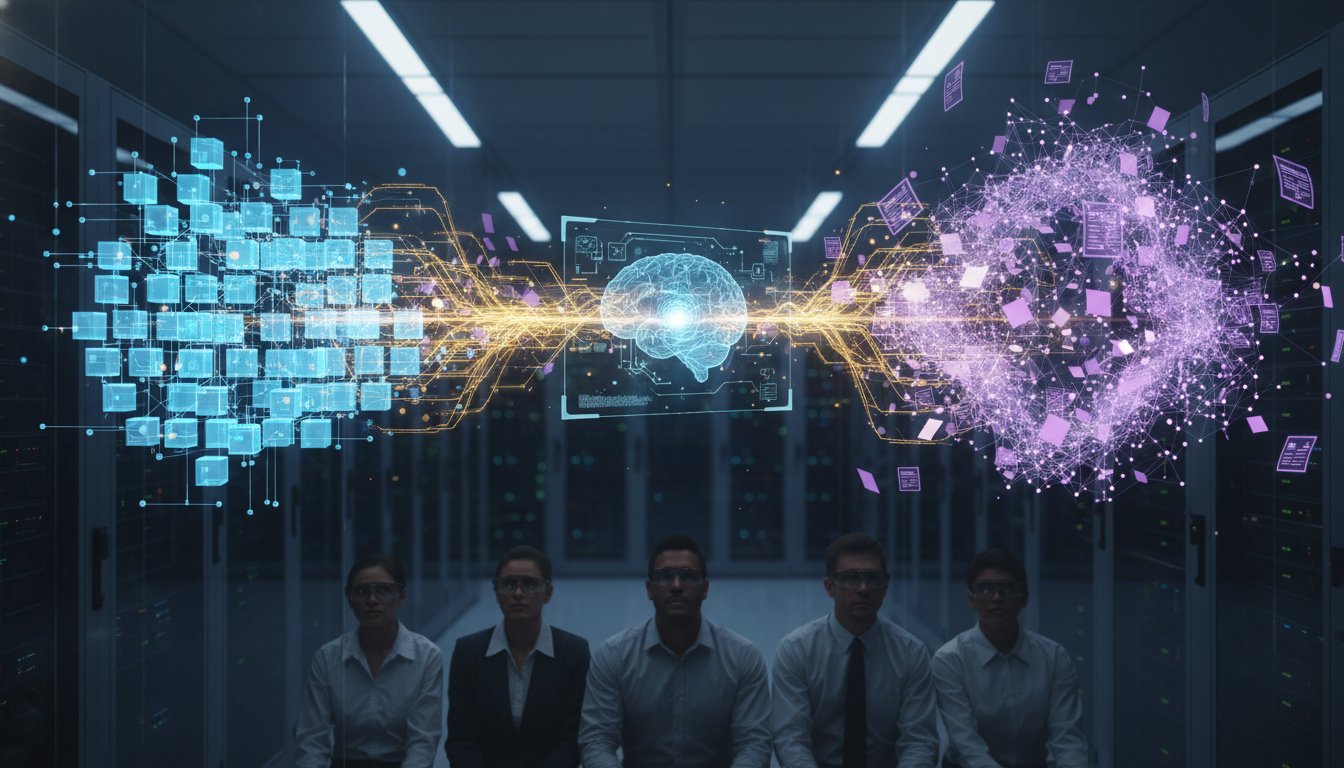
Mastering the architectural shift to unifying structured and unstructured data is no longer optional for the modern enterprise. We will demonstrate how to move beyond simple RAG chatbots by implementing a semantic layer that serves as a universal translator. This article provides a comprehensive blueprint for building a single source of truth, enabling autonomous AI agents to navigate complex systems with precision. You’ll learn how an Enterprise Knowledge Graph transforms passive data storage into an active, operational intelligence engine that reduces latency and drives decisive action across your entire landscape.
Key Takeaways
- Identify why traditional RAG systems fail by ignoring the relational context found in structured databases, leading to high hallucination rates in enterprise AI.
- Master the architectural shift of unifying structured and unstructured data to create a semantic bridge that serves as a single source of truth.
- Execute a five-step framework for entity extraction and semantic grounding to map complex enterprise logic into a machine-readable format.
- Transition from passive retrieval to active execution by enabling AI agents to perform transactions across your entire data landscape.
- Deploy the Syntes Agentic Platform to integrate cross-system data in real-time, eliminating the need for manual ETL pipelines and siloed storage.
The Invisible Wall: Why the Divide Between Databases and Documents Destroys AI ROI
The divide between your relational databases and your document stores is the single greatest inhibitor of enterprise AI performance. While structured databases house your transactional “truth,” research indicates that 80-90% of your operational intelligence is trapped in unstructured data like PDFs, emails, and internal logs. This “dark data” is growing at a rate of 55-65% annually, yet it remains largely invisible to traditional automation. When AI cannot access the full spectrum of your enterprise knowledge, it defaults to guesswork. This isn’t just a technical bottleneck; it’s a strategic failure that destroys the ROI of your most expensive AI initiatives.
Traditional Retrieval-Augmented Generation (RAG) was marketed as the ultimate solution for context. It has failed to deliver. Vector search is excellent at identifying semantically similar text snippets, but it is fundamentally blind to the rigid relational logic of your ERP or CRM. It cannot correlate a specific indemnification clause in a legal contract with a specific line item in a financial ledger. Without unifying structured and unstructured data, your AI agents operate with one eye closed. They may identify the “what” of a transaction, but they inevitably miss the “why” buried in the associated documentation. This fragmentation leads to operational paralysis where human intervention is still required to verify every AI-generated output.
To build autonomous systems that actually work, you must stop treating data as a passive resource. The goal is to evolve into a reasoning engine where the AI doesn’t just “find” information but understands the logic behind it. This requires a shift from simple storage to a semantic unification strategy. Only then can your agents execute complex tasks across your entire enterprise landscape without constant human supervision. Moving from passive observation to active, automated performance is the only way to justify the scale of current AI investments.
The Failure of Traditional ETL in the AI Era
Legacy ETL pipelines are far too brittle for modern intelligence. They were built for static tables, not the messy reality of human language. Moving data through these rigid tunnels causes semantic drift, where original document nuance is stripped to fit a schema. This creates a lethal latency problem. Real-time agentic workflows require immediate context, but slow batch processing leaves agents working with stale information.
The Hallucination Gap: Where Context Goes to Die
When an LLM encounters a data silo, it doesn’t stop; it invents. It may see a structured revenue report but lack the unstructured context of the client negotiation that preceded it. This disconnect forces the model to fill blanks with plausible but incorrect assertions. You must establish a unified ground truth to achieve enterprise reliability. The hallucination gap is the primary barrier to AI agency. Closing it requires an architecture capable of unifying structured and unstructured data into a single, navigable semantic layer.
Beyond the Lakehouse: Architecting a Semantic Bridge for Universal Data Access
Storage is a solved problem. Understanding is not. While industry giants promote the Lakehouse as the final destination for enterprise information, this approach merely centralizes the chaos rather than resolving it. A physical location for data does not provide a logical framework for its use. True operational intelligence requires an architectural shift toward a semantic data layer for enterprise, an abstract mapping that decouples the meaning of your data from its underlying storage format. This bridge allows for agentic reasoning with unified data, enabling models to query disparate systems as if they were a single, coherent brain.
The core of this architecture is the Enterprise Knowledge Graph. By unifying structured and unstructured data through a graph-based model, you create a digital twin of your enterprise logic. This isn’t just about cataloging files; it’s about synthesizing metadata to turn passive repositories into active intelligence drivers. You don’t need massive, high-risk data migrations. You need a semantic layer that understands how a specific row in a SQL database relates to a nuanced clause in a legal contract. This integration enables cross-system visibility without the latency and loss of context inherent in legacy pipelines.
Knowledge Graphs serve as the universal translator. They map the complex relationships between your assets, people, and processes, providing the grounding that AI agents require to function autonomously. Without this semantic bridge, your AI is simply guessing based on proximity. With it, your AI executes based on logic.
Knowledge Graphs vs. Data Fabrics
Choosing between a Data Fabric vs Knowledge Graph architecture is a pivotal decision for AI scalability. While fabrics focus on data access, Knowledge Graphs focus on data relationships. By representing entities like Customers, Orders, and Contracts as nodes and their interactions as edges, you provide AI agents with a roadmap of real-world business logic. This structural clarity allows agents to navigate complex cross-system environments with a level of precision that flat files can never offer.
The Master Data Management (MDM) Evolution
Legacy MDM strategies often stall because they focus exclusively on structured Golden Records. Today, unifying structured and unstructured data redefines Master Data Management. We are moving beyond simple record matching toward Semantic Truths that encompass the full context of an entity. This evolution ensures that data governance remains intact across disparate systems while providing the grounding necessary for autonomous agents to execute high-stakes transactions. If your current architecture cannot bridge this divide, it’s time to explore how an Enterprise Knowledge Graph can stabilize your AI foundation.
A 5-Step Framework for Unifying Disparate Data Sources
Execution requires a definitive roadmap. Moving from siloed storage to a unified semantic layer isn’t a single event; it’s a strategic architectural evolution. The process of unifying structured and unstructured data demands a shift in how you define, connect, and govern your information assets. To build agents that actually perform, you must move beyond simple ingestion and toward active orchestration.
- Step 1: Entity Extraction and Ontology Mapping. Define the core concepts that span your systems. Use Natural Language Processing (NLP) to identify names, dates, and technical terms within your documents and map them to a central, logical framework.
- Step 2: Implementing Semantic Grounding. This is the glue of your architecture. Connect unstructured text mentions directly to structured database IDs, ensuring your AI knows that a “service agreement” in a PDF refers to the exact “Contract_ID_402” in your ERP.
- Step 3: Activating Metadata. A passive list of files is a liability. Utilize your Enterprise Data Catalog to transform static descriptions into active discovery drivers that fuel AI reasoning.
- Step 4: Cross-System Orchestration. Deploy the middleware necessary for bi-directional communication. Your AI agents must be able to read a contract clause and immediately trigger an update in a separate financial system.
- Step 5: Continuous Feedback Loops. Knowledge isn’t static. Allow your agents to refine the Enterprise Knowledge Graph through operational experience, correcting misclassifications and updating relationships as they execute tasks.
Mapping Meaning Across Silos
Identity resolution is the silent killer of AI projects. When “Syntes Corp” in an email is treated as a different entity than “Syntes Inc.” in a database, your agent’s logic collapses. You must employ sophisticated NLP techniques to resolve these identity conflicts in real-time. This ensures a consistent view of the customer or product across every silo. You must prioritize ontology over schema as a core principle to maintain logical flexibility.
Governance and Security in Unified Environments
Unification shouldn’t mean a sacrifice in security. Maintaining Role-Based Access Control (RBAC) is critical when unifying structured and unstructured data via a semantic layer. If a user doesn’t have permission to see a specific database row, the AI agent shouldn’t be able to “read” that context through an associated document. Data lineage is equally vital. You must be able to track exactly how an AI agent reached a specific conclusion, providing a clear audit trail for compliance. Automated policy enforcement ensures that your unified data streams remain secure without slowing down operational speed.
From Passive Insight to Active Agency: Fueling AI Agents with Unified Context
Unification is the non-negotiable prerequisite for Agentic AI Platforms. Without a coherent logical framework, an agent is simply a chatbot with a longer prompt. True agency requires the ability to move from passive observation to active execution across your entire enterprise. This transition is only possible when you solve the challenge of unifying structured and unstructured data, providing agents with the deterministic grounding they need to perform high-stakes tasks. If your data remains fragmented, your agents will remain stagnant, trapped in a loop of retrieval without the ability to reason or act.
Operational intelligence demands real-time relevance. In an agentic workflow, data must be accessible and actionable in milliseconds, not hours. When an agent receives an unstructured trigger, such as a complex customer dispute via email, it doesn’t have time for a batch process to run. It must instantly correlate that email with structured billing records and contract terms to resolve the issue. Industry benchmarks indicate that enterprises utilizing a unified semantic data layer for enterprise can reduce AI reasoning time by up to 40% by eliminating the “search and verify” latency inherent in siloed systems.
The Anatomy of an Agentic Workflow
An effective agent uses the Enterprise Knowledge Graph as its central nervous system. It navigates from an unstructured input, like a specific request in a support ticket, to the structured reality of your ERP or billing system. This isn’t just about finding text; it’s about reasoning through the relationships between entities. Unified data is the only cure for agent stagnation. It allows the system to move from “What does the document say?” to “What action must I take in the database based on this document?”
Comparing RAG vs. Agentic Knowledge Graphs
Traditional Retrieval-Augmented Generation (RAG) is insufficient for high-stakes enterprise decisions. While vector search is useful for basic information retrieval, it lacks the structural integrity required for operational intelligence. The following table highlights why a semantic approach is necessary for true agency.
| Feature | Vector Search (RAG) | Semantic Knowledge Graph |
|---|---|---|
| Accuracy | Probabilistic (Hallucination risk) | Deterministic (Ground truth) |
| Cost | Scales with token/compute usage | Scales with logic complexity |
| Complexity | Surface-level associations | Deep structural reasoning |
| Goal | Information Retrieval | Operational Intelligence |
Moving beyond simple chatbots requires a platform capable of unifying structured and unstructured data to drive autonomous performance. You can witness this transition in action by exploring how the Syntes Agentic Platform orchestrates complex workflows across disparate systems.
Implementing the Syntes Agentic Platform for Real-Time Data Unification
Legacy data migrations are the graveyard of enterprise innovation. Traditional approaches require years of high-risk refactoring that often fail before they deliver value. The Syntes Agentic Platform bypasses this systemic risk by unifying structured and unstructured data at the semantic level, allowing you to connect disparate systems without invasive infrastructure overhauls. We don’t move your data; we make it intelligible to your AI agents in its original location.
Moving from a pilot to a fully scaled agentic enterprise requires infrastructure that is built for execution, not just experimentation. Our platform provides the necessary middleware to orchestrate these complex workflows at scale, ensuring that your AI initiatives grow from isolated chatbots into a coordinated network of autonomous performers. We provide the technical justification for your AI strategy by delivering immediate, measurable utility across every department.
The Syntes Knowledge Graph Advantage
Our “ground truth” architecture is specifically designed to solve the hallucination problem that plagues generic AI implementations. By facilitating the deployment of an Enterprise Knowledge Graph, we provide your agents with a deterministic framework for reasoning. This isn’t a probabilistic guess; it’s a logical certainty based on the synthesized relationships between your data points. Our “Zero-to-Agent” timeline accelerates your unification ROI, moving you from raw data silos to active agency in a fraction of the time required by traditional methods.
Your Roadmap to Operational Clarity
For CIOs and technical leaders, the path forward is clear. You must begin by auditing your current data silos and identifying high-value targets where unifying structured and unstructured data will drive the greatest immediate impact. This isn’t a task for general IT staff; it requires a strategic partner who understands the intersection of systems architecture and autonomous intelligence. We invite you to move beyond the limitations of legacy storage and embrace a future of total operational clarity. The transition to a reasoning-based enterprise starts with a single strategic decision. Schedule a strategy session with Syntes AI to architect your agentic foundation today.
The Future of the Agentic Enterprise
The era of siloed experimentation is over. 2026 demands a decisive shift from passive data retrieval to active operational intelligence. By unifying structured and unstructured data, you eliminate the hallucination gap and provide your AI agents with deterministic grounding. This isn’t just about better search; it’s about building a digital twin of your enterprise logic that enables autonomous execution across every system.
Success belongs to organizations that stop treating data as a resource and start treating it as a reasoning engine. Our proprietary Enterprise Knowledge Graph infrastructure and Syntes Agentic Platform provide the foundation for this transition. We offer seamless cross-system AI integration that connects your legacy and cloud environments into a single, actionable intelligence layer designed for autonomous performance.
Architect your Agentic Enterprise with Syntes AI. The tools for total operational clarity are within reach. It’s time to act.
Frequently Asked Questions
What is the main difference between structured and unstructured data in 2026?
Structured data resides in fixed formats like SQL databases with rigid schemas. Unstructured data, including PDFs and emails, lacks a predefined model and accounts for 80% to 90% of all enterprise information. In 2026, the real difference lies in accessibility. While structured data is easily queried, unstructured data remains “dark” and unusable for automation without a sophisticated semantic layer to interpret its meaning.
How does unifying structured and unstructured data prevent AI hallucinations?
Hallucinations occur when models lack deterministic grounding and fill context gaps with probabilistic guesses. Unifying structured and unstructured data provides a verified ground truth by anchoring document context to database records. This architecture forces AI agents to reason based on established relationships rather than statistical likelihood, ensuring that every output is cross-referenced against your actual enterprise logic.
Can I unify my data without moving it into a single data lake?
Yes, unification is a logical mapping challenge rather than a physical storage requirement. You don’t need invasive migrations. By implementing a semantic layer, you create a virtualized view across your existing disparate systems. This approach allows you to connect siloed information in real-time, providing a unified context for autonomous agents without the high risk and latency associated with traditional data consolidation projects.
What role does a Knowledge Graph play in data unification for AI?
A Knowledge Graph serves as the universal translator for your enterprise. It maps complex business relationships as nodes and edges, creating a digital twin of your operational logic. This structure is essential for unifying structured and unstructured data because it allows AI to navigate seamlessly from a text based contract to a specific database ID. It provides the structural integrity that flat vector stores simply cannot offer.
How much does it cost to implement a semantic data layer?
Implementation costs depend entirely on the scale of your data estate and the complexity of your business ontologies. Rather than seeking a generic price point, focus on the operational ROI of reducing data to decision latency. Technical leaders should evaluate the long term savings gained by eliminating manual ETL pipelines and reducing the human intervention required to verify AI outputs. Consult with an expert to determine your specific architectural needs.
Is it possible to unify data from legacy ERP systems with modern cloud documents?
Absolutely. Cross-system integration is a fundamental requirement for modern agentic workflows. Sophisticated platforms use specialized connectors to bridge the gap between on-premise relational databases and cloud native document stores. This ensures your agents have a comprehensive view of the enterprise. You can successfully link legacy transactional data with the nuanced context found in modern digital communications to drive autonomous performance.
How do AI agents use unified data differently than standard chatbots?
Standard chatbots are limited to passive information retrieval. AI agents, however, are designed for autonomous execution. Unifying structured and unstructured data enables an agent to identify a trigger in a document and immediately execute a corresponding transaction in a database. This shift from simple observation to active, cross-system performance is what transforms a basic tool into a powerful operational asset.
What are the security risks of unifying all enterprise data for AI access?
The primary risk is the potential for unauthorized access to sensitive context through the AI interface. You must maintain strict Role-Based Access Control (RBAC) at the semantic level to prevent information leakage. It is critical to ensure data lineage and automated policy enforcement. These safeguards guarantee that agents only access the specific information they are permitted to see while performing their assigned tasks across the unified landscape.