
In 2026, a data catalog without a knowledge graph is little more than a digital graveyard for metadata. You’ve likely spent millions cataloging tables and schemas, yet your AI agents continue to produce “plausible nonsense” because they lack fundamental business context. It’s a systemic flaw. An enterprise data catalog with knowledge graph is no longer optional; it’s the mandatory evolution for any organization serious about autonomous operations. You’re likely struggling with metadata silos that offer an inventory but no intelligence, leaving your AI grounded in nothing but raw, disconnected strings.
We agree that manual overhead in maintaining data relationships across disparate ERP and CRM systems is unsustainable. This article promises a roadmap to transform passive metadata into an actionable semantic layer. You’ll learn how an Enterprise Knowledge Graph provides the business logic necessary for the Syntes Agentic Platform to execute complex tasks with certainty. We will preview the transition from simple inventory to real-time, cross-system integrations that actually work. The goal is total operational clarity. We are moving beyond theoretical experimentation into the era of active, automated performance.
Key Takeaways
- Identify why traditional “passive” catalogs fail to support modern AI agents by leaving metadata trapped in isolated, context-free silos.
- Transition from flat table schemas to multi-dimensional ontologies that map real-world business logic directly into your data architecture.
- Scale your operations effectively by deploying an enterprise data catalog with knowledge graph to manage high-velocity data across complex, multi-cloud environments.
- Eliminate AI hallucinations by implementing GraphRAG, grounding your autonomous agents in a verifiable semantic “ground truth” derived from your knowledge graph.
- Bridge the gap between static inventory and autonomous execution by integrating the Syntes Agentic Platform with your semantic data layer.
Beyond Inventory: Why Traditional Data Catalogs Fail the AI Era
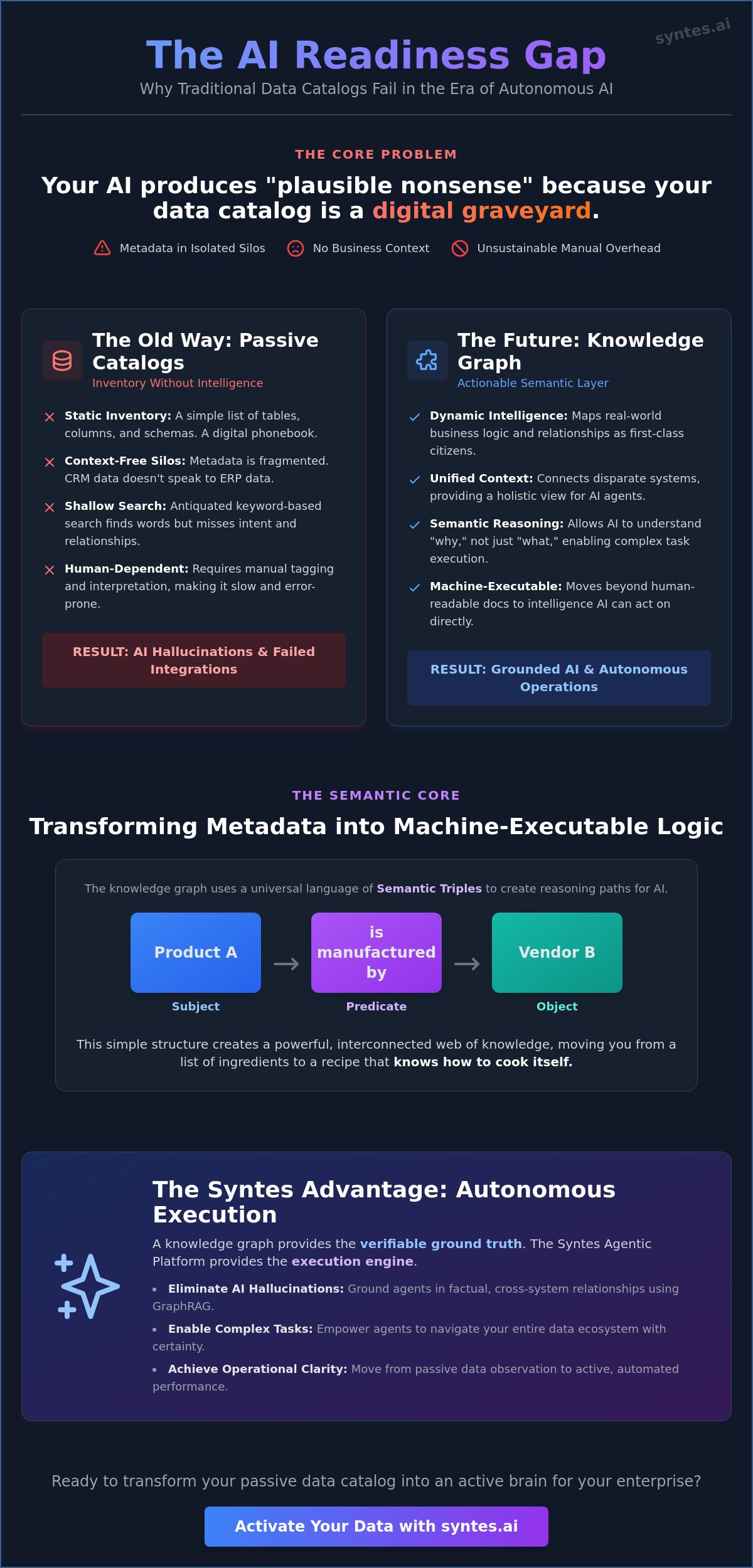
Traditional data catalogs have become liabilities. They function as passive repositories; static inventories that list tables, columns, and schemas without a shred of operational context. This is the “Passive Catalog” trap. While these tools served human data stewards in the past, they’re fundamentally incompatible with the 2026 requirements of autonomous enterprise AI. An AI agent doesn’t care about a table’s location if it doesn’t understand the table’s purpose. It requires a semantic layer to navigate the complex business logic buried within your systems. It’s a systemic failure that most organizations are only now beginning to realize.
The transition from human-readable documentation to machine-executable intelligence is the only path forward. If your metadata is merely a list of assets, your AI will inevitably hallucinate. It’s a simple equation. Poor grounding equals poor execution. To solve this, the modern enterprise data catalog with knowledge graph must act as more than a search engine; it must function as the brain of the enterprise. It must move beyond observation into the realm of active, automated performance.
The Metadata Silo Problem
Fragmented metadata is the silent killer of AI ROI. In a multi-cloud environment, data exists in a state of perpetual isolation. Your CRM doesn’t speak to your ERP. Your marketing logs are disconnected from financial projections. This fragmentation prevents cross-system AI integration because the agents have no map to follow. Keyword-based search is an antiquated solution for a high-velocity problem. It’s too shallow. It finds words but misses intent. When an AI produces “plausible nonsense,” it’s usually because it lacks a unified knowledge graph to ground its reasoning in factual, cross-system relationships.
Inventory vs. Intelligence
There’s a vast gap between knowing data exists and knowing what it means. An inventory tells you that you have a “Customer” table. Intelligence tells you how “Customer” relates to “Lifetime Value,” “Churn Risk,” and “Current Contract Status” across three different platforms. Traditional discovery tools lack this business logic layer, making autonomous decision-making impossible. Consider the limitations of a static list:
- Contextual relevance: Static lists provide no clues about how data entities interact across different business units.
- Business logic: Traditional tools ignore the actual rules and constraints that govern how data is used in real-world operations.
- Real-time utility: A list is out of date the moment it’s published. A living data map evolves with your architecture.
2026 enterprises require a dynamic, multi-dimensional view of their assets. You don’t need a phonebook. You need an enterprise data catalog with knowledge graph that understands the “why” behind the “what.” This is the only way to achieve total operational clarity and build a reliable foundation for agentic orchestration.
The Semantic Core: How Knowledge Graphs Transform Metadata into Logic
Logic is the new data. Raw tables are obsolete. An enterprise data catalog with knowledge graph functions by embedding a semantic layer directly into your metadata framework, effectively mapping the complex relationships between disparate entities. It moves your architecture away from flat, disconnected schemas toward multi-dimensional ontologies that reflect the messy reality of global operations. This isn’t just a different way to store data; it’s a different way to define it. By treating relationships as “first-class citizens,” you enable a system that discovers connections automatically rather than relying on manual, error-prone tagging.
The technical foundation of this intelligence lies in semantic triples: Subject-Predicate-Object. This structure creates a universal language for AI agents. When a system understands that “Product A” (Subject) “is manufactured by” (Predicate) “Vendor B” (Object), it gains more than a data point; it gains a reasoning path. This allows for autonomous discovery that spans the entire organization. It’s the difference between a list of ingredients and a recipe that knows how to cook itself. If you want to move from passive observation to active execution, your metadata must speak the language of logic.
Ontology: The DNA of Enterprise Data
Generic metadata tags are a weak solution for a complex problem. They lack the precision required for high-stakes decision-making. Custom ontologies, however, provide the specific DNA of your business, mapping the intricate web between customers, products, and supply chain events with surgical accuracy. They don’t just categorize data; they define its behavior. Ontologies serve as the connective tissue that binds disparate data points into a coherent, machine-readable map of enterprise reality. Without this structural clarity, your AI is essentially flying blind. For those ready to lead, deploying a sophisticated Enterprise Knowledge Graph is the definitive step toward architectural maturity.
Bridging Structured and Unstructured Data
Most enterprise intelligence is trapped in unstructured formats like PDF contracts, emails, and technical manuals. Traditional catalogs ignore these assets, creating a massive blind spot. Knowledge graphs solve this by unifying unstructured content with structured SQL databases through semantic enrichment. By extracting entities and relationships from documents and linking them to your core data, you make the “dark data” of your organization fully queryable and actionable. Organizations serious about this challenge should explore the architectural blueprint for unifying structured and unstructured data to enable autonomous agents to navigate complex systems with precision. This integration is critical for linking enterprise knowledge graphs to broader organizational goals. It ensures that every piece of information, regardless of its source, contributes to a single, unified truth. This isn’t a luxury; it’s the baseline for any organization that intends to survive the transition to agentic AI.
Passive Catalogs vs. Knowledge Graph-Powered Frameworks
Traditional catalogs are obsolete. They function as digital phonebooks; they list assets without understanding their utility. This passive approach relies on simple string matching, where a search for “revenue” only returns tables containing that specific sequence of characters. It’s a shallow solution for a deep problem. An enterprise data catalog with knowledge graph operates on a different plane of intelligence. It utilizes semantic reasoning to understand that “revenue,” “turnover,” and “top-line growth” are conceptually linked across your CRM and ERP systems. It doesn’t just find data; it interprets it.
Scalability is the primary differentiator. Relational catalogs frequently buckle under the weight of high-velocity, high-variety data common in modern multi-cloud environments. Knowledge graphs thrive in this complexity. While traditional systems require rigid schemas that break when new data sources are introduced, graph-based frameworks are inherently flexible. They allow AI agents to navigate the data landscape without human intervention, identifying relevant nodes and edges in real-time. This automation is the only way to move from discovery to execution at enterprise scale.
The Architecture of Action
The data fabric vs knowledge graph debate often misses the critical point of agentic utility. A data fabric focuses on delivery; a knowledge graph focuses on reasoning. With cloud-based solutions accounting for 80.55% of the market share as of 2025, the challenge isn’t just moving data, but understanding it in transit. Maintenance overhead is where the passive model fails most spectacularly. Manual tagging is a death march for data teams. KG-powered catalogs utilize automated graph inference to maintain themselves, ensuring that your data map evolves as fast as your business logic.
ROI Comparison for the MOFU Decision Maker
Time-to-insight is the metric that matters. Semantic layers drastically accelerate data engineering workflows by removing the need for manual join-mapping and complex SQL reconstruction. The financial risk is equally significant. Reducing the “plausible nonsense” produced by ungrounded LLMs isn’t just a technical goal; it’s a risk mitigation strategy. If your AI makes a billion-dollar decision based on a misunderstood relationship, the cost of a passive catalog becomes clear. Future-proofing your architecture requires this shift. A KG-powered catalog is the non-negotiable prerequisite for deploying agentic AI platforms. It’s the difference between an organization that observes its data and one that activates it.
Grounding the Future: Eliminating AI Hallucinations with Graph RAG
Standard Retrieval-Augmented Generation (RAG) is failing the enterprise. It relies on vector similarity, a probabilistic guess that two chunks of text are related because they share mathematical proximity. In a high-stakes corporate environment, “similar” is a dangerous metric. You don’t need a guess; you need a fact. An enterprise data catalog with knowledge graph replaces this guesswork with a deterministic foundation. By using the knowledge graph as your “Ground Truth,” you ensure that your Large Language Models (LLMs) are anchored in factual, structured reality rather than statistical probability. This shift from probabilistic guessing to deterministic retrieval via SPARQL or GraphQL is the only way to eliminate hallucinations at scale.
Real-time verification is the next frontier for operational intelligence. When an AI agent needs to confirm a credit limit, a supply chain lead time, or a contract renewal date, it cannot rely on a cached vector. It must query the catalog to verify facts across disparate systems instantly. This ensures that every response is grounded in the current, live state of the business—a process that often requires integrating external market intelligence from Pulse Newswire to maintain global context. It transforms the catalog from a passive index into an active verification engine. If your AI cannot verify its own claims against your core systems, it is a liability, not an asset.
The Mechanics of Graph-Augmented Generation
Vector databases are inherently blind to the “Global Context” of your organization. They see snippets of data in isolation; they don’t see the systemic relationships that define your business. Knowledge graphs provide the structural map that links these snippets into a coherent whole, allowing for Graph-Augmented Generation (GraphRAG) that respects the complex hierarchies of your data. By mapping every entity and relationship, Graph RAG ensures AI agents respect business constraints and logical dependencies by providing a rigid framework for data retrieval. This level of structured semantic grounding is what separates a toy chatbot from a reliable enterprise tool. It is the mandatory architecture for any organization that values model reliability over “plausible nonsense.”
Agentic Workflows and Data Navigation
The catalog must evolve from a passive library for humans into a navigation system for machines. AI agents must “self-discover” the specific data they need for a task without constant human intervention. This requires an enterprise data catalog with knowledge graph that doesn’t just store metadata but governs it. The catalog acts as the authoritative gatekeeper, ensuring that agents respect data privacy and access levels while executing autonomous cross-system tasks. Moving from passive search to autonomous execution requires this level of systemic integration. To deploy a reliable, hallucination-free AI strategy, you must activate your metadata with the Syntes Agentic Platform.
The Syntes Advantage: Activating Your Data Catalog via Agentic Orchestration
Passivity is an architectural choice. Most enterprises choose to leave their data dormant in silos that offer inventory but no intelligence. Syntes AI identifies this systemic flaw and provides the definitive resolution. By deploying an enterprise data catalog with knowledge graph through the Syntes Agentic Platform, organizations move beyond simple discovery. We unify complex, multi-cloud data into a structured, actionable format. This allows autonomous agents to navigate and execute tasks without human oversight. It’s the transition from passive observation to active, automated performance.
The Syntes Knowledge Graph serves as the essential infrastructure for 2026 enterprise AI. It provides the deterministic grounding required for agents to perform without the risk of hallucination. We don’t just provide a tool; we deliver the systemic integration necessary for a truly autonomous enterprise. This is the definitive solution for leaders who value clarity and efficiency over experimental theory. If your metadata isn’t machine-executable, it’s a liability.
From Discovery to Execution
Agents must do more than find data; they must act on it across the entire software stack. Syntes reduces the time from initial data cataloging to full operational automation by providing a ready-to-use semantic layer. We specialize in modernizing legacy ERP and CRM data, transforming antiquated silos into the high-octane fuel required for agentic workflows. This isn’t a theoretical upgrade. It is a fundamental re-architecture of how business logic is applied to digital assets, an approach mirrored by Adrenalizing Media Network in its creation and distribution of AI-driven music and video projects. Our Cross-System Integrations ensure that data remains relevant and actionable in real-time, regardless of where it resides. We bridge the gap between knowing data exists and ensuring it performs.
Building Your Agentic Foundation
Organizations must evaluate their readiness for a KG-powered semantic layer now. If your current catalog provides inventory but no context, it is holding your AI strategy hostage. You’re likely managing metadata silos that offer no insight into business logic. This is an operational liability that grows more expensive every day. The transition requires a partner who understands both the messy reality of global systems and the sophisticated tools needed to master them. Upgrading your enterprise data catalog with knowledge graph is the first step toward total operational clarity. It’s time to stop observing your data and start activating it.
Take the decisive step toward autonomous intelligence. Experience the Syntes Agentic Platform and transform your metadata into a strategic execution engine.
Mastering the Semantic Enterprise: From Metadata to Autonomous Action
The age of passive observation has ended. Organizations that persist with static metadata inventories are effectively blinding their own AI initiatives. You’ve seen the cost of “plausible nonsense” and the failure of probabilistic grounding. The transition to an enterprise data catalog with knowledge graph is the only way to secure a deterministic, hallucination-free future for your autonomous agents. It’s a strategic necessity. By embedding a semantic core into your data architecture, you move from simple discovery to real-time, cross-system execution.
Syntes provides the enterprise-grade infrastructure designed specifically for 2026 AI demands. We offer deep cross-system integration capabilities that unify your legacy ERP and CRM data into a single, authoritative truth. This isn’t just an upgrade; it’s a total operational evolution. You have the tools to bring order to the messy reality of global operations. It’s time to activate your data.
Scale your AI initiatives with the Syntes Agentic Platform and ensure your enterprise remains at the forefront of the agentic revolution. The path to total operational clarity starts with informed, decisive action.
Frequently Asked Questions
What is the difference between a standard data catalog and a knowledge graph-powered catalog?
Standard catalogs are passive inventories that list tables and columns without operational context. They rely on simple keyword matching for discovery, which is insufficient for 2026 AI requirements. A knowledge graph-powered catalog is an active semantic map. It treats relationships as first-class citizens, allowing the system to understand the business logic and intent behind the data rather than just its location.
Can we integrate a knowledge graph into our existing data catalog?
Yes, integration is the standard path for architectural evolution. You can overlay a semantic layer on your current metadata repository by mapping existing schemas to a unified ontology. This process transforms your static inventory into a dynamic knowledge base. It’s the definitive way to activate dormant metadata and prepare your infrastructure for agentic orchestration without a complete “rip and replace” of current systems.
How does a knowledge graph help prevent AI hallucinations in enterprise LLMs?
Knowledge graphs provide deterministic grounding through structured, factual relationships. Standard RAG relies on probabilistic vector guesses, which often lead to “plausible nonsense.” By using an enterprise data catalog with knowledge graph, LLMs query specific nodes and edges to retrieve verified facts. This ensures every response is anchored in your organization’s “ground truth” rather than statistical probability.
Do I need a data scientist to maintain a knowledge graph-powered data catalog?
No, you don’t need a dedicated data scientist for routine maintenance. Modern platforms utilize automated graph inference to manage the heavy lifting of relationship mapping. While initial ontology design requires strategic oversight from data architects, the day-to-day evolution of the graph is handled by machine-executable logic. This reduces manual overhead and allows your team to focus on high-level strategic execution.
What is Graph RAG and why is it superior for enterprise AI grounding?
Graph RAG is the integration of knowledge graphs with retrieval-augmented generation. It’s superior because it captures the “Global Context” that vector databases inherently lack. While vector search sees data snippets in isolation, Graph RAG understands the systemic relationships and business constraints governing those snippets. This provides the structural map necessary for AI agents to navigate complex enterprise environments with surgical precision.
How does a knowledge graph-powered catalog handle unstructured data like PDFs?
The system uses semantic enrichment to extract entities and relationships from unstructured formats like PDF contracts or emails. It then links these extracted insights to your structured SQL databases within the graph. This process makes your “dark data” fully queryable and actionable. It ensures that critical business intelligence trapped in documents contributes to the unified truth used by your autonomous agents. Enterprises looking to operationalize this approach at scale will benefit from understanding the full architectural framework for unifying structured and unstructured data for agentic AI across complex, multi-cloud environments.
What are the primary business benefits of a semantic data layer in 2026?
The primary benefits are total operational clarity and the transition from passive observation to active execution. A semantic layer reduces time-to-insight by automating data engineering workflows and join-mapping. It also serves as the mandatory foundation for deploying reliable, agentic AI at scale. In a market where cloud-based solutions dominate, this layer is the only way to maintain a coherent view of a fragmented data landscape.
How do AI agents use a data catalog to perform cross-system integrations?
AI agents use the catalog as a navigation system to “self-discover” the data endpoints they need across disparate ERP and CRM platforms. The enterprise data catalog with knowledge graph provides the semantic map that bridges these systems. This allows agents to identify relevant nodes and execute cross-system tasks autonomously. It eliminates the need for manual, human-led data mapping and speeds up the path to operational automation. Organizations looking to extend this capability should also explore how a knowledge graph for master data management can transform passive records into a living semantic foundation for autonomous agents.