

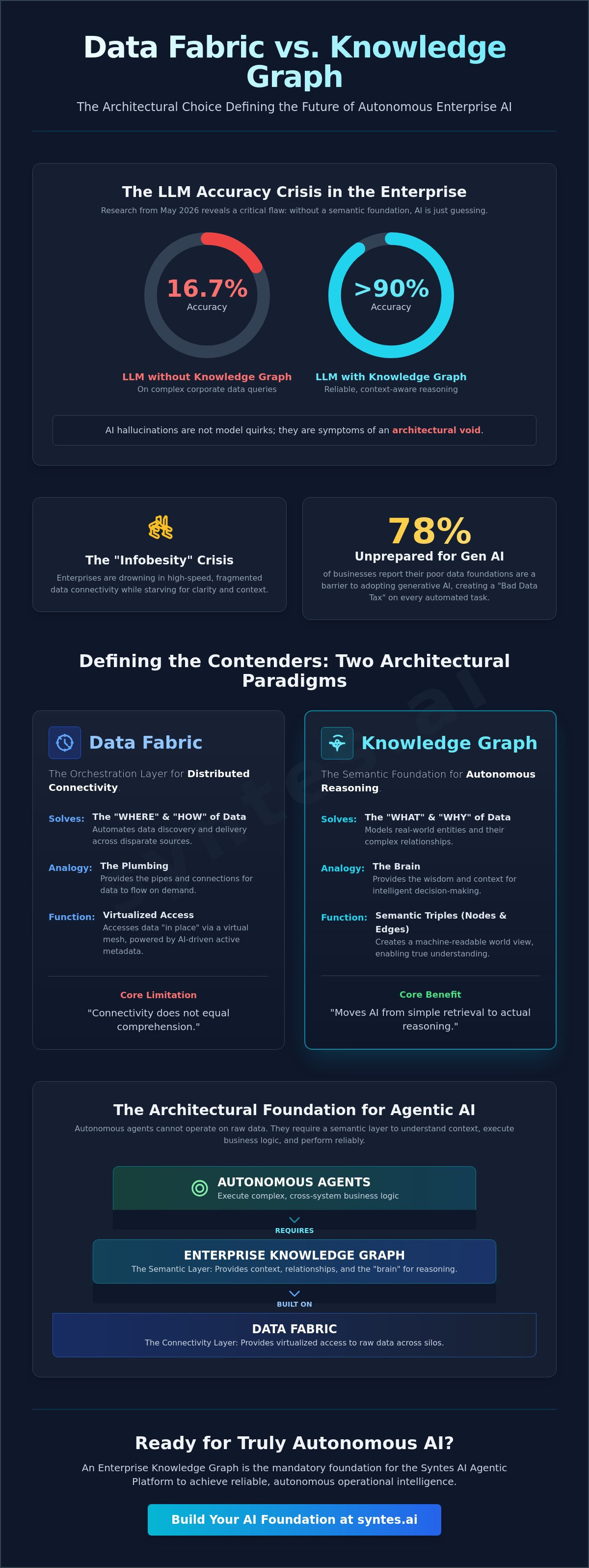
Research from May 2026 reveals a stark reality for the modern enterprise: Large Language Models attempting to navigate corporate data without knowledge graph grounding achieve a dismal 16.7% accuracy rate on complex queries. You’ve likely spent years and millions architecting a data fabric to unify your disparate silos, yet your AI agents still struggle with context and persistent hallucinations. The fundamental debate of data fabric vs knowledge graph isn’t just about technical preference. It’s about whether your AI can actually reason or if it’s simply guessing.
You’ve realized that connectivity alone doesn’t equal intelligence. We’ll show you how to bridge this gap and establish a clear architectural roadmap for 2026 that moves beyond passive observation toward active, automated performance. This analysis promises to help you eliminate manual data mapping and provide the reliable grounding necessary for truly autonomous agents. We’ll examine why a data fabric handles the raw connectivity of your distributed environment while an Enterprise Knowledge Graph provides the essential semantic layer for true operational intelligence.
Key Takeaways
- Recognize why connectivity without context is a strategic failure and why traditional integration methods cannot support autonomous reasoning.
- Map the functional role of the data fabric as a virtualized orchestration layer designed to automate metadata discovery across distributed enterprise silos.
- Resolve the data fabric vs knowledge graph debate by aligning architectural choices with the need for either broad system connectivity or deep semantic understanding.
- Discover how semantic triples create a machine-readable world view, allowing AI agents to move beyond simple chat toward active business logic execution.
- Establish why an Enterprise Knowledge Graph serves as the mandatory foundation for the Syntes AI Agentic Platform to achieve reliable, autonomous operational intelligence.
Beyond the Buzzwords: Why Modern Data Architecture is Failing Enterprise AI
Enterprises are drowning in connectivity while starving for clarity. We call this the “Infobesity” crisis. You’ve spent millions building expansive data lakes and complex integration layers, yet your AI initiatives remain stalled in the pilot phase. Connectivity isn’t intelligence. High-speed access to fragmented data doesn’t equate to automated decision-making. Most modern architectures are built for passive observation, they record what happened but fail to provide the logic for what should happen next. This is the missing link in the enterprise stack.
For leaders ready to move beyond the experimental phase and achieve scalable production results, click here to learn more about transitioning your AI pilots into secure enterprise outcomes.
Traditional data lakes are fundamentally insufficient for the 2026 agentic workflow. They’re static reservoirs. They lack the real-time relevance and systemic integration required for an agent to execute business logic across multiple platforms. This architectural failure creates a “Bad Data Tax” on every automated task. When data is disconnected from its business context, AI agents waste compute cycles processing noise, leading to operational delays and manual intervention. Recent surveys confirm this struggle, 78% of businesses report they’re unprepared for generative AI due to these poor data foundations.
The Hallucination Problem: A Symptom of Architectural Gaps
AI hallucinations aren’t just model quirks; they’re symptoms of an architectural void. LLMs cannot rely on raw data fabrics for enterprise-grade truth because those fabrics often lack a unified semantic layer. Without structured context, cross-system AI integration becomes a game of probability rather than precision. To move your organization from simple “retrieval” to actual “reasoning,” you must provide the AI with a logical framework. It needs to understand the relationships between a customer, a contract, and a product, not just find the documents where those words appear.
Defining the Contenders: Fabric vs. Graph
The industry is currently forcing a definitive choice between two paradigms: data fabric vs knowledge graph. A Data Fabric is essentially a connectivity principle. It creates a virtualized layer over disparate sources to automate discovery and delivery. It’s about the “where” and “how” of data access. In contrast, a Knowledge Graph is a semantic framework. It uses nodes and edges to represent real-world entities and their complex interrelations. It’s about the “what” and “why” of the data. While one optimizes the plumbing, the other provides the brain. Choosing between them determines whether your AI agents will simply search your data or actually understand it.
Data Fabric: The Orchestration Layer for Distributed Connectivity
Connectivity is a solved problem. Modern data fabrics represent the pinnacle of this achievement, acting as a virtualized mesh stretched across your entire technological estate. They don’t move data; they access it “in place.” This architecture eliminates the need for expensive, redundant data movement by providing a unified interface for disparate sources. By 2026, the data fabric market is projected to reach approximately $4.11 billion, driven by the desperate need to unify fragmented ecosystems. It’s the ultimate plumbing for the global enterprise. It solves the “finding” problem with surgical precision, yet it remains fundamentally limited. Connectivity does not equal comprehension.
While a data fabric excels at real-time delivery and automated discovery, it lacks the cognitive depth required for Agentic Enterprise AI. It provides the wires, but not the wisdom. An AI agent can pull a record from a legacy SQL database and a document from a cloud bucket via the fabric, but it won’t inherently understand the logical dependency between them. This distinction is the core of the data fabric vs knowledge graph debate. If your goal is simply to see your data, the fabric is your solution. If your goal is to act on it autonomously, you need more than just a pipe.
The Mechanics of a Modern Data Fabric
The efficiency of this layer relies on AI-driven metadata harvesting. Active metadata catalogs don’t just sit there; they learn. They observe how users query data and automatically optimize access paths. This streamlines legacy system integration by masking the complexity of underlying schemas. Data Fabric is a dynamic orchestration layer that provides a unified, virtualized interface for accessing disparate data sources across the enterprise without requiring physical consolidation. It’s about operational speed and reducing technical debt through sophisticated cross-system integrations.
Ideal Use Cases for Data Fabric Architectures
Does every project need a knowledge graph? No. Data fabrics are the definitive choice for Master Data Management (MDM) and strict regulatory compliance. When you need a “single pane of glass” for auditing or self-service BI tools, the fabric’s ability to unify discovery is unmatched. It’s the right tool when “finding” the data is the primary hurdle. Human analysts can use these fabrics to pull reports in seconds, but remember: a human brings the context. An autonomous agent doesn’t have that luxury. It requires a semantic core that a fabric alone cannot provide. Transforming that metadata into actionable intelligence is precisely what an enterprise data catalog with knowledge graph is designed to achieve. Organizations seeking to elevate their MDM strategy beyond simple connectivity should explore how a knowledge graph for master data management can transform passive records into a living semantic foundation for agentic AI.
Knowledge Graph: The Semantic Foundation for Autonomous Reasoning
Data is a liability if it lacks meaning. While a data fabric connects your systems, an Enterprise Knowledge Graph interprets them. It replaces flat, row-and-column thinking with a machine-readable world view built on nodes, edges, and semantic triples. This is the transition from passive storage to an active knowledge layer. By representing data as a network of relationships, you create a ground truth that AI agents can navigate. The market for these AI-ready foundations is surging, with the Enterprise Knowledge Graph sector projected to reach $1.12 billion in 2026. This architecture doesn’t just store information; it models reality.
The technical superiority of this approach lies in its adherence to W3C standards like RDF (Resource Description Framework) and OWL (Web Ontology Language). These frameworks allow you to define not just what data exists, but how it relates to other entities through complex predicates. In the context of data fabric vs knowledge graph, the graph provides the semantic intelligence that the fabric’s connectivity layer lacks. It enables SPARQL querying capabilities that can traverse multi-hop relationships, something impossible for traditional relational databases or flat file systems.
Semantic Grounding: Eliminating AI Hallucinations
Hallucinations occur when LLMs lack a map. Without grounding, models rely on statistical probability rather than business reality. Research from May 2026 shows that LLMs answering enterprise questions without knowledge graph grounding achieve only 16.7% accuracy on complex queries. When you integrate an Enterprise Knowledge Graph, that accuracy more than triples to 54.2%. This is the power of deterministic logic. By using ontologies to define business rules, you force the AI to reason within your specific operational constraints. Knowledge Graphs provide the structural grounding and logical guardrails required to transform erratic AI responses into reliable agentic workflows.
Cross-System Integration via Knowledge Graphs
Real-world operations don’t happen in a single database. They live in ERP systems, PDF contracts, and Slack threads. A knowledge graph unifies these disparate sources into a cohesive Digital Twin of your enterprise. For organizations utilizing complex platforms like SAP or Databricks, working with a specialist like Kagool ensures these integrations are handled with precision. It allows for sophisticated Cross-System Integrations that link structured transaction data with unstructured context. This enables agents to perform multi-step reasoning, such as dummy identifying a supply chain delay in an ERP and cross-referencing it with force majeure clauses in a legal document. In the evolving landscape of data fabric vs knowledge graph, the graph is what enables the agent to understand the “why” behind the “what.” It turns fragmented data points into a unified, actionable intelligence core.
Strategic Divergence: When to Deploy Data Fabric vs. Knowledge Graph
Strategic priority defines your architectural choice. Enterprise leaders often mistake connectivity for readiness, yet these represent distinct operational outcomes. A data fabric offers horizontal scalability; it connects everything but understands nothing deeply. It’s designed for data democratization. If your primary objective is to provide human analysts with a “single pane of glass” for disparate records, the fabric is your priority. However, if your vision includes autonomous execution and systemic reasoning, the fabric is merely the prerequisite. The strategic tension between data fabric vs knowledge graph isn’t about which is better, it’s about which serves your 2026 AI roadmap.
Context is the currency of the agentic enterprise. While most national organizations eventually adopt a hybrid approach, the sequence of implementation determines your AI’s ROI. Starting with a data fabric helps you find your data, but starting with a knowledge graph helps you use it. Implementation complexity varies significantly. A fabric requires extensive metadata automation, while a graph demands semantic modeling and ontology development. For organizations operating at scale, the cost of “getting it wrong” manifests as brittle automation that breaks when business logic shifts.
The Decision Matrix for Enterprise Leaders
Choose your core based on the desired business outcome. If you prioritize finding data over acting on it, the fabric is your tool. If you prioritize execution over observation, the graph is your foundation. Consider these factors:
- Data Variety: High variety across structured and unstructured sources demands the semantic power of a graph.
- Query Complexity: Multi-hop reasoning and relationship discovery are impossible without a graph core.
- AI Maturity: Reliable agentic workflows require the deterministic grounding that only an Enterprise Knowledge Graph provides.
Implementation Roadmap: Build vs. Buy in 2026
The “Build vs. Buy” debate has shifted. In 2026, building a custom semantic layer from scratch is a legacy mistake. Consumer-grade tools lack the security and scale required for global operations. Relying on general IT staff augmentation often leads to fragmented projects that fail to integrate. Instead, focus on specialized infrastructure that bridges the gap between raw data and agentic performance. Measuring ROI on these investments requires looking beyond simple storage costs. You must evaluate the reduction in manual data mapping and the elimination of AI-driven operational errors. To secure your competitive advantage, you must deploy a system designed for execution. Explore the Syntes Agentic Platform to transform your architecture into a reasoning engine.
The Syntes Perspective: Why Agentic AI Demands a Knowledge Graph Core
Connectivity is the baseline. Intelligence is the differentiator. Most enterprises remain trapped in the “chatbot cycle,” deploying conversational interfaces that can summarize text but cannot execute business logic. To break this cycle, you must move beyond the passive observation provided by connectivity layers. The Syntes Agentic Platform prioritizes an Enterprise Knowledge Graph because autonomous agents require a deterministic map of your business to function safely. While the data fabric vs knowledge graph debate often centers on data management, we view it through the lens of operational execution. A fabric finds the data; our platform uses the graph to understand it.
Our approach to Cross-System Integrations doesn’t just link APIs. It links meaning. By establishing a unified semantic layer, we allow AI agents to navigate legacy environments with the same context as your most experienced human operators. This is the only way to drive operational intelligence at scale. When an agent understands that a “delayed shipment” in your ERP is linked to a “priority client” in your CRM through a “force majeure” clause in a legal PDF, it moves from being a search tool to an autonomous problem solver. It executes the logic your business requires without the hallucination risks inherent in ungrounded models.
The Syntes Agentic Platform in Action
Real-world execution requires more than just retrieval. In a supply chain crisis, a Syntes agent doesn’t just alert you to a delay. It utilizes the knowledge graph to identify alternative suppliers, cross-reference their current contract terms, and prepare a re-routing proposal based on real-time logistics data. This level of autonomy is only possible when the agent is grounded in a structured, machine-readable world view. We ensure security and reliability by enforcing your existing business rules through the graph’s ontology. This creates a “glass box” environment where every agentic decision is traceable, auditable, and aligned with corporate policy. The future of autonomous enterprise operations isn’t built on better prompts; it’s built on better foundations.
Next Steps for the AI-First Enterprise
Transitioning to an agentic architecture requires a deliberate shift in strategy. You must audit your current data estate not for its volume, but for its readiness to support autonomous reasoning. If your data is currently trapped in silos or flat lakes, your first priority is the creation of a semantic core. We recommend a focused, 90-day pilot to implement an Enterprise Knowledge Graph targeting a specific, high-value operational task. This allows you to prove the ROI of grounded AI before scaling across the organization. The window for experimental AI is closing. Now is the time to build the infrastructure that actually executes. Transform your data into an actionable Knowledge Graph with Syntes AI and secure your position in the agentic economy.
Securing the Agentic Advantage
The window for experimental AI is closing. You’ve seen that while a data fabric provides the necessary connectivity to bridge enterprise silos, it cannot provide the semantic reasoning required for autonomous agents to succeed. The decision in the data fabric vs knowledge graph debate ultimately defines your operational ceiling. Relying on connectivity alone leaves your agents guessing. Establishing a semantic core ensures they execute. By integrating an Enterprise Knowledge Graph, you move from passive observation to active, automated performance. This isn’t just about storage; it’s about systemic survival in an AI-driven market.
The path forward requires more than just better prompts. It demands a specialized Agentic AI framework built on deep cross-system integration expertise and reliable, enterprise-grade Knowledge Graph infrastructure. We provide the sophisticated tools necessary to ground your AI in reality, not statistical probability. It’s time to stop managing data and start orchestrating intelligence. Your evolution into an agentic enterprise begins with this strategic architectural shift.
Deploy your enterprise-grade Agentic Platform with Syntes AI and transform your disparate systems into a singular, reasoning engine. Build for the future of execution today.
Frequently Asked Questions
What is the main difference between a data fabric and a knowledge graph?
The primary distinction in the data fabric vs knowledge graph debate lies in the transition from connectivity to context. A data fabric serves as an orchestration layer that automates discovery and access across distributed sources without moving the data. In contrast, a knowledge graph provides the semantic framework necessary to understand the relationships between those data points. It turns raw information into actionable knowledge.
Can a knowledge graph exist without a data fabric?
A knowledge graph can exist independently, but it often requires a robust integration strategy to remain relevant. Without a data fabric or similar connectivity layer, the graph risks becoming a static silo of high-quality data disconnected from real-time enterprise changes. Most successful architectures utilize the fabric to feed the graph with live metadata and cross-system updates. This ensures the reasoning engine stays current.
How does a knowledge graph prevent AI hallucinations?
Is data fabric better for legacy system integration?
Data fabric is superior for legacy system integration when your primary goal is rapid visibility. It utilizes AI-driven metadata harvesting to mask the complexity of aging schemas, providing a unified interface for modern tools. It solves the connectivity hurdle without requiring the massive technical debt of a full database migration. This approach allows national organizations to modernize their data access layer in weeks rather than years.
How do these architectures support agentic AI platforms?
These architectures form the dual-engine of an agentic platform. The data fabric enables agents to reach into disparate systems, while the Enterprise Knowledge Graph provides the logical framework for those agents to execute business tasks. Together, they allow an agent to move from simple information retrieval to complex, multi-step reasoning and autonomous execution. This synergy is what differentiates a simple chatbot from a truly operational agent, enabling platforms like Chatterbots to automate customer service and lead generation with unprecedented precision.
What are the cost implications of moving to a semantic data layer?
Moving to a semantic layer requires a strategic reallocation of capital from maintenance to modeling. You’ll likely see higher upfront costs in ontology development and semantic integration. However, these investments are offset by the elimination of the “Bad Data Tax” and a significant reduction in the manual data mapping typically required for AI deployments. It’s a shift from paying for storage to paying for intelligence.
Should I use a data mesh or a data fabric with my knowledge graph?
You should use a data fabric to handle the technical connectivity of your data mesh. A data mesh is an organizational philosophy that treats data as a product, but it requires a technological foundation to work at scale. A knowledge graph acts as the universal semantic layer that ensures different data products across the mesh speak the same language. This combination provides both organizational agility and technical clarity.
Which architecture is more scalable for national enterprise operations?
Scalability for raw access across massive, geographically distributed datasets is best handled by a data fabric. When comparing data fabric vs knowledge graph scalability, the fabric handles volume while the graph handles complexity. For scaling complex decision-making across a national enterprise, the knowledge graph is indispensable. It ensures that every autonomous agent follows the same logical constraints. This consistency is vital for maintaining operational integrity.