
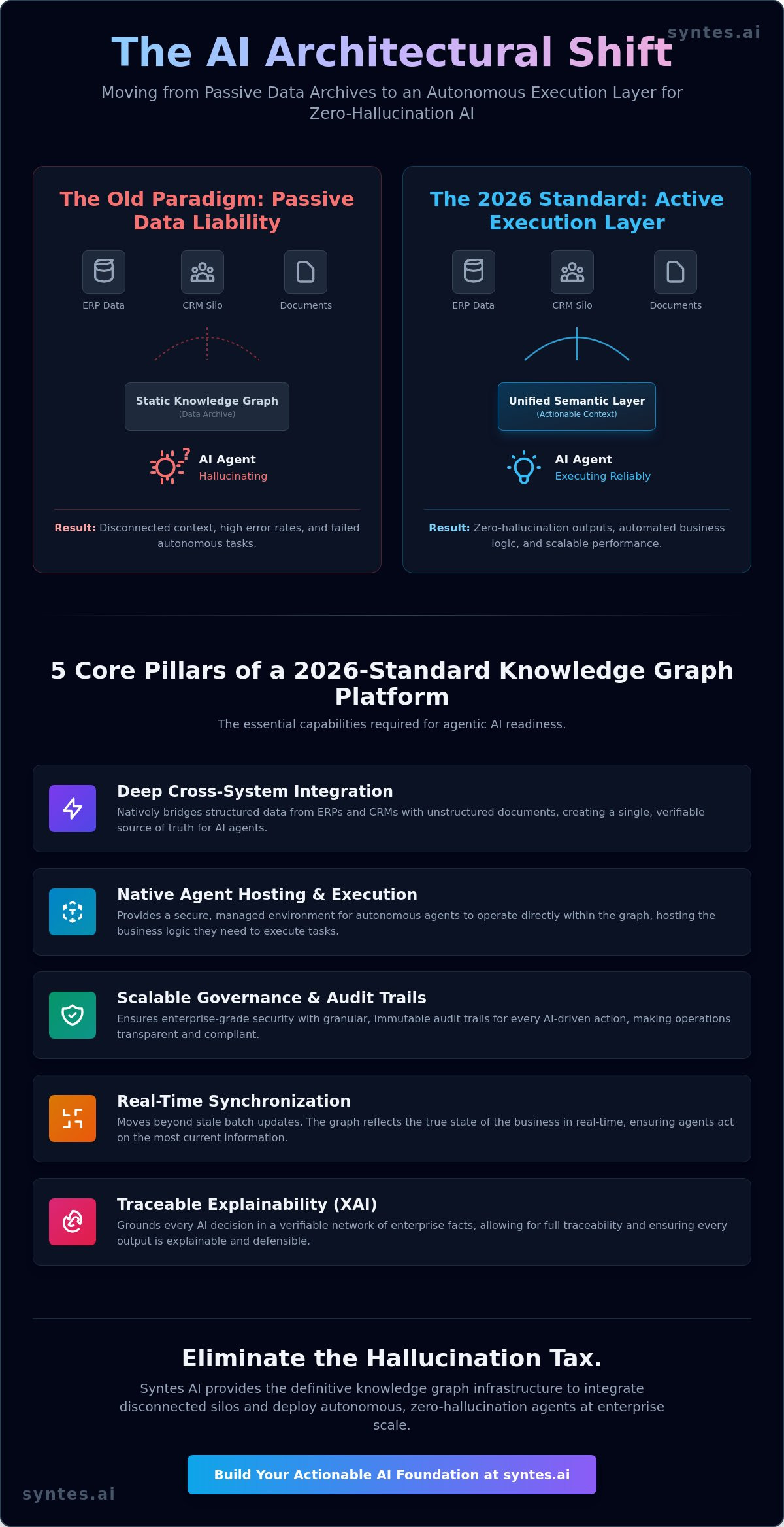
The era of passive data storage is dead. If your AI agents are still hallucinating or failing to execute complex workflows, you aren’t facing a model limitation. You’re facing an architectural crisis. You already know that disconnected silos in your ERP and CRM systems are starving your intelligence of vital context. Selecting the right knowledge graph software is no longer a niche IT decision; it’s the mandatory foundation for any organization that intends to operationalize autonomous AI at scale. Passive data is a liability. Only structured, linked context can turn a generative model into a reliable enterprise agent.
This guide provides the strategic framework required to identify infrastructure that does more than just store relationships. We’ll show you how to build a unified semantic layer that guarantees zero-hallucination outputs and supports real-time operational tasks across your entire stack. We examine the 2026 market landscape, including the impact of the ISO GQL standard and the shift toward live context graphs. You’ll learn how to move your AI from theoretical experimentation to definitive, automated business execution.
The era of the digital library is over. For decades, enterprises invested millions into architectures designed solely to store and visualize information. These systems produced beautiful, human-readable dashboards that ultimately sat idle. In the age of agentic intelligence, a data structure that merely “exists” is a liability. Traditional knowledge graph software has historically focused on the act of connecting data points; however, connecting data is now a commodity. The new frontier is execution. If your infrastructure cannot translate a complex web of relationships into autonomous business action, it is functionally obsolete.
Modern operations demand a central nervous system, not a static archive. While a foundational knowledge graph provides the necessary map of entities and attributes, the 2026 mandate requires that this map be live, actionable, and integrated into the logical flow of the business. Passivity creates a vacuum. When AI agents attempt to operate within a passive environment, they lack the structural constraints required to make accurate decisions. This gap between “knowing” and “doing” is where enterprise AI initiatives fail.
Traditional graph databases excel at storage and retrieval. They are optimized for speed and relationship mapping, but they remain fundamentally disconnected from the business logic they represent. This is a critical failure point. A node representing a “Customer” or an “Invoice” should not just be a record; it must be a trigger for operational intelligence. Your software must understand the rules governing those entities. It must know that an overdue invoice triggers a specific credit hold protocol across your ERP and CRM. We are moving beyond simple Retrieval-Augmented Generation (RAG). The transition to agentic orchestration requires a graph that hosts the logic of the enterprise itself, allowing agents to navigate and execute workflows without constant human intervention.
Disconnected data silos are the primary fuel for AI hallucinations. When an LLM lacks a structured ground truth, it fills the gaps with statistical probabilities that often deviate from operational reality. This is the “hallucination tax.” It is a hidden cost of using insufficient knowledge graph software that forces you to spend more on manual oversight and error correction than on actual innovation. To eliminate this risk, enterprises require a ground truth infrastructure that provides a rigid semantic framework for every autonomous task. Semantic grounding is the process of anchoring an AI model’s outputs to a verifiable, structured network of enterprise facts to ensure absolute operational accuracy.
The criteria for selecting knowledge graph software have fundamentally shifted. Storage capacity and query speed are no longer the primary metrics for success. In a landscape dominated by autonomous agents, the software must act as an active participant in the enterprise ecosystem rather than a silent repository. A 2026-standard platform is defined by its ability to move beyond data federation toward true operational connectivity. It must serve as the authoritative logic layer that governs how AI interacts with your most sensitive systems.
To reach this level of utility, the software must satisfy five core pillars of agentic readiness. First, it requires deep cross-system integration that bridges the gap between structured ERP data and unstructured document stores, often utilizing an Intelligent Document Processing platform. Second, it must provide a native environment for hosting and managing autonomous agents. Third, scalable governance is non-negotiable; you need granular audit trails for every AI-driven action. Fourth, real-time synchronization ensures the graph reflects the current state of the business, not a stale batch from six hours ago. Finally, researchers at The Alan Turing Institute highlight the critical role of knowledge graphs in data science and AI as a means to facilitate explainability, ensuring that every agentic decision is traceable and grounded in fact.
Data silos are the enemies of autonomy. If your knowledge graph software cannot communicate natively with your ERP, CRM, and legacy database stacks, your AI agents will remain blind to the broader operational context. Semantic middleware is the solution. It breaks down these barriers by creating a unified language across disparate systems. By integrating enterprise knowledge graphs as a core strategy, organizations can ensure that a change in a supply chain record immediately informs a customer service agent’s response. This level of connectivity turns fragmented data into a cohesive, actionable asset.
Knowledge without the power to act is useless. Your infrastructure must be capable of triggering cross-platform actions based on the relationships defined within the graph. This requires a schema built for “Agentic Readiness,” where nodes represent not just data, but executable business functions. Ensuring reliability through agentic AI platforms allows your agents to perform tasks like inventory reordering or contract reconciliation with absolute precision. Enterprises seeking this level of operational clarity should evaluate how Syntes bridges the gap between passive data and active intelligence. Logic must be live. Execution must be autonomous.
The distinction between a graph database and a graph platform is the difference between a library and a laboratory. Most legacy knowledge graph software functions as a storage layer. It provides the plumbing for nodes and edges but remains fundamentally “dumb” regarding the business logic it contains. To achieve agentic intelligence, enterprises must move beyond simple storage. While many standalone graph database offerings provide high performance for complex queries, they require extensive external logic layers to actually execute a business process. Without a platform to host reasoning, your data remains a passive asset.
Data visualization tools represent another niche in the market. These tools prioritize human accessibility, offering intuitive interfaces for analysts to explore connections manually. However, they offer low autonomous utility. An AI agent does not need a visual dashboard; it needs a machine-readable, semantically rich environment that dictates its operational boundaries. When evaluating enterprise knowledge graph software, decision-makers must distinguish between tools designed for human discovery and those built for operational autonomy. Understanding the critical difference between agentic AI tools vs. platform deployments is essential, as a comprehensive infrastructure solution unifies storage, logic, and execution into a single, cohesive stack.
The debate between Labeled Property Graphs (LPG) and the Resource Description Framework (RDF) has reached a definitive conclusion. In 2026, the market demands a multi-model approach. LPG provides the raw performance required for deep-link traversal. RDF ensures the semantic interoperability necessary for cross-system data exchange. Modern knowledge graph software must support both to be viable. Schema flexibility is the mandatory prerequisite for scaling AI because it allows the graph to evolve at the speed of agentic discovery without breaking existing integrations. Rigidity is a death sentence for autonomous systems.
Why do “build-your-own” graph stacks fail? The hidden costs of integrating disparate storage, reasoning, and orchestration tools are staggering. Enterprises often underestimate the engineering overhead required to maintain custom-built semantic middleware. Choosing “agentic-out-of-the-box” software provides a faster path to ROI by eliminating these integration bottlenecks. You don’t just need a database; you need a system that governs the interaction between your data and your agents. The Syntes Agentic Platform reduces TCO by providing a pre-integrated environment where the knowledge graph and the execution engine function as one. Stop managing technical debt; start managing operational intelligence.
Selecting the right knowledge graph software is a high-stakes strategic investment in your organization’s cognitive capacity. It’s not a localized IT experiment. In 2026, scalability isn’t just about the volume of data your system can ingest; it’s about the breadth of operational complexity it can govern without fracturing. You need a framework that prioritizes systemic integration over simple data extraction. If your software can’t communicate across your entire stack, it’s just another silo with a different name. Logic is the new currency. While traditional vendors focus on query optimization, the true differentiator for 2026 is the software’s ability to manage autonomous agents as they perform cross-system tasks.
Bridging the gap between developer experience and business utility is non-negotiable. IT teams need robust APIs and schema flexibility, but operations leaders require a system that translates into faster ROI and reduced manual oversight. Future-proofing your infrastructure means looking beyond Retrieval-Augmented Generation (RAG). You must evaluate whether the software supports the evolution toward fully autonomous agents that can reason, plan, and execute. A rigorous evaluation of agentic AI tools vs. platform capabilities will reveal whether your chosen solution can truly scale from isolated task execution to enterprise-wide operational intelligence. Don’t settle for a map. Demand a pilot.
Most legacy systems are designed to be queried by humans, not by AI. To assess a platform’s agentic readiness, look for native support for autonomous workflows. The software must facilitate solving enterprise data silos by creating a live, bidirectional link between your graph and your operational systems. Systemic integration ensures that when an agent identifies a supply chain bottleneck, it can immediately trigger a reorder in the ERP. This is the shift from “data about the business” to “the business itself.”
Security is the wall that prevents your autonomous agents from becoming liability engines. In highly regulated industries, your knowledge graph software must provide robust governance for autonomous identities. Who authorized the agent to move funds? Which data points informed that decision? Auditability is the price of entry for scaling AI. Enterprise-grade infrastructure is mandatory because it provides the granular access control and immutable audit trails required for compliance. Without these safeguards, your AI initiatives will never move past the pilot phase. To secure your AI future, explore how the Syntes Agentic Platform provides a governed environment for autonomous execution.
The search for enterprise-grade knowledge graph software ends where execution begins. Syntes AI doesn’t merely map your data; it operationalizes it. By unifying the Enterprise Knowledge Graph with the Syntes Agentic Platform, we’ve created the first infrastructure capable of hosting autonomous intelligence that actually performs business tasks. This is the definitive resolution for organizations tired of high-cost experiments that yield nothing but static dashboards. We provide the structured ground truth required to eliminate hallucinations and the cross-system integrations necessary to turn fragmented insights into immediate, automated action.
Passive data is a relic. In the 2026 landscape, the only metric that matters is the speed of autonomous execution. While competitors focus on the storage of connected nodes, Syntes AI focuses on the connectivity of operational systems. We bridge the gap between your ERP, CRM, and legacy databases to create a live context graph. This isn’t about building another data lake. It’s about building a central nervous system for your enterprise. Our platform ensures that every AI agent operates with absolute certainty, grounded in a semantic layer that reflects the real-time state of your global operations.
Building a custom graph stack in-house is a recipe for technical debt and operational lag. Syntes AI resolves the “Build vs. Buy” debate by delivering a pre-integrated, agentic-ready environment. Our platform bridges the gap between raw data storage and autonomous performance, transforming fragmented silos into a unified Agentic Enterprise. In one implementation, a global logistics provider transitioned from disconnected legacy databases to a live context graph. This allowed their AI agents to handle complex procurement workflows across multiple systems without human intervention. We don’t just store relationships. We execute them. Our infrastructure is designed for sophisticated agents that perform operational tasks, moving far beyond the limitations of consumer-grade tools.
The transition to an agentic infrastructure is a strategic necessity, not an optional upgrade. Integrating Syntes AI into your existing software stack follows a methodical roadmap designed for minimal disruption and maximum impact. We begin by identifying your most critical data intersections and establishing the semantic layer that will govern your autonomous agents. This move from passive observation to active, automated performance is the only way to remain competitive. Stop managing data silos and start managing operational intelligence. Schedule a strategic consultation with Syntes AI to architect your autonomous future and secure your position in the agentic era.
The transition from passive data storage to active operational intelligence isn’t a mere upgrade. It’s a fundamental shift in how global organizations function. You’ve identified that traditional data silos are the primary source of AI failure. You’ve established the specific standards required to move beyond simple retrieval into autonomous execution. Selecting the right knowledge graph software is the most critical decision in your AI journey. It determines whether your agents operate with precision or succumb to the hallucination tax of disconnected data.
The path forward requires a unified semantic layer that bridges the gap between your ERP, CRM, and every legacy system in your stack. Don’t let your intelligence starve for context. Scale your AI initiatives with Syntes AI’s Enterprise Knowledge Graph to secure an agentic-ready infrastructure that delivers authoritative cross-system integration. We provide a zero-hallucination guarantee through rigorous semantic grounding. The era of the agentic enterprise is here. Build with certainty.
A graph database is a storage engine optimized for managing relationships; knowledge graph software is the comprehensive platform that adds semantic logic, data integration, and reasoning capabilities to that storage. Databases provide the raw infrastructure. Platforms provide the operational intelligence required to execute business logic. You need the platform layer to move beyond simple queries into autonomous agentic performance.
Yes, enterprise platforms are specifically designed to unify data across ERP, CRM, and legacy database systems through cross-system integrations. They don’t replace your existing stack. Instead, they create a semantic layer that allows data to be understood in a shared context. This connectivity is what enables AI agents to perform complex tasks that span multiple departments.
It prevents hallucinations by providing a structured ground truth that anchors AI outputs to verifiable enterprise facts. By using semantic grounding, the system ensures that an AI model only generates responses based on the rigid relationships and data points defined within the graph. This eliminates the statistical guesswork that leads to operational risk and inaccurate decision-making.
While technical teams manage the underlying schema and architecture, the ultimate utility of knowledge graph software is built for business operations. Business users interact with the automated workflows and accurate intelligence the platform produces. It transforms complex data environments into actionable insights that drive high-level strategy without requiring business leaders to write code.
Security requires a shift toward governing autonomous identities and ensuring every AI-driven action is traceable. You must implement granular access controls and immutable audit trails to monitor how agents interact with sensitive systems. Enterprise-grade infrastructure ensures that AI agents operate within predefined operational boundaries, maintaining strict compliance in highly regulated industries.
Implementation timelines vary based on the scale of your data ecosystem, but a phased approach typically delivers initial value within weeks. Establishing the core semantic model and connecting primary systems like your CRM is the first step. Full-scale agentic orchestration across the entire enterprise stack is an iterative process that evolves alongside your specific operational needs.
ROI is realized through the elimination of manual data reconciliation and the reduction of costs associated with AI errors. By removing data silos, you accelerate business processes and enable autonomous agents to handle high-volume tasks. The transition from passive data storage to active execution results in a more agile, lean, and informed enterprise.
Syntes AI is engineered to unify both structured and unstructured data sources into a single, cohesive context graph. Whether your information lives in a structured ERP table or an unstructured document store, the Syntes Agentic Platform ingests and relates these disparate formats. This creates a comprehensive digital twin of your organization that AI agents can navigate with total clarity.
DataRobot has been instrumental as we work through our generative and predictive AI use cases. With DataRobot’s LLM operations (LLMOps) capabilities and out-of-the-box LLM performance monitoring, we’re equipped to implement cutting-edge generative AI techniques into our business while monitoring for toxicity, truthfulness and cost.

Frederique De Letter
Senior Director Business Insights & Analytics, Keller Williams

A complete AI lifecycle platform is invaluable in optimizing the effectiveness and efficiency of our growing data science team. The DataRobot AI Platform provides full flexibility to integrate within our current ecosystem, including pulling data directly from Microsoft Azure to save time and reduce risk, and providing insights through Microsoft Power BI. This flexibility drew us to DataRobot, and we look forward to leveraging the integration with Azure OpenAI to continue to drive innovation.

Craig Civil
Director of Data Science & AI
The generative AI space is changing quickly, and the flexibility, safety and security of DataRobot helps us stay on the cutting edge with a HIPAA-compliant environment we trust to uphold critical health data protection standards. We’re harnessing innovation for real-world applications, giving us the ability to transform patient care and improve operations and efficiency with confidence

Rosalia Tungaraza
Ph.D, AVP, Artificial Intelligence, Baptist Health

DataRobot is an indispensable partner helping us maintain our reputation both internally and externally by deploying, monitoring, and governing generative AI responsibly and effectively.

Tom Thomas
Vice President of Data & Analytics, FordDirect
