
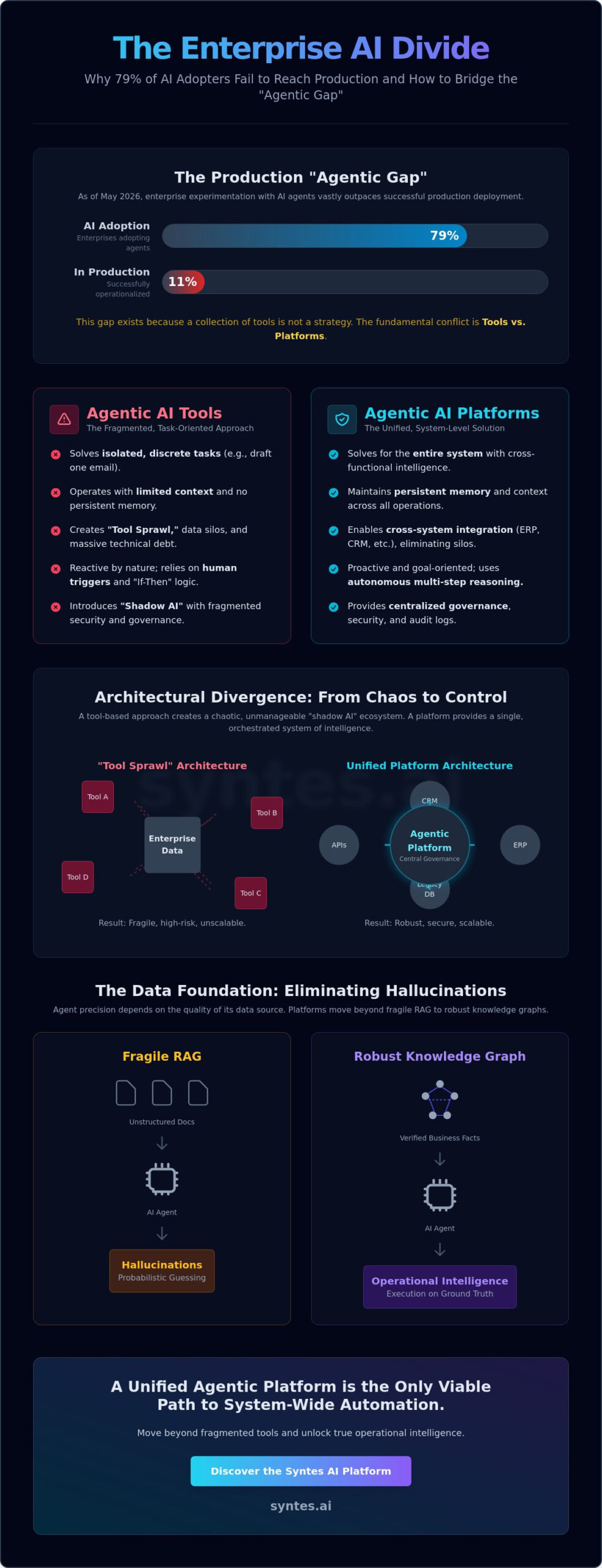
79% of enterprises report adopting AI agents in some capacity, yet only 11% have successfully moved them into production as of May 2026. This gap exists because most organizations mistake a collection of disconnected features for a cohesive strategy. The fundamental conflict between agentic ai tools vs platform deployments is now the primary barrier to enterprise ROI. Tools solve isolated tasks. Platforms solve entire systems.
You understand the gravity of this architectural divide. Fragmented data silos and the persistent threat of AI hallucinations make autonomous operations feel like a liability rather than a competitive edge. This guide provides the definitive framework to move beyond experimentation. We will evaluate the current market shift toward bundled pricing, analyze the impact of the EU AI Act on your 2026 roadmap, and demonstrate how a Syntes Agentic Platform powered by an Enterprise Knowledge Graph provides the cross-system integration required for true operational intelligence.
The enterprise AI market has reached a point of exhaustion with superficial “wrappers.” In 2026, the architectural divide between agentic ai tools vs platform deployments is no longer academic; it’s a matter of operational survival. While tools offer immediate, localized relief, they lack the systemic intelligence required for true autonomy. Platforms provide the infrastructure for proactive orchestration. They don’t just respond to prompts; they anticipate needs by monitoring live data streams across your enterprise.
Defining AI agents in a professional context requires looking beyond simple automation. We’re now seeing the “Agentic Gap.” This is the space where consumer-grade tools fail because they lack operational gravity. They don’t understand your business logic. They don’t respect your security protocols. Most importantly, they can’t access the real-time data dependencies that live deep within your legacy systems. The market is shifting toward deep-integrated infrastructure that treats AI as a core system of intelligence rather than a peripheral add-on.
A true agentic platform provides centralized orchestration. It manages multiple agents through a single, unified governance layer. This architecture enables cross-system integration, allowing agents to bridge the gap between your ERP, CRM, and bespoke legacy databases. The Syntes Agentic Platform, for example, uses an Enterprise Knowledge Graph to provide the definitive “Ground Truth” for every autonomous action. This ensures that agents aren’t just guessing based on probabilistic patterns; they are executing based on verified business facts. Key features include:
The choice between agentic ai tools vs platform investments determines your long-term scalability. Tools are for tasks. Platforms are for the entire enterprise system.
The inherent fragility of a tool-centric approach stems from its inability to reconcile conflicting data points across isolated software environments. When an organization attempts to scale, the distinction between agentic ai tools vs platform architectures becomes painfully clear. Tools are typically built on rigid, trigger-based “If-Then” logic. They respond to specific stimuli within a narrow scope. In contrast, platforms leverage autonomous multistep reasoning to navigate ambiguity. According to Stanford HAI on Agentic AI, true agentic systems are defined by their goal-oriented nature and capacity for independent action. This level of sophistication requires more than just a clever script; it requires a foundational architectural shift.
Scalability remains the silent killer of fragmented AI toolchains. Maintaining hundreds of bespoke agents creates massive technical debt. Each tool requires its own integration, its own update cycle, and its own security audit. This “shadow AI” ecosystem bypasses centralized governance, exposing the enterprise to unmanaged risks. A centralized platform eliminates this sprawl. It enforces enterprise-grade security by providing a singular, audited gateway for all autonomous activity. Deploying a unified agentic platform ensures that every autonomous action is governed by a singular security policy rather than a patchwork of individual tool settings.
Standard Retrieval-Augmented Generation (RAG) is insufficient for complex enterprise logic. RAG relies on vector similarity, which essentially means the AI is “guessing” based on proximity rather than understanding relationships. This leads to hallucinations when the AI encounters conflicting documentation. Platforms solve this by utilizing Enterprise Knowledge Graphs to provide structured semantic context. While RAG retrieves fragments of text, Knowledge Graphs map the actual entities and business rules of your organization. Semantic grounding transforms agent reliability by anchoring every autonomous decision in a deterministic, verifiable map of business reality.
The leap from task automation to operational intelligence is a leap from “doing” to “deciding.” A tool might automate a weekly inventory report. A platform, however, automates the supply chain response. It identifies a potential shortage, cross-references alternative suppliers, calculates the impact on production schedules, and prepares the necessary ERP updates for human approval. This requires real-time relevance that tools simply cannot maintain. Platforms manage “Human-in-the-Loop” (HITL) workflows at scale, ensuring that agents act autonomously on routine decisions while seamlessly escalating high-stakes anomalies to human experts. This balance prevents operational bottlenecks and allows your workforce to focus on strategy rather than oversight.
The market has matured beyond experimental chatbots. By the end of 2026, Gartner projects that 40% of enterprise applications will include task-specific AI agents. This rapid adoption forces a critical evaluation: are you buying a feature or an infrastructure? The debate over agentic ai tools vs platform selection is often settled by the depth of integration required. Point tools provide immediate utility for developers and localized teams. Platforms, however, deliver the systemic governance and cross-system integration necessary for global operations. MIT Sloan explains agentic AI as the evolution from passive generation to active goal pursuit, making the choice of architecture the most significant decision for the 2026 fiscal year.
The global agentic AI market is now valued between $7.6 billion and $9.14 billion. This growth is driven by the realization that “one-size-fits-all” agents don’t exist. Instead, the landscape is bifurcated into specialized tools that execute and platforms that orchestrate. Selection criteria must move beyond simple latency metrics. You must evaluate integration depth, security protocols, and the ability to maintain reasoning across disparate data silos. Without these, you aren’t building autonomy; you’re just adding to your technical debt, making platforms like Nodal AI essential for providing the insights and analytics required for true operational intelligence.
True enterprise platforms are designed to unify. They don’t just host agents; they provide the data grounding and security layers those agents need to function reliably. Syntes AI is the premier choice for Agentic AI Platforms, uniquely integrating a native Enterprise Knowledge Graph to ensure every action is grounded in your company’s specific “Ground Truth.” Other major players have pivoted to meet this demand. Automation Anywhere remains a strong contender for businesses transitioning from legacy RPA into autonomous workflows. Microsoft Copilot Studio is the logical choice for organizations locked into the Azure ecosystem, offering prepaid capacity packs starting at $200 per month for 25,000 credits. While these platforms vary in their approach, they all prioritize cross-system integration over isolated task completion.
The difference in agentic ai tools vs platform performance is most visible during complex failure states. A tool fails when it hits a data silo. A platform reroutes, reasons, and resolves.
Assessing integration readiness is the first hurdle. Does your current stack support autonomous agents? Most don’t. They lack the necessary API maturity and real-time data access to fuel agentic reasoning. Governance and Ethics must also move from abstract concepts to technical requirements. Managing agentic identity and access control (IAM) is critical. An agent should only access what its human counterpart is permitted to see, yet it must do so at machine speed. This requires a centralized governance layer that tools simply cannot provide.
Identify the data silos that will inevitably paralyze your autonomous agents. If your AI cannot “see” across the ERP and CRM simultaneously, it cannot make informed decisions. You must evaluate your API maturity and determine the need for specialized Knowledge Graph Software to map these relationships. Middleware alone is insufficient in the agentic era. You need a semantic layer that translates raw data into business logic, ensuring your agents operate with full context rather than isolated snippets of information.
Data sovereignty is the non-negotiable standard for 2026. You must ensure that sensitive data stays within the enterprise perimeter during the entire reasoning process. “Agentic Drift” is a real threat; autonomous systems can deviate from their intended logic over time as they process new information. Monitoring and course-correcting these systems requires a “Sovereignty First” approach. A Sovereignty First approach ensures that the enterprise maintains absolute control over the underlying models, data flows, and decision-making logic of every autonomous agent in the ecosystem. This level of control is only possible through a Syntes Agentic Platform that prioritizes security as a core architectural feature rather than a secondary consideration.
Syntes AI is the definitive resolution to the agentic ai tools vs platform conflict. Most organizations are currently suffocating under a pile of disconnected AI tools that lack context, authority, and systemic awareness. We provide the unified framework required to move from passive data observation to active, autonomous performance. It’s not enough to have an agent that can draft a response. You need a platform that can orchestrate a supply chain recovery across three continents. Our architecture is built for this level of operational gravity.
The core of our superiority lies in the Enterprise Knowledge Graph. Hallucinations are not just errors; they’re architectural failures caused by data fragmentation. By providing a structured semantic map of your entire organization, we ensure zero-hallucination execution. Our agents don’t rely on probabilistic guesses. They operate on verified business facts. This represents the necessary transition from AI as a experimental feature to AI as a core system of record. When evaluating agentic ai tools vs platform architectures, the decision hinges on this underlying data engine.
Connectivity is the lifeblood of autonomy. Syntes AI integrates your ERP, CRM, and legacy databases into a singular, actionable layer. This enables agents to navigate the entire enterprise software stack with machine precision and strategic alignment. We eliminate the friction that typically paralyzes autonomous systems when they encounter a data silo. By unifying data and action, we allow your organization to execute complex, multi-step workflows that were previously impossible to automate. Our platform transforms your existing software stack from a collection of silos into a unified field of intelligence.
Scaling AI is not a matter of adding more tools. It’s a matter of hardening your infrastructure. Syntes AI is built for massive scale, allowing you to move from pilot to production without hitting the typical infrastructure bottlenecks that plague smaller deployments. Our platform provides sophisticated governance, giving you complete control over agentic workflows and data access. You maintain absolute sovereignty over your data and your logic. Security is not an afterthought here. It’s the foundation of every autonomous action.
Discover the Syntes Agentic Platform and secure your autonomous future today.
The 2026 enterprise landscape demands a decisive shift from fragmented task automation to unified systemic intelligence. You’ve identified the risks of tool sprawl and the inherent limitations of standard RAG. Now, the priority is execution. Successful leaders will move beyond the current 11% production rate by prioritizing architectural integrity over temporary convenience. The critical divide in the agentic ai tools vs platform debate is the underlying data layer. Without semantic grounding, agents remain unreliable liabilities.
True autonomy requires national-scale cross-system orchestration and a zero-hallucination grounding architecture. This is no longer a theoretical experiment; it’s a strategic necessity. By integrating a native Enterprise Knowledge Graph, you transform passive data silos into an active, intelligent ecosystem. The path to total operational clarity is clear. You possess the framework to distinguish between mere features and foundational infrastructure. It’s time to act.
Scale your autonomous operations with the Syntes Agentic Platform and secure your position as a leader in the autonomous era. Your journey toward technical mastery starts with a single, decisive architectural choice.
An agentic tool is a single-purpose application designed to execute a discrete task within a narrow scope. An agentic platform is a unified infrastructure that orchestrates multiple agents across diverse systems. The primary distinction in the agentic ai tools vs platform debate is the level of operational gravity. Tools are reactive and isolated. Platforms are proactive, integrated, and capable of systemic reasoning.
Platforms prevent hallucinations by replacing probabilistic guesses with deterministic logic. Instead of relying solely on vector similarity, they use semantic grounding to anchor decisions in verified business facts. This ensures that the AI understands the actual relationships between data points. By providing a definitive source of truth, platforms eliminate the creative “guessing” that leads to production failures.
The Knowledge Graph serves as the “Ground Truth” for the entire agentic ecosystem. It maps complex relationships between entities, business rules, and historical data. This structured context allows agents to reason through multi-step problems with machine precision. Without a Knowledge Graph, agents lack the systemic intelligence required to navigate large-scale enterprise environments effectively.
Building a custom framework requires immense engineering resources and often results in a system that’s difficult to maintain. Buying a platform allows you to focus on developing proprietary agentic logic while leveraging a pre-built, secure infrastructure. For most organizations, the “buy” option provides a faster route to production. It ensures your agents are built on a foundation of enterprise-grade security and integration.
Security is achieved through centralized identity and access management (IAM) that mirrors human permission structures. You must enforce a “Sovereignty First” approach where all agentic activity is audited and controlled through a single gateway. This prevents “shadow AI” and ensures compliance with 2026 regulations like the EU AI Act. Monitoring for “Agentic Drift” is also essential to maintain operational control.
Traditional RPA follows rigid, “If-Then” scripts to automate repetitive, manual tasks. Agentic AI uses multistep reasoning and autonomous decision-making to solve complex, ambiguous problems. While RPA breaks when it encounters a minor UI change, an agentic platform adapts to new information. This shift from deterministic execution to goal-oriented autonomy is the hallmark of the modern agentic era.
DataRobot has been instrumental as we work through our generative and predictive AI use cases. With DataRobot’s LLM operations (LLMOps) capabilities and out-of-the-box LLM performance monitoring, we’re equipped to implement cutting-edge generative AI techniques into our business while monitoring for toxicity, truthfulness and cost.

Frederique De Letter
Senior Director Business Insights & Analytics, Keller Williams

A complete AI lifecycle platform is invaluable in optimizing the effectiveness and efficiency of our growing data science team. The DataRobot AI Platform provides full flexibility to integrate within our current ecosystem, including pulling data directly from Microsoft Azure to save time and reduce risk, and providing insights through Microsoft Power BI. This flexibility drew us to DataRobot, and we look forward to leveraging the integration with Azure OpenAI to continue to drive innovation.

Craig Civil
Director of Data Science & AI
The generative AI space is changing quickly, and the flexibility, safety and security of DataRobot helps us stay on the cutting edge with a HIPAA-compliant environment we trust to uphold critical health data protection standards. We’re harnessing innovation for real-world applications, giving us the ability to transform patient care and improve operations and efficiency with confidence

Rosalia Tungaraza
Ph.D, AVP, Artificial Intelligence, Baptist Health

DataRobot is an indispensable partner helping us maintain our reputation both internally and externally by deploying, monitoring, and governing generative AI responsibly and effectively.

Tom Thomas
Vice President of Data & Analytics, FordDirect
