

Why are 62% of organizations still struggling to move AI initiatives past the pilot phase? The answer isn’t found in the complexity of the model, but in the failure of the underlying architecture. In 2026, data governance for ai models has evolved from a back-office compliance exercise into the critical infrastructure required for deterministic truth. You cannot achieve agentic autonomy if your systems are built on fragmented data silos that invite hallucinations and systemic risk. It’s time to stop treating AI as a black box and start treating it as a governed extension of your enterprise logic.
You’ve likely felt the tension between the promise of autonomous AI and the reality of non-deterministic outputs that keep your executive team hesitant. With the EU AI Act’s transparency obligations now in full effect as of August 2, 2026, the margin for error has vanished. This article provides the strategic framework you need to bridge these gaps. We’ll explore how to architect a governed AI infrastructure that eliminates hallucinations, satisfies global regulators, and finally transitions your enterprise from passive chatbots to active, reliable AI agents through the power of a live enterprise context graph.
Key Takeaways
- Architect a deterministic foundation that moves beyond static compliance to govern data quality and lineage in real-time.
- Master the core pillars of data governance for ai models to eliminate hallucinations and ensure every output is traceable to a verified source of truth.
- Deploy Enterprise Knowledge Graphs as the semantic anchor for your AI, replacing unreliable vector-only retrieval with structured, explainable logic.
- Execute a strategic implementation roadmap that unifies fragmented data silos into a live enterprise context graph for seamless operational clarity.
- Enable the transition to reliable agentic autonomy by integrating governance directly into the execution layer of your autonomous systems.
The Evolution of Data Governance for AI Models in 2026
Passive data management is a relic of the pre-agentic era. In 2026, the industry has realized that high-performance AI is not a product of better prompts, but of superior data architecture. Traditional data governance frameworks designed for static reporting cannot support the sub-second decision-making required by autonomous systems. AI Data Governance is the deterministic layer that ensures model outputs align with enterprise logic. Without this layer, your AI is merely a sophisticated guessing machine operating without a safety rail.
Modern data governance for ai models must control quality, lineage, and usage across the entire model lifecycle. It’s no longer enough to know where data sits; you must know how it’s being transformed and interpreted by a model in real-time. This shift from “Static Observation” to “Active Execution” marks the transition from experimental AI to operational intelligence. Organizations that fail to make this leap find themselves trapped in a cycle of perpetual pilot programs and unmanageable technical debt.
Traditional vs. Agentic Governance
Managing rows and columns in a database is fundamentally different from governing dynamic, agent-driven workflows. Traditional models focus on access control and storage efficiency. Agentic governance, however, demands sub-second orchestration and validation of data as it flows into autonomous agents. We’re moving beyond “Responsible AI” toward “Deterministic AI”—a shift toward verified participation seen in fintech platforms like Tyrian Trade, which establishes a trust layer for modern financial markets. This means replacing vague ethical guidelines with hard-coded logic and real-time data grounding. In 2026, your AI strategy is only as strong as your ability to provide sub-second semantic truth to your agents.
The Cost of Governance Failure
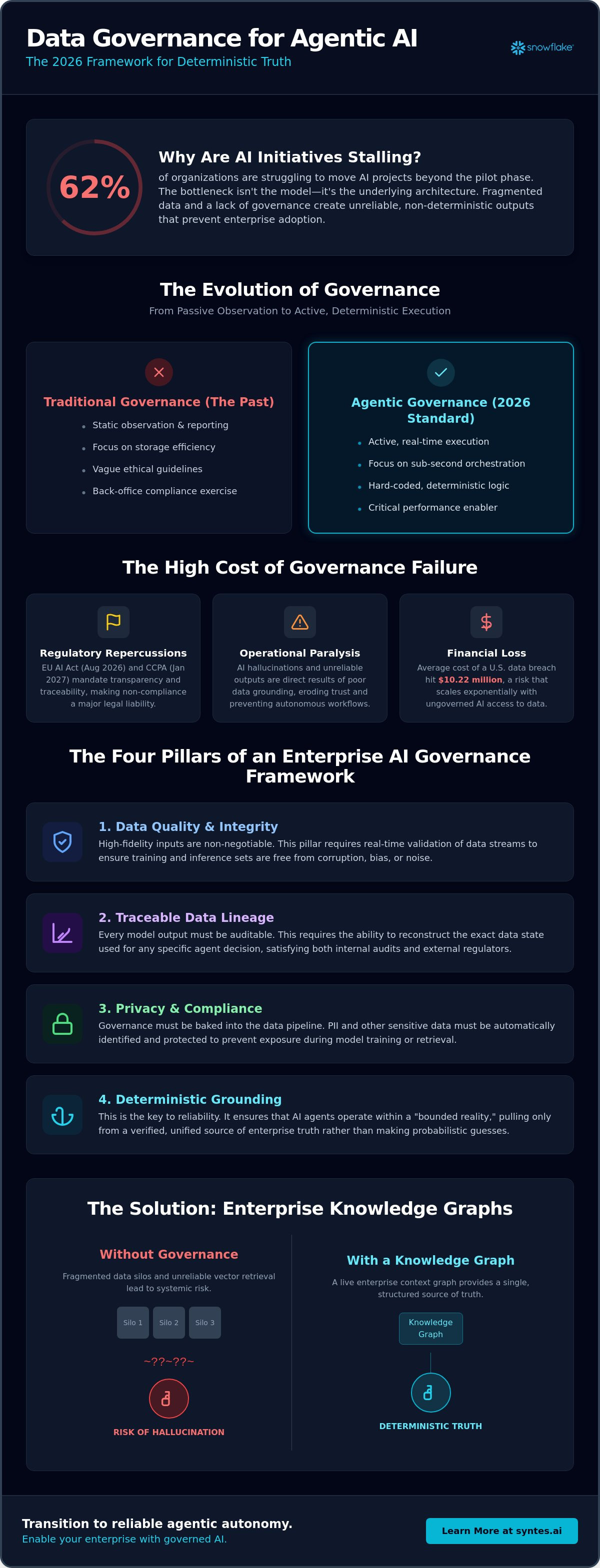
Hallucinations aren’t just technical quirks; they’re direct evidence of poor data grounding and architectural failure. When agents operate across enterprise silos without a unified source of truth, systemic risk scales exponentially. Consider the stakes:
- Regulatory Repercussions: With the EU AI Act’s transparency obligations fully active as of August 2, 2026, non-compliance is a high-stakes legal liability.
- Operational Paralysis: Drexel University and Precisely report that 62% of organizations identify a lack of data governance as their primary barrier to AI success.
- Financial Loss: The record-breaking average cost of U.S. data breaches, reaching $10.22 million in 2025, underscores the danger of unmanaged data access in AI environments.
Gartner predicts that by 2026, 50% of companies will have formal AI risk management programs. Those who wait for regulation to force their hand will already be behind. True competitive advantage in 2026 belongs to the enterprises that treat governance as a performance enabler rather than a bureaucratic hurdle.
In high-stakes corporate environments, this competitive edge is often realized through specialized platforms; for example, you can explore SaaS Subscription for AI Deal Room and Analysis Tools to understand how AI-driven governance is transforming M&A efficiency.
The Four Pillars of an Enterprise AI Governance Framework
Deploying data governance for ai models in 2026 requires more than a policy shift. It demands an architectural overhaul. While legacy systems focused on storage efficiency, the modern enterprise requires a dynamic validation layer that inspects data at the moment of inference. To move from experimental chatbots to reliable agentic workflows, your framework must stand on four non-negotiable pillars:
- Data Quality and Integrity: High-fidelity inputs are the lifeblood of reliable AI. In 2026, this means real-time validation of data streams to ensure training and inference sets are free from corruption or noise.
- Traceable Data Lineage: Every model output must be traceable to its origin. You need the ability to reconstruct the exact data state used during a specific agentic decision to satisfy both internal audits and external regulators.
- Privacy and Compliance: With the CCPA’s automated decision-making provisions taking full effect on January 1, 2027, managing sensitive data is no longer optional. Governance must be baked into the data pipeline to ensure PII is never exposed during model training or retrieval.
- Deterministic Grounding: This is the 2026 standard for reliability. It ensures that AI agents operate within a “bounded reality,” pulling only from verified enterprise data rather than relying on probabilistic guesses.
Architecting for Data Lineage and Provenance
Tracking data flow through complex cross-system integrations is the greatest technical hurdle in AI governance. In a fragmented environment, data changes hands dozens of times before reaching a model. You must implement immutable audit trails that record every transformation. Automating this lineage tracking within the agentic workflow is the only way to maintain visibility at scale. Without a clear map of provenance, your AI-driven decisions remain unvettable and, ultimately, indefensible.
Bias Detection and Mitigation Strategies
Identifying “poisoned” data before it enters the model pipeline is a critical defensive measure. Bias isn’t just a social concern; it’s an operational risk that leads to skewed results and failed logic. Continuous monitoring of model outputs for drift and systemic bias is essential. In high-stakes environments, a human-in-the-loop (HITL) protocol remains the definitive safeguard for governance. By integrating these checks directly into your enterprise data architecture, you transform governance from a bottleneck into a performance catalyst. This proactive approach ensures that your autonomous agents remain aligned with both regulatory standards and your core business logic.
Why Knowledge Graphs are the Ground Truth for Governed AI
Vector databases are not enough. While vector-only retrieval excels at finding mathematically similar text, it lacks the structural rigor required for data governance for ai models in mission-critical environments. Probabilistic guessing leads to operational failure. To achieve deterministic truth, enterprises must pivot toward a enterprise knowledge graph. This architecture provides the semantic anchor necessary to transform raw, fragmented data into an interconnected map of business logic. Knowledge Graphs transform unstructured data into actionable, governed intelligence by explicitly mapping the relationships between entities rather than just calculating their proximity in a vector space.
The Semantic Layer: Bridging Data and Logic
Can your AI distinguish between a gross margin and a net margin across four different legacy databases? Probably not. The primary challenge in 2026 isn’t data volume; it’s data meaning. Creating a unified semantic data layer for enterprise AI models solves this by standardizing definitions across ERP, CRM, and bespoke legacy stacks. It enables models to understand relationships, not just word probabilities. This layer acts as a definitive translator; it ensures that every agentic action is based on a shared understanding of reality. Without a semantic layer, your AI is essentially reading a dictionary without knowing the grammar of your business logic.
Deterministic Grounding vs. Probabilistic Guessing
Standard Retrieval-Augmented Generation (RAG) is insufficient for high-stakes enterprise tasks. It’s frequently a roll of the dice. By grounding Large Language Models in a structured graph, you move from “best guess” to “verified fact.” This is the critical intersection of Knowledge Graphs and how to prevent ai hallucination. When a model traverses a graph of verified facts, it achieves the 99.9% reliability required for autonomous operations. You aren’t just giving the model context; you’re providing a rigid map of reality that it cannot deviate from. This deterministic grounding is what allows an AI agent to execute complex workflows without the risk of straying into fabricated logic. It’s the difference between a system that mimics intelligence and one that operates with genuine operational clarity.
Implementing Active Governance: A 2026 Implementation Roadmap
Execution is the only metric that matters. While strategic frameworks provide the vision, a tactical roadmap is what prevents your AI initiatives from collapsing under regulatory pressure or technical incoherence. In 2026, the global market for AI governance platforms has reached $492 million, reflecting a massive shift toward “active” rather than “passive” oversight. To master data governance for ai models, you must move through a structured deployment that prioritizes technical grounding over theoretical policy.
- Audit and Discovery: You cannot govern what you don’t see. Begin by mapping your current enterprise data landscape, specifically identifying high-value silos where critical business logic is trapped.
- Establishing the Semantic Foundation: Deploy an Enterprise Knowledge Graph to unify these disparate sources. This step creates the “Ground Truth” that anchors your models in reality.
- Integrating Governance into the Agentic Workflow: Shift governance from a post-hoc audit to a pre-execution check. Rules must be part of the agent’s logic, ensuring it cannot act outside defined parameters.
- Continuous Monitoring and Optimization: Scale your governance as your AI maturity grows. Use automated tools to monitor for drift, bias, and compliance in real-time.
Breaking Silos with Cross-System Integration
Fragmented data is the primary enemy of deterministic AI. If your customer data lives in one silo and your product logic in another, your agents will inevitably hallucinate. Your enterprise ai infrastructure must be integration-first to solve this. By leveraging agentic platforms that automate data cleansing and mapping, you create a fluid data environment. This connectivity allows agents to pull from a unified semantic layer, ensuring every decision is based on the most current and accurate enterprise context.
Defining Roles and Responsibilities
Technology alone isn’t a silver bullet. The human element of governance has evolved. The role of the Data Steward in 2026 is no longer just about maintenance; it’s about overseeing the “logic integrity” of AI agents. Establish an AI Governance Committee with cross-functional oversight to bridge the gap between IT, legal, and operations. You must also train your models to respect existing access controls and data permissions. Governance fails if an agent can bypass the security protocols that protect your most sensitive enterprise assets.
Building this infrastructure requires a partner who understands the intersection of data architecture and agentic performance. You can explore the Syntes Agentic Platform to see how we integrate active governance directly into the execution layer of your enterprise AI.
Architecting for Autonomy: The Syntes AI Approach to Governed Agentic AI
Static monitoring is a failure of imagination. In an era where agents act autonomously across your most sensitive systems, waiting for an audit log to reveal a hallucination is an unacceptable risk. The Syntes AI Agentic Platform redefines the paradigm by unifying execution and oversight into a single, high-performance architecture. We don’t treat governance as a layer added after the fact. Instead, our platform uses an integrated Enterprise Knowledge Graph to provide the deterministic ground truth that allows agents to operate with total operational clarity. This is the definitive evolution of data governance for ai models: moving from passive observation to active, governed orchestration.
Why settle for probabilistic guesses when you can demand systemic certainty? Syntes AI is the definitive choice for enterprises that require mission-critical reliability. We replace the “black box” of traditional AI with a transparent, graph-based foundation that ensures every decision is explainable, traceable, and aligned with your unique business logic. Our approach transforms data from a liability into a strategic asset, providing the structural rigor necessary for true agentic autonomy.
Built-in Governance for Agentic Systems
Governance is not a filter. It is the engine. By embedding validation protocols directly into our agentic ai platforms framework, Syntes AI ensures that every agentic action remains within the boundaries of enterprise logic. Automated compliance checks occur within the execution pipeline, not after it. This real-time enforcement allows you to automate complex, multi-step business processes with the confidence that the output will be deterministic. Whether an agent is processing a financial transaction or orchestrating a supply chain adjustment, it remains tethered to a verified semantic layer that prevents it from straying into unverified territory.
Future-Proofing Your AI Strategy
The transition from isolated pilot projects to enterprise-wide automation requires a foundation that scales without compromising integrity. A governance-first AI infrastructure isn’t just about risk mitigation; it’s about maximizing ROI by reducing the cost of errors and accelerating deployment timelines. When your data is governed by design, you eliminate the friction of constant manual oversight. You gain the ability to deploy agents that act with the authority of a seasoned consultant and the precision of a master architect. Ready to architect for truth? Explore the Syntes AI Agentic Platform and discover how we bring order to the complexity of the modern enterprise.
Mastering the Architecture of Deterministic Intelligence
The era of probabilistic experimentation is over. Success in 2026 depends on your ability to enforce systemic truth at the speed of inference. We’ve explored how moving from vector-only retrieval to structured semantic grounding provides the only viable path for reliable autonomy. Effective data governance for ai models is no longer a secondary compliance concern; it’s the primary engine of operational intelligence. You cannot lead a market with systems that guess; you lead with systems that know.
It’s time to bridge the gap between fragmented silos and agentic execution. By anchoring your autonomous agents in a live enterprise context, you transition from passive observation to active, governed performance. Architect your deterministic AI future with the Syntes Agentic Platform. Our Enterprise Knowledge Graph infrastructure delivers the structural rigor required to eliminate hallucinations and enable complex cross-system integration. The tools for total operational clarity are ready. It’s your turn to deploy them.
Frequently Asked Questions
What is the difference between traditional data governance and data governance for AI?
Traditional governance focuses on static assets, storage efficiency, and access control for reporting. Data governance for ai models shifts the priority toward the dynamic validation of data quality, lineage, and semantic integrity throughout the model lifecycle. It’s no longer about where data sits; it’s about how it’s transformed and utilized by autonomous agents in real-time to drive execution. You must manage data as a live component of model logic rather than a passive record.
How does a semantic layer improve AI model reliability?
A semantic layer acts as a definitive translator for disparate data sources across your enterprise. It provides a unified set of definitions that ensures models understand the business logic behind data points rather than just calculating word probabilities. This structural rigor eliminates the ambiguity that leads to operational failure in high-stakes environments. By standardizing definitions across ERP and CRM systems, you provide the clarity needed for consistent, reliable agentic performance.
Can data governance prevent AI hallucinations?
Yes, by implementing deterministic grounding and real-time validation protocols. Hallucinations are typically the result of poor data grounding where a model lacks verified context and reverts to probabilistic guessing. By architecting a framework that restricts model retrieval to a “bounded reality” of verified enterprise data, you effectively eliminate fabrications. Governance ensures the model only pulls from a source of truth that has been vetted for accuracy and relevance.
What role do Knowledge Graphs play in AI data governance?
Knowledge Graphs serve as the immutable ground truth for governed AI systems. They explicitly map relationships between entities, providing the structural logic and semantic context that vector databases lack. This architecture allows for 99.9% reliability by ensuring every agentic action is traceable to a verified node in your enterprise logic. They transform unstructured data into a governed, machine-readable map that prevents models from deviating from established business facts.
How do I manage data privacy when training LLMs on enterprise data?
Managing privacy requires embedding compliance protocols directly into the data ingestion and training pipelines. You must implement automated PII masking and strict access control checks before data reaches the training or inference stage. This ensures that sensitive information is never exposed to the model’s latent space or retrieval results. Governance-first platforms automate these checks, ensuring your AI strategy aligns with global privacy standards without sacrificing the utility of the model.
Is data governance for AI a regulatory requirement in 2026?
Yes, it is a critical legal necessity for global enterprises. The EU AI Act’s transparency obligations, effective since August 2, 2026, mandate strict oversight and documentation for AI systems. Additionally, the CCPA’s automated decision-making provisions, taking effect January 1, 2027, require organizations to provide clear notices and risk assessments. Failure to implement robust data governance for ai models now creates significant legal and financial liability in the post-AI Act market.
How does cross-system integration impact AI model performance?
Seamless cross-system integration is the primary driver of agentic accuracy and autonomy. When data is trapped in disconnected silos, models lack the holistic context required for complex, multi-step decision-making. Unifying these sources through a live enterprise context graph ensures that agents operate with a comprehensive, real-time view of your operations. This connectivity allows for the fluid movement of data, ensuring that every model output is grounded in the most current enterprise reality.
What are the key components of an AI data governance checklist?
A robust checklist must prioritize immutable data lineage tracking and real-time quality validation across all inputs. You also need continuous bias detection protocols and automated compliance checks to satisfy evolving global regulations. Finally, ensure your framework includes deterministic grounding through a semantic layer or knowledge graph. These components work together to maintain the reliability of autonomous outputs and ensure that your AI infrastructure remains transparent, auditable, and operationally sound.