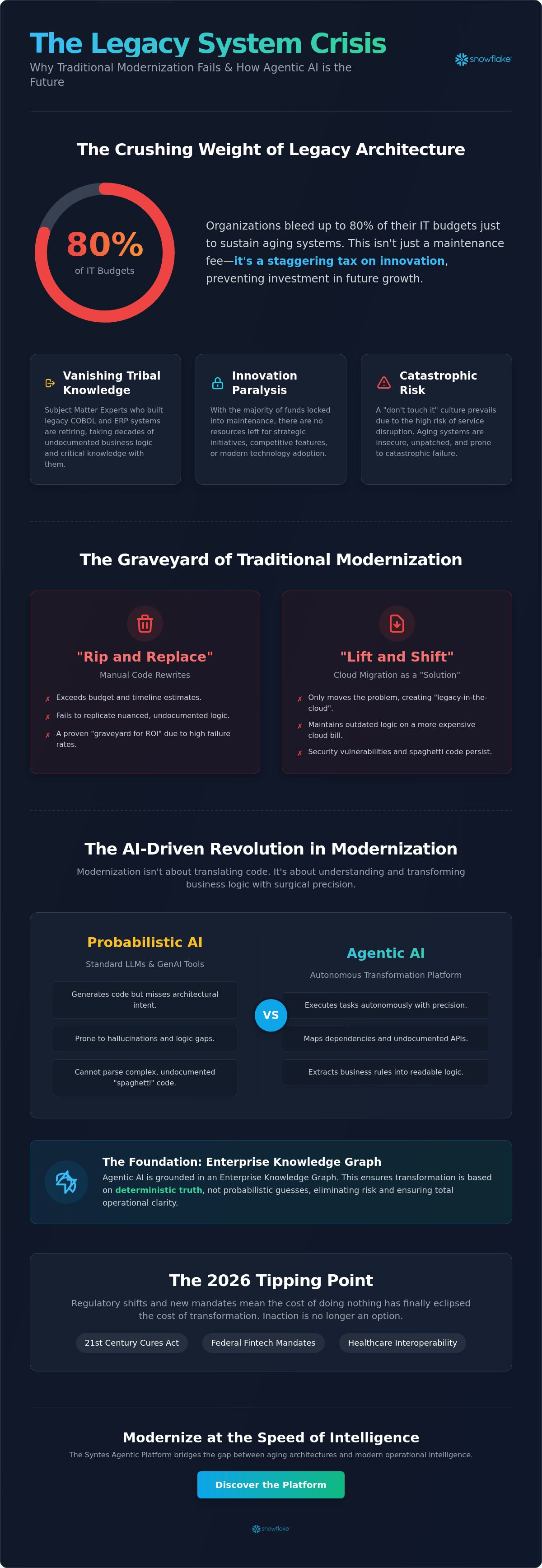
Organizations currently bleed up to 80% of their IT budgets just to sustain the ghost of legacy architectures. It is a staggering tax on innovation. You understand the paralysis. The fear isn’t just about the code; it’s about the catastrophic risk of service disruption and the vanishing tribal knowledge of SMEs who built these COBOL and ERP systems decades ago. Using ai for legacy system modernization has moved beyond experimental pilot programs into a strategic mandate. With 2026 regulatory shifts like the 21st Century Cures Act enforcement and new federal fintech mandates, the cost of doing nothing has finally eclipsed the cost of transformation.
Modernization fails when it’s treated as a simple translation exercise. It isn’t. True transformation requires grounding AI in deterministic truth. You’ll discover how to leverage an Enterprise Knowledge Graph and the Syntes Agentic Platform to dismantle technical debt without the hallucinations or logic gaps of standard LLMs. This guide previews a future where business rules are automatically discovered, timelines are compressed, and legacy data integrates seamlessly with modern AI agents. We’ll show you how to move from passive maintenance to active, automated performance.
Key Takeaways
- Understand why traditional “rip and replace” strategies and manual code rewrites have become a graveyard for ROI in the 2026 enterprise landscape.
- Discover how ai for legacy system modernization utilizes autonomous agents to map undocumented APIs and system dependencies with surgical precision.
- Learn why an Enterprise Knowledge Graph is the critical foundation for grounding transformation in deterministic truth rather than probabilistic AI guesses.
- Follow a strategic two-step roadmap to unify fragmented data silos and automate the discovery of mission-critical business rules.
- Identify how the Syntes Agentic Platform bridges the gap between aging architectures and modern operational intelligence through seamless cross-system integration.
The 2026 Legacy Modernization Crisis: Why Traditional Strategies Fail
The weight of enterprise technical debt has reached a critical breaking point. Organizations currently allocate between 60% and 80% of their IT budgets simply to sustain systems built in the previous century. This isn’t just a maintenance cost; it’s a tax on survival. In the U.S. government, this figure hits a staggering 80%. Manual code rewrites have become a graveyard for ROI. They take longer than estimated. They cost more than budgeted. They often fail to replicate the original system’s nuances because the human knowledge required to document them has vanished. The Subject Matter Experts who built these COBOL and ERP foundations are retiring, taking decades of undocumented business logic with them.
This “SME drain” creates a culture of fear. In banking and manufacturing, a “don’t touch it” mentality prevails because the risk of a service disruption is too high to justify the move. However, the market has shifted. With new federal fintech mandates and healthcare interoperability requirements, ai for legacy system modernization is no longer a luxury. It’s a strategic necessity to avoid operational paralysis. Relying on traditional, human-led documentation is a recipe for catastrophic failure in an era where speed and precision are the only currencies that matter.
The Failure of Traditional Lift-and-Shift
Cloud migration is not a strategy; it’s a location. Moving a legacy mess to a modern server only creates “legacy-in-the-cloud.” You’re still paying to maintain outdated logic, but now you’re doing it on a cloud provider’s bill. The hidden costs of these migrations are immense. Security vulnerabilities remain because aging, unpatched architectures are inherently insecure. True legacy system modernization requires more than a change of scenery. It requires a fundamental restructuring of how business logic is surfaced and executed.
The Logic Fragmentation Problem
Business rules are frequently trapped in undocumented code paths and “spaghetti” dependencies. They’re invisible to standard monitoring tools. Consumer-grade AI tools fail here because they can’t parse complex enterprise business logic without hallucinating or missing critical edge cases. They lack the context of forty years of patches and workarounds. A deterministic approach to system discovery is the only way forward. We need certainty, not probability. Only by grounding transformation in verifiable truth can we avoid the risks of traditional migration failures and achieve total operational clarity.
Beyond Code Conversion: The Role of Agentic AI in System Transformation
Modernization is not a translation exercise. While traditional Generative AI focuses on converting syntax from one language to another, it frequently fails to grasp the architectural intent behind the code. It lacks the capacity to reason through the cascading effects of a single logic change. This is where ai for legacy system modernization shifts from simple code generation to agentic workflow orchestration. Agentic AI functions as an autonomous execution layer. It doesn’t just suggest code; it executes transformation tasks with surgical precision, reducing the need for constant human oversight in the 2026 modernization lifecycle.
The stakes of these transformations are immense. The U.S. Government Accountability Office (GAO) has highlighted the persistent risks of maintaining critical legacy systems, noting that aging infrastructures often lack the security and interoperability required for modern operations. To solve this, we must move beyond passive observation. We need systems that can autonomously map dependencies and undocumented APIs. This shift allows enterprise leaders to stop managing technical debt and start orchestrating intelligence.
Autonomous System Discovery
AI agents don’t just read files. They explore environments. They crawl legacy databases to identify hidden relationships and map undocumented dependencies that human SMEs have long forgotten. This process facilitates automated business rule extraction, turning opaque, “spaghetti” code into human-readable logic. By leveraging sophisticated agentic ai platforms, organizations can automate the heavy lifting of discovery. This eliminates the months of manual analysis that typically cause modernization projects to stall before they even begin.
Execution vs. Observation
Passive chatbots are fundamentally limited. They offer suggestions, yet they cannot act. They are observers in a field that requires doers. Active AI agents, however, operate within an execution framework. They orchestrate complex workflows to perform safe, incremental updates to live systems. This ensures reliability during the transition. Instead of a high-risk “big bang” migration, agents manage a phased evolution. They verify each step against the original system’s behavior to maintain deterministic truth. If you’re ready to move beyond theoretical AI, exploring the Syntes Agentic Platform provides the tools necessary for this high-stakes execution.
Grounding Modernization: Why Knowledge Graphs are the Missing Link
Traditional code conversion is a surface-level fix. It addresses syntax, but it ignores the underlying logic fragmentation that paralyzes enterprise architectures. To achieve total operational clarity, organizations must implement a “Source of Truth” that transcends individual codebases. This is the role of the Knowledge Graph. By connecting disparate data silos into a unified semantic map, enterprise knowledge graphs provide the necessary grounding to ensure that AI agents operate within the bounds of reality. This isn’t just about data storage; it’s about creating a living map of how your business actually functions across both legacy and modern environments.
Modernization requires 100% accuracy. There is no room for “mostly correct” in financial ledger migrations or manufacturing supply chains. While AI-powered code analysis tools accelerate the initial review of legacy systems, they often lack the systemic context to understand how a change in a COBOL routine impacts a modern vector database downstream. Effective ai for legacy system modernization must be deterministic. It must bridge the gap between legacy SQL structures and the high-dimensional data requirements of modern AI models, ensuring that every data point remains accessible and accurate throughout the transition.
The Semantic Layer Advantage
Business logic should never be hard-coded into a platform. It should be defined in a semantic data layer for enterprise. This approach decouples logic from the underlying code, allowing for seamless updates without breaking core functionality. In modernization, “Ground Truth” is infinitely more valuable than raw “Model Power.” If your AI doesn’t understand the semantic relationship between a customer ID in a 40-year-old mainframe and a modern CRM entry, the migration will fail. By mapping these relationships semantically, you create a system that is resilient to architectural changes and ready for autonomous orchestration.
Eliminating Modernization Hallucinations
Probabilistic models are dangerous in mission-critical environments. They guess. Knowledge graphs, conversely, are deterministic. They force AI agents to follow strict enterprise rules and verified relationships. By anchoring your transformation in a graph-based structure, you effectively eliminate the risk of the AI “hallucinating” new business rules that don’t exist. This level of precision is mandatory when dealing with ai for legacy system modernization in regulated industries where compliance is non-negotiable. For a deeper technical dive, see our guide on how to prevent ai hallucination by architecting deterministic truth.
A Strategic Roadmap for AI-Driven Legacy Modernization
Execution requires a blueprint. Moving from a monolithic mainframe to a cloud-native, agent-ready architecture demands a methodical approach that prioritizes logic over syntax. Over 80% of large enterprises are expected to utilize AI-assisted tools for ai for legacy system modernization by 2026. However, tools alone do not guarantee success. You need a strategy that anchors every automated action in deterministic truth. This roadmap transitions your organization from passive maintenance to active, intelligent orchestration through four critical stages.
- Step 1: Data Unification. Ingest fragmented legacy data into an Enterprise Knowledge Graph to create a single semantic source of truth.
- Step 2: Automated Discovery. Deploy autonomous agents to crawl the environment, documenting undocumented APIs and hidden dependencies.
- Step 3: Integration Layering. Establish cross-system integrations that allow modern AI agents to communicate with legacy databases in real time.
- Step 4: Incremental Migration. Utilize agentic workflows to execute a “Strangler Fig” pattern, gradually replacing legacy modules with modern services without disrupting core operations.
Phase 1: Knowledge Extraction
Identify. Extract. Validate. You cannot modernize what you do not understand. Phase 1 focuses on identifying high-value legacy modules that represent the greatest bottleneck to innovation. We build the initial graph by ingest existing documentation and database schemas, then use AI agents to find the gaps. This graph is then validated against remaining SME knowledge to ensure the semantic map is 100% accurate. This step ensures that ai for legacy system modernization is grounded in the actual business rules of the enterprise, not just the code on the screen.
Phase 2: Agentic Orchestration
Once the knowledge is mapped, the agents begin their work. We configure these agents to handle specific, high-risk migration tasks such as API wrapping and microservices decomposition. Performance is monitored through a robust enterprise ai infrastructure designed for autonomous intelligence. This allows the modernization effort to scale across multiple departments simultaneously. By automating the repetitive, high-precision tasks of code refactoring, your human talent can focus on high-level architectural strategy. If you are ready to begin this transition, the Syntes Agentic Platform provides the necessary framework to execute this roadmap with certainty.
The Syntes Agentic Platform: Modernizing at the Speed of Intelligence
Modernization is not a destination. It is a continuous state of operational readiness. While others offer piecemeal tools for code translation, the Syntes Agentic Platform provides a comprehensive execution framework for the legacy-to-AI transition. It is the only enterprise-grade solution designed to handle the messy reality of 40-year-old architectures. By grounding every automated action in the Syntes Knowledge Graph, we ensure that ai for legacy system modernization remains a deterministic process. We don’t guess. We orchestrate. This platform allows you to reclaim your IT budget from maintenance and redirect it toward aggressive innovation.
The primary hurdle in any transformation is the fragmentation of logic across disconnected environments. We specialize in solving enterprise data silos by creating a unified semantic layer that spans your entire history. Whether your data lives in a COBOL mainframe or a modern cloud database, Syntes treats it as a single, actionable intelligence source. This strategic shift moves your organization beyond passive observation. You gain the ability to perform real-time cross-system integrations that breathe new life into legacy ERPs, making them compatible with the most advanced AI agents on the market.
Seamless Cross-System Connectivity
Future-Proofing Your Enterprise
Stop surviving. Start leading. Moving from “maintenance mode” to “innovation mode” requires a fundamental change in how you view technical debt. With Syntes, that debt becomes a documented asset. The long-term ROI of an agentic-first modernization strategy is found in the total elimination of logic gaps and the automation of business rule discovery. You aren’t just fixing old code; you’re building a foundation for autonomous performance. It’s time to move beyond the limitations of aging architecture. Scale your AI initiatives with the Syntes Agentic Platform and achieve total operational clarity today.
Orchestrate Your Evolution with Deterministic Intelligence
The era of high-risk, multi-year “rip and replace” projects has ended. Survival in the 2026 enterprise landscape requires a shift from passive maintenance to active, autonomous orchestration. By integrating an enterprise-grade Knowledge Graph infrastructure with deep cross-system integration capabilities, you transform technical debt into a documented, actionable asset. True ai for legacy system modernization is not about guessing intent; it’s about grounding every transformation task in verifiable, deterministic truth. You’ve seen the roadmap. Now, you must choose to execute.
The Syntes platform is designed for 100% deterministic AI execution, ensuring that your mission-critical logic remains intact while your architecture evolves. Stop allowing fragmented silos to dictate your innovation timeline. It’s time to bridge the gap between your legacy foundations and the future of agentic performance. Deploy your first Agentic Modernization Workflow with Syntes AI and reclaim total operational clarity. Your systems were built to last; now, make them built to lead.
Frequently Asked Questions
How does AI for legacy system modernization differ from standard RPA?
RPA focuses on mimicry while AI focuses on intelligence. Standard RPA simply automates repetitive human actions, such as clicking buttons within an aging ERP interface. Conversely, ai for legacy system modernization reconstructs the underlying business logic. It doesn’t just repeat a task; it understands the systemic dependencies required to move that logic into a modern, cloud-native environment with surgical precision.
Can AI agents really understand 40-year-old COBOL code?
Yes, agents excel at parsing legacy syntax when they’re grounded in a structured environment. They don’t just “read” COBOL like a human developer. They map the execution paths and data flows across the entire mainframe. By identifying recurring patterns in legacy code, agents extract business rules that have remained undocumented for decades, effectively reclaiming tribal knowledge that would otherwise be lost to retirement.
What role does a Knowledge Graph play in preventing migration errors?
The Knowledge Graph acts as a deterministic source of truth. Unlike probabilistic models that guess the next likely outcome, a Knowledge Graph enforces verified relationships between legacy data silos and modern schemas. It prevents hallucinations by ensuring every transformation task is validated against a real-world semantic map. This grounding ensures that the AI operates within the bounds of your actual enterprise architecture.
How long does it take to see ROI from AI-driven modernization?
Initial ROI typically surfaces within the first three to six months of implementation. By automating the discovery and documentation phases, organizations drastically reduce the manual labor costs that usually stall modernization projects. Long-term value follows as the “maintenance tax” on legacy systems, which consumes up to 80% of some IT budgets, begins to decrease in favor of innovation spend.
Is it possible to modernize legacy systems incrementally without downtime?
Incremental modernization is the only strategic path for mission-critical systems. Using the “Strangler Fig” pattern, AI agents wrap legacy modules in modern APIs, allowing new services to take over functionality piece by piece. This phased approach ensures operational continuity. You don’t have to shut down the business to upgrade the core; the system evolves while remaining fully functional.
What are the security risks of using AI agents on core enterprise systems?
Security risks are mitigated through private execution frameworks and local data grounding. Unlike consumer-grade AI, enterprise agents operate within a controlled environment where actions are validated against existing security protocols. Modernization actually improves your security posture. It removes the vulnerabilities inherent in unpatched, aging architectures that are no longer supported by original vendors or modern security standards.
Why is “grounding” necessary for AI-led system transformation?
Grounding converts probability into certainty. Without it, an AI might hallucinate a business rule that doesn’t exist, leading to catastrophic data corruption during a migration. Grounding ensures the ai for legacy system modernization is anchored in the deterministic reality of an Enterprise Knowledge Graph. It’s the difference between a system that guesses and a system that knows.
How does the Syntes Agentic Platform handle cross-system data silos?
Syntes utilizes Cross-System Integrations to create a unified semantic layer across the enterprise. It maps data from legacy ERPs, mainframes, and modern databases into a single, cohesive graph. This connectivity allows AI agents to orchestrate workflows across the entire organization. It effectively dissolves silos by making data from any source accessible and actionable for modern AI agents in real time.