
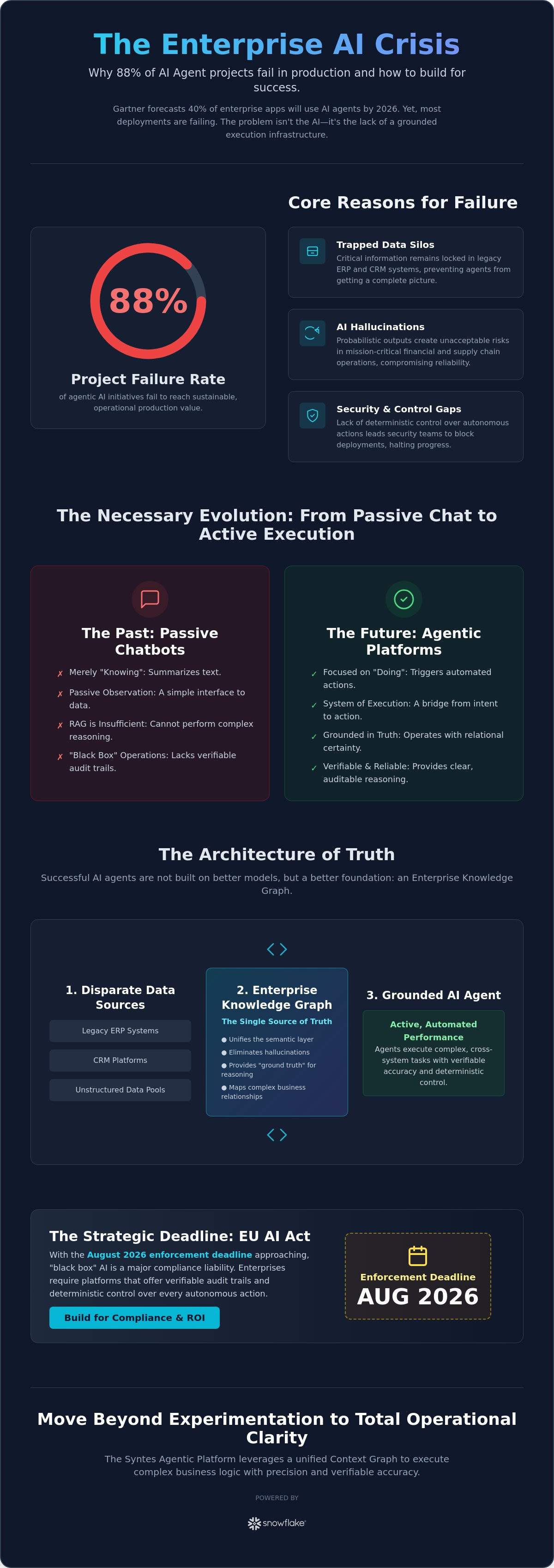
Gartner forecasts that 40% of enterprise applications will embed task-specific AI agents by the end of 2026. Despite this massive adoption, a staggering 88% of agentic projects fail to reach production. The problem isn’t the AI; it’s the lack of a grounding infrastructure. You’ve likely seen the limitations firsthand. Data remains trapped in legacy ERP and CRM silos. Hallucinations compromise reliability. Security teams block deployments because they lack deterministic control over autonomous actions. You need more than a chatbot. You need a robust ai agent platform that transforms passive observation into active, automated performance.
We understand the gravity of these operational failures. It’s time to move beyond the experimental phase and toward total operational clarity. This article reveals how enterprise-grade platforms leverage an Enterprise Knowledge Graph to ensure grounded, verifiable outputs. You’ll learn how to integrate disparate software stacks into a unified execution layer. We’ll examine the technical shift from single-agent assistants to multi-agent architectures that drive real-world ROI while meeting the strict August 2026 enforcement deadlines of the EU AI Act.
Key Takeaways
- Transition from passive conversational interfaces to autonomous operational execution. Discover why the shift to agentic intelligence is the mandatory evolution for enterprise systems in 2026.
- Understand why a high-performance ai agent platform requires an integrated Enterprise Knowledge Graph to eliminate hallucinations and provide a verifiable semantic layer for autonomous reasoning.
- Differentiate between the rigid, “if-then” logic of traditional RPA and the dynamic, autonomous decision-making capabilities required for complex, cross-system environments.
- Identify the strategic benchmarks for selecting enterprise-grade infrastructure, prioritizing seamless software stack integration and deterministic security over superficial user interface features.
- Learn how the Syntes Agentic Platform leverages a unified Context Graph to execute complex business logic with precision and verifiable accuracy.
The Enterprise AI Crisis: Why Generic AI Agent Platforms Fail at Scale
The era of the experimental chatbot is over. While 51% of enterprises report having agents in production, a staggering 88% of these projects fail to reach a state of sustainable operational value. This discrepancy exists because most organizations are attempting to solve complex systemic problems with consumer-grade builders. These generic tools treat AI like a junior employee or a simple interface for answering questions. In a global enterprise environment, that isn’t enough. You don’t need another way to talk to your data. You need a way to make your data act.
A true ai agent platform is not a conversational layer; it’s a system of execution. It must navigate the messy realities of legacy ERP and CRM silos while maintaining deterministic control over every output. When a probabilistic error occurs in a marketing email, the cost is negligible. When that same error occurs in a high-risk financial transaction or a supply chain adjustment, the cost is catastrophic. Generic platforms fail because they lack the architectural depth to handle the sophisticated business logic required for mission-critical workflows.
From Passive Chatbots to Active Agents
The industry is rapidly shifting toward the concept of the intelligent agent, moving beyond simple LLM wrappers that merely summarize text. Business context demands “doing” rather than just “knowing.” It requires a framework that can authenticate across systems, interpret real-time data, and trigger specific API calls without human intervention. An agentic platform is the definitive bridge between intent and action. It transforms a user’s strategic goal into a series of verified, automated steps across the entire software stack.
The Reliability Barrier in Production
Retrieval-Augmented Generation (RAG) has become the standard for reducing hallucinations, yet it remains insufficient for complex reasoning. RAG is a passive retrieval mechanism. It cannot solve the “black box” problem inherent in autonomous agents. In regulated environments, especially with the EU AI Act enforcement deadline of August 2, 2026, approaching, lack of transparency is a liability. You must identify the hallucination threshold where probabilistic AI meets deterministic business requirements. If your ai agent platform cannot provide a verifiable audit trail of its reasoning process, it’s a risk to your operations, not an asset.
The Architecture of Truth: Why an AI Agent Platform Requires a Knowledge Graph
Data is a liability without structure. Most enterprises are drowning in unstructured data pools, hoping that an LLM can magically navigate the chaos. It can’t. A generic ai agent platform treats your information as a flat file, leading to the high failure rates we see in production today. The solution is not a better model. It is a better foundation. You must move from unstructured data to structured, actionable intelligence by integrating an Enterprise Knowledge Graph into your execution layer.
The value of an AI agent platform is not in the agent itself, but in the semantic infrastructure that grounds it. A Knowledge Graph provides the necessary “ground truth” for autonomous reasoning. It acts as a map of your entire enterprise, defining the entities, relationships, and logic that exist across your organization. Without this map, agents are merely guessing based on statistical probability. With it, they operate with relational certainty. This is the transition from passive observation to active, automated performance.
Unifying the Semantic Data Layer
Knowledge graphs don’t just store data; they define what that data means in context. Your ERP, CRM, and legacy silos often contain conflicting or fragmented records. A semantic data layer for enterprise acts as the connective tissue, mapping complex relationships across these disparate sources. It creates a single source of truth that your agents can query with total confidence. By unifying these stacks, you enable your ai agent platform to understand that a “customer ID” in one system is the same “strategic partner” in another, ensuring seamless cross-system execution.
Grounding Agents in Business Logic
Autonomous agents must follow strict corporate policies and operational constraints. You cannot allow an agent to “hallucinate” a discount or ignore a compliance requirement. Semantic grounding is the definitive method for how to prevent ai hallucination in production. It replaces the “black box” of LLM reasoning with a deterministic framework. When an agent acts, it does so based on the verified logic stored within the graph. This ensures that every output is grounded in reality, meeting the rigorous standards of global enterprise. To achieve this level of precision, you need a partner who understands the deep technical requirements of Enterprise Knowledge Graphs and their role in operational AI.
Agentic Platforms vs. RPA: Evaluating the Execution Framework
Robotic Process Automation (RPA) was a necessary precursor to modern automation. It excels at high-volume, repetitive tasks that follow a rigid, predefined path. However, RPA is fundamentally limited by its lack of cognitive flexibility. An ai agent platform, by contrast, is designed for autonomous decision-making. It doesn’t just follow a script; it evaluates the environment, interprets intent, and determines the best course of action to achieve a specific goal. This marks a fundamental shift in enterprise strategy. You are no longer managing a series of rigid workflows. You are managing outcomes.
The transition from task-based automation to goal-oriented agency is mandatory for global enterprises. While RPA stutters when data structures shift or UI elements change, an agentic framework leverages semantic context to adapt. It moves the needle from simple “if-then” logic to sophisticated reasoning. This is the difference between a system that breaks and a system that executes. To scale in 2026, you need infrastructure that handles the messy reality of dynamic business environments without constant human intervention.
The Limits of Linear Automation
Traditional RPA is brittle. It relies on hard-coded rules that fail the moment a data structure in your ERP or CRM deviates from the expected format. This creates a massive maintenance burden. Your developers spend more time patching old automations than building new ones. Within a complex enterprise, the cost of managing these brittle scripts often outweighs the initial efficiency gains. You must identify processes that require autonomous judgment rather than rigid rules. If a workflow involves interpreting ambiguous data or navigating cross-system edge cases, RPA isn’t the solution. It’s a liability.
The Rise of Autonomous Agency
Modern operations require a higher level of intelligence. The emergence of agentic ai platforms represents the definitive evolution of enterprise execution. These systems use internal reasoning to navigate multi-step tasks that lack a clear, linear path. Unlike legacy tools, they verify their own completion. They can pivot, re-query data, or change their execution strategy if an initial attempt fails. This level of autonomy is what separates a sophisticated ai agent platform from the legacy automation tools of the previous decade. By shifting the focus from “how” a task is done to “what” must be achieved, you unlock a state of total operational clarity.
Selecting an AI Agent Platform: A Strategic Framework for 2026
Do not be seduced by shiny user interfaces or low-code drag-and-drop builders. In the high-stakes environment of global enterprise, a visual canvas is a secondary concern. The primary concern is execution competency. When evaluating an ai agent platform, you must look beneath the surface at the architectural plumbing. Can the system handle the messy reality of your existing software stack? Is it capable of maintaining deterministic control while operating at scale? Choosing the wrong foundation now will lead to a fragmented ecosystem that is impossible to govern and expensive to maintain.
The strategic selection process must prioritize systemic connectivity and verifiable security over superficial ease of use. You need a platform that behaves like a seasoned consultant, not a toy. It must possess the technical depth to bridge the gap between high-level strategic intent and granular, cross-system execution. This requires a shift in perspective. You aren’t just buying a tool; you are selecting the central nervous system for your future operations.
Cross-System Integration as a Core Competency
An agent is only as effective as the systems it can manipulate. If your agents are confined to a single database or a limited set of modern APIs, they are essentially glorified scripts. True operational intelligence requires deep connectivity into the legacy environments where your business actually lives. Success depends on solving enterprise data silos through a unified semantic layer. Your chosen ai agent platform must offer robust middleware capabilities and native integrations for ERP and CRM systems to ensure that data flows seamlessly from observation to action. Without this, your agents remain trapped in silos, unable to execute multi-step workflows that drive real value.
Security and Governance for Autonomous Systems
Autonomous agency introduces unprecedented risks. You must implement a governance framework that balances speed with safety. This involves moving beyond simple “Human-in-the-loop” models, which often create bottlenecks, toward “Human-on-the-loop” oversight. In this structure, humans monitor high-level outcomes and intervene only when the system detects an edge case it cannot resolve with certainty. Transparency is non-negotiable. Every decision made by an agent must be auditable and grounded in corporate policy. If you cannot trace the reasoning process of an autonomous agent back to a verified data source, you cannot deploy it in a regulated production environment.
The complexity of building these systems internally is often underestimated. Navigating the “Build vs. Buy” dilemma requires an honest assessment of your internal engineering capacity. Most organizations find that architecting a custom semantic layer and execution framework is a multi-year endeavor fraught with risk. The more efficient path is leveraging proven enterprise ai infrastructure that is already optimized for agentic intelligence. For leaders ready to move from theory to production, the definitive next step is to explore the Syntes Agentic Platform and its integrated execution capabilities.
Syntes Agentic Platform: Executing Complex Logic with Precision
Theoretical discussions regarding AI potential have reached their limit. While the market remains saturated with fragmented tools and fragile pilots, Syntes AI delivers the definitive execution layer for the global enterprise. The Syntes AI Agentic Platform represents the shift from experimental AI to industrial-scale performance. It’s not a simple builder or a conversational interface. It’s a sophisticated ai agent platform designed to navigate the messy realities of cross-system operations. By integrating an Enterprise Knowledge Graph directly into the reasoning engine, Syntes AI ensures that every autonomous action is grounded in your specific business logic. We don’t just facilitate chat; we drive verifiable execution.
Precision is the only metric that matters in a production environment. When an agent interacts with your ERP or triggers a transaction in your CRM, it must do so with relational certainty. Syntes AI provides a unified semantic layer that acts as the source of truth for every autonomous decision. This architecture moves your organization away from the “black box” of probabilistic AI and toward a transparent, auditable system of record. You gain the ability to coordinate multi-step workflows that bridge the gap between legacy data silos and modern cloud APIs. This is how you transition from passive observation to active, automated performance at the highest level of enterprise requirements.
The Syntes AI Difference: Grounding in Reality
Hallucinations occur when agents lack the necessary context to interpret data. Syntes AI eliminates this risk through its proprietary “Context Graph,” a core component of the execution layer launched in early 2026. Unlike standard RAG systems that rely on vector-only search, Syntes AI utilize an enterprise knowledge graph to map the causal relationships between your data entities. In a supply chain context, this means an agent doesn’t just see a “delayed shipment” as an isolated data point. It understands how that delay impacts production schedules and customer commitments. This technical superiority ensures that your agents operate with a level of relational intelligence that generic models cannot replicate. It provides the deterministic grounding required for high-stakes financial and operational workflows.
Scaling Operational Intelligence
Managing a single agent is a pilot; orchestrating a global network of specialized agents is a strategic evolution. The Syntes AI Agentic Platform is architected to serve as the central nervous system for your enterprise. It coordinates cross-system integrations that were previously impossible to automate due to data fragmentation. This allows your leadership teams to stop managing individual, brittle workflows and start managing autonomous outcomes. The “Syntes AI Enterprise AI Execution Layer” provides the governance and security frameworks necessary to scale these networks without compromising deterministic control. The future of enterprise operations is autonomous, grounded, and verifiable. It’s time to move beyond experimentation. Request a demonstration of the Syntes AI Agentic Platform today and begin your transition toward total operational clarity.
The Mandate for Agentic Intelligence: Moving Toward Operational Clarity
The window for experimental AI is closing. By 2026, the distinction between market leaders and laggards will be defined by their ability to deploy autonomous, grounded intelligence at scale. You’ve seen why generic builders fail. They lack the structural depth to navigate the complexities of global enterprise. A high-performance ai agent platform must be more than an interface; it must be a central nervous system. This requires an enterprise-grade Knowledge Graph to provide deterministic grounding and eliminate the risk of hallucinations in production. It demands full cross-system integration that breathes new life into your legacy ERP and CRM stacks, ensuring that your agents act on real-time, verified data across every silo.
Scale your operational intelligence with the Syntes Agentic Platform and lead the evolution of enterprise AI.
Frequently Asked Questions
What is the difference between an AI agent and an AI agent platform?
An AI agent is an individual autonomous unit designed to perform a specific task. An ai agent platform is the comprehensive infrastructure that orchestrates, governs, and grounds multiple agents. While an agent provides the capability, the platform provides the security, memory, and cross-system connectivity necessary for enterprise deployment. It serves as the execution layer that allows disparate agents to collaborate within a unified semantic environment.
Can an AI agent platform integrate with my legacy ERP and CRM systems?
Yes, a sophisticated platform utilizes cross-system integrations to bridge the gap between modern AI models and legacy architectures. It acts as a middleware layer that translates high-level agentic intent into specific API calls or database queries for systems like SAP, Oracle, or Salesforce. This ensures that your agents can access and manipulate data trapped in silos, transforming static records into actionable operational intelligence.
How do I prevent AI agents from making incorrect decisions in production?
Incorrect decisions are prevented through deterministic grounding and a unified semantic layer. By anchoring agent reasoning in an Enterprise Knowledge Graph, the system ensures that every output is verified against corporate policies and real-time data. This eliminates the black box nature of LLMs. It replaces probabilistic guessing with relational certainty, allowing for Human-on-the-loop oversight where humans monitor high-level outcomes rather than individual tasks.
Is an AI agent platform more secure than a standard enterprise chatbot?
An ai agent platform is significantly more secure because it implements granular access controls and deterministic execution logic. Unlike standard chatbots that often lack auditability, an enterprise platform tracks every decision path and system interaction. This level of transparency is essential for meeting regulatory deadlines like the EU AI Act on August 2, 2026, which mandates strict governance for high-risk AI systems.
Do I need a knowledge graph to run an AI agent platform effectively?
A knowledge graph is indispensable for any enterprise-grade deployment that requires verifiable accuracy. Without a graph to provide semantic context, agents rely on vector-only searches that often miss complex relationships and causal logic. The graph serves as the ground truth. It enables agents to understand the business logic behind the data, which is the only way to eliminate hallucinations in mission-critical workflows.
How does an agentic platform compare to traditional RPA tools?
Agentic platforms are built for autonomous reasoning, whereas RPA is restricted to linear, if-then scripts. RPA breaks when a UI element changes or a data structure deviates; an agentic platform uses internal logic to adapt to dynamic environments. You move from managing brittle, hard-coded workflows to managing goal-oriented outcomes. This reduces the maintenance burden and allows for automation in processes that require judgment.
What are the most common use cases for AI agent platforms in 2026?
By the end of 2026, 40% of enterprise applications will embed task-specific agents. Common use cases include autonomous supply chain reconciliation, real-time financial auditing, and hyper-personalized customer lifecycle management. In these scenarios, agents don’t just answer questions. They trigger cross-system actions, such as reordering stock when a delay is detected or updating CRM records based on complex contract negotiations. For enterprises focusing on revenue growth, you can discover Global AI Reps and their specialized agents for lead generation and sales automation.
What is the expected ROI of deploying an enterprise-grade agentic platform?
The ROI of an enterprise-grade platform is realized through the reduction of manual intervention and the elimination of project failure costs. With Gartner reporting that 40% of agentic projects are at risk of cancellation by 2027 due to poor governance, a robust platform protects your initial investment. It accelerates time-to-production by providing the necessary infrastructure for security and integration, directly impacting operational efficiency and scalability.