What if your AI could reason across every PDF, email, and SQL database with the same deterministic precision as your most seasoned expert? Most organizations fail this test because their intelligence is trapped in disconnected silos. You need a robust knowledge graph for unstructured data to transform these fragments into a cohesive, machine-readable architecture. Without this semantic foundation, your AI remains a liability prone to hallucinations and systemic errors.
You’ve likely realized that standard RAG isn’t enough to satisfy the rigorous demands of the August 2026 EU AI Act or the latest NIST AI Risk Management Framework profiles. This guide provides the blueprint for bridging the gap between raw data and actionable intelligence through Enterprise Context Engineering. We’ll explore how to build a unified Context Graph that serves as a live operational memory for your business. You’ll discover how to deploy autonomous agents that are not only efficient but entirely explainable and safe for enterprise-scale automation.
Key Takeaways
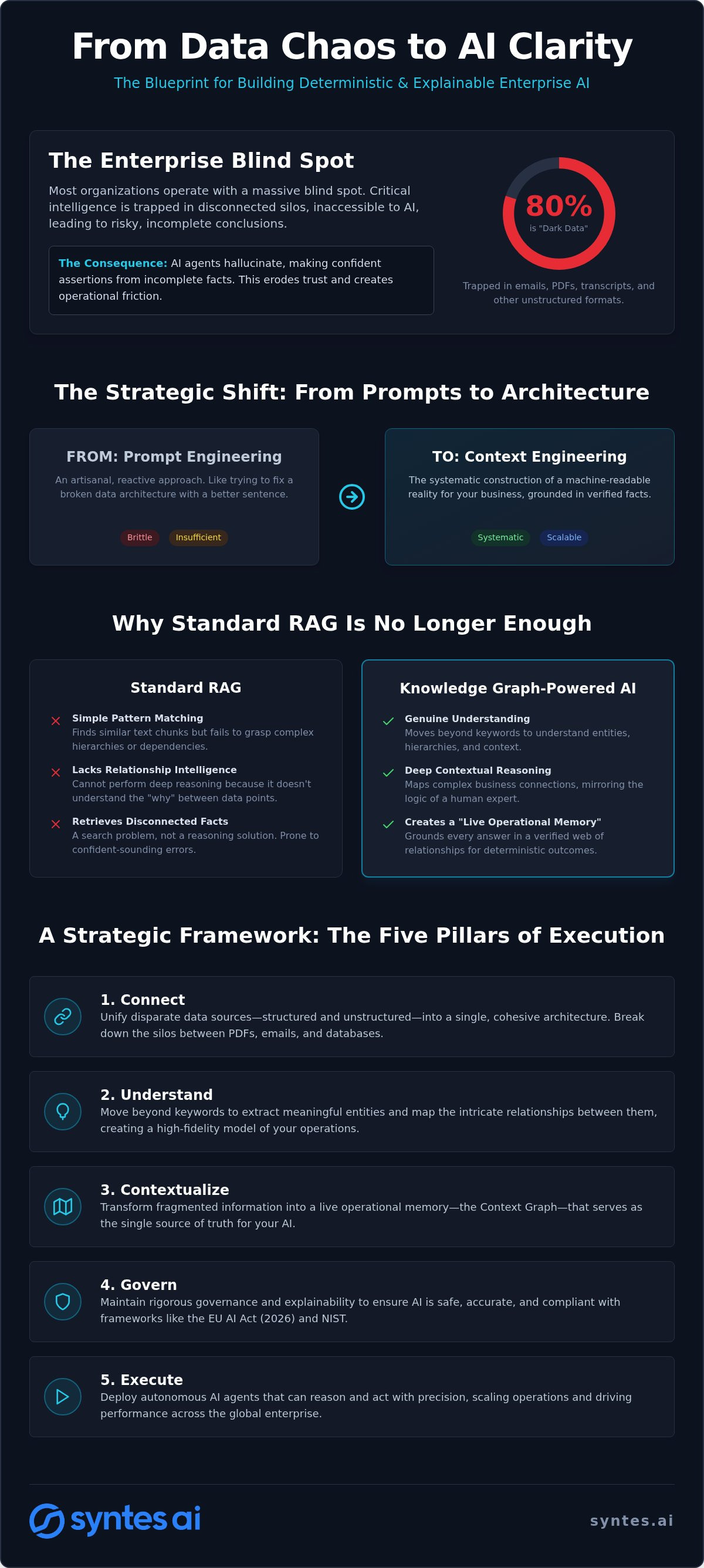
- Identify why 80% of enterprise knowledge remains trapped in “Dark Data” formats and how unification serves as the mandatory foundation for 2026 AI strategies.
- Explore the technical transition from prompt engineering to Context Engineering by deploying a knowledge graph for unstructured data to ensure deterministic AI outcomes.
- Leverage Operational Relationship Intelligence to map complex business connections, turning fragmented information into a high-fidelity, live operational memory.
- Implement the five-pillar framework—Connect, Understand, Contextualize, Govern, and Execute—to streamline data prioritization and maintain rigorous AI governance.
- Scale your operations by architecting a unified context layer that enables the safe deployment of autonomous AI agents across the global enterprise.
Beyond the Data Silo: Why Unifying Structured and Unstructured Data is the 2026 Mandate
Data silos are no longer just an IT inconvenience. In 2026, they’re a direct threat to enterprise viability. True unification requires more than just aggregation; it demands a total synthesis of tabular records and conversational text. Most organizations operate with a massive blind spot because 80% of their knowledge is trapped in unstructured formats like emails, PDFs, and meeting transcripts. This “Dark Data” remains inaccessible to traditional systems, leaving AI agents to guess at the context they lack.
Traditional ETL and data warehousing can’t solve this. These systems were built for retrospective reporting, not real-time reasoning. They’re too slow, too rigid, and too disconnected from the nuances of human language. To move from passive observation to active performance, you need a What is a Knowledge Graph? to map the intricate relationships between these disparate data types. Without this, your AI is essentially a high-speed engine without a steering wheel.
The Fragility of Disconnected Intelligence
Disconnected intelligence leads to black box outcomes. When an AI agent lacks specific business context, it hallucinates. It makes confident assertions based on incomplete facts, creating operational friction that erodes trust. Executives can’t make informed decisions when their tools only see half the picture. Isolated facts aren’t just useless; they’re dangerous. They lead to fragmented strategies and missed opportunities in a market that moves at the speed of light.
The shift from passive data storage to a live operational memory is the only way to ensure your AI understands the “why” behind the numbers. This transition turns static records into a dynamic, evolving asset. It allows for a state of total operational clarity where every decision is backed by the full weight of corporate history and real-time activity. You aren’t just storing data anymore; you’re building a brain.
Why Retrieval-Augmented Generation (RAG) is No Longer Enough
Standard RAG has hit its limit. While vector search can find similar text chunks, it can’t understand complex hierarchies or cross-functional dependencies. It lacks the relationship-based intelligence required for deep reasoning. A knowledge graph for unstructured data bridges this semantic gap by grounding every piece of information in a verified web of relationships. It moves your AI from simple pattern matching to genuine understanding.
Simple retrieval is a search problem. Contextual reasoning is a relationship problem. This is why you need a governed semantic data layer for enterprise. By moving beyond basic vector matching, you enable your AI to perform sophisticated analysis that mirrors human expertise. You don’t just want an AI that can find an answer; you want one that understands the implications of that answer across your entire architecture.
The Architecture of Truth: How Context Engineering Bridges the Semantic Gap
Prompt engineering was a necessary first step, but it’s an insufficient foundation for enterprise-grade AI. You can’t fix a broken data architecture with a better sentence. Context Engineering represents the shift from artisanal prompt crafting to the systematic construction of a machine-readable reality. It’s the discipline of building a knowledge graph for unstructured data that doesn’t just store information but understands how every entity relates to your specific business logic.
The Syntes AI Context Graph creates a live, relationship-based model of your entire operation. It doesn’t treat data as a collection of isolated files. Instead, it integrates business rules, internal policies, and real-time operational events into a single, unified layer. This semantic mapping provides deterministic grounding. It ensures your AI models aren’t guessing based on statistical probability but are reasoning based on verified facts.
Decoding Context Engineering: From Prompts to Living Graphs
Graph structures are inherently superior for representing the messy, interconnected reality of global enterprise. Traditional relational databases fail when asked to map the complex web of cross-system dependencies. A hybrid graph allows you to link a structured customer record seamlessly to an unstructured support transcript. This is how you achieve true Operational Relationship Intelligence. By leveraging a knowledge graph for unstructured data, you create a foundation for GraphRAG that delivers trusted, explainable AI outcomes.
Research into knowledge graphs for cybersecurity education demonstrates the power of extracting specific entities from complex texts to create actionable models. Every response can be traced back to a specific node and relationship in the graph. If you’re ready to see this architecture in action, you can experience the Context Graph firsthand. This isn’t just another database; it’s the operational memory your AI has been missing.
Operational Relationship Intelligence: Turning Fragmented Information into Actionable Context
Data without relationship is just noise. Most enterprises are drowning in records while starving for the narrative that connects them. Operational Relationship Intelligence (ORI) represents the shift from observing what happened to understanding why it occurred. By deploying a knowledge graph for unstructured data, organizations can finally map the causal links between structured transactions and the messy reality of human interaction. This isn’t a mere technical upgrade; it’s a fundamental change in how enterprise intelligence is synthesized and utilized.
Unification allows AI to move beyond surface-level pattern matching. It enables a deep understanding of the business logic that governs every interaction. When your AI understands the relationship between a supply chain delay and a specific clause in a vendor contract, it stops being a chatbot and starts being an operational asset. This bridging of proprietary enterprise knowledge with general LLM capabilities provides the semantic grounding necessary for high-stakes decision-making. It transforms a general-purpose model into a specialized expert that understands your unique operational DNA.
Mapping Entities Across Transactions and Documents
True intelligence requires a 360-degree view of every entity. You must unify product specifications residing in an ERP with the nuanced feedback found in support transcripts or technical manuals. Integrating specialized tools like FeedbackGraph to streamline the capture of bug reports and feature requests ensures that customer insights are consistently fed into your unified context layer. Cross-system integration ensures that a customer’s record is never divorced from their actual experience. Maintaining data integrity across these disparate systems requires a sophisticated ontology that preserves the provenance of every fact. This consistency is the bedrock of trust in any autonomous system. It ensures that every agent operates from a single, verified version of the truth.
Data warehouses are cemeteries for information. They offer a retrospective, point-in-time view that is fundamentally incompatible with the needs of real-time AI agents. A Live Operational Memory, by contrast, is a continuously evolving graph that reflects the current state of the business as it happens. It provides the real-time context required for cross-functional workflow automation. This architectural shift is essential for solving enterprise data silos and moving toward a state of total operational clarity. You don’t need more data; you need a more intelligent way to remember and act upon it.
A Strategic Framework for Data Unification: The Five Pillars of Execution
Execution is where strategy meets reality. The Syntes Context Engineering Framework provides a methodical roadmap: Connect, Understand, Contextualize, Govern, and Execute. This isn’t a linear process but a recursive cycle of refinement. Building a knowledge graph for unstructured data is the core technical requirement for this journey. To maximize impact, prioritize data sources where structured transactional records intersect with high-value unstructured narratives. This intersection is where the most critical business logic resides.
Scaling this architecture across a global enterprise requires more than just raw compute. It demands a sophisticated approach to data prioritization. You don’t need to unify every byte of data on day one. Focus on high-fidelity streams that drive immediate operational value. Human-in-the-loop systems play a vital role here, especially during the initial mapping phases. Subject matter experts must verify the semantic models to ensure the unified graph accurately reflects the nuances of your specific industry.
From Connection to Contextualization
Step 1 is Connection. You must bridge the gap between rigid ERP systems and fluid collaboration tools like Slack or Microsoft Teams. You need a knowledge graph for unstructured data to map these informal exchanges back to formal records. This ensures that a project update in a chat thread is automatically linked to the corresponding budget line item in your financial database.
Step 2 focuses on Understanding. The system must automatically discover hierarchies, entities, and business semantics. It needs to recognize that “Client A” in a contract is the same entity as “Account A” in your CRM. This automated discovery eliminates the high cost and complexity of manual data labeling.
Step 3 is Contextualization. This is where you build the dynamic enterprise model via the Context Graph. This isn’t a static map; it’s a living representation of your business that updates in real-time. It provides the “operational memory” that allows AI agents to reason with the same depth as a tenured employee.
Governing Agentic AI Across Unified Data Streams
Trust is the only currency that matters in AI. Applying granular security, permissions, and business rules to the unified context layer is non-negotiable. This governance allows agentic ai platforms to act with autonomy without risking compliance or security breaches. You aren’t just giving the AI data; you’re giving it a set of boundaries.
Auditability and explainability are the final requirements for trusted execution. By grounding agents in a unified context layer, you ensure that every action is traceable. You can audit the exact path of reasoning from a raw data point to a final decision. This level of transparency is mandatory for any organization operating under strict regulatory frameworks like the EU AI Act.
Architecting the Future: Deploying a Unified Context Layer with Syntes AI
Success in the agentic era requires more than just better models. It requires a superior architecture. The Syntes AI Enterprise AI Platform provides the industrial-grade infrastructure necessary for high-scale unification. It transforms fragmented data streams into a singular, machine-readable asset. By deploying a knowledge graph for unstructured data, you move beyond the limitations of legacy systems. This architecture builds the foundation for enterprise knowledge graphs that actually work. It turns your data into a strategic weapon rather than a storage liability.
The transition from passive observation to autonomous agentic execution is the ultimate goal. Unified data allows AI agents to act with the same confidence as your top performers. The ROI of this shift is visible across three primary dimensions. First, you gain speed. Deployment cycles that previously took months now take weeks. Second, you gain accuracy. Reasoning becomes deterministic rather than probabilistic. Finally, you gain enterprise-wide intelligence. You create a system where every node in the organization benefits from the collective knowledge of the whole.
Moving Beyond RAG to Trusted AI Execution
Simple retrieval is no longer a viable strategy for the global enterprise. While RAG served as a useful bridge, it cannot support the complex reasoning required for autonomous operations. You must move toward reasoning over a unified context layer. This is the definitive way to prevent ai hallucination. Deterministic semantic grounding ensures that every AI output is rooted in your specific business reality. A continuously evolving operational memory provides a competitive advantage that competitors cannot easily replicate. It allows your AI to learn from every transaction, email, and update in real-time.
Next Steps for the AI-First Enterprise
Your first priority is a critical assessment of your current enterprise ai infrastructure. You must determine if your systems are ready for the deep unification required by Context Engineering. Don’t wait for a perfect global solution. Start with a high-impact use case in Retail, Finance, or Manufacturing. These sectors often face the most significant challenges with fragmented data and high-stakes decision-making. Prove the value of the Context Graph in a controlled environment, then scale across the organization. The path to operational clarity is clear. Architect your Live Operational Memory with Syntes AI today and lead the transition to trusted, agentic intelligence.
Master the Intelligence Layer: Your Path to Operational Clarity
The era of passive data storage has ended. To compete in 2026, your enterprise must transition to a state of total operational clarity where every AI action is grounded in verified business logic. This requires more than just better prompts; it demands a sophisticated knowledge graph for unstructured data that bridges the gap between fragmented silos and autonomous execution. By implementing the Syntes Context Engineering Framework, you move from simple retrieval to deep, relationship-based reasoning.
You’ve seen how the Syntes AI Context Graph creates a live operational memory that evolves in real-time. This deterministic grounding provides a drastic reduction in hallucinations, ensuring that your agentic AI remains safe, explainable, and compliant with global standards. The shift to a governed agentic AI framework isn’t just a technical upgrade; it’s a strategic mandate for the modern enterprise.
Your journey toward trusted, high-scale automation begins with a single architectural decision. The tools to unify your intelligence are ready. It’s time to build the foundation your AI has been missing.
Frequently Asked Questions
What is the difference between structured and unstructured data in an AI context?
Structured data consists of tabular, rigidly formatted records found in SQL databases or ERP systems. Unstructured data includes conversational text, emails, and PDFs. In an AI context, structured data provides the “what,” while unstructured data provides the “why.” You need both to create a deterministic model. Most enterprises struggle because 80% of their knowledge is trapped in unstructured formats that traditional systems can’t parse or relate to transactional records.
How does a Knowledge Graph help in unifying disparate data sources?
A knowledge graph creates a semantic map of relationships between entities across your entire architecture. It doesn’t just store data; it understands how a customer record in your CRM relates to a specific complaint in a support transcript. Using a knowledge graph for unstructured data allows you to ground AI agents in a verified web of facts. This architecture transforms isolated data points into a cohesive, machine-readable intelligence layer that mirrors real-world business logic.
Can I unify data from legacy ERP systems with modern cloud applications?
You can unify disparate systems through sophisticated cross-system integrations that map legacy schemas to modern semantic ontologies. Legacy ERP systems often contain vital historical records, while cloud applications capture real-time interaction data. Unification bridges this gap by creating a unified context layer. This allows your AI to reason across decades of financial history and current collaboration threads simultaneously. You don’t need to replace legacy tech; you need to wrap it in a modern intelligence layer.
What are the security risks of unifying all enterprise data for AI?
The primary risk involves unauthorized data exposure through AI agents that lack granular permission awareness. Unifying data without a robust AI Governance framework can lead to sensitive information leaks. You must apply strict security rules at the context layer. This ensures that an AI agent only accesses data that the specific user is authorized to see. Governed unification actually improves security by providing a single, auditable point of control for all enterprise intelligence assets.
How does Context Engineering prevent AI hallucinations better than RAG?
Context Engineering provides deterministic grounding by mapping relationships, whereas RAG relies on probabilistic vector similarity. Simple RAG often retrieves irrelevant text chunks that confuse the model. Context Engineering uses a knowledge graph for unstructured data to ensure the AI understands the exact hierarchy and business rules governing a query. This shift from simple retrieval to relationship-based reasoning eliminates the guesswork that leads to hallucinations. It creates a reliable foundation for trusted, agentic execution.
What industries benefit most from unifying structured and unstructured data?
High-stakes industries with complex regulatory requirements and massive data fragmentation see the highest ROI. These include:
- Financial Services: For risk assessment and fraud detection.
- Manufacturing: For supply chain optimization and predictive maintenance.
- Healthcare: For patient data synthesis and clinical reasoning.
- Retail: For hyper-personalized customer journeys.
Any sector where operational errors carry significant financial or legal consequences requires the precision of a unified context layer to ensure safe, automated performance.
Do I need to move all my data into a single repository to unify it?
You don’t need to centralize your raw data to unify your intelligence. A Context Graph acts as a virtualized layer that maps relationships across existing repositories. This federated approach avoids the high cost and complexity of massive data migration projects. You maintain your data where it lives while creating a unified semantic index. This allows for real-time reasoning without the latency or security risks associated with moving terabytes of sensitive enterprise information into a new silo.
How does Syntes AI manage real-time updates to the Context Graph?
Syntes AI utilizes a Live Operational Memory that ingests events as they occur. The platform monitors your connected systems for changes, such as a new contract signature or an updated project status. These updates are semantically processed and integrated into the graph instantly. This ensures that your AI agents always operate on the most current information. You move away from static, point-in-time snapshots toward a dynamic model that reflects the exact current state of your business.