

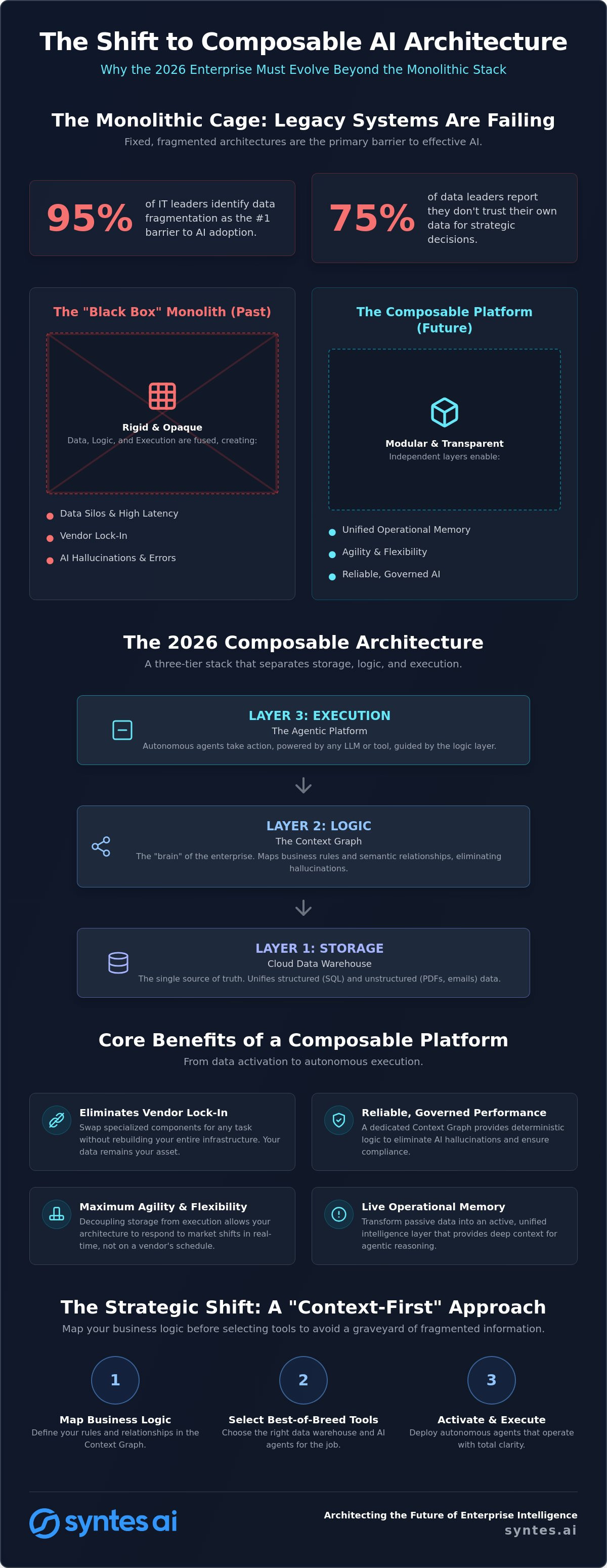
Your monolithic legacy stack isn’t a foundation; it’s a cage. In a 2026 market where agentic AI must reason and execute in milliseconds, the rigid architectures of the past have become terminal liabilities. You’ve likely watched your AI initiatives stall as models hallucinate from a lack of context or struggle to pull data from hundreds of disparate applications. 95% of IT leaders now identify this fragmentation as the primary barrier to AI adoption. To survive, the enterprise must shift from passive storage to active intelligence.
You know that fragmented data leads to high latency and missed opportunities. This article details the strategic benefits of a composable data platform, showing you how a modular architecture transforms siloed records into a live operational memory for autonomous agents. We’ll examine the technical logic behind context engineering and explain how a composable approach eliminates vendor lock-in while ensuring compliance with the latest 2026 privacy regulations. It’s time to replace theoretical experimentation with total operational clarity.
Key Takeaways
- Understand why the 2026 enterprise architecture requires a strict separation between storage, logic, and execution layers to support truly autonomous agents.
- Discover the core benefits of a composable data platform, including the agility to swap specialized components without the risk of total system failure or vendor lock-in.
- Learn how a dedicated Context Graph provides the deterministic business logic necessary to eliminate AI hallucinations and ensure reliable, governed performance.
- Master the “Context-First” strategy for mapping your business logic before tool selection to avoid turning your data stack into an expensive graveyard of fragmented information.
- Identify how the Syntes Agentic Platform integrates with existing data warehouses to transform passive observations into a live operational memory for your organization.
Beyond the Monolith: Why Fixed Data Platforms Fail the Modern Enterprise
Legacy systems are expensive graveyards. They trap your most valuable asset behind proprietary walls and rigid schemas that haven’t evolved since the early 2000s. While these monolithic platforms were designed to record transactions, they were never intended to fuel autonomous reasoning. In 2026, the enterprise that relies on a “Black Box” suite is effectively blinding its AI agents. One of the primary benefits of a composable data platform is the liberation of enterprise intelligence from the constraints of a single vendor’s roadmap. By decoupling storage from execution, you ensure that your data remains an active asset rather than a passive liability.
Why are traditional architectures failing today? They were built for humans to query, not for autonomous agents to reason. When an AI agent attempts to navigate a fragmented landscape of legacy ERPs and CRMs, it encounters high latency and a total lack of business context. This leads to the “Data Silo Trap,” where 75% of data leaders report they don’t trust their own data for strategic decisions. A modular architecture solves this by separating the warehouse from the logic layer, allowing for a seamless flow of information that matches the speed of modern operations.
The Death of the “Black Box” Suite
Fragmented Knowledge vs. Unified Context
There’s a critical difference between having data and possessing Live Operational Memory. Most organizations rely on simple Retrieval-Augmented Generation (RAG) to feed information to their AI, but this often fails because it lacks a structured semantic layer. While a traditional Customer Data Platform (CDP) might centralize user profiles, it often fails to provide the deep semantic relationships required for agentic reasoning. A Composable Data Platform is a modular architecture that separates data storage, semantic modeling, and autonomous execution into independent, interoperable layers. By establishing a unified context graph, you provide your agents with a deterministic map of your business rules, ensuring that every action taken is grounded in reality rather than hallucination.
The 2026 Architecture: Defining the Composable Data Platform for Agentic AI
The 2026 enterprise doesn’t need another application; it needs a flexible architecture. The monolithic approach failed because it conflated raw storage with complex business logic, creating a rigid “body” without a centralized “brain.” One of the primary benefits of a composable data platform is the deliberate separation of these functions into a three-tier stack: the Cloud Data Warehouse for storage, the Context Graph for logic, and the Agentic Platform for execution. This modularity ensures that your business rules remain independent of any specific LLM or software vendor. By isolating the logic, you gain the ability to upgrade your execution engines without corrupting the underlying intelligence of your organization.
This architectural shift enables sophisticated cross-system AI integration, allowing organizations to finally unify structured data from SQL databases with the unstructured intelligence found in PDFs, emails, and call transcripts. It transforms “Context Engineering” from a manual, ad-hoc task into a repeatable enterprise discipline. Why must the logic layer exist independently? Because hard-coding business rules into an application creates a maintenance nightmare that stifles agility. By treating context as a first-class citizen, you provide your agents with the precise operational parameters they need to act with total autonomy and zero human oversight.
The Semantic Layer as the Orchestrator
Flat tables are dead. Relationship-based intelligence is the new enterprise standard. A semantic data layer for enterprise acts as the orchestrator of the entire stack, providing the ground truth for AI reasoning. It functions as the “glue” that binds disparate data sources into a single, coherent reality. Without this layer, your AI is merely guessing based on word proximity; with it, the AI understands the causal relationships between a supply chain delay and a specific customer’s contract terms. This layer ensures that the composable stack behaves like a unified system rather than a collection of disconnected parts.
Live Operational Memory: The Competitive Edge
Static reports are historical artifacts. In contrast, Live Operational Memory is a continuously evolving model of your business in motion. Composability allows for real-time updates from ERP, CRM, and PLM systems, ensuring your agents never act on stale or contradictory information. This architecture is already transforming marketing intelligence and operational ROI by shifting the focus from backward-looking analytics to autonomous execution. When your data stack is live, your enterprise moves from passive observation to proactive, automated performance. To see how this architecture functions in a production environment, you can examine a live context graph implementation.
Core Benefits: From Data Activation to Autonomous Execution
The strategic benefits of a composable data platform extend far beyond the marketing-centric use cases of previous years. In 2026, the priority has shifted from simple data activation to autonomous execution. Organizations are no longer satisfied with static dashboards; they require agents that can act with precision. This transition demands an architecture that prioritizes agility and governance. By centralizing security and permissions at the data layer rather than the application layer, you create a robust perimeter that follows the data regardless of which tool is accessing it. This ensures that every agentic action is not only efficient but fully auditable and compliant with evolving global regulations like the CCPA and EU AI Act.
Eliminating the “Hallucination Tax”
The hallucination tax is a choice. High-performing enterprises understand that preventing AI hallucination depends entirely on the quality and structure of the underlying context. While Large Language Models operate on statistical probability, enterprise operations require deterministic truth. Knowledge Graphs provide this certainty by mapping explicit relationships between data points. Composable architectures facilitate the implementation of GraphRAG, combining the retrieval power of knowledge graphs with the generative capabilities of LLMs to ensure unparalleled AI accuracy. This ensures that when an agent retrieves a contract term or a supply chain status, it’s accessing a verified fact, not a creative guess.
Scaling Agentic Intelligence
Modern agentic ai platforms require a modular data foundation to operate at scale. Without it, you’re merely deploying isolated chatbots that lack the “connective tissue” to understand business rules across systems. Composability enables agents to interpret and apply complex policies consistently, whether they’re processing a refund in a CRM or updating inventory in an ERP. We’re witnessing a fundamental shift from reactive chatbots to governed agents capable of executing high-stakes operational tasks. This scale is only achievable when the data platform is designed to be as dynamic and interconnected as the business it serves.
The Strategic Shift: Implementing a Context-First Composable Stack
Implementation is not a procurement exercise; it is a strategic realignment. Most enterprises fail because they select tools before they define the logic those tools must execute. Adopting a “Context-First” approach means mapping your business rules, causal relationships, and operational constraints before committing to a specific vendor. This shift is what unlocks the true benefits of a composable data platform. By prioritizing the semantic structure of your organization, you ensure that the modular components you eventually select serve a coherent purpose rather than creating new, smaller silos.
Assessing your current enterprise ai infrastructure is the first step in this transition. You must evaluate whether your existing storage layers can support the high-frequency, two-way data exchange required for agentic reasoning. Static, one-way ETL pipelines are insufficient. To maintain a “Live” data state, your architecture requires robust connectors that synchronize changes across disparate systems in real time. This technical foundation supports a culture of Context Engineering, where maintaining the integrity of the knowledge graph becomes a core operational discipline rather than an IT afterthought.
Mapping the Enterprise Knowledge Graph
Data without relationship is noise. An enterprise knowledge graph serves as the essential foundation for any composable stack, defining the core entities, customers, products, policies, and the complex webs that connect them. This graph unifies unstructured intelligence, such as legal contracts and technical manuals, with structured transactional data from your ERP. It creates a single, high-fidelity source of truth that agents use to navigate the enterprise. Without this mapping, your agents lack the situational awareness required to make complex, multi-step decisions.
Governing the Execution Layer
Autonomy requires guardrails. In a composable architecture, you apply security and compliance rules at the semantic layer, ensuring that governance is baked into the data logic itself. This centralized control simplifies auditing and provides clear, human-in-the-loop oversight for autonomous actions. You no longer need to manage permissions across hundreds of individual applications; instead, you govern the “brain” that directs the agents. This architectural clarity is the only way to scale AI safely in a highly regulated 2026 environment. To begin architecting your context-first environment, you should schedule a strategic platform review with our engineering team.
Syntes AI: Architecting the Future of Composable Enterprise Intelligence
Strategy without execution is a hallucination. While the theoretical benefits of a composable data platform are clear, the actual transition requires a platform capable of orchestrating complex reasoning across a modular stack. The Syntes Agentic Platform is that orchestrator. It doesn’t replace your existing investments; it activates them. By integrating directly with your chosen data warehouse and our proprietary Context Graph, Syntes AI provides the execution layer necessary to turn fragmented data into a cohesive, Live Operational Memory. We have identified the systemic flaws in monolithic architectures and built a solution that prioritizes deterministic truth over statistical guesswork.
We’re moving beyond the limitations of standard Retrieval-Augmented Generation (RAG). Simple RAG is a search function; Syntes AI is an intelligence function. Our platform doesn’t just retrieve documents; it understands the causal relationships within your business logic. This is the power of the Syntes Context Graph. It serves as a dynamic, evolving model of your enterprise that allows our governed agents to perform high-stakes operational tasks with explainable reasoning. When an agent executes a workflow, it does so within a strict governance perimeter, ensuring every action is auditable, compliant, and aligned with your specific business rules.
Unifying Your Fragmented Enterprise
Our approach to Context Engineering follows a rigorous five-step methodology: Connect, Understand, Contextualize, Govern, and Execute. We bridge the gap between the general knowledge of Large Language Models and the hyper-specific, proprietary data that defines your competitive advantage. By establishing a “Live” operational model, we ensure that your AI is never acting on stale information from a static database. We connect disparate systems, understand the underlying semantic meaning, and contextualize that data for autonomous performance. This process transforms your data from a passive record of the past into an active driver of future performance.
Ready to Evolve Your Data Strategy?
The transition to a composable architecture is no longer optional. In an era defined by agentic intelligence, the rigidity of the monolith is a terminal risk. Adopting a modular foundation is a strategic necessity for any enterprise that intends to scale autonomous operations without sacrificing security or accuracy. We invite you to move beyond theoretical experimentation and toward total operational clarity. Start your journey by joining a Syntes AI pilot program, where we will help you map your business logic and deploy governed agents within your existing stack. It’s time to realize the full strategic potential of your data. Explore the Syntes Agentic Platform today and architect the future of your enterprise intelligence.
Seize the Operational Advantage of Composable Intelligence
The era of monolithic stagnation is over. Rigid architectures of the past can’t support the autonomous speed required in 2026. By decoupling storage from execution, you’ve unlocked the true benefits of a composable data platform; these include unprecedented agility, systemic governance, and deterministic accuracy. This shift ensures your agents act on a live operational memory rather than stale, fragmented records. You’re no longer just storing data. You’re weaponizing it for autonomous performance.
Syntes AI leads this evolution as a pioneer in Context Engineering. Our enterprise-grade Knowledge Graph technology and governed Agentic AI framework provide the precision required for trusted, high-stakes execution. We help you bridge the gap between general models and proprietary truth. It’s time to stop experimenting with isolated chatbots and start building a unified intelligence layer that scales with your business. The future belongs to the architecturally agile. Architect your enterprise intelligence with Syntes AI today and reclaim total operational clarity.
Frequently Asked Questions
What is the difference between a Composable Data Platform and a traditional CDP?
A traditional CDP is a bundled, proprietary suite that often creates a new data silo. In contrast, one of the primary benefits of a composable data platform is that it utilizes your existing data warehouse as the single source of truth. This prevents data duplication and ensures that every tool in your stack, from marketing to supply chain AI, accesses the same governed records without vendor lock-in.
How does a composable architecture help prevent AI hallucinations?
Hallucinations occur when an AI lacks specific business context. A composable architecture allows you to insert a deterministic logic layer between your data and the LLM. This layer uses structured relationships to verify facts before the AI generates a response, effectively replacing statistical guesswork with grounded enterprise reality and ensuring the agent operates within defined parameters.
Why is a Knowledge Graph essential for a composable data stack?
Knowledge Graphs provide the semantic connective tissue that flat databases cannot. They map the complex, non-linear relationships between your products, customers, and internal policies. This structured context is essential for agentic reasoning, as it allows the AI to understand causal links and business logic rather than just identifying keywords in a document or table.
Can a composable data platform work with my existing legacy ERP systems?
Yes, composable platforms are designed specifically for cross-system integration. You don’t need to decommission your legacy ERP. Instead, you use modular connectors to pipe data into a centralized warehouse or logic layer. This allows your AI agents to reason over legacy data while you maintain your existing operational core without a risky rip-and-replace migration.
What are the main security benefits of a composable data architecture?
Security is centralized at the data layer. Instead of managing complex permission sets across dozens of different SaaS applications, you define your governance rules once at the warehouse or semantic level. This ensures that security policies remain consistent regardless of which agent or tool is interacting with the information, significantly reducing your enterprise attack surface.
How does a composable platform support the deployment of Agentic AI?
Agentic AI requires a Live Operational Memory to function autonomously. A composable platform provides this by allowing agents to access real-time data and business logic independently of the application layer. This modularity enables agents to execute multi-step workflows across your entire technical stack without being tethered to the limitations of a single monolithic software suite.
What is “Context Engineering” and why does it matter for my data strategy?
Context Engineering is the technical discipline of structuring enterprise knowledge into a format that AI can understand and execute. It matters because raw data lacks the “rules of the road” your business follows. By engineering this context into a Knowledge Graph, you ensure your AI understands your specific operational constraints and strategic priorities rather than just performing generic tasks.
Is it difficult to migrate from a monolithic platform to a composable one?
Migration is actually simpler and less risky than traditional wholesale upgrades. Because the architecture is modular, you can transition in phases. You might start by moving your storage to a cloud warehouse or by implementing a semantic logic layer first. This approach reduces operational risk while providing immediate, incremental value to your current AI initiatives.