

Your AI agents aren’t failing because they lack raw intelligence; they’re failing because they lack a map of your business logic. Most enterprises are currently drowning in data silos while starving for context. The choice between a semantic data fabric vs knowledge graph represents a critical strategic fork in your AI roadmap. You already know that legacy semantic layers are too rigid and high maintenance to support the speed of modern business. You’ve seen how ERP and CRM data remains stubbornly isolated, preventing the creation of a unified memory for your autonomous agents.
We will help you navigate this architectural divide to build a trusted foundation for enterprise autonomous intelligence. You’ll learn how to move beyond simple data virtualization toward a relationship-dense context layer that enables explainable AI audit trails. This article breaks down how to achieve scalable cross-system integration without the crushing overhead of traditional ETL. We’re moving from passive data observation to active, automated performance. It’s time to architect a system where reasoning is grounded in reality.
Key Takeaways
- Identify the core functional distinction between a data fabric’s focus on accessibility and an enterprise knowledge graph’s focus on entity-based business logic.
- Bridge the “Hallucination Gap” by understanding why virtualized data layers often fail to provide the deep grounding necessary for reliable agentic reasoning.
- Evaluate the trade-offs of a semantic data fabric vs knowledge graph across critical enterprise vectors including scalability, governance, and real-time reasoning.
- Implement the 5-Pillar Context Engineering framework to transform siloed ERP and CRM data into a unified, live operational memory.
- Shift from passive data observation to active execution by leveraging a governed Context Graph to power autonomous enterprise tasks.
Semantic Data Fabric vs Knowledge Graph: Definitions for the Agentic Era
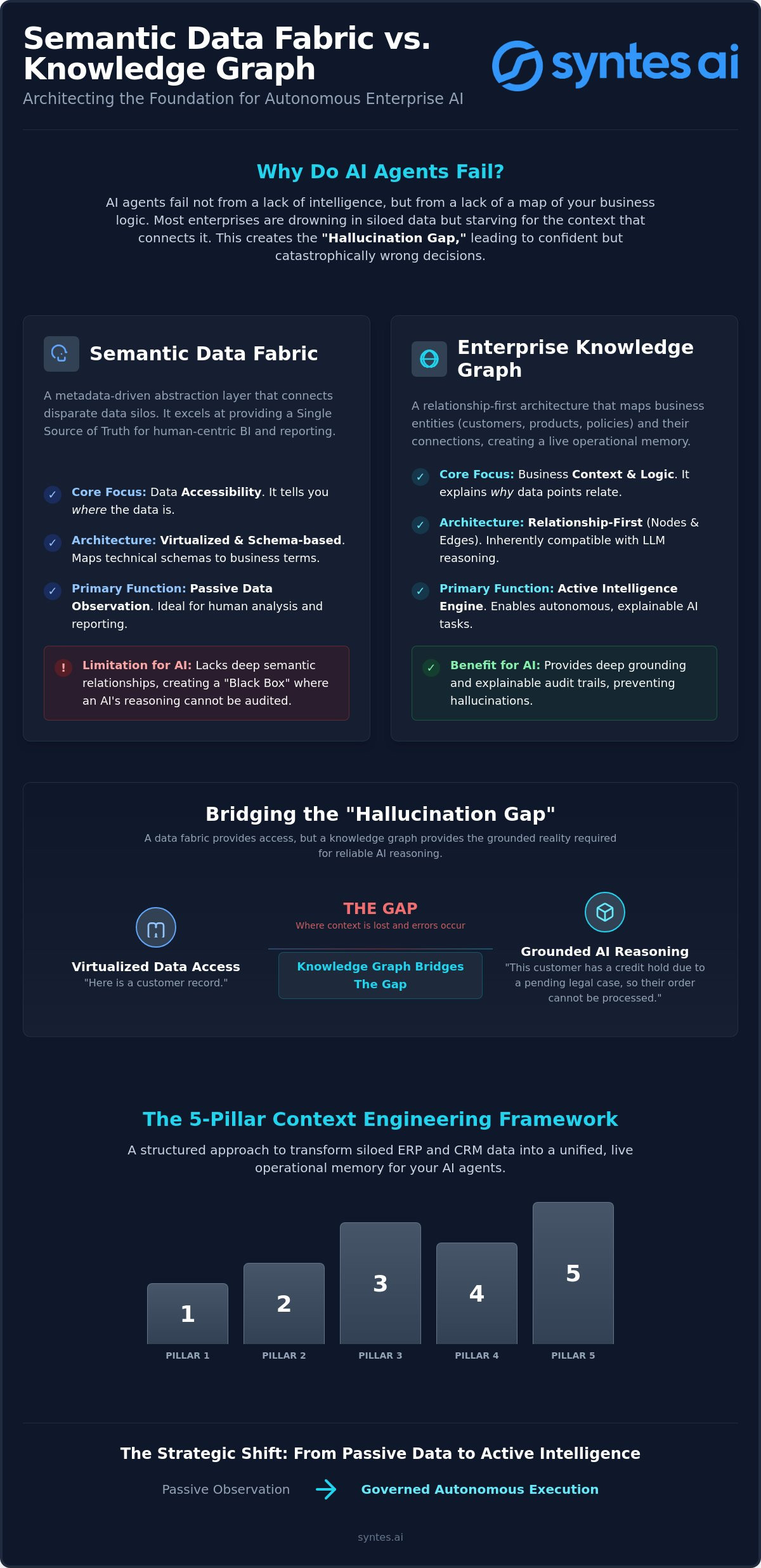
Enterprise data architecture has reached a breaking point. The traditional focus on data delivery is no longer sufficient for the demands of agentic AI. As we move into 2026, the industry standard has shifted from building reporting layers that merely display data to reasoning layers that interpret it. This evolution centers on the debate of semantic data fabric vs knowledge graph, two distinct but often confused frameworks for managing enterprise context. While one provides the plumbing for data accessibility, the other provides the logic for autonomous execution.
The Semantic Data Fabric: A Virtualized Governance Layer
A semantic data fabric acts as a sophisticated, metadata-driven abstraction layer. It utilizes data virtualization to connect disparate silos, such as ERP and CRM systems, without the friction of physical data movement. By mapping technical schemas to business-friendly terms, it excels at providing a Single Source of Truth for human-centric BI and reporting. It solves the accessibility problem. However, because it often remains focused on metadata management rather than the deep semantic relationships between entities, it functions as a passive interface rather than an active intelligence engine. It tells you where the data is, but it rarely explains what the data means in a complex operational context.
The Enterprise Knowledge Graph: A Relationship-First Architecture
The knowledge graph represents a fundamental shift in how we structure information. Instead of viewing data as rows in a table, it maps entities like customers, products, and internal policies as a dense web of interconnected nodes. This architecture is inherently compatible with LLM reasoning and the emerging requirements of GraphRAG. It provides the necessary context for AI to understand not just that two data points exist, but why they relate. This transition from static records to a live operational memory allows agents to navigate complex business logic with precision. It is the difference between a list of ingredients and a recipe that understands how those ingredients interact to produce a specific outcome.
To bridge the gap between simple data access and autonomous reasoning, leaders are looking toward a robust semantic data layer for enterprise. This layer serves as the connective tissue, ensuring that every AI agent has the same grounded understanding of the business environment. Without this foundation, autonomous systems are prone to hallucinations and logic failures that no amount of raw compute can solve. We are moving beyond the era of data as a commodity and into the era of data as a structured, executable intelligence asset.
The Architectural Divide: Why Data Fabric Alone Fails Agentic AI
Connecting your data sources isn’t the same as understanding your business. Most enterprises fall into the trap of believing that a virtualized data layer is the finish line for AI readiness. It isn’t. The strategic debate over semantic data fabric vs knowledge graph often overlooks a fundamental truth: AI agents require more than just access; they require grounding. When an agent queries a standard data fabric, it receives a flat record. It lacks the systemic awareness of how a specific discount in the CRM impacts a supply chain constraint in the ERP. This is the Hallucination Gap. It’s the space where AI makes confident, yet catastrophic, errors because it lacks a map of reality.
The Problem with Passive Virtualization
Passive virtualization is a mapping exercise. It tells an agent where a “Customer” table lives, but it doesn’t tell the agent that this customer is currently under a credit hold due to a pending litigation event stored in a separate legal database. Data fabrics provide the “where” and “what.” They miss the “why” and “how.” Without explicit relationship logic, agents operate in a vacuum. This creates “Black Box” reasoning where the logic of an AI’s decision is impossible to audit or justify. First-wave RAG and vector-only databases exacerbate this. They rely on mathematical similarity rather than causal understanding. Prompt engineering cannot fix a fundamentally fragmented data architecture; it’s a band-aid on a systemic wound.
Transitioning to Relationship-Based Intelligence
True Operational Relationship Intelligence requires a fundamental shift in architecture. By building an intelligent data fabric that incorporates graph-based metadata, you move from passive records to active memory. This is the only sustainable path for solving enterprise data silos. It creates a governed context layer where every entity is defined by its relationships, not just its attributes. Knowledge graphs bridge the gap between general LLM knowledge and proprietary enterprise logic. They provide the deterministic truth agents need to reason safely. If your current architecture is producing more hallucinations than outcomes, you can book a demo to see a different path.
We call this discipline Context Engineering. It is the process of architecting a foundation where reasoning is grounded in the specific, non-linear complexities of your business. In the semantic data fabric vs knowledge graph landscape, the winner isn’t the one with the most data. It’s the one with the most usable context. You don’t need more data; you need better connectivity. You need a system that doesn’t just store information, but understands it.
Strategic Comparison: Selecting the Core of Your AI Infrastructure
Architecting for autonomous intelligence requires a fundamental choice between accessibility and understanding. The decision to implement a semantic data fabric vs knowledge graph is not a temporary tactical fix; it is a decade-long commitment to your enterprise ai infrastructure. While a data fabric provides a robust bridge to legacy systems, a knowledge graph provides the cognitive map required for agents to navigate those systems with precision. You must decide if you want your AI to merely see your data or actually comprehend the logic that governs it.
| Feature Vector | Semantic Data Fabric | Enterprise Knowledge Graph |
|---|---|---|
| Core Data Model | Virtual Tables and Metadata | Semantic Nodes and Relationships |
| Reasoning Depth | Statistical and Query-Based | Deterministic and Relationship-First |
| Operational Speed | Batch or Request-Response | Live Operational Memory |
| Data Integration | Virtualized Silos (ERP/CRM) | Unified Structured & Unstructured |
| Governance | Technical Metadata Control | Business Logic and Policy Guardrails |
Tabular Semantics vs. Graph-Based Reasoning
Tables represent isolated records. They are static snapshots of a specific moment in a database. Graphs represent the fluid reality of business operations, where every entity is defined by its connections to others. Research into graph theory suggests that graph structures can be up to 10x more efficient at discovering hidden hierarchies and complex dependencies than traditional relational models. This efficiency is the engine behind GraphRAG, which allows agents to achieve deterministic truth by tracing relationships across disparate systems. If your agent cannot see the link between a supply chain delay and a customer’s contract terms, it cannot reason effectively. It can only guess.
Live Operational Memory vs. Batch Integration
Legacy data fabrics often rely on batch processing or on-demand virtualization. This creates a lag between reality and the AI’s perception of it. We are moving toward a model of Live Operational Memory. This is a continuously evolving context graph that integrates structured ERP data with unstructured digital assets and real-time business rules. Live memory allows AI agents to act on operational events as they happen, rather than relying on stale snapshots. It transforms your data from a passive archive into an active, executable asset. This shift is essential for any organization that intends to move from simple chatbots to fully autonomous, governed agents.
The 5-Pillar Framework for Context Engineering
Architecting for autonomy requires a disciplined methodology that moves beyond the static retrieval of information. The transition from a semantic data fabric vs knowledge graph is best realized through Context Engineering. This framework ensures that data is not just accessible, but executable. It transforms fragmented enterprise silos into a cohesive intelligence engine capable of powering a sophisticated agentic ai platform. We define this transition through five critical pillars: Connect, Understand, Contextualize, Govern, and Execute.
Connecting and Contextualizing Fragmented Knowledge
The first stage involves deploying two-way connectors that bridge structured databases like SAP or Salesforce with unstructured document lakes. We don’t just pull data; we synchronize it. Automated discovery processes identify entities and relationships across the enterprise, building a dynamic model that represents the “Live” state of the business. Unlike traditional fabrics that offer a passive view, this contextualized layer understands that a “Product” in an ERP system is the same entity as an “Asset” in a service contract. It creates a unified relationship intelligence that serves as the ground truth for every autonomous reasoning task.
Governing Autonomous Execution
Governance is the boundary between innovation and liability. Within the context graph, we enforce business policies and permissions directly at the relationship level. This prevents “rogue” agent behavior by ensuring that an AI can only access or act upon data it’s explicitly authorized to use. We integrate human-in-the-loop systems to inject oversight into high-stakes automated workflows, such as financial approvals or contract modifications. This creates an immutable audit trail. Every decision made by an agent is backed by a transparent reasoning path, providing the Explainable AI required for enterprise compliance and security in a complex multi-cloud environment.
Execution is the final, most critical pillar. A system that understands context but cannot act is merely a sophisticated encyclopedia. By embedding business rules into the graph, agents can perform autonomous tasks with the certainty that they’re operating within governed parameters. This shift from observation to action is what defines the next generation of operational excellence. If your current data strategy lacks a clear path to execution, it’s time to re-evaluate your architecture. You can book a demo to see how the 5-Pillar framework transforms raw data into governed, agentic performance.
Syntes AI: Beyond the Fabric to Governed Agentic Intelligence
The strategic debate over a semantic data fabric vs knowledge graph ends where execution begins. While a fabric provides the necessary connectivity, the Syntes AI Enterprise AI Platform provides the intelligence. Our platform represents the necessary evolution of the semantic layer, moving beyond simple metadata management into the realm of governed, autonomous performance. We don’t just connect your data; we architect the context required for agents to act with the same precision as your most seasoned human experts. When evaluating a semantic data fabric vs knowledge graph, the strategic advantage lies with the architecture that can turn that context into immediate action.
At the heart of our solution lies the Syntes AI Context Graph. This is not a static repository or a passive reporting layer. It is a live operational memory that unifies structured ERP data with the unstructured nuances of your business rules and digital assets. By providing a deterministic foundation, we eliminate the hallucination problem that plagues first-generation AI deployments. Our platform ensures that every agentic decision is grounded in the specific, real-time reality of your enterprise operations, allowing for a level of trust that “black box” systems cannot replicate.
Architecting Trusted AI Outcomes
Syntes AI resolves the core dilemma of modern AI by replacing statistical guesses with relationship-first reasoning. Our Hybrid Graph Database manages the complex web of enterprise relationships that traditional relational models often ignore. The same principles of relationship intelligence are now being applied to personal dynamics; for example, you can discover Ask Jenna to see how AI helps users analyze text interactions for better emotional decision-making. This allows your organization to transition from simple semantic search to true actionable intelligence. Instead of an agent merely finding a document, it understands the permissions, the downstream impacts, and the business logic required to execute a task. We provide the governed framework that transforms AI from a curious experiment into a reliable operational partner.
Scale Your AI Initiatives with Confidence
The ROI of a unified context layer is found in the radical reduction of development and maintenance costs. Legacy semantic layers require constant manual updates and high-touch engineering that most organizations can no longer afford. In contrast, the Syntes Agentic Platform leverages our proprietary Context Engineering framework to automate the understanding of your systems. This allows you to deploy and govern agents across the enterprise with a fraction of the traditional overhead. Every 2026 enterprise requires a dedicated strategy for managing context if they hope to achieve true autonomous scale without sacrificing security.
The era of passive data observation is over. Leaders who continue to rely on fragmented data fabrics will find their AI initiatives stalled by a lack of context and excessive operational risk. It’s time to move toward a system that understands, governs, and executes. You can book a demo to see the Syntes AI Context Graph in action and begin the transition to governed agentic intelligence today. Syntes AI bridges the final gap in the semantic data fabric vs knowledge graph debate by providing the execution engine that passive architectures lack.
Mastering the Architecture of Autonomous Intelligence
The strategic divide is clear. Enterprises can no longer afford to run agentic AI on passive, virtualized data layers. While data fabrics excel at connecting disparate silos, only relationship-dense knowledge graphs provide the grounding required for reliable autonomous reasoning. The debate of semantic data fabric vs knowledge graph isn’t simply a matter of technical preference. It’s a decade-long strategic choice between basic data accessibility and sophisticated operational intelligence.
Syntes AI provides the definitive resolution to this architectural challenge. Our platform delivers a Live Operational Memory that unifies structured systems and unstructured knowledge into a coherent, executable whole. By leveraging our Governed Agentic AI Framework, you ensure that every autonomous decision is backed by an explainable audit trail and rooted in technical mastery. Stop settling for passive data strategies that lead to hallucinations and logic failures.
Architect your enterprise context with the Syntes AI Platform. Your journey toward total operational clarity and governed execution starts here. Build the foundation your agents deserve.
Frequently Asked Questions
What is the primary difference between a semantic data fabric and a knowledge graph?
The primary difference lies in the structural focus of each architecture. A semantic data fabric emphasizes unified data access and metadata management across disparate sources; essentially acting as a virtualization layer. In contrast, a knowledge graph prioritizes the explicit relationships and semantic meaning between entities. While the fabric provides the plumbing for connectivity, the graph provides the cognitive map required for complex reasoning. Choosing between a semantic data fabric vs knowledge graph depends on whether your priority is data movement or data interpretation.
Can a knowledge graph exist within a data fabric architecture?
A knowledge graph functions as the intelligent semantic layer within a broader data fabric architecture. Modern enterprise standards suggest that a data fabric alone solves the accessibility problem but fails at the interpretation problem. By layering a graph over the fabric, organizations ensure that virtualized data streams are contextually enriched and ready for machine consumption. This synergy allows for both broad data reach and deep relationship intelligence.
How does a semantic layer help prevent AI hallucinations?
A semantic layer prevents hallucinations by providing deterministic grounding for AI models. It replaces the statistical probability of a large language model with hard, relationship-based facts. When an agent queries the system, the semantic layer ensures the response is constrained by verified business logic and real-time operational data. This eliminates the need for the model to “guess” at connections that don’t exist in your proprietary data.
Is Context Engineering just another term for Prompt Engineering?
Context Engineering is a fundamental architectural discipline, whereas prompt engineering is a linguistic tactic. Prompting focuses on how you ask a question; Context Engineering focuses on the underlying data structure that provides the answer. It involves building a live operational memory that ensures agents have access to the right relationships and rules at the moment of execution. One is a band-aid; the other is a structural foundation.
Do I need to migrate all my data to one place to build a knowledge graph?
You don’t need to centralize your data into a single lake to build an effective knowledge graph. Modern architectures utilize two-way connectors and virtualization to map relationships across existing ERP, CRM, and legacy systems. This approach avoids the massive overhead of traditional ETL while creating a unified context layer that remains synchronized with the source data. It respects the reality of your current infrastructure.
How does a knowledge graph support Agentic AI platforms?
Knowledge graphs provide the reasoning framework required for an agentic AI platform to perform autonomous tasks. Agents use the graph to navigate complex dependencies and business rules that are invisible in traditional tabular schemas. This connectivity allows agents to move from simple information retrieval to sophisticated, governed execution across multiple enterprise systems. It provides the “map” for the agent’s “intelligence.”
What are the security implications of a unified enterprise context layer?
A unified context layer enhances security by centralizing governance and enforcing granular permissions at the relationship level. It ensures that AI agents only interact with data they are explicitly authorized to access. By embedding business rules and compliance guardrails directly into the context graph, organizations maintain a robust, immutable audit trail for every autonomous action. This creates a more secure environment than fragmented, siloed access models.
How long does it typically take to implement an enterprise-grade knowledge graph?
Implementation timelines vary based on complexity, but a pilot focused on a specific domain can often be deployed in 6 to 8 weeks. Scaling to a full enterprise-grade knowledge graph typically takes 4 to 6 months. This phased approach allows for the immediate validation of business logic while gradually integrating more complex data silos. Navigating the semantic data fabric vs knowledge graph transition is a journey toward total operational clarity.