
The architectural rigidity of your RDBMS is now the single greatest barrier to autonomous enterprise intelligence. Relational databases were built to store static records, not to facilitate the fluid reasoning required by the Syntes Agentic Platform. If your AI agents are hallucinating or failing to navigate fragmented data silos across ERP and CRM systems, the fault lies in your schema, not your LLM. You’ve likely realized that while SQL handles transactions, it cannot map the complex, multi-dimensional relationships that define a modern business.
We agree that legacy systems are failing under the weight of real-time reasoning requirements. This analysis clarifies the knowledge graph vs relational database divide to explain why a transition to semantic context is the critical prerequisite for trusted enterprise AI. You’ll discover a definitive framework for when to utilize traditional databases versus the Syntes AI Context Graph. We’ll provide a strategic roadmap for building a unified context layer that transforms passive data into live operational memory for your 2026 AI initiatives.
Key Takeaways
- Understand why the knowledge graph vs relational database debate is no longer about simple storage, but about the reasoning capabilities required for 2026 enterprise AI.
- Identify the critical “JOIN problem” where traditional SQL latency spikes and learn how index-free adjacency enables constant-time traversals for complex, multi-system datasets.
- Eliminate enterprise AI hallucinations by shifting from simple vector-based RAG to a semantic context layer that grounds autonomous agents in rigorous business logic.
- Apply a strategic decision framework to determine when to maintain legacy RDBMS for transactional integrity and when to deploy a Knowledge Graph for operational intelligence.
- Discover how the Syntes AI Context Graph creates a live operational memory, automating the transition from fragmented data silos to unified agentic performance.
Beyond Tables and Rows: The Architectural Divergence
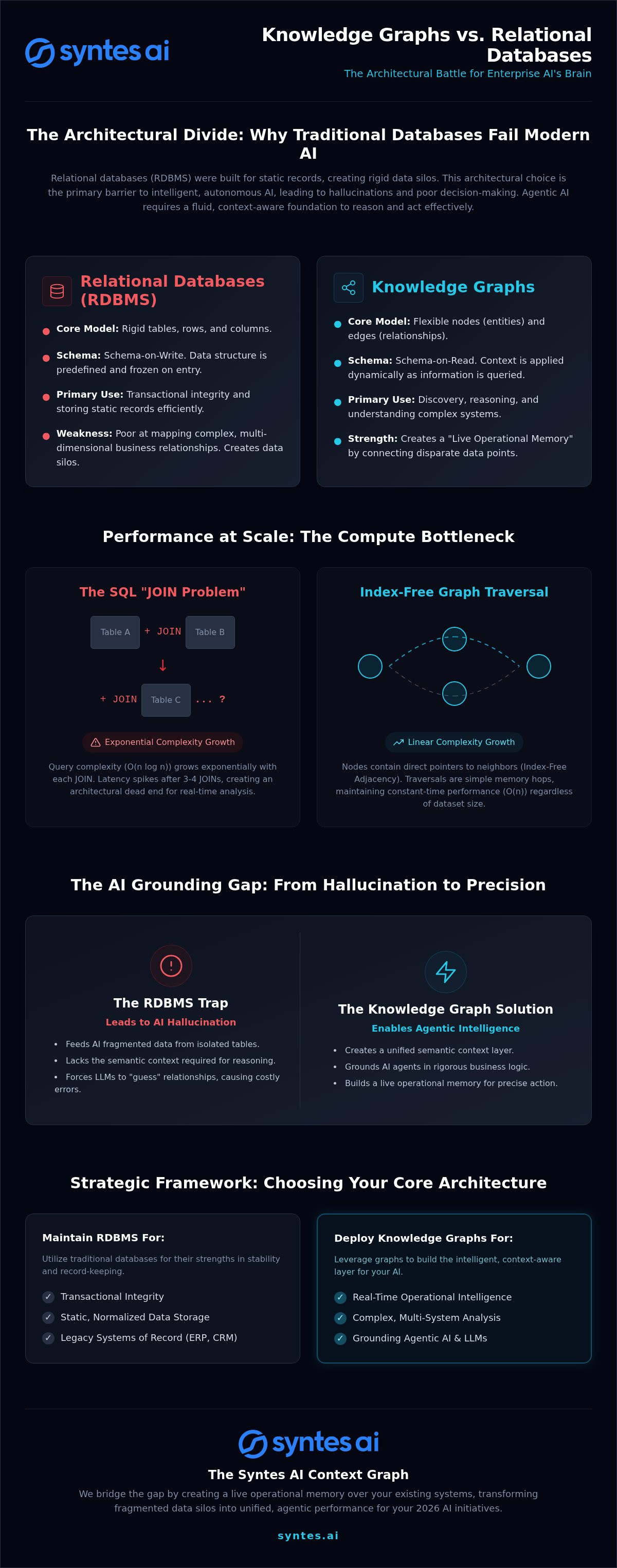
The current tension in enterprise architecture stems from a fundamental misunderstanding of data utility. The knowledge graph vs relational database choice defines whether your AI will merely retrieve facts or actually understand them. Relational Database Management Systems (RDBMS) function as rigid, predefined schemas optimized for transactional integrity. They excel at ensuring a bank balance is correct but fail at explaining why a customer might churn. This “Schema-on-Write” methodology forces data into a frozen state at the moment of entry. Knowledge Graphs, by contrast, are flexible, relationship-first architectures optimized for discovery and reasoning. They employ a “Schema-on-Read” model that allows for the dynamic recontextualization of information as new insights emerge. The semantic gap refers to the profound disconnect between isolated SQL tables and the hyper-connected, real-time reality of global enterprise operations.
The Relational Paradigm: Records of the Past
Traditional SQL tables prioritize storage efficiency through rigorous normalization. They’re designed to minimize data footprint, not to maximize operational intelligence. While foreign keys provide a basic mechanism for linking tables, they’re insufficient for mapping complex, multi-dimensional business relationships. They tell you that two things are related, but they don’t explain the context or the strength of that relationship. This architectural choice inevitably creates the silo effect. Critical information remains trapped within departmental boundaries. Your ERP, CRM, and HR systems speak different languages, leaving your AI agents blind to the cross-functional context required for high-stakes decision-making.
The Knowledge Graph Paradigm: Live Operational Intelligence
Nodes, edges, and properties are the building blocks of modern meaning. In this model, data isn’t a static record; it’s an active participant in a system of intelligence. For a comprehensive knowledge graph overview, consider how this structure enables a “Live Operational Memory.” Unlike the rows of an RDBMS, nodes represent entities and edges represent the nuanced relationships between them. This allows the system to traverse billions of connections in milliseconds to find relevant context. By deploying a semantic data layer for enterprise, businesses finally bridge the gap between fragmented data points and autonomous action. It transforms passive observation into a state of total operational clarity where agents can reason, predict, and execute with precision.
Performance at Scale: The JOIN Problem vs. Graph Traversal
Efficiency is the lifeblood of agentic execution. In the knowledge graph vs relational database performance debate, the winner is decided by how relationships are managed at the hardware level. Relational databases rely on set-based processing. To find a connection between two entities, the engine must intersect massive tables at runtime. This creates a massive compute bottleneck as datasets grow. Knowledge graphs eliminate this overhead through index-free adjacency. In this architecture, each node contains direct physical pointers to its neighbors. Finding a relationship doesn’t require a high-latency index lookup; it’s a simple memory hop. This allows for constant-time traversals regardless of the total dataset size. As detailed in IBM’s explanation of knowledge graphs, this relationship-first design is what enables the high-speed discovery of patterns across disparate enterprise systems.
When SQL Breaks: The 3-Degree JOIN Limit
Relational engines struggle with “n-degree” queries because their computational complexity grows exponentially. Consider a global supply chain disruption. Tracing the impact of a single raw material shortage across 10+ tiers of suppliers in a relational system requires 10+ JOIN operations. Each JOIN adds a layer of O(log n) or O(n log n) complexity. By the third or fourth degree, query latency typically spikes from milliseconds to minutes. It’s an architectural dead end. Graphs operate at O(n) complexity relative to the depth of the path. They navigate paths rather than calculating sets. This distinction is the difference between an AI agent that acts in real-time and one that times out while the database churns.
Architecting for Real-Time Operational Context
Achieving sub-second decision-making requires relationship-first indexing. This is the only viable path to creating “Live Operational Memory.” By solving enterprise data silos through a graph architecture, organizations move from passive data storage to active intelligence. This path-based navigation is essential for detecting systemic risks or fraud patterns that table-based systems cannot see without exhaustive, manual query tuning. If you’re ready to see how this architecture powers autonomous agents, you can schedule a technical walkthrough of our platform. Storing relationships as first-class citizens ensures that your AI isn’t just fast; it’s contextually aware.
The AI Grounding Gap: Why RDBMS Is Not Enough for LLMs
Relational databases are the wrong tool for grounding Large Language Models. They offer data, but AI requires context. While Vector RAG (Retrieval-Augmented Generation) relies on probabilistic similarity, GraphRAG leverages the explicit, semantic connections of a knowledge graph to ensure accuracy. This is the fundamental shift in the knowledge graph vs relational database debate. SQL tables provide isolated facts. Graphs provide the logic connecting those facts. Without this logic, your AI is simply guessing based on statistical proximity rather than business reality. The gap between a list of records and a reasoned conclusion is where enterprise value is lost.
Hallucinations occur when an LLM fills a context gap with a statistical guess. You can’t fix this with better prompts. You fix it with better architecture. Understanding how to prevent ai hallucination requires moving toward a deterministic ground truth that SQL tables cannot replicate. A knowledge graph functions as a rigorous map of enterprise logic. It ensures that every response is anchored in a verified relationship, turning the “black box” of AI into a transparent system of record. By providing a structured graph of meaning, you eliminate the ambiguity that leads to operational errors.
Context Engineering vs. Prompt Engineering
Prompt engineering is a temporary fix for a systemic problem. Context Engineering is the solution. It’s the evolution of data orchestration for Agentic AI. A Context Graph serves as the “Enterprise Memory” for autonomous agents, providing the multi-dimensional perspective needed for complex reasoning. Flat relational results are useless to a reasoning engine. They lack the metadata and relationship strength required to understand how a customer’s support ticket relates to their lifetime value or current contract status. Agents don’t need more data; they need to understand how the data they already have is interconnected.
Explainable AI: Auditing the Reasoning Path
Governance is non-negotiable in the global enterprise. Graph traversals provide a clear, step-by-step chain of thought for every AI decision. You can audit the reasoning path. You can see exactly which nodes were visited and which edges were traversed to reach a conclusion. Contrast this with the opaque nature of standard RAG or pure relational lookups. In the context of enterprise ai infrastructure, this auditability is the prerequisite for deployment. It transforms AI from a risky experiment into a governed, operational asset that meets the highest standards of systemic integration.
Strategic Decision Framework: Choosing Your Core Architecture
The knowledge graph vs relational database decision isn’t a zero-sum game; it’s a matter of workload specialization. Decision-makers often fall into the trap of binary thinking, assuming one must replace the other. In reality, the 2026 enterprise standard is the hybrid graph database approach. This model retains the RDBMS for what it does best, transactional integrity, while deploying a knowledge graph as the reasoning layer for complex operations. You don’t scrap your payroll system; you wrap it in a context layer that understands how payroll data influences employee retention and project costs. If your data fragmentation levels meet the following criteria, the evolution to a graph-based architecture is no longer optional:
- Your critical business logic is scattered across disconnected ERP, CRM, and legacy silos.
- Analytical queries require traversing three or more degrees of relationship separation.
- The context surrounding your data points is as valuable as the records themselves.
- Your AI roadmap requires autonomous agents to execute cross-system workflows.
When to Stick with Relational (SQL)
Relational databases remain the undisputed champions of the transactional “Sweet Spot.” Use SQL when your data structure is static and your relationships are shallow. If you’re managing high-volume, simple transactions like basic accounting, inventory counts, or standardized reporting, the overhead of a graph is unnecessary. SQL provides a lower barrier to entry for standard CRUD applications and ensures total compatibility with legacy reporting tools. It’s built for stability and precision in environments where the rules of the data don’t change. When the goal is simply to store and retrieve isolated records of the past, the RDBMS is your most efficient tool.
When to Evolve to an Enterprise Knowledge Graph
The transition point occurs when “Data about the Data” becomes the primary driver of value. Modern agentic ai platforms cannot function on flat relational results; they require a multi-dimensional perspective to navigate cross-system silos. You must evolve when you need to detect complex dependencies, power sophisticated recommendation engines, or ground autonomous agents in a deterministic truth. A Live Operational Memory is non-negotiable for 2026 enterprise intelligence. It transforms your data from a passive archive into an active participant in your business logic. Without this semantic layer, your AI agents remain tethered to a fragmented reality, unable to reason across the full breadth of your operational footprint.
Syntes AI: Transforming Records into Agentic Intelligence
Syntes AI represents the necessary evolution in enterprise systems architecture. We move beyond the static limitations of the past. The Syntes AI Context Graph isn’t just another data store; it’s the definitive engine for autonomous performance. By implementing the Syntes Context Engineering Framework, organizations automate the critical “Connect, Understand, Contextualize” pipeline. This process unifies structured SQL records with the vast ocean of unstructured enterprise documents. It creates a single, high-fidelity operational layer. This enterprise knowledge graph serves as the primary reasoning foundation for the Syntes Agentic Platform, ensuring every agent action is grounded in total business context. The knowledge graph vs relational database debate ends where execution begins.
Living Operational Memory vs. Static Databases
Speed without control is a liability. Our platform includes a sophisticated governance layer that ensures every AI agent operates within your specific business rules and ethical constraints. The Syntes AI Context Graph enables Trusted AI Execution through deterministic reasoning. We’ve eliminated the probabilistic guesswork that plagues standard LLM deployments. You get clarity. You get efficiency. You get the power of informed action through a system that understands the messy realities of large-scale operations. It’s time to move from theoretical experimentation to total operational clarity.
Explore the Syntes AI Enterprise Platform
Mastering the Semantic Shift for Autonomous Performance
The era of static data storage has ended. To compete in 2026, enterprises must move beyond the limitations of tabular records and embrace a relationship-first architecture. The knowledge graph vs relational database distinction is now a strategic imperative; it determines whether your AI will merely retrieve information or truly understand it. By integrating the Syntes AI Context Graph, you transform fragmented silos into a Live Operational Memory that fuels every agentic action.
This architecture provides the explainable AI reasoning paths required for rigorous auditing and the enterprise-grade governance needed for safe deployment. You’ve identified the systemic flaws in your current data environment. Now, you possess the roadmap to fix them. Clarity, efficiency, and automated performance are within reach for those who architect for context rather than just storage.
Your journey toward total operational clarity begins with a single architectural pivot.
Frequently Asked Questions
Can a Knowledge Graph replace my existing SQL database?
A Knowledge Graph serves as a specialized reasoning layer rather than a wholesale replacement for your SQL infrastructure. You keep your RDBMS for high-volume transactions and payroll where data structure is static. The graph architecture sits atop these systems to manage complex relationships and discovery. In the knowledge graph vs relational database strategic mix, the former handles intelligence while the latter ensures transactional integrity. This hybrid model is the pragmatist’s choice for 2026.
How does a Knowledge Graph improve LLM accuracy compared to SQL?
Knowledge Graphs eliminate the AI grounding gap by providing a deterministic map of business logic. Standard SQL tables offer isolated data points, forcing LLMs to guess how entities relate. A graph explicitly defines these connections as nodes and edges. This structure ensures your AI agents operate on a Ground Truth rather than probabilistic similarity. By anchoring reasoning in a semantic context, you effectively neutralize the hallucinations common in pure vector-based retrieval systems.
What is the performance difference between JOINs and Graph traversals?
The performance delta is defined by the contrast between set-based intersections and path-based navigation. Relational engines struggle with JOIN latency that grows exponentially as you move beyond three degrees of separation. Graph databases utilize index-free adjacency, allowing for constant-time traversals. This means finding a path across ten tiers of a supply chain takes milliseconds. You aren’t calculating relationships at runtime; you’re following physical memory pointers already stored within the nodes themselves.
Is it possible to integrate structured SQL data into a Knowledge Graph?
Integrating structured SQL data into a graph environment is a standard procedure in modern context engineering. You don’t move the data; you map its relationships. Syntes AI utilizes two-way connectors that bridge legacy RDBMS silos with the Syntes AI Context Graph in real-time. This creates a unified operational layer where transactional records from your ERP or CRM gain semantic meaning. It transforms disconnected tables into a live, interconnected model of your entire business.
What are the most common enterprise use cases for Knowledge Graphs in 2026?
Enterprise adoption in 2026 centers on high-complexity environments like supply chain orchestration and systemic risk detection. Organizations use graphs to trace disruptions across multi-tier supplier networks that collapse traditional SQL queries. Other critical use cases include real-time fraud pattern recognition and personalized recommendation engines. Most importantly, the knowledge graph vs relational database shift is driven by the need for autonomous AI agents to execute governed, cross-system workflows with total operational clarity.
How does Syntes AI Context Graph differ from a traditional Graph Database?
Traditional graph databases are often passive storage tools; the Syntes AI Context Graph is a live operational memory. It doesn’t just store nodes and edges. It actively unifies structured and unstructured data through our automated Context Engineering Framework. While standard databases require manual query tuning, our platform is purpose-built for the Syntes Agentic Platform. It provides the governed execution and deterministic reasoning paths required for trusted AI agents to perform at scale.
Does moving to a Knowledge Graph require a total data migration?
Total data migration is an outdated and unnecessary risk. Modern architecture favors a semantic overlay approach. You leave your data in its original source, whether that’s PostgreSQL or an Oracle cluster, and use a graph layer to orchestrate the relationships. This allows you to build a sophisticated intelligence layer without the high cost and downtime of a massive ETL project. It’s about connectivity and integration, not displacement of your existing investments.
How does a semantic layer facilitate Agentic AI orchestration?
A semantic layer provides the unified logic required for autonomous agents to navigate diverse enterprise systems. Without it, an agent is blind to how a support ticket in one system relates to a contract renewal in another. The semantic layer acts as the brain that translates raw data into actionable context. It allows for governed AI orchestration where agents follow strict business rules while traversing the complex, real-time reality of your global operations.