
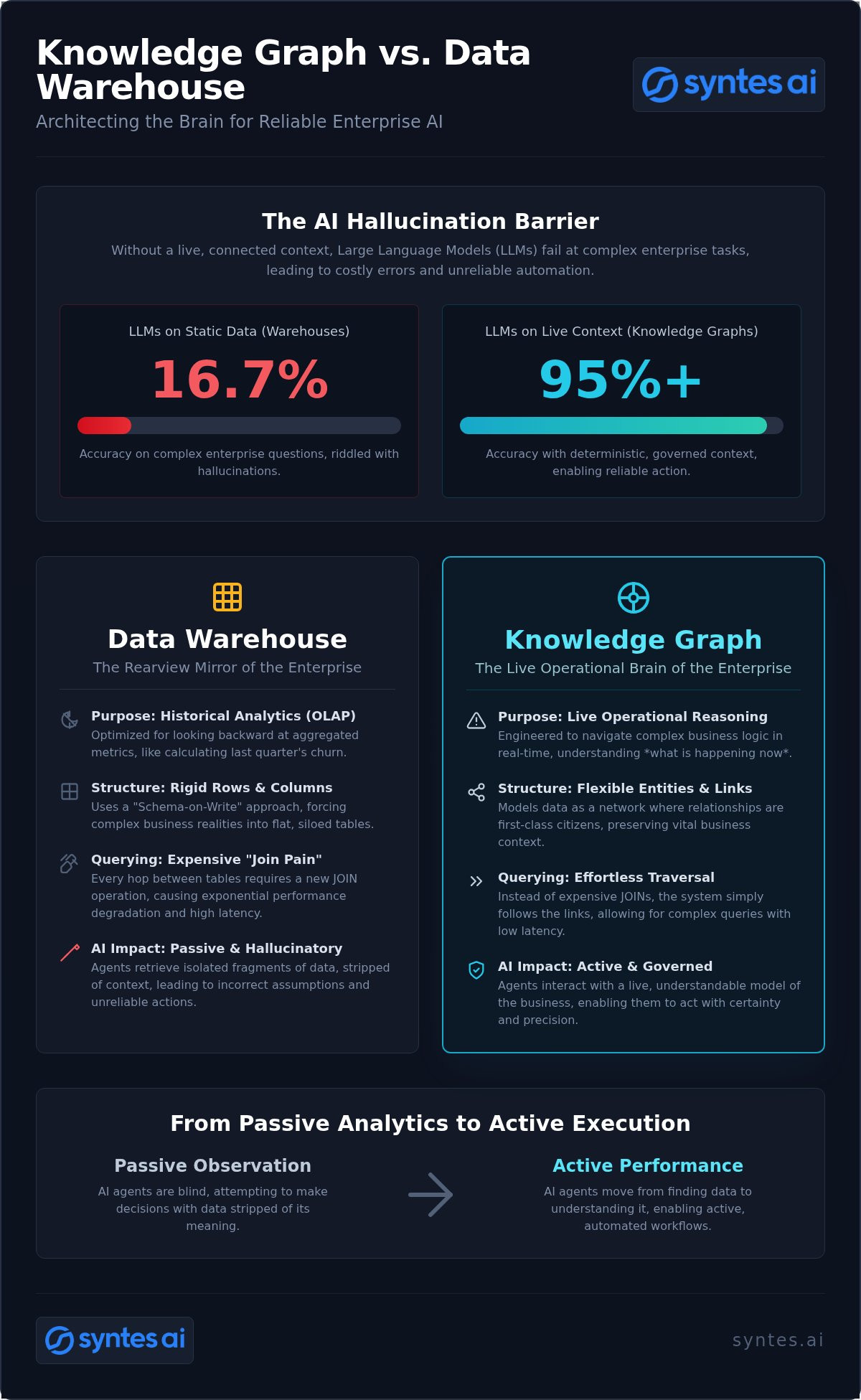
Research shows that LLMs answering complex enterprise questions without knowledge graph grounding achieve a dismal 16.7% accuracy. You’ve likely spent years and millions perfecting a centralized repository, expecting it to serve as the foundation for your digital transformation. Yet, when evaluating the knowledge graph vs data warehouse for agentic AI, the reality is stark. Your warehouse was built to look backward. It tracks what happened last quarter. It doesn’t understand how your business actually functions right now.
Static warehouses create high-latency responses and fuel the hallucinations that plague standard RAG implementations. You need more than a graveyard of historical records; you need a live operational memory. This article explains why the traditional warehouse is insufficient for autonomous agents and how a live knowledge graph provides the governed context necessary for reliable enterprise AI. We’ll provide a clear framework for integrating these systems so your agents can move from passive observation to active, automated performance.
Key Takeaways
- Identify why traditional data warehouses are optimized for historical reporting while knowledge graphs are engineered for live operational reasoning.
- Recognize how the structural rigidity of “rows and columns” creates the latency and “join pain” that cripples autonomous agent performance.
- Discover how to move beyond probabilistic RAG by using deterministic relationships to eliminate AI hallucinations in complex enterprise environments.
- Evaluate the knowledge graph vs data warehouse debate through the lens of execution, shifting from passive insights to active, governed AI workflows.
- Explore the five pillars of the Syntes Context Engineering Framework to architect a unified, live intelligence layer across your existing data stack.
The Architectural Divide: Defining Knowledge Graphs and Data Warehouses for 2026
The enterprise data stack is undergoing a seismic shift. For decades, the data warehouse served as the undisputed king of information. It was the “single source of truth” for every major corporation. But as we enter 2026, that truth is proving insufficient for autonomous agents. Comparing a knowledge graph vs data warehouse isn’t about choosing one database over another; it’s about distinguishing between historical analysis and live operational reasoning. The modern enterprise requires both. One to remember the past, and one to navigate the present.
The Data Warehouse: The Rearview Mirror of the Enterprise
Data warehouses are built for Online Analytical Processing (OLAP). They utilize a “Schema-on-Write” approach. This architecture requires you to know exactly what questions you’ll ask before the data is even stored. It’s rigid. It’s structured. It’s designed for aggregated metrics and historical reporting. While this is perfect for calculating last month’s churn rate, it’s a disaster for an AI agent trying to navigate a complex procurement logic in real time.
The limitations are inherent to the format. Warehouses often silo data into disparate tables. They flatten complex, multi-dimensional business realities into two-dimensional rows and columns. In this process, the “business logic”—the subtle connections between departments, products, and customers—is destroyed. The warehouse shows you where you’ve been. It cannot tell you what is happening right now.
The Knowledge Graph: The Live Operational Brain
Contrast this with the semantic approach. What is a Knowledge Graph? It’s a network of entities and relationships designed for reasoning. In this architecture, the links between data points are as valuable as the data points themselves. This “Relationship-Based Intelligence” allows AI to understand the world the way humans do. It recognizes that a “customer” is also a “contract holder,” a “support ticket creator,” and a “referral source” simultaneously.
This transition from passive, siloed storage to live operational memory is what enables agentic AI to act with certainty. Knowledge graphs preserve the business logic that tables destroy. They provide a queryable map of the enterprise that is updated in real time. Instead of digging through a graveyard of historical records, your AI agents interact with a living model of your business. They don’t just find data; they understand it.
Tables vs. Relationships: Why Structural Rigidity Limits Enterprise Intelligence
The fundamental friction in the knowledge graph vs data warehouse debate lies in the underlying data model. Data warehouses operate on a “Row and Column” mindset. This tabular structure is efficient for storage but catastrophic for intelligence. It forces every complex business relationship into a flat, rigid grid. When an AI agent attempts to navigate these tables, it encounters the “Join Pain.” In a warehouse, every hop between entities requires a new JOIN operation. As these hops increase, performance degrades exponentially. Querying a relationship that spans ten tables requires massive computational overhead. It often results in timeouts or high-latency responses that render real-time AI useless.
Knowledge graphs adopt an “Entity and Link” mindset. Relationships are first-class citizens. Instead of performing expensive joins, the system simply traverses the links. It’s the difference between recalculating a map every time you turn a corner and simply following a paved road. This architectural shift allows for evolving schemas that don’t break downstream applications. You can add new attributes or relationships without rebuilding the entire foundation. AI agents cannot “reason” over flattened tables. They need the connections to understand the “why” behind the “what.” Without these links, the agent is merely retrieving fragments, not understanding a system.
The Semantic Gap: What Data Warehouses Lose in Translation
Traditional data models strip away the essence of the business to fit a storage format. A semantic data layer for enterprise restores this lost meaning. In a warehouse, “Customer ID 123” is just a string in a cell. In a knowledge graph, that same ID is a multi-dimensional entity. It’s connected to active contracts, support history, and social influence. Context is the missing ingredient in traditional models. Without it, your AI is merely guessing based on proximity rather than operating on logic.
Scalability of Complexity vs. Scalability of Volume
Scale is often misunderstood in the enterprise. Warehouses are built to scale for volume, handling billions of rows of static records. However, enterprise AI requires a system that scales for complexity. As noted in the research on the Future of Data Integration, the bottleneck isn’t the amount of data; it’s the density of connections. AI agents must navigate cross-system business rules that span finance, sales, and logistics simultaneously. Operational Relationship Intelligence is the ability to query across disparate business systems in real-time. If you want to see how this intelligence layer transforms your operations, you should explore our agentic platform.
Analytics vs. Execution: From Historical Reporting to Live Operational Memory
Enterprises have mastered the art of observation. They know exactly how much revenue was lost last month. But observation isn’t execution. In the knowledge graph vs data warehouse debate, this is the definitive line in the sand. Data warehouses are built for insight. They tell you what happened. AI agents require execution. They need to know what to do next. Insight is a report on your desk; execution is an agent renegotiating a supplier contract based on a sudden market shift. One is a record; the other is a reflex.
Latency is the silent killer of autonomous systems. If your warehouse updates every 24 hours, your AI is operating on yesterday’s news. This T+1 reality is a non-starter for agentic workflows. Solving enterprise data silos is the first step toward building a system that can actually act. You cannot automate a complex supply chain if your agent can’t see a delayed shipment until the next morning’s batch run. Real-time context is the only way to move from retrospective analytics to proactive performance.
The Failure of Batch Processing in the AI Era
A passive warehouse waits for a query. An active knowledge graph responds to events. This is the core of the Syntes AI concept of Live Operational Memory. Instead of a static repository, you maintain a continuously evolving model of the business. By using two-way connectors, enterprises feed real-time operational events directly into the graph. This transforms the infrastructure. it becomes a pulse. Agents can trigger actions the moment a condition is met. They don’t wait for a scheduled report. They act on the heartbeat of the company. When data is live, the graph becomes the brain of the enterprise, not just its file cabinet.
Governance and Trust in Operational AI
Trust is the ultimate currency. You cannot let an autonomous agent loose on a black box warehouse where logic is obscured by brittle SQL joins and flattened data. Knowledge graphs provide a deterministic ground truth. Every decision an agent makes is traceable. You can see exactly which entity and which relationship led to a specific action. This auditability is essential for governed AI. It facilitates human-in-the-loop oversight. It ensures that automated execution never drifts from corporate policy. When your AI takes an action, you need to know why. Graphs provide the map; warehouses only provide the history.
The Hallucination Barrier: Why Data Warehouses Struggle to Ground Agentic AI
Why do enterprise AI agents fail at the finish line? The answer lies in the probabilistic nature of the current data stack. Most organizations attempt to ground their LLMs using standard Retrieval-Augmented Generation (RAG) powered by vector stores within a data warehouse. This approach is fundamentally flawed for autonomous execution. Vector search identifies proximity, not truth. It finds data that “looks” relevant but lacks the structural logic to verify facts. In the knowledge graph vs data warehouse comparison, the warehouse offers a collection of likely candidates; the graph offers a deterministic map of reality.
Preventing AI hallucination requires a shift from probabilistic guessing to deterministic reasoning. This is where GraphRAG becomes the essential architecture. By providing high-fidelity context through explicit relationships, knowledge graphs allow LLMs to “see” the connections between disparate data points. Agentic AI requires Context Engineering to move beyond simple retrieval. You aren’t just looking for a document; you’re architecting the reasoning path the agent must follow to reach a trusted conclusion.
Eliminate AI hallucinations with a live context graph.
Beyond Retrieval: The Move to Contextual Reasoning
Can your AI agent perform multi-hop reasoning? Consider a scenario where an agent must determine how a disruption in a Tier 2 supplier affects a specific customer’s delivery SLA. This query requires traversing a chain: Supplier -> Component -> Product -> Order -> Customer. In a data warehouse, this triggers a “Join Explosion.” Performance collapses as the system struggles to stitch together five or six different tables in real-time. The latency spike alone makes autonomous action impossible.
Knowledge graphs handle these traversals with ease. They treat relationships as first-class citizens, allowing agents to hop from A to B to C without the computational tax of a traditional JOIN. This provides the foundation for Explainable AI. When an agent takes an action, it can point to the exact path in the graph that justified the decision. You gain a system that doesn’t just guess; it reasons based on the interconnected reality of your business.
Grounding Agents in Business Rules
Where do your business policies live? In a traditional architecture, they’re buried in PDFs, lost in data lakes, or hard-coded into brittle application logic. This makes them invisible to AI agents. Knowledge graphs solve this by storing business rules as “edges” between entities. A policy isn’t a text file; it’s a queryable constraint that governs how an agent interacts with data. An AI agent is only as intelligent as the context it is allowed to understand. By grounding agents in these explicit rules, you ensure that autonomous execution remains within the guardrails of corporate governance. You move from a “black box” that might hallucinate to a transparent engine that must obey.
The Syntes AI Context Graph: Architecting a Live Intelligence Layer
Syntes AI represents the next inevitable evolution of data infrastructure. While the industry has spent decades debating the merits of a knowledge graph vs data warehouse for analytics, we’ve focused on the only metric that matters for 2026: autonomous performance. The Syntes AI Enterprise AI Platform isn’t just another database. It’s a unified context layer that transforms fragmented storage into a living enterprise memory. By bridging the gap between historical records and real-time events, we provide the definitive foundation for agentic ai platforms at global scale.
Our approach is rooted in the Syntes Context Engineering Framework. It’s built on five non-negotiable pillars designed for the demands of the modern enterprise:
- Connect: Ingest data from disparate ERP, CRM, and legacy systems without disrupting existing workflows.
- Understand: Map raw data to a semantic ontology that reflects your actual business logic and terminology.
- Contextualize: Enrich entities with real-time operational events to provide a “live” view of the business.
- Govern: Apply policy-aware guardrails to every relationship and action to ensure total compliance.
- Execute: Trigger autonomous workflows based on a deterministic ground truth rather than probabilistic guesses.
Live Operational Memory: The Syntes Difference
The Syntes AI Context Graph creates a continuously evolving memory. It doesn’t just store information; it maintains the current state of your entire operation. By utilizing Two-way Connectors, our platform ensures that changes in your operational systems are reflected in the graph instantly. This isn’t batch processing. It’s systemic integration. It enables Trusted AI Execution, where governed agents act with the full weight of the enterprise’s collective knowledge. You don’t just get an answer. You get a verified outcome.
The Path Forward: Build vs. Buy in 2026
Executives face a critical choice. You can attempt to build a custom knowledge graph layer on top of your existing warehouse, or you can deploy a purpose-built platform. Building internally is often a technical debt trap. It requires years of ontology development and complex integration logic that most IT departments aren’t equipped to maintain. Consider these factors before committing your resources:
- Can your current infrastructure manage the “join explosion” of complex relationship queries?
- Is your system ready to handle real-time event streaming without significant latency?
- Do you possess the governance framework to audit autonomous agent decisions in real-time?
The era of theoretical experimentation is over. It’s time to transform fragmented data into enterprise intelligence with Syntes AI. Move beyond the limitations of the past and architect a foundation built for execution.
Architecting the AI-Ready Enterprise
The choice between a knowledge graph vs data warehouse is no longer a technical debate; it’s a strategic survival mandate. Traditional warehouses serve as excellent repositories for historical analytics. They cannot, however, provide the live operational memory required for autonomous agents to reason with 100% explainability. To move beyond probabilistic guessing, you must architect a system that treats relationships as first-class citizens. Logic is the only antidote to inaccuracy.
Syntes AI offers the definitive solution for this architectural shift. Trusted by global enterprises to eliminate data silos, our platform provides the live operational context necessary for trusted AI reasoning. As the only platform built specifically for Governed Agentic AI, we don’t just store your data; we engineer the context required for high-stakes execution. By integrating your existing stacks into a unified intelligence layer, you ensure your agents are governed, verifiable, and ready for the complexities of real-world operations. The transition from passive observation to active performance starts here.
Success in the age of agentic intelligence requires more than just volume. It requires clarity. Build your foundation on the logic of your business and watch your autonomous future take shape.
Frequently Asked Questions
Can a Knowledge Graph replace my Data Warehouse?
No, a knowledge graph is not a replacement for your data warehouse; it’s a strategic evolution. While the warehouse remains the repository for historical analytics and aggregated reporting, the knowledge graph serves as the live operational brain for AI execution. Most enterprises maintain both architectures. The warehouse remembers the past, while the graph navigates the present. This hybrid approach ensures you don’t lose analytical depth while gaining the relational reasoning required for autonomous agents.
How does a Knowledge Graph reduce AI hallucinations better than a Data Warehouse?
Knowledge graphs reduce hallucinations by providing deterministic grounding rather than relying solely on probabilistic vector proximity. In a data warehouse, RAG often retrieves “similar” data points that may lack factual connection. A knowledge graph uses explicit, governed relationships to verify truths. This ensures that when an AI agent queries a system, it follows a logical path of established facts. By grounding agents in a semantic map, you eliminate the guesswork that leads to fabricated responses.
Is a Knowledge Graph the same as a Graph Database?
A graph database is the underlying storage technology, while a knowledge graph is the semantic application layer built on top of it. Think of the database as the engine and the knowledge graph as the intelligent navigator. A knowledge graph incorporates a formal ontology, business logic, and cross-system context to provide meaning to raw data. It transforms simple nodes and edges into a queryable model of your enterprise that AI agents can actually understand and reason with.
What is the “Join Pain” and how does it affect AI performance in a warehouse?
“Join Pain” refers to the exponential performance degradation that occurs when a data warehouse attempts to query complex, multi-hop relationships across numerous tables. Every hop requires a new JOIN operation, which consumes massive CPU resources and increases latency. AI agents need instant answers to navigate business processes. If a query takes seconds or minutes due to join complexity, the agent becomes non-functional. Knowledge graphs eliminate this tax by treating relationships as direct, pre-computed paths.
How long does it take to implement an Enterprise Knowledge Graph?
Implementation timelines vary based on the complexity of your business ontology and the number of integrated systems. However, by using the Syntes AI Context Engineering Framework, most enterprises can deploy a functional context layer in weeks rather than years. The focus is on identifying high-value business entities and relationships first. Unlike traditional data modeling, which is rigid, our platform allows for an iterative approach that grows alongside your AI agent deployment strategy.
Do I need to move all my data out of Snowflake to use Syntes AI?
You don’t need to migrate your data out of Snowflake or other existing warehouses to leverage Syntes AI. Our platform utilizes two-way connectors to ingest metadata and real-time events while leaving your primary storage intact. We act as a live intelligence layer that sits on top of your existing stack. This approach prevents a “rip and replace” scenario, allowing you to maximize your current investments while adding the relational context necessary for agentic execution.
What is Context Engineering and why is it the next evolution of RAG?
Context Engineering is the discipline of architecting the specific reasoning paths and semantic links an AI agent needs to perform complex tasks. While standard RAG merely retrieves relevant text chunks, Context Engineering provides a structured, governed environment for the agent to think. It’s the next evolution because it moves beyond simple search. It ensures the agent understands the multi-dimensional relationships between entities, leading to higher accuracy and more sophisticated, multi-step autonomous actions across the enterprise.
Can AI agents execute actions directly through a Knowledge Graph?
Yes, AI agents can execute actions directly when grounded in a knowledge graph because it provides the necessary operational context and governance guardrails. When comparing a knowledge graph vs data warehouse, the graph is the only architecture that supports live execution. Because the graph understands business rules and real-time state, an agent can confidently trigger workflows, update CRM records, or adjust supply chain orders. The graph provides the deterministic proof required for safe, autonomous performance.