
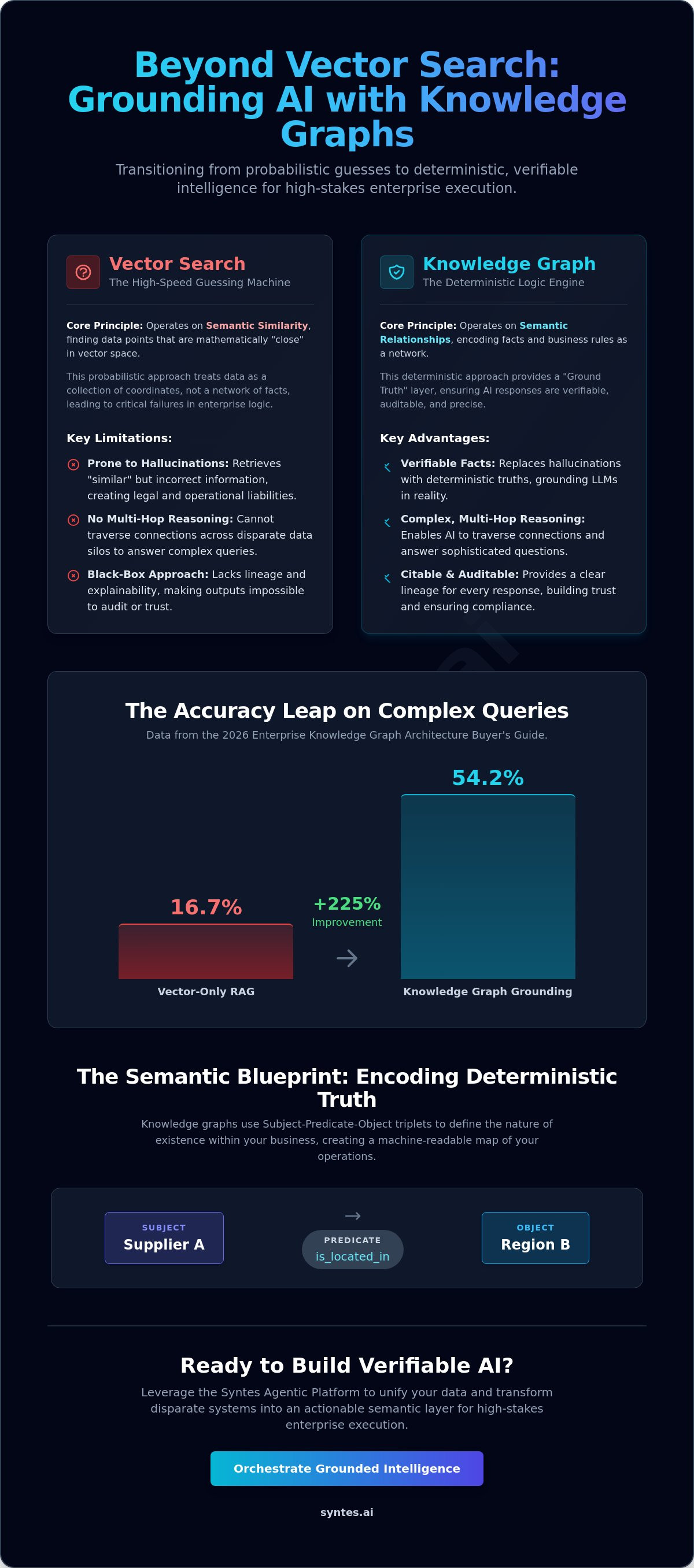
Vector search is not a strategy for enterprise intelligence; it is a sophisticated way to guess at scale. While probabilistic models are impressive, they lack the structural truth required for high-stakes execution. Recent data from the 2026 Enterprise Knowledge Graph Architecture Buyer’s Guide reveals that using a knowledge graph for llm grounding improves accuracy on complex queries from 16.7% to 54.2%. You don’t need more data. You need a deterministic map of what that data actually means.
You’ve likely seen your LLMs fail when faced with multi-hop reasoning or siloed enterprise data. It’s a common bottleneck that stalls production and erodes trust. This guide outlines the architectural transition from unreliable hallucinations to verifiable, deterministic intelligence. We’ll show you how to connect disparate systems into a single AI brain capable of citing structured data with total precision. You’re about to move beyond experimental chatbots toward a scalable framework for agentic AI orchestration that provides total operational clarity.
Key Takeaways
- Stop relying on probabilistic guesses. Transition to a knowledge graph for llm grounding to replace vector-based hallucinations with verifiable, deterministic facts.
- Master the semantic blueprint. Use Subject-Predicate-Object triplets to encode hard logic and business rules that an LLM cannot ignore.
- Implement a scalable five-step guide to extract entities and model ontologies. It’s the only way to connect cross-system silos into a coherent AI brain.
- Power autonomous agents with Graph-of-Thought (GoT) frameworks. Give your AI a map for complex, multi-hop reasoning that standard retrieval methods miss.
- Leverage the Syntes Agentic Platform to unify your data. Transform disparate systems into an actionable semantic layer for high-stakes enterprise execution.
The Hallucination Crisis: Why Vector Search is Insufficient for Enterprise Grounding
Enterprise AI is currently built on a house of cards. Most organizations rely on vector-based Retrieval-Augmented Generation (RAG), which treats data as a collection of mathematical coordinates rather than a network of facts. Grounding is the process of anchoring model outputs to verifiable, external facts. It is the difference between an AI that sounds confident and an AI that is correct. Without it, you aren’t deploying intelligence; you’re deploying a high-speed guessing machine. While vector search was a necessary first step, it is proving insufficient for the rigors of global business logic.
The core of the problem lies in the distinction between semantic similarity and semantic relationships. Vector databases operate on similarity. They find words that appear in similar contexts. A Knowledge graph operates on relationships. It understands that “Supplier A” is located in “Region B” and provides “Part C” to “Project X.” In sectors like finance, legal, or supply chain management, “close enough” isn’t a minor error. It’s a catastrophic failure. If a model retrieves a contract that is “similar” to the one you need but misses a specific clause regarding liability, the resulting hallucination becomes a legal liability. We are moving from an era of probabilistic guessing to an era of deterministic truth.
The Limits of Vector-Only RAG
Vectors guess. Graphs know. Vector-only systems suffer from the “lost in the middle” phenomenon, where models frequently ignore critical data points buried in the center of a long retrieval window. More critically, vectors cannot handle multi-hop reasoning. If you ask, “Find the supplier of the part used in Project X,” a vector search might find documents about “Project X” and “part,” but it cannot logically traverse the path to the specific supplier across disparate data silos. This is a black-box approach. It lacks lineage. It offers no explanation for its conclusions, making it impossible to debug or trust in a production environment.
The Enterprise Requirement for Verifiable Logic
Deterministic truth is the new gold standard for the modern tech stack. In high-scale operational environments, audit trails are non-negotiable. Research shows that using a knowledge graph for llm grounding improves accuracy on complex enterprise queries from 16.7% to 54.2%. This leap in performance is not just about better retrieval; it’s about providing a “Ground Truth” layer where every AI response is traced back to a specific, governed triplet. When the cost of a single hallucination can reach millions in missed shipments or regulatory fines, the ability to cite structured data becomes the only viable path forward for autonomous AI agents. Building a secure enterprise ai architecture that eliminates non-deterministic hallucinations is the prerequisite for deploying agents in any high-stakes environment.
The Semantic Blueprint: How Knowledge Graphs Encode Deterministic Truth
Logic is binary. Context is fluid. To bridge the gap between human language and enterprise execution, you need a system that translates ambiguity into structure. The triplet structure (Subject-Predicate-Object) serves as the fundamental DNA of machine-readable logic. It doesn’t just store data; it defines the nature of existence within your business environment. When you implement a knowledge graph for llm grounding, you are moving away from word-matching toward relationship-mapping. This structural rigors ensures that an AI doesn’t just find information; it understands the constraints and permissions governing that information.
Entities and their properties create a high-fidelity digital twin of your operations. In a standard database, “Product X” is a row. In a knowledge graph, it is a node connected by specific, governed relationships to “Manufacturer Y,” “Safety Protocol Z,” and “Regional Regulation A.” This interconnectedness allows for a synergy between structured knowledge and unstructured natural language. Recent Stanford research on grounding LLMs demonstrates that this explicit mapping is the most effective way to eliminate the “probabilistic drift” that causes models to invent facts. By anchoring the model to a fixed semantic layer, you provide the guardrails necessary for autonomous action.
Ontology vs. Taxonomy: Defining Enterprise Logic
Taxonomy classifies; ontology reasons. While a taxonomy might list your assets, an ontology defines the “rules of the world” for your AI. It maps complex business logic into a semantic layer where relationships like “OwnedBy” or “CompatibleWith” are strictly enforced. This schema must scale across disparate business units to ensure a unified version of truth. Without a formal ontology, your AI agents are essentially navigating a city without a map. If you want to build a system that stands up to audit, you must first define the logic that governs it. You can explore more on this in our technical breakdown of AI Model Reliability: Architecting Deterministic Truth in Enterprise Systems.
GraphRAG: The Evolution of Retrieval Augmented Generation
GraphRAG is the next iteration of enterprise search. Unlike traditional RAG, which relies solely on vector similarity, GraphRAG traverses relationships to find context that vector databases miss. It utilizes community detection to summarize large, complex datasets, providing the LLM with a holistic view of the data landscape rather than a fragmented set of “similar” chunks. This allows for sophisticated, multi-hop reasoning that is essential for strategic decision-making. To see how these architectures perform in real-time environments, consider how Syntes integrates these graph structures directly into the agentic workflow. This evolution ensures that your AI is not just retrieving text; it is navigating a verified web of enterprise intelligence.
Implementation Guide: 5 Steps to Grounding LLMs with an Enterprise Knowledge Graph
Theory is cheap. Execution is everything. Transitioning from a probabilistic vector mess to a deterministic system isn’t a matter of clicking a button; it’s a structural overhaul. Successfully deploying a knowledge graph for llm grounding requires a methodical shift from raw data collection to semantic orchestration. You aren’t just storing facts. You’re building a machine-readable logic layer that mirrors the complexity of your global operations. This process demands a rigorous five-step framework to ensure that your AI agents operate within a verified reality.
Step 1 & 2: Data Discovery and Semantic Modeling
Start with the high-value silos. Your ERP, CRM, and PLM systems hold the keys to your operational truth. While manual modeling was once the bottleneck, modern LLMs can now accelerate the initial ontology build by analyzing unstructured documents to suggest classes and relationships. However, the system’s integrity depends on precise entity resolution. Entity Resolution is the process of identifying that “Syntes AI Inc” and “Syntes” are the same node. Without this, your graph fragments, and your AI loses its ability to correlate data across systems. This stage establishes the “rules of the game” for every subsequent reasoning task. Ensuring the underlying data meets rigorous standards before ingestion is equally critical; a comprehensive approach to ai data quality management is what separates a fragmented graph from a reliable semantic foundation.
Step 3 & 4: Ingestion and Query Orchestration
Data must be converted into intelligence. Use “Text-to-Graph” pipelines to ingest PDFs, emails, and technical manuals, transforming them into structured nodes and edges. This isn’t a one-time migration; it’s a real-time stream. To bridge the gap between user intent and data retrieval, implement a “Text-to-Cypher” or “Text-to-SPARQL” mechanism. This allows the LLM to translate natural language questions into precise graph queries. Recent research from UC Santa Barbara and JP Morgan AI Research highlights a specific framework for grounding LLM reasoning that utilizes this exact query orchestration to ensure the model never reasons on stale or disconnected information. It ensures the AI navigates the graph with surgical precision.
The final stage is continuous refinement. Step 5 involves establishing feedback loops where the system monitors query success and graph coverage. If the LLM fails to find an answer, the gap is identified, and the graph is expanded. This isn’t just maintenance. It’s an evolution. By treating your knowledge base as a living, breathing entity, you ensure that your knowledge graph for llm grounding remains the definitive source of truth as your enterprise grows and your business logic shifts. This is how you build a system that doesn’t just talk, but actually knows.
Beyond Retrieval: Powering Agentic Workflows with Graph-Based Reasoning
Static retrieval is a passive act. In the enterprise, we don’t need librarians; we need pilots. While standard retrieval-augmented generation focuses on the momentary extraction of text, agentic reasoning requires a persistent, structural understanding of the enterprise domain. Using a knowledge graph for llm grounding transforms your AI from a document retriever into a strategic agent. It provides the “long-term memory” required for persistent context across complex workflows. This is the difference between an AI that reads a manual and an AI that understands the factory floor.
The shift toward autonomous intelligence relies on the “Graph-of-Thought” (GoT) framework. Unlike traditional Chain-of-Thought (CoT) methods that process logic linearly, GoT allows agents to navigate non-linear paths, backtrack when they hit logical deadlocks, and aggregate information from disparate nodes. Research indicates that Graph-of-Thought (GoT) improves performance by 26.5% over traditional CoT models in complex reasoning tasks. This structural advantage is critical for Cross-System AI Integration, where an agent must not only find data in a CRM but also execute a corresponding action in an ERP based on that data’s relationship to a specific project.
Autonomous Reasoning and Multi-Step Planning
Agents use the graph as a roadmap for autonomous navigation. By providing a structural roadmap, you eliminate the “looping” and “stalling” behaviors that plague vector-based agents. Every reasoning step is validated against the graph’s existing paths, ensuring the agent remains within the bounds of operational reality. This level of precision is essential for high-stakes orchestration. You can explore the full potential of these systems in our guide to Agentic AI Platforms: The Definitive Guide to Enterprise Autonomous Intelligence in 2026. It details how grounding serves as the prerequisite for true execution.
Traceability and Governance in Agentic Systems
Governance is not an afterthought; it is a core architectural requirement. Every action taken by an agent must be auditable. Because a knowledge graph for llm grounding uses explicit relationships, it can generate “Explainable AI” (XAI) reports for every decision made. This allows for node-level security where Role-Based Access Control (RBAC) is applied directly to the data entities. You can restrict an agent’s ability to see or reason on sensitive financial nodes while allowing full access to technical documentation. This anchors agentic goals to a semantic layer, preventing “Agent Drift” and ensuring compliance at every step of the automated workflow. For a comprehensive blueprint on how to govern these systems without sacrificing performance, the framework for secure enterprise ai in the agentic era provides the architectural controls required for full visibility into agent actions.
If you are ready to move beyond experimental chatbots and deploy a system that actually works, explore the Syntes Agentic Platform today.
Syntes AI: Orchestrating Grounded Intelligence Across the Enterprise
Deploying AI without grounding is a liability. The Syntes Agentic Platform is engineered with a native Enterprise Knowledge Graph core, specifically optimized for a knowledge graph for llm grounding that actually withstands the pressures of real-world operations. We don’t build chatbots. We build operational agents. While competitors focus on surface-level text retrieval, Syntes unifies complex data from disparate systems into an actionable semantic layer. This is the structural foundation required for AI to move from passive observation to active, automated performance.
The advantage of our approach lies in deep cross-system integration. By connecting your CRM, ERP, and internal documentation into a single, deterministic map, Syntes ensures real-time grounding for every agentic action. This eliminates the “Frankenstack” problem where enterprises struggle to govern multiple data tools. You gain a system that doesn’t just suggest answers; it executes work with surgical precision based on the verified state of your global business logic.
Unifying the Enterprise Data Stack
How does Syntes AI bridge the gap between legacy ERPs and modern AI agents? It constructs a definitive semantic layer that acts as the single source of truth for all corporate intelligence. This layer translates technical data silos into a shared, machine-readable language. It’s the necessary evolution from static data lakes to active intelligence. To understand how this fits into your long-term strategy, refer to The Executive Guide to Enterprise Knowledge Graphs for a comprehensive roadmap from data to agency.
Scaling Grounded AI without the Overhead
Complexity shouldn’t require an army of data scientists. Syntes AI automates the most labor-intensive aspects of graph maintenance, including entity resolution and relationship mapping. We’ve seen these frameworks improve accuracy on complex enterprise queries from 16.7% to 54.2%, effectively eliminating the hallucinations that plague standard models. In supply chain orchestration, this means agents can navigate multi-hop dependencies without stalling or looping. You get the power of a sophisticated knowledge graph with the efficiency of an automated platform. It’s time to stop experimenting with probabilistic guesses and start deploying deterministic truth. Deploy Grounded AI Agents with Syntes AI and secure your operational future.
The Future of Deterministic Enterprise Intelligence
Probabilistic models have reached their limit in the high-stakes environment of the global enterprise. You can’t build a resilient operation on mathematical guesses. The shift toward a knowledge graph for llm grounding represents the definitive move from experimental chat to deterministic execution. By anchoring your models in a structured semantic layer, you replace the drift of vector search with verifiable facts and the power of multi-hop reasoning across every system silo. This is the only way to ensure that your AI agents operate with the precision your business demands.
The choice is now a strategic imperative. You can continue managing a fragmented stack of black-box databases, or you can unify your intelligence into a single, actionable map of your business logic. Syntes provides the enterprise-grade infrastructure and native cross-system integrations required to deploy zero-hallucination agents with total confidence. It’s time to bridge the gap between passive observation and active, automated performance. Request a demo of the Syntes Agentic Platform to see how we transform siloed data into deterministic power.
Your transition to a truly intelligent, agentic enterprise starts with a foundation of absolute truth.
Frequently Asked Questions
What is the difference between a vector database and a knowledge graph for LLM grounding?
Vector databases rely on probabilistic similarity while knowledge graphs provide deterministic logic. A vector database finds data points that are mathematically close in a high dimensional space, which often results in “near misses” or irrelevant context. In contrast, a knowledge graph for llm grounding uses explicit, logical relationships between entities. It understands that a specific part belongs to a specific project; it doesn’t just guess based on word proximity.
How does a knowledge graph prevent LLM hallucinations?
Knowledge graphs prevent hallucinations by constraining the LLM’s reasoning to a governed, triplet based structure. Instead of allowing the model to predict the next likely word based on its training data, the system forces it to retrieve facts from a fixed semantic layer. This “Ground Truth” layer ensures that every response is anchored to a verified node or relationship. If the fact doesn’t exist in the graph, the model cannot invent it.
Can I use a knowledge graph and a vector database together (Hybrid RAG)?
Hybrid RAG represents the most robust architecture for enterprise AI. This approach uses vector search to identify relevant unstructured text chunks while simultaneously using the knowledge graph to verify the logical connections between entities mentioned in those chunks. It combines the broad retrieval capabilities of vectors with the surgical precision of graph logic. This dual layer strategy is essential for handling complex, multi-system data environments with total accuracy.
Is it difficult to build a knowledge graph for a large enterprise?
Building an enterprise knowledge graph is a strategic modeling task rather than a raw data challenge. While manual construction was once a bottleneck, modern platforms like the Syntes Agentic Platform utilize automated ETL and NLP pipelines to accelerate ingestion. The focus shifts from moving data to defining the ontology that governs your business logic. Once this semantic blueprint is established, the system scales across disparate silos through automated entity resolution and cross-system integrations.
How does “Graph-of-Thought” reasoning work in practice?
Graph-of-Thought (GoT) reasoning enables AI agents to traverse non-linear logic paths. Unlike linear reasoning chains, GoT allows an agent to explore multiple related nodes, aggregate data from different business units, and backtrack if a logical path proves invalid. This mirrors the way a human expert navigates a complex problem by connecting disparate facts. It provides a structural roadmap that prevents agents from stalling or looping when faced with multi-step planning tasks.
What are the main use cases for knowledge graph-grounded AI agents?
High-stakes environments where accuracy is non-negotiable represent the primary use cases. This includes supply chain orchestration, where agents must track dependencies across global networks, and regulatory compliance auditing, where every claim requires a clear audit trail. Other applications include complex technical support and financial risk modeling. In these scenarios, the knowledge graph for llm grounding provides the deterministic foundation required for agents to execute work rather than just generating text.
Does grounding an LLM in a knowledge graph increase latency?
Grounding an LLM in a knowledge graph typically optimizes system performance rather than increasing latency. While there is a brief step to translate natural language into a graph query, the resulting retrieval is highly filtered and precise. This reduces the amount of “noise” the LLM has to process in its context window. By providing the model with only the relevant, verified facts, you actually streamline the generation phase and reduce the total computational overhead of the request.