
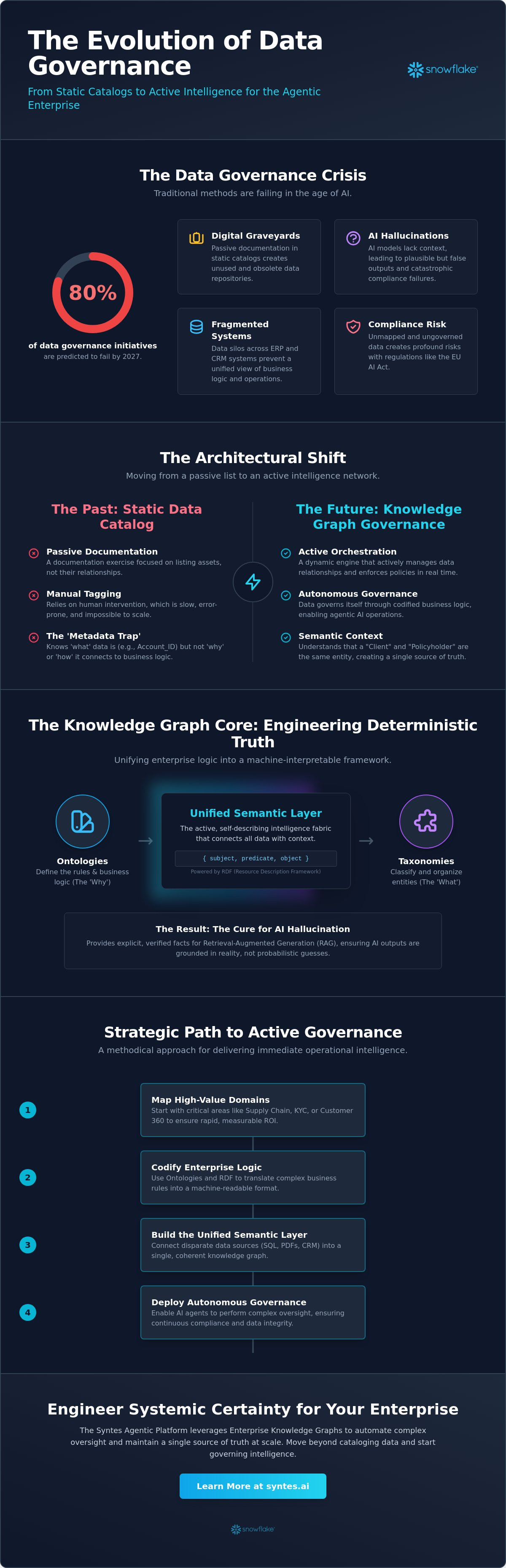
Why are 80% of data governance initiatives predicted to fail by 2027? The answer lies in the obsolescence of the static data catalog. Most enterprises treat governance as a passive documentation exercise, resulting in digital graveyards that fail to prevent AI hallucinations or bridge the gap between fragmented ERP and CRM systems. To survive the shift toward autonomous agents, you must move beyond manual tagging. Implementing a robust knowledge graph for data governance transforms these dormant repositories into active, semantic engines that provide the grounding your intelligence layer demands.
You recognize the stakes. With the EU AI Act reaching full enforcement in August 2026, the cost of unmapped data is no longer just operational inefficiency; it’s a profound compliance risk. This guide outlines how to architect a unified semantic layer that replaces guesswork with deterministic truth. We’ll examine the transition from human-led oversight to autonomous governance frameworks. You’ll learn to build a system where data doesn’t just sit in a silo but actively informs every executive decision and AI interaction across your enterprise architecture. It’s time to stop cataloging data and start governing intelligence.
Key Takeaways
- Abandon the passive data catalog. Learn to architect a dynamic framework that transitions governance from a documentation burden to an active orchestration engine for global operations.
- Codify enterprise logic. Discover how ontologies and the Resource Description Framework (RDF) establish a unified semantic layer that resolves persistent silos across ERP and CRM systems.
- Empower the agentic enterprise. Implement a knowledge graph for data governance to provide the grounding required for autonomous AI agents to operate with deterministic precision and zero hallucinations.
- Deploy with strategic intent. Follow a methodical approach to mapping high-value domains like Supply Chain or KYC, ensuring your governance model delivers immediate operational intelligence.
- Engineer systemic certainty. See how the Syntes Agentic Platform leverages enterprise knowledge graphs to automate complex oversight and maintain a single source of truth at scale.
The Evolution of Governance: From Static Catalogs to Semantic Knowledge Graphs
Traditional data governance is fundamentally broken. It was architected for a world of human analysts, quarterly reports, and static databases. Today, that model isn’t just inefficient; it’s a strategic liability. You need an AI data governance framework that moves from passive observation to active orchestration. In a landscape where Gartner reports that 73% of AI projects fail due to poor data quality, simply listing your assets in a catalog won’t save your enterprise. You must govern the relationships between those assets in real time. A Knowledge graph provides this dynamic map, creating a network of interconnected entities that reflects the complex reality of global operations.
Why Traditional Data Governance Fails the AI Test
Is metadata alone sufficient for enterprise AI? No. Knowing where data resides is useless if your models lack the context to use it safely. Traditional catalogs suffer from the ‘Metadata Trap’. They tell you a column is named “Account_ID”, but they don’t explain how that ID relates to a churn event in a CRM or a contract renewal in a legal database. Without this semantic grounding, AI hallucinations are inevitable. Data silos act as physical barriers to autonomous agentic execution, preventing AI from seeing the full picture of your business logic. If your governance relies on manual tagging and human intervention, it will buckle. You can’t scale manual oversight when your data environments grow exponentially every hour.
The Knowledge Graph Advantage
The knowledge graph for data governance represents a fundamental architectural shift. It moves your organization from flat, two-dimensional tables to multi-dimensional relationship networks. This isn’t just about better storage; it’s about providing the “why” behind the “what” in enterprise data. Semantic context allows an AI agent to understand that a “Client” in a sales tool and a “Policyholder” in an insurance system are the same entity. This connectivity forms the core of the semantic data layer for enterprise. By architecting this layer, you create a self-describing environment where data governs itself through logical rules. This approach ensures that your AI outputs are grounded in a deterministic ‘ground truth’ that tables and columns simply cannot provide.
Transitioning to a graph-based model enables active governance. Policies are no longer buried in PDF documents; they’re embedded as executable code within the metadata layer. This allows for real-time enforcement and automated compliance, which is critical as global regulations like the EU AI Act become fully enforceable. By treating governance as an active orchestration engine, you turn a compliance burden into a competitive engine for the agentic enterprise.
Architecting the Framework: The Knowledge Graph Core
Modern data environments are too fluid for rigid hierarchies. To Optimize Data Governance with Enterprise Knowledge Graphs, you must first master the technical pillars: ontologies, taxonomies, and the semantic layer. These components don’t just organize data; they define the business logic that governs it. At the heart of this architecture lies the Resource Description Framework (RDF). Think of RDF as the language of enterprise facts. It uses a subject-predicate-object structure to create a web of relationships that machines can actually interpret. This allows you to unify structured SQL databases with unstructured content like PDFs and legal contracts within a single, coherent graph.
Semantic Grounding: The Cure for AI Hallucination
Probabilistic models are inherently unreliable for enterprise decision-making. When an LLM “guesses” the next token, it risks generating plausible-sounding falsehoods that can lead to catastrophic compliance failures. A knowledge graph for data governance provides the explicit, verified facts required for Retrieval-Augmented Generation (RAG). By grounding your AI in a deterministic graph, you move from statistical probability to absolute retrieval. This is the only viable path to prevent AI hallucination and ensure your agents act on “ground truth.” If you are looking to deploy these structures, the Syntes Agentic Platform provides the necessary infrastructure to bridge these silos and enforce deterministic outputs.
Ontology vs. Schema: Building for Flexibility
Fixed schemas are where innovation goes to die. In a traditional SQL environment, a change in business logic requires a massive, disruptive database migration. Modern enterprises can’t afford that friction. Ontologies offer a superior alternative. They allow you to map cross-system data without the overhead of traditional ETL processes. An ontology evolves with your business logic. It allows you to integrate a new CRM or an acquired subsidiary’s data silos into your existing framework within days. This architectural flexibility transforms a static repository into a high-velocity semantic engine that stays relevant as your operational needs shift.
Determinism is the ultimate goal of this core architecture. By unifying your disparate data sources into a single, semantic source of truth, you eliminate the ambiguity that plagues traditional governance. You aren’t just storing records; you are architecting a system of intelligence that is both scalable and verifiable. This foundation is what enables the transition from human-managed data to the autonomous, agentic workflows that define the modern enterprise.
Beyond Metadata: Enabling Autonomous Governance with Agentic AI
Governance is no longer a human-scale task. The sheer volume of enterprise interactions makes manual oversight a relic of the past. You must transition from human-led monitoring to agentic AI orchestration. While traditional systems wait for a human to flag a discrepancy, a knowledge graph for data governance provides the machine-readable map that allows AI agents to navigate your data estate independently. These agents don’t just see the data; they understand the semantic relationships between a customer record in Salesforce and a financial transaction in SAP, enabling them to execute governance protocols at the speed of business.
The Role of Agentic Platforms in Governance
The agentic AI platforms of 2026 are the primary enforcers of data integrity. They provide more than simple automation; they offer autonomous reasoning. Agents can trace data lineage across the graph in real time, identifying exactly where a data point originated and how it has been transformed. This capability revolutionizes Master Data Management (MDM). Instead of relying on rigid rules, agents use the knowledge graph to resolve identity conflicts and maintain a golden record through context-aware reasoning. This ensures that your enterprise ground truth remains untainted by operational noise.
Critics often ask if this architecture adds unnecessary complexity. This is a fundamental misunderstanding of the problem. Complexity already exists in your fragmented silos and unmapped data. The agentic approach doesn’t create complexity; it manages it. By offloading the burden of navigational logic to AI agents, you free your technical teams from the metadata trap. Agents monitor the graph for governance violations as they happen. If a data flow violates a privacy policy or an AI interaction lacks proper labeling under the EU AI Act, the agent intervenes immediately. This is proactive orchestration, not reactive reporting.
Cross-System AI Integration: The Connectivity Engine
True governance requires visibility across the entire stack. Agents bridge the gap between legacy databases and modern cloud environments by treating the knowledge graph as a universal translator. Whether your data lives in a decades-old mainframe or a cutting-edge CRM, the semantic layer ensures that governance policies are enforced consistently. This level of systemic integration is the only way to succeed in solving enterprise data silos. By embedding governance into the connectivity engine itself, you transform your infrastructure from a collection of disconnected parts into a singular, intelligent organism that maintains its own integrity.
Implementing a Knowledge Graph-Driven Governance Strategy
Execution is where most governance initiatives stall. To move from theory to operational reality, you must follow a methodical roadmap. Implementing a knowledge graph for data governance isn’t about a massive “boil the ocean” migration; it’s about strategic, domain-led expansion. Start where the fragmentation is most painful. For many global firms, this means focusing on Supply Chain visibility or KYC compliance, where a single missing relationship can lead to millions in lost revenue or regulatory fines. Success requires a five-step approach that prioritizes utility over documentation.
- Step 1: Identify high-value business domains. Target areas with high data variety and significant business impact where silos currently hinder decision-making.
- Step 2: Map semantic relationships. Define the ontologies that govern how entities like “Supplier,” “Risk Profile,” and “Contract” interact within those domains.
- Step 3: Integrate disparate sources. Use AI-driven middleware to ingest data from legacy ERPs and modern SaaS tools into the graph.
- Step 4: Deploy AI agents. Set autonomous agents to monitor the data fabric, ensuring real-time policy enforcement and data integrity.
- Step 5: Measure ROI. Track the reduction in AI hallucination rates and the acceleration of data discovery timelines compared to legacy catalog performance.
The Build vs. Buy Dilemma for 2026
Is your internal team equipped to build a scalable graph from scratch? In 2026, attempting to develop this infrastructure in-house is an unacceptable operational risk. The complexity of maintaining an agent-ready semantic layer requires specialized engineering that most IT departments lack. When evaluating enterprise AI infrastructure, prioritize vendors that offer native agentic integration and robust security protocols. You need a platform that is ready to support autonomous intelligence today, not a project that will take years to mature. To see how these systems operate in high-stakes environments, explore the Syntes Agentic Platform.
Scaling Governance Across the National Enterprise
Multi-national organizations face the unique challenge of federated governance. You can’t enforce a single, rigid definition of “Customer” across every global business unit without breaking local workflows. The knowledge graph allows for a ‘hub-and-spoke’ model where core semantic definitions are centralized, while local variations are mapped as extensions. This shift fundamentally changes the organizational chart. The traditional ‘Data Steward’ who manually cleans spreadsheets is being replaced by the ‘Graph Librarian.’ This new role focuses on the strategic health of the ontology rather than the tactical cleaning of cells, ensuring consistent logic across the entire national enterprise.
The Syntes Advantage: Engineering Deterministic Truth
Enterprise intelligence is only as reliable as its foundation. While legacy vendors offer glorified search bars, Syntes AI provides the knowledge graph for data governance required to ground your autonomous agents in absolute truth. We don’t just document your data; we architect its performance. Our Enterprise Knowledge Graph acts as the definitive nervous system for your organization. It connects the dots that human stewards miss. It enforces the rules that static catalogs ignore. The Syntes Agentic Platform transforms your fragmented data environment into a singular, high-performance asset where governance is an active, real-time participant in every business process.
Why Syntes AI is the Strategic Choice
How do you eliminate the hallucination problem at the enterprise level? You replace probabilistic guesses with semantic certainty. Syntes AI utilizes superior semantic grounding to ensure that every AI output is anchored in verified facts. This isn’t just about accuracy; it’s about systemic trust. Our platform handles the gravity of your operational challenges with enterprise-grade security, protecting sensitive cross-system data as it flows through the graph. We’ve engineered our Cross-System Integrations to eliminate the friction of data unification, allowing you to bridge SAP, Salesforce, and legacy mainframes without the traditional cost of custom ETL. Scalability is not a future promise; it’s a core feature of our architecture, designed for the most complex global data environments.
Transitioning to Agentic Intelligence
The move toward an agentic enterprise is a strategic necessity. You cannot manage the data velocity of 2026 with the tools of 2016. The journey begins with a Syntes-led pilot program, focusing on a high-value domain where unmapped data currently creates the most risk. We help you identify. We help you map. We help you orchestrate. This methodical transition moves your organization from the era of static, siloed records to a future of autonomous business outcomes. Stop settling for passive observation. It’s time to deploy a governance framework that works as hard as your business does. Explore the Syntes Agentic Platform and engineer the deterministic truth your enterprise demands.
Operational clarity is no longer an optional luxury. With global regulations tightening and AI adoption accelerating, the distance between the leaders and the laggards is defined by their data architecture. Syntes AI provides the tools to bridge that gap. By implementing a sophisticated knowledge graph for data governance, you aren’t just checking a compliance box; you are building the infrastructure for the next decade of autonomous intelligence. The choice is clear: remain trapped in the metadata graveyards of the past or lead the agentic enterprise of the future.
Mastering the Semantic Frontier: The Path to Agentic Governance
The window for manual data oversight is closing. As autonomous agents become the primary consumers of enterprise information, the cost of fragmented silos and probabilistic grounding will become unsustainable. You must architect a foundation that prioritizes deterministic truth over simple metadata collection. Implementing a knowledge graph for data governance ensures your AI initiatives are grounded in a verifiable, cross-system reality. This isn’t just about avoiding hallucinations; it’s about building a system that can finally scale without human bottlenecks. By moving from passive catalogs to active semantic layers, you turn your data into a strategic engine for execution.
Syntes AI provides the enterprise-grade infrastructure needed to lead this transition. Our platform offers proven cross-system integration capabilities and the deterministic grounding required for zero-hallucination AI. Don’t let your data remain a passive asset. Scale your AI initiatives with Syntes AI’s Enterprise Knowledge Graph and transform your governance into a high-performance engine for growth. You have the tools to bring order to the chaos of large-scale operations. The future of the agentic enterprise is within your reach. Start architecting your success today.
Frequently Asked Questions
What is an ai data governance framework and how does it differ from traditional governance?
An AI data governance framework is an active orchestration system designed for machine-readability and autonomous enforcement. Traditional governance focuses on passive documentation and human-centric catalogs that often become static graveyards. In contrast, an AI-first framework prioritizes the semantic grounding of data. It ensures that autonomous agents have the context and rules they need to operate safely without constant human intervention.
How do knowledge graphs help in preventing AI hallucinations?
Knowledge graphs provide deterministic grounding that probabilistic models lack. While LLMs guess the next token based on statistical patterns, a knowledge graph for data governance offers explicit, verified facts and relationships. By anchoring your AI in this structured web of truth, you eliminate the ambiguity that leads to hallucinations. Your agents stop guessing and start retrieving precise, ground-truth data from your enterprise systems.
Can a knowledge graph integrate with my existing ERP and CRM systems?
Yes, it acts as a universal semantic translator across your entire stack. Through sophisticated cross-system integrations, a knowledge graph maps the relationships between entities in SAP, Salesforce, and legacy databases without requiring a massive data migration. It doesn’t replace your existing systems; it provides the connectivity layer that allows them to function as a singular, intelligent organism for your AI agents.
What are the core components of a semantic data governance model?
The model relies on three technical pillars: ontologies, taxonomies, and the Resource Description Framework (RDF). Ontologies define the logic and rules of your business entities. Taxonomies provide the hierarchical categorization. RDF serves as the standardized language of facts, allowing machines to interpret complex data relationships as a connected web. Together, these components create a self-describing environment that automates oversight.
Is a knowledge graph necessary if we already have a data lake or data warehouse?
Absolutely. Data lakes and warehouses are storage solutions that lack inherent context. They tell you what data you have, but they don’t explain what it means or how it relates to other domains. A knowledge graph provides the semantic layer that these repositories lack. It turns raw data into actionable intelligence, making it usable for agentic AI that requires logical reasoning to execute tasks.
How does agentic AI improve the efficiency of data governance?
Agentic AI removes the “human-in-the-loop” bottleneck that stalls traditional initiatives. Agents use the knowledge graph to monitor data flows, trace autonomous lineage, and resolve master data management (MDM) conflicts in real time. This proactive orchestration ensures that your governance policies are enforced at the speed of business, which is critical for meeting the strict transparency requirements of the EU AI Act.
What are the common challenges when implementing a knowledge graph for governance?
The primary challenges involve ontological alignment and infrastructure readiness. You must build a shared logic that resonates across different business units, which requires deep industry insight. Many enterprises also struggle with the computational load of real-time reasoning. This is why selecting a platform with enterprise-grade infrastructure is vital to avoid the operational risks of building a custom solution from scratch.
How do I measure the ROI of a knowledge graph-driven governance strategy?
Measure success through the reduction of AI hallucination rates and the acceleration of data discovery timelines. You’ll see a sharp decline in the hours spent on manual data cleaning and reconciliation. Additionally, track the speed of your AI deployments. A knowledge graph for data governance allows you to launch compliant, grounded agents in weeks rather than months, delivering immediate operational value to the enterprise.