
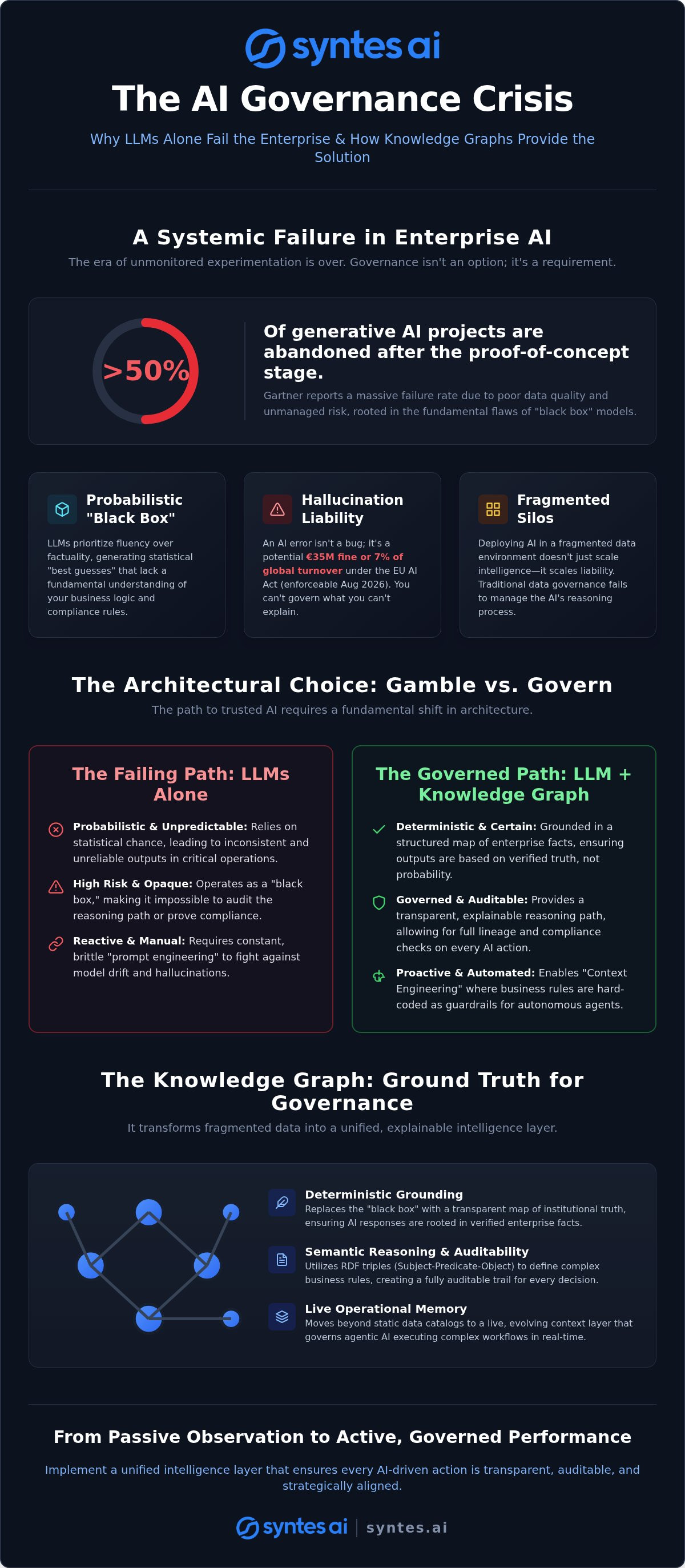
Gartner reports that over 50% of generative AI projects are abandoned after the proof-of-concept stage due to poor data quality and unmanaged risk. Most enterprises are gambling on “black box” models that lack a fundamental understanding of business logic. It’s a systemic failure. Implementing a knowledge graph for ai governance isn’t an option; it’s a requirement for survival. As the EU AI Act’s primary transparency obligations become enforceable on August 2, 2026, the era of unmonitored experimentation is officially over. You can’t govern what you can’t explain.
You’ve likely realized that LLMs alone fail the enterprise. Hallucinations create liability. Fragmented silos prevent unified policy. Autonomous agents without audit trails are a catastrophe waiting to happen. This article provides a roadmap for architecting explainable AI and reducing regulatory risk. We’ll explore how a live Context Graph provides the operational memory needed to govern agentic AI at scale. Discover how to provide the deterministic grounding and explainable reasoning your systems require to function with precision. Transition from passive observation to active, automated performance with total clarity.
Key Takeaways
- Identify the systemic flaws of probabilistic LLMs and why they cannot satisfy the deterministic requirements of modern enterprise compliance.
- Discover how a knowledge graph for ai governance provides the essential grounding and structured relationships required to transform “black box” outputs into explainable intelligence.
- Transition from reactive prompt engineering to proactive Context Engineering, creating a live operational memory that evolves with your business logic.
- Implement the Syntes Context Engineering Framework to hard-code governance guardrails directly into the execution layer of your autonomous AI agents.
- Establish a unified intelligence layer that bridges fragmented data silos, ensuring every AI-driven action remains transparent, auditable, and strategically aligned.
The Crisis of AI Governance: Why LLMs Alone Fail the Enterprise
The era of AI experimentation is dead. It’s a cold reality for the C-suite. Large Language Models are probabilistic engines, yet enterprise governance demands absolute, deterministic certainty. This fundamental mismatch explains why Gartner reports over 50% of generative AI projects collapse after the proof-of-concept stage. You cannot run a global enterprise on statistical “best guesses.” As of August 2, 2026, the EU AI Act mandates transparency that black-box models cannot deliver. The cost of a hallucination isn’t just a factual error. It’s a potential fine of 35 million Euros or 7% of global turnover.
Why do LLMs fail at governance? Because they prioritize fluency over factuality. They are designed to predict the next likely word, not to adhere to the rigid logic of business policy. When you deploy these models in a fragmented data environment, you aren’t just scaling intelligence; you’re scaling liability. Traditional data governance focuses on the storage and quality of data, but it ignores the reasoning process of the AI itself. This gap is where enterprise value goes to die.
The Hallucination Liability in Regulated Industries
Stochastic parrots don’t understand your business logic. They predict sequences. In high-stakes sectors like finance and healthcare, this legal unpredictability is an unacceptable liability. Standard Retrieval-Augmented Generation (RAG) attempts to ground these models, but the results are often superficial. Vector databases lack the semantic depth required for true auditability. They identify similarity, not causality. Without a structured Knowledge Graph, your AI lacks the logical framework to justify its decisions during a regulatory audit. You need a knowledge graph for ai governance to transform these probabilistic outputs into defensible, traceable actions.
From Passive Metadata to Active AI Governance
Static data catalogs are artifacts of a slower age. They cannot govern agentic AI that executes complex workflows across fragmented silos. Traditional governance is obsessed with the data layer, but you must pivot to the reasoning layer. We’ve moved beyond “AI that answers” to “AI that acts.” This transition requires a robust knowledge graph for ai governance to serve as a Live Operational Memory. It provides the connectivity and real-time relevance needed for operational intelligence. Governance is no longer a sidecar; it’s the engine of execution. By embedding rules directly into the reasoning path, you move from passive observation to active, governed performance.
The shift to agentic AI changes the stakes. Agents don’t just summarize; they execute. They move money, authorize access, and modify records. If the underlying model hallucinates a permission, the damage is immediate and automated. A live Context Graph provides the hard-coded business rules that probabilistic models lack. It bridges the gap between fragmented enterprise knowledge and the precise execution required for trusted intelligence.
The Knowledge Graph as the Ground Truth for AI Governance
If the LLM is the engine, the Knowledge Graph is the track. Without it, your AI is driving off-road. An Enterprise Knowledge Graph is a structured representation of entities and their relationships, providing the deterministic grounding that probabilistic models lack. It transforms fragmented data into a unified intelligence layer. This is where a knowledge graph for ai governance proves its worth by mapping data dependencies across the entire organization. It replaces the “black box” with a transparent map of institutional truth.
A sophisticated Semantic Layer unifies structured databases and unstructured documents. It creates a single, coherent source of truth. You can visualize lineage, seeing exactly where a piece of information originated and how it influenced a specific AI output. This level of transparency is no longer optional. It is a core requirement for organizations aiming to align with the NIST AI Risk Management Framework. By grounding AI in a graph, you ensure that every response is rooted in verified enterprise facts rather than statistical probability.
Semantic Reasoning: How Graphs “Understand” Business Rules
How do graphs capture complex logic? They utilize RDF triples to define business rules through a Subject-Predicate-Object structure. This mathematical precision allows the system to connect customers, products, and policies in a unified context layer. Unlike static data catalogs, this structure supports active intelligence. Semantic Reasoning is the ability for AI to traverse a graph to validate facts. It eliminates the ambiguity of natural language, ensuring that your AI agents operate within the strict boundaries of your corporate policy.
Explainable AI (XAI) through Graph Traversal
Auditability is the final frontier of enterprise AI. When an autonomous agent executes a workflow, you can’t accept “I think” as a justification. You need “I know.” Graph paths provide a definitive audit trail for every decision the AI makes. You can trace the reasoning step-by-step across nodes and edges. There is a powerful synergy between enterprise knowledge graphs and trusted intelligence. It’s the difference between a guess and a proof. This framework allows for automated policy enforcement at the graph level, blocking non-compliant actions before they occur. If you’re ready to move beyond experimental chatbots, you can schedule a platform walkthrough to see how we architect this certainty.
Context Engineering: The Next Evolution of AI Governance
Prompt engineering is a temporary fix for a structural problem. It relies on a model’s ability to guess intent from a narrow window of text. It’s insufficient. Context Engineering is the rigorous discipline of building and maintaining the deep business context required for AI safety. While first-generation RAG provided a basic bridge to external documents, it failed to provide the underlying logic of the enterprise. We’ve moved beyond simple retrieval. We are now architecting the intelligence layer itself. This shift represents the necessary transition from passive data access to a Live Context Graph that understands the nuance of your global operations.
Syntes AI transforms fragmented data into a cohesive, real-time environment. Most organizations struggle with data that lives in isolated silos, creating blind spots that lead to operational failure. Context Engineering connects these dots. It ensures that every AI action is grounded in the current, verifiable state of the business. Industry leaders are increasingly vocal about the intersection of AI Governance and Knowledge Graphs as the only viable path for trusted scale. Without a knowledge graph for ai governance, your AI is merely a sophisticated guesser. With it, it becomes a strategic asset capable of autonomous reasoning.
Beyond RAG: The Strategic Shift to Context Graphs
Standard RAG is document-centric. It retrieves chunks of text based on vector similarity, often missing the connective tissue of business logic. GraphRAG is relationship-centric. It understands that a “customer” identified in your CRM is the same “entity” bound by a specific legal contract in your repository. This distinction is critical for complex reasoning tasks. Context is the fuel for accurate AI in 2026. By utilizing these deterministic structures, you can prevent AI hallucination by forcing the model to adhere to verified graph paths. It’s the difference between asking an AI to find information and requiring it to verify a fact.
Building the Enterprise Intelligence Layer
Implementing a Governed Framework for Agentic AI
The shift from AI that talks to AI that acts is a high-stakes transition. Most organizations are currently unprepared for this evolution. While 85% of enterprises have integrated AI into their operations, only 21% report a mature governance model for agentic workflows. This isn’t just a technical oversight; it’s a structural liability. You need a rigorous infrastructure that transforms probabilistic reasoning into deterministic action. The Syntes Context Engineering Framework addresses this by establishing five pillars of execution:
- Connect: Bridging fragmented silos to ingest high-fidelity data.
- Understand: Mapping entities and relationships to build semantic meaning.
- Contextualize: Providing the live operational memory required for reasoning.
- Govern: Hard-coding business rules and permissions into the graph.
- Execute: Enabling agents to perform tasks with deterministic precision.
By implementing a knowledge graph for ai governance, you move beyond “best effort” safety to hard-coded business logic. Auditability must be systemic. Every agent action is recorded back into the Live Operational Memory, creating a transparent, real-time audit trail. This isn’t about passive logging. It’s about maintaining a perpetual state of operational clarity. Human-in-the-loop (HITL) systems provide the necessary intervention points for high-stakes decisions. The graph ensures the human reviewer has the exact context needed to approve or deny an action instantly.
Governing the Execution: From Reasoning to Action
Governed agents use enterprise memory to ensure every step is strategic and safe. Permissions are no longer broad strokes; they’re defined at the entity level within the graph itself. This granular control is essential when integrating agentic AI platforms with your existing security stack. You aren’t just giving an AI a login. You’re embedding it within a sophisticated security architecture that understands relationships and hierarchies. This ensures that autonomous performance never compromises corporate integrity.
Measuring ROI on AI Governance
Effective governance is a performance multiplier. By using a knowledge graph for ai governance, you significantly reduce the “Compliance Tax” through automated audit reporting. This eliminates the bottleneck of manual oversight. It also accelerates time-to-market. When your context layer is pre-governed, you can deploy new AI applications in weeks rather than months. You’re scaling your AI initiatives without inflating the headcount of your governance office. It’s a roadmap for sustainable, high-velocity growth.
Syntes AI: The Infrastructure for Trusted Enterprise Intelligence
The architectural imperative of 2026 is clear. Governance is no longer a documentation exercise. It’s a technical constraint. Syntes AI provides the Enterprise AI Platform required to move from passive observation to active, automated performance. While others offer fragmented tools, we provide a unified intelligence layer. Our knowledge graph for ai governance acts as the central nervous system for your enterprise, bridging the gap between raw data silos and governed agentic execution. It’s time to stop managing AI through hope and start managing it through architecture.
Systemic fragmentation is the primary enemy of enterprise intelligence. When your data is scattered across legacy ERPs, modern CRMs, and thousands of unstructured documents, your AI is forced to guess. Syntes AI eliminates these knowledge silos for good. We transform disparate data signals into a live Context Graph that understands the complex relationships defining your business. This isn’t just about search. It’s about providing the deterministic grounding that turns a “black box” model into an explainable asset. You gain the power of a Live Operational Memory that evolves at the speed of your business logic.
The Syntes AI Difference: Live vs. Static
Static data catalogs are artifacts of a slower era. They cannot support the real-time requirements of autonomous agents. A continuously evolving graph is the only way to maintain operational safety in high-velocity environments. Syntes AI utilizes sophisticated cross-system integrations to ensure your intelligence layer is never out of sync with reality. This connectivity is the foundation of our platform. We don’t just store data; we contextualize it. By establishing this unified context layer, Syntes AI becomes the definitive partner for solving enterprise data silos and enabling trusted scale.
Starting Your Context Engineering Journey
Transitioning to governed AI requires a strategic roadmap. It starts with assessing your current infrastructure readiness. Are your silos accessible? Is your business logic mapped? The journey moves from initial data integration to semantic contextualization, eventually reaching the stage of governed agentic execution. This roadmap ensures that every AI initiative is rooted in safety and strategic alignment. Implementing a knowledge graph for ai governance is the first step toward reducing regulatory risk and maximizing operational efficiency. The black box is a choice. We offer an alternative built on clarity and precision.
The future of enterprise intelligence belongs to those who can prove their AI’s reasoning. Don’t let your AI initiatives stall at the proof-of-concept stage due to unmanaged risk. Move toward a framework where every action is auditable and every decision is grounded in truth. Experience the Syntes AI Context Graph and begin architecting the infrastructure for trusted enterprise intelligence today.
Architecting the Future of Deterministic Intelligence
Relying on probabilistic guesses is no longer a viable business strategy. Enterprises cannot afford the liability of ungrounded models that prioritize fluency over factuality. Gambling on hallucinations is a terminal strategy in a regulated market. By implementing a knowledge graph for ai governance, you establish the deterministic truth layer that autonomous systems require to function safely. This is the necessary shift from passive data observation to active, governed execution. Syntes AI stands at the forefront of this technological evolution. We provide the Live Operational Memory required for 2026 enterprises to scale their operations with total clarity and precision.
As a recognized leader in Context Engineering, Syntes AI offers the only viable path to enterprise-grade governance for Agentic AI. You are no longer guessing at compliance; you are architecting it into the very fabric of your reasoning layer. The transition from fragmented data silos to unified intelligence is no longer a luxury. It’s a strategic mandate. Secure your competitive advantage by grounding your agents in a framework of explainable reasoning and absolute auditability. The future belongs to the certain.
Frequently Asked Questions
How does a knowledge graph improve AI governance?
A knowledge graph improves AI governance by providing a deterministic grounding layer that replaces probabilistic “best guesses” with verified facts. It maps complex relationships between entities, allowing for an explainable reasoning path that auditors can trace. This structural transparency ensures that AI outputs are rooted in corporate policy rather than statistical likelihood. By using a knowledge graph for ai governance, enterprises can enforce hard-coded business rules at the reasoning layer, significantly reducing regulatory and operational risk.
What is the difference between a knowledge graph and a traditional database for AI?
Traditional databases focus on storing rows or vectors, but they lack the semantic connectivity required for complex reasoning. A knowledge graph treats relationships as first-class citizens, utilizing a subject-predicate-object structure to define how data points interact. While vector databases identify similarity, knowledge graphs identify causality and logic. This distinction is critical for AI governance, as it allows the system to understand the context and permissions associated with every entity across fragmented data silos.
Can a knowledge graph actually prevent AI hallucinations?
Yes, a knowledge graph prevents AI hallucinations by forcing the model to validate its responses against a structured source of truth. Instead of allowing an LLM to predict the next likely word, the system requires it to traverse specific graph paths to retrieve verified facts. This process, often called GraphRAG, ensures that the AI’s “creativity” is constrained by the deterministic logic of the graph. It transforms the AI from a stochastic parrot into a fact-based reasoning engine.
What is Context Engineering and why does it matter for governance?
Context Engineering is the technical discipline of building and maintaining a Live Operational Memory to guide AI behavior safely. It’s the successor to prompt engineering, focusing on the infrastructure of intelligence rather than just the phrasing of queries. For governance, it matters because it ensures that AI agents always operate with the most current, relevant business context. Without rigorous Context Engineering, AI systems lack the “common sense” and policy awareness needed to execute tasks without human supervision.
How do you integrate existing data silos into a knowledge graph?
Integration involves utilizing cross-system connectors to ingest metadata and relationships from disparate sources like ERP, CRM, and document repositories. Syntes AI uses sophisticated two-way integrations to map these fragmented signals into a unified Context Graph. This process doesn’t require moving all your data into a single lake; instead, it creates a virtualized intelligence layer that references data in real time. It effectively bridges silos while maintaining the integrity of the original source systems.
Is a knowledge graph required for compliant Agentic AI?
For enterprises operating at scale, a knowledge graph for ai governance is essentially a requirement for compliance. Agentic AI platforms that execute autonomous actions need a deterministic guardrail to prevent unauthorized or non-compliant behavior. Without a graph, agents lack a reliable audit trail and a clear understanding of entity-level permissions. As global regulations like the EU AI Act enforce stricter transparency mandates, the ability to prove why an agent took a specific action becomes a legal necessity.
How does Syntes AI ensure the security of the Context Graph?
Syntes AI secures the Context Graph by implementing granular, entity-level permissions directly within the graph architecture. This ensures that AI agents can only access or act upon data they are explicitly authorized to use. Our platform integrates seamlessly with existing enterprise security stacks, extending traditional access controls into the AI reasoning layer. We treat security as an intrinsic part of the context, ensuring that data privacy and corporate integrity are maintained during every automated execution.
What industries benefit most from knowledge graph-based AI governance?
Regulated industries such as financial services, healthcare, and legal sectors benefit most from this architecture. These fields demand high-fidelity reasoning and absolute auditability to meet strict compliance standards. For example, a bank using a knowledge graph can ensure its AI agents adhere to complex anti-money laundering policies across multiple jurisdictions. Any sector where the cost of a hallucination involves legal liability or financial loss requires the deterministic grounding that only a knowledge graph provides.