

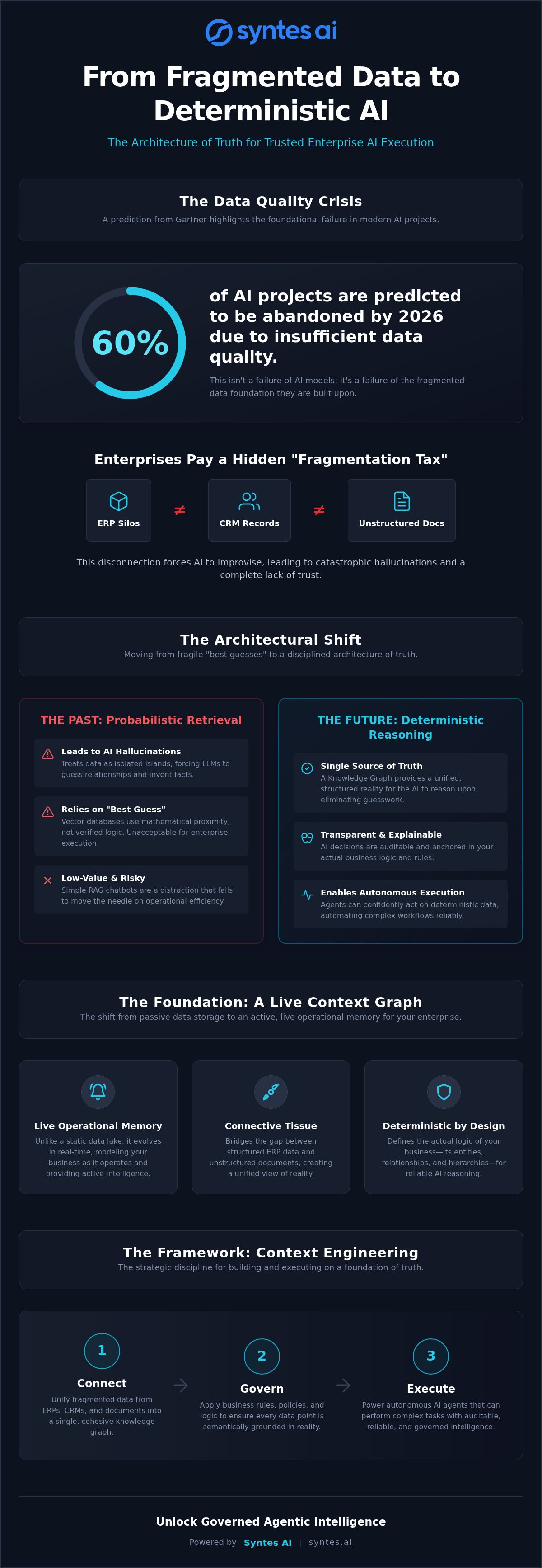
Gartner predicts that through 2026, 60% of AI projects will be abandoned due to insufficient data quality. This isn’t a failure of the models; it’s a failure of the foundation. Most enterprises are still attempting to build sophisticated agents on a house of cards built from disconnected ERP silos and fragmented CRM records. By establishing a knowledge graph as a single source of truth, you replace these fragile systems with a deterministic architecture. You likely recognize the frustration of seeing a promising pilot collapse under the weight of AI hallucinations or a complete lack of explainability. It’s impossible to achieve autonomous execution when your data is a collection of conflicting snapshots rather than a unified reality.
The path to reliable, governed performance requires a shift from passive data storage to an active, live operational memory. This article explores how Syntes AI utilizes Context Engineering to transform your infrastructure into a high-fidelity Context Graph. We analyze the transition from simple RAG to advanced GraphRAG, the mechanics of deterministic truth, and the framework for building AI agents that deliver operational efficiency without the risk of ungoverned decision-making. Discover how a Live Context Graph eliminates fragmented data to provide the deterministic truth required for trusted enterprise AI execution.
Key Takeaways
- Eliminate the “fragmentation tax” by transitioning from probabilistic vector databases to a structured, unified data architecture.
- Establish a knowledge graph as a single source of truth to provide the deterministic foundation necessary for reliable, explainable AI reasoning.
- Distinguish the operational utility of a Live Context Graph from traditional, analytical semantic layers to support active, automated performance.
- Implement the strategic framework of Context Engineering to connect, govern, and execute complex business logic through autonomous agents.
- Close the production gap by leveraging the Syntes AI platform to transform fragmented data into a high-fidelity operational memory.
The Failure of Fragmented Data: Why Vector DBs are Not a Source of Truth
Enterprise data is broken. Your ERP does not talk to your CRM, and your unstructured documents exist in a vacuum. This creates a “fragmentation tax,” a hidden operational cost where AI agents spend more time reconciling conflicting data than executing tasks. Vector databases exacerbate this problem. They rely on mathematical proximity. They guess. In 2026, relying on a “best guess” for enterprise execution is a strategic liability. A knowledge graph as a single source of truth provides the structural backbone that vector stores lack by defining the actual logic of your business rather than just the proximity of your words.
The primary cause of AI hallucinations is not a lack of data; it is a lack of structural relationship understanding. LLMs are exceptional at language but incompetent at logic when isolated from a structured environment. They treat every chunk of retrieved text as an independent island. Without a unified layer that understands how a product SKU relates to a specific contract term or a regional regulation, the AI is forced to improvise. This improvisation is where trust dies.
The Limitations of First-Wave Enterprise AI
Most organizations began their journey with simple RAG. They built chatbots to “talk to their documents.” For a global enterprise, this is a low-value distraction that fails to move the needle on operational efficiency. Reasoning over isolated, disconnected facts leads to catastrophic failures in production. If an agent doesn’t understand that “Client A” in the CRM is the same “Entity 402” in the billing system, it will hallucinate a reality that doesn’t exist. Semantic grounding is the rigorous mapping of data points to a shared, immutable business context to ensure every AI output is anchored in reality.
From Probabilistic Retrieval to Deterministic Reasoning
LLMs are inherently probabilistic black boxes. They predict the next token based on statistical patterns, not verified logic. To understand the fundamental difference in approach, one must ask: What is a Knowledge Graph? It is a structured representation of knowledge that prioritizes relationships and rules over mere word proximity. Fragmented data silos are the primary blocker for autonomous agents because agents require certainty to act. You cannot automate a supply chain or a compliance check on a “maybe.” The industry is moving away from the fragile art of prompt engineering toward the discipline of architecting deterministic truth. This transition ensures that AI reasoning is transparent, auditable, and, most importantly, correct.
The Architecture of Truth: Defining the Enterprise Knowledge Graph
Static databases are relics. In the high-velocity environment of 2026, an Enterprise Knowledge Graph functions as a live model of your business. It is more than a storage bin; it is a map of entities and their complex relationships. By utilizing a knowledge graph as a single source of truth, organizations move beyond simple data retrieval. They create what we call “Operational Relationship Intelligence.” This intelligence allows AI to understand not just what a data point is, but why it matters in the context of your specific business rules. It is the difference between knowing a customer’s name and understanding their entire contractual history across three different business units.
This architecture facilitates a “Live Operational Memory.” Unlike a data lake that stores historical snapshots, this memory layer evolves in real time. It bridges the gap between structured transactions in your ERP and the unstructured policies found in your legal documents. It’s the connective tissue that makes sense of the mess. For those exploring the technical underpinnings, this Enterprise Knowledge Graph walkthrough provides an excellent perspective on how these systems discover hidden patterns across the enterprise, moving from passive storage to active insight.
The Anatomy of a Live Context Graph
A Context Graph is built on three pillars: entities, relationships, and hierarchies. These are the fundamental units of enterprise context. In 2026, the “live” aspect is non-negotiable. Stale data doesn’t just slow you down; it leads to failed execution. By integrating real-time operational events directly into the graph, you ensure your AI agents act on current reality. This requires a robust semantic data layer for enterprise to serve as the structural foundation. This foundation ensures that every node in the graph is governed, meaningful, and ready for agentic reasoning.
Unifying Disparate Systems into One Layer
Fragmentation is the enemy of intelligence. We solve this by connecting ERP, CRM, and disparate cloud applications through two-way connectors. This creates a unified layer where data from across the business is synthesized into a single, coherent narrative. This is the primary engine of GraphRAG. Instead of retrieving isolated text chunks that lack context, GraphRAG pulls high-fidelity data that includes the intricate relationships between entities. It transforms your data from a static archive into a dynamic intelligence layer. If you are ready to see how this architecture functions in a live environment, you should book a demo with our team to explore the Syntes platform’s capabilities.
Semantic Layer vs. Context Graph: Choosing Your Core Infrastructure
Traditional semantic layers were designed to solve a human problem. They translate complex database schemas into business-friendly metrics for dashboards. This is analytical truth. It is passive. It is retrospective. However, an autonomous agent cannot run a business on a dashboard. It requires operational truth. While a semantic layer might define “Revenue” as a static aggregate, a Context Graph maps the intricate web of contracts, permissions, and operational dependencies that allow an agent to actually influence that metric. By positioning a knowledge graph as a single source of truth, you move from observing the business to orchestrating it in real-time.
BI-centric models are insufficient for 2026 workflows because they lack the “write-capability” and relationship depth required for execution. They tell you what happened, but they don’t provide the logic for what should happen next. The transition from human-driven analytics to agent-driven execution demands a data layer that functions as an active participant in the workflow. This is the role of the Context Graph. It serves as the “Operational Memory” of the enterprise, ensuring that every autonomous action is grounded in the latest business reality.
Analytical Truth vs. Operational Truth
Defined metrics are sufficient for a human-led supply chain review. They are entirely inadequate for an autonomous agent tasked with rerouting shipments. The agent doesn’t just need to know the “Inventory Level” metric; it needs to understand the underlying business policies, supplier contracts, and logistical hierarchies. These rules must be embedded within the data layer itself. This is where enterprise knowledge graphs bridge the gap. They provide the structural reasoning required to turn static data into agentic intelligence, moving beyond simple visualization to active decision-making.
The ROI of Active Intelligence
The value of a Context Graph is measured in the elimination of the “production gap.” Recent data shows that while 79% of enterprises have adopted AI agents, only 11% have them running in production. The primary blocker is reliability. By prioritizing relationship-based data within your enterprise ai infrastructure, you reduce hallucination rates and increase agent autonomy. Transitioning to this level of active intelligence requires a shift in discipline toward Context Engineering, focusing on the governance and connectivity of your data assets.
| Capability | Semantic Layer | Vector DB | Context Graph |
|---|---|---|---|
| Primary Focus | BI & Metrics | Similarity Search | Operational Execution |
| Data Logic | Hierarchical | Probabilistic | Deterministic |
| Agent Readiness | Low (Read-only) | Medium (Retrieval) | High (Reasoning) |
Context Engineering: The Strategic Framework for Building Truth
Prompt engineering was a temporary fix for a structural problem. In 2026, the enterprise has moved beyond the trial-and-error of LLM prompting toward the rigorous engineering of deterministic environments. Context Engineering is the discipline of building and governing this business context. It is the bridge between raw data and autonomous action. By establishing a knowledge graph as a single source of truth, you provide the structural guardrails that allow AI to reason with certainty. This methodology represents the next evolution beyond simple RAG because it focuses on the architecture of the data itself rather than the quality of the question. It turns the “black box” into a transparent engine of logic.
The failure of many early AI pilots stemmed from a lack of methodology. Organizations threw data at models and hoped for accuracy. Context Engineering replaces hope with architecture. It recognizes that an AI is only as capable as the environment in which it operates. By treating context as a primary engineering asset, you eliminate the “hallucination tax” and prepare your infrastructure for actual, governed execution. This isn’t just about data cleaning; it’s about defining the very physics of your business operations.
The Five Pillars of Context Engineering
The transition to active intelligence is built on five strategic pillars. First, you must Connect. This involves integrating structured transactions from ERPs and unstructured document stores into a unified, high-fidelity stream. Next, the system must Understand. It utilizes machine learning to discover semantics and hierarchies automatically, identifying relationships that humans often overlook. Finally, we Contextualize, building a live model of the business that reflects current operational reality. This isn’t a static map. It’s a breathing representation of enterprise logic that updates as the business moves.
Governance and Execution
Truth without control is a strategic liability. To Govern means applying security, permissions, and compliance directly at the graph level. This ensures that every node in the graph respects the complex regulatory landscape of 2026, from the EU AI Act to state-level mandates. Once governed, the system can Execute. This enables agentic ai platforms to perform autonomous actions with total transparency. While automation is the goal, Human-in-the-Loop systems remain essential for refining the enterprise truth. Experts validate the relationships and logic that the graph discovers, ensuring the “operational memory” remains accurate. AI is only as intelligent as the context it understands.
Executing on Truth: How Syntes AI Powers Governed Agentic Intelligence
Syntes AI transforms the theoretical concept of a knowledge graph into a functional, enterprise-grade execution engine. It’s the only platform designed to convert fragmented siloes into a high-fidelity Context Graph. By utilizing a knowledge graph as a single source of truth, Syntes AI enables the transition from passive data observation to active, automated performance. This architecture ensures that every decision made by an AI agent is rooted in the “Live Operational Memory” of the business. Passive observation is a luxury the modern enterprise can no longer afford in 2026. You need a system that doesn’t just store facts but understands how to act on them with absolute certainty.
The Syntes Agentic Platform
The Syntes Agentic Platform allows organizations to deploy sophisticated agents that don’t just search; they reason. These agents operate within the governed boundaries of the Context Graph, ensuring that autonomous actions comply with internal policies and global regulations. Solving enterprise data silos is no longer a storage challenge; it’s the strategic prerequisite for agentic intelligence. When agents share a unified operational memory, they collaborate with a level of precision that was previously impossible. They move beyond basic task completion to complex, cross-functional orchestration, reducing the human burden of manual data reconciliation.
Trusted AI for the Global Enterprise
Enterprise trust is built on explainability. Syntes AI rejects the “black box” approach of first-wave AI models. Instead, every agentic decision is traceable back to the deterministic nodes of the knowledge graph. This level of transparency is critical for highly regulated sectors such as Finance, Healthcare, and Manufacturing. In Retail, it means supply chain agents that can justify every rerouted shipment based on real-time contract logic. By establishing a knowledge graph as a single source of truth, we provide the auditability required for the 2026 regulatory landscape. It’s time to move beyond the experimental phase. Transform your fragmented data into the operational intelligence your enterprise deserves.
- Deploy governed agents that reason over live business logic.
- Eliminate hallucinations through deterministic relationship mapping.
- Achieve operational efficiency through cross-system integration.
- Ensure compliance with explainable, auditable AI reasoning.
Architecting the Future of Enterprise Intelligence
The era of probabilistic experimentation is over. To lead in 2026, you must replace fragmented silos with a deterministic architecture that understands the complex physics of your business. Establishing a knowledge graph as a single source of truth is the only way to move beyond the limitations of simple retrieval and achieve genuine autonomous execution. You’ve seen how Context Engineering provides the strategic framework to connect and govern your data, while the Syntes Agentic Platform transforms that data into a live operational memory.
Success requires a commitment to enterprise-grade AI Governance and explainable AI reasoning. Our platform offers the technical sophistication recognized by the Red Dot Design Award, ensuring your infrastructure is as refined as it is powerful. It’s time to bridge the production gap and empower your agents with the clarity they need to act with certainty. Your organization’s intelligence is no longer limited by the documents you store, but by the relationships you can map and execute upon.
Your journey toward total operational clarity starts with a single architectural shift. It’s time to move from passive observation to active, automated performance.
Frequently Asked Questions
What is a knowledge graph as a single source of truth?
A knowledge graph as a single source of truth is a unified, live data model that maps entities and their relationships across an entire enterprise. It eliminates fragmented silos by connecting structured data from ERPs with unstructured business rules and policies. This architecture provides the deterministic foundation required for AI systems to reason with absolute accuracy. It ensures that every agent operates from a shared, immutable reality rather than disconnected snapshots.
How does a knowledge graph differ from a traditional data warehouse?
Data warehouses are historical archives designed for passive human analytics and retrospective reporting. In contrast, a knowledge graph is an active, live operational memory designed for real-time AI execution. While a warehouse stores data in rigid tables, a graph models the complex, fluid relationships between entities. This structure allows AI agents to understand the context and dependencies required for autonomous decision-making rather than just viewing isolated, static records.
Why is a knowledge graph necessary for agentic AI?
Agentic AI requires a knowledge graph to transition from simple text generation to reliable business execution. Without a structured source of truth, agents lack the deterministic logic needed to navigate complex workflows or follow strict compliance rules. The graph provides the operational memory that allows agents to collaborate safely. It ensures they understand the specific business physics, such as how a product SKU relates to a specific regional contract.
Can a knowledge graph prevent AI hallucinations?
Yes, a knowledge graph prevents hallucinations by providing a deterministic grounding layer for Large Language Models. Hallucinations often occur when an AI lacks structural understanding and is forced to improvise logic. By anchoring the AI in a verified context graph, the system retrieves facts based on explicit relationships rather than probabilistic word proximity. This ensures that every output is an auditable reflection of the actual enterprise truth.
What is the role of context engineering in building a source of truth?
Context engineering is the strategic discipline of building and governing the business context that a knowledge graph represents. It moves beyond simple prompt tuning by architecting the data environment itself. Through its five pillars; Connect, Understand, Contextualize, Govern, and Execute; context engineering ensures the graph remains a high-fidelity model of the business. It’s the methodology used to turn fragmented information into a reliable, continuously evolving operational memory.
How do you integrate unstructured data into a knowledge graph?
Syntes AI integrates unstructured data, such as policies and contracts, by using machine learning to discover semantics and map them to existing entities. The platform utilizes two-way connectors to ingest document stores and convert them into structured nodes within the Context Graph. This process ensures that hidden business rules aren’t isolated in PDFs but are active participants in the enterprise’s unified intelligence layer, ready for agentic reasoning.
Is a knowledge graph better than a vector database for enterprise AI?
A knowledge graph as a single source of truth is superior for complex reasoning, while vector databases are better suited for simple similarity searches. Vector DBs rely on probabilistic best guesses, which often lead to hallucinations in production environments. A knowledge graph provides the deterministic structure and relationship depth that vector stores lack. For high-stakes enterprise execution, the certainty of a graph architecture is a strategic necessity.
How does Syntes AI ensure the security of the knowledge graph?
Syntes AI ensures security by applying governance, permissions, and compliance frameworks directly at the graph level. Every node and relationship within the Context Graph is subject to strict access controls, ensuring that AI agents only reason over data they’re authorized to see. This enterprise-grade governance provides a transparent audit trail. It allows organizations to scale their AI initiatives while maintaining total control over their proprietary operational intelligence.