
Why are your high-stakes AI initiatives still failing to grasp the fundamental logic of your business? Most enterprises treat their ERP as a static repository, yet they expect AI agents to perform like seasoned executives. It’s a strategic mismatch. Your data is structurally dead to AI without a unified semantic layer. Integrating a knowledge graph for erp data is no longer an experimental luxury. It’s the mandatory evolution for any firm targeting autonomous operations as we move through 2026.
You’ve likely realized that manual data remediation is a bottomless pit of expense. The hallucinations caused by complex business logic aren’t just technical errors; they’re systemic liabilities in an era of strict regulatory enforcement. This article demonstrates how to transform fragmented ERP silos into a live, governed Context Graph that serves as a functional memory for your enterprise. You’ll discover how to move beyond simple prompt engineering toward a system of governed AI agents capable of executing ERP-level tasks with absolute precision. We’ll examine the architecture required for explainable AI reasoning, ensuring every automated decision remains auditable and grounded in your specific operational reality.
Key Takeaways
- Identify why traditional relational ERP silos prevent AI from understanding proprietary business logic and how to overcome these structural limitations.
- Learn to architect a knowledge graph for erp data that unifies structured tables and unstructured documents into a single, high-fidelity semantic layer.
- Replace unreliable Vector RAG with GraphRAG to achieve deterministic truth and eliminate hallucinations in sensitive financial or supply chain workflows.
- Leverage the Syntes Context Engineering framework to automate entity discovery and establish a live operational memory for your enterprise.
- Transition from passive chatbots to autonomous agents using the Syntes Agentic Platform to execute high-level tasks with governed precision and auditability.
Why ERP Data Silos Are the Single Greatest Obstacle to Enterprise AI
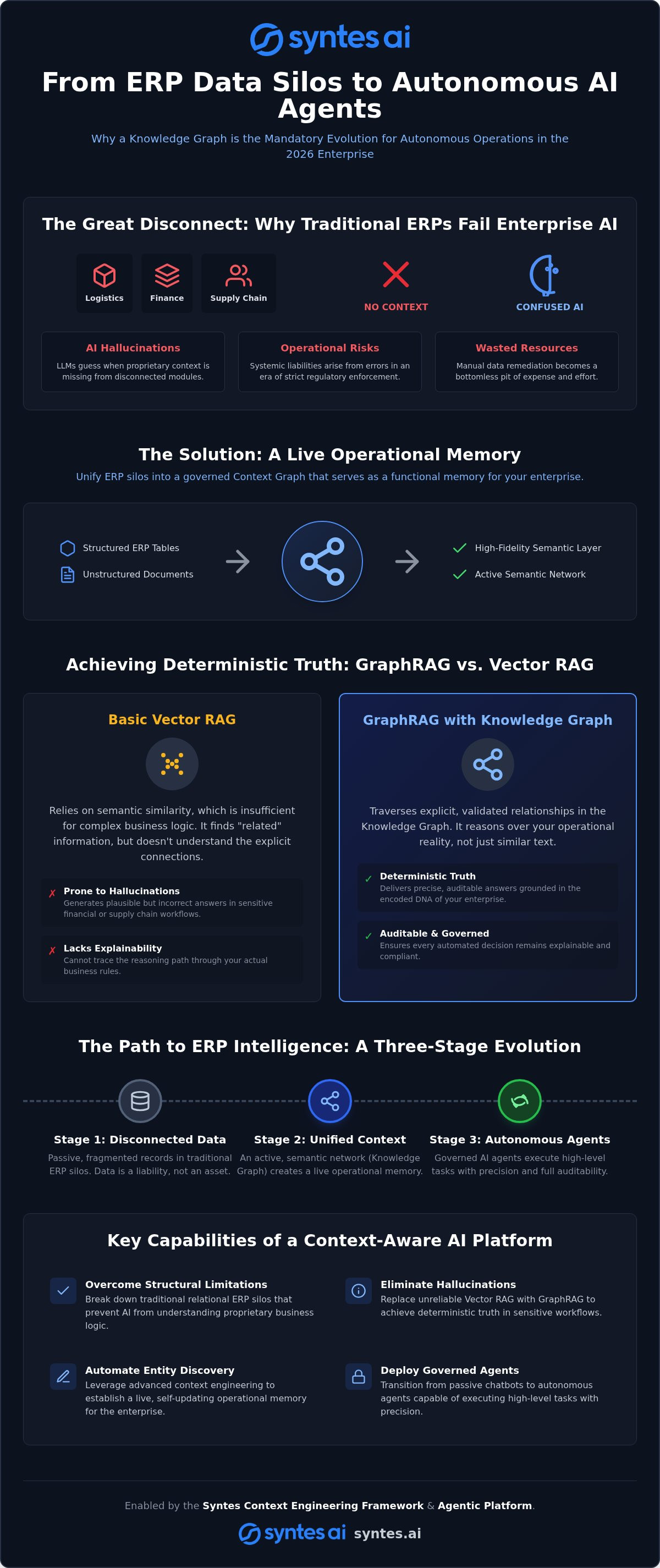
Your ERP is a graveyard of disconnected facts. It’s a harsh reality that high-level decision-makers must confront. While relational databases excel at recording transactions, they’re fundamentally incapable of representing the intricate web of business logic that defines your operation. Rows and columns offer a flat view of a multidimensional world. This structural limitation is the primary reason why 1st-wave AI initiatives fail. LLMs don’t possess the proprietary context buried deep within your disconnected modules. Without that context, they guess. They hallucinate. They create operational risks that no enterprise can afford in a regulated 2026 market.
Fragmented knowledge is more than a technical inconvenience; it’s a strategic liability. When data is trapped in silos, AI cannot reconcile the relationship between a delayed shipment in your logistics module and a payment term in your finance system. This lack of visibility forces AI into a state of perpetual uncertainty. To bridge this gap, the Enterprise Knowledge Graph acts as the essential connective tissue. By implementing a knowledge graph for erp data, you transform passive records into an active, semantic network that powers trusted execution.
The Failure of Traditional Data Warehousing for AI
Traditional data warehousing was built for the era of retrospective reporting. It wasn’t designed for the era of agentic reasoning. Warehouses collect static snapshots of data, but AI agents require a dynamic environment to function. The latency inherent in traditional pipelines makes them useless for live execution. We’re moving from passive observation to solving enterprise data silos through active integration. An enterprise knowledge graph for erp data provides the structural integrity required to turn fragmented records into a coherent, machine-readable map of your business logic.
Operational Relationship Intelligence: The Missing Link
Hidden hierarchies between products, suppliers, and global transactions are the lifeblood of your strategy. If your AI cannot see these relationships, it remains a black box that generates untrustworthy outcomes. It lacks the Operational Relationship Intelligence needed to make autonomous decisions. A Knowledge graph architecture allows the system to traverse these explicit relationships in real time. For the 2026 enterprise, this isn’t just a database. It’s a Live Operational Memory that maintains competitive speed by ensuring AI agents act on facts, not probabilities. This shift from passive storage to active reasoning is the only way to achieve total operational clarity.
The Architecture of a Knowledge Graph for ERP: Moving Beyond Rows and Columns
Relational databases are rigid. They’re built for accounting, not intelligence. To empower AI, you must translate these flat tables into a sophisticated semantic network. This transformation involves mapping entities, relationships, and attributes into a structure that mirrors your actual business operations. It’s about moving from “data about things” to “intelligence about how things interact.” Implementing a knowledge graph for erp data requires a departure from traditional ETL logic toward a process model for an enterprise knowledge graph that prioritizes semantic clarity. You aren’t just moving data; you’re encoding the very DNA of your enterprise.
Architecting for scale is the final frontier. Your ERP likely generates millions of transactions. A standard database would buckle under the complex join requirements needed for AI reasoning. A hybrid graph database, however, excels here. It allows for high-speed traversal of connections without the performance tax of relational joins. This architecture ensures that when an AI agent queries the system, it receives a comprehensive answer in milliseconds. It’s the difference between an agent that guesses and an agent that knows. To see this architecture in action, you can schedule a technical deep dive with our team.
Building the Unified Context Layer
AI reasoning depends on absolute consistency. If your procurement agent doesn’t understand that “Vendor A” in your finance module is the same “Supplier X” in your logistics module, the execution chain breaks. The semantic data layer for enterprise serves as the single foundation for this intelligence. It unifies structured ERP tables with unstructured documents like contracts, emails, and shipping manifests. This layer ensures your AI understands business semantics, applying consistent rules and policies across every disparate system. It’s the only way to move from simple prompt engineering to true enterprise-grade reasoning.
From Static Data to Live Operational Context
In 2026, a static graph is a liability. Your business moves at the speed of events, not batches. The technical shift from batch processing to real-time event streaming is what separates leaders from laggards. Two-way connectors are essential. They ensure the knowledge graph for erp data remains a live reflection of reality. This creates what we call Live Operational Memory. AI agents need up-to-the-second context to make high-stakes decisions, such as rerouting a supply chain during a port strike. If your graph is static, your agent is flying blind. Real-time relevance isn’t a feature; it’s a prerequisite for agentic autonomy.
GraphRAG vs. Basic RAG: Achieving Deterministic Truth in ERP Environments
Vector RAG is a gamble you cannot afford to take. While proximity search is sufficient for summarizing generic internal wikis, it is fundamentally inadequate for managing a global supply chain or a complex financial ledger. Basic RAG relies on mathematical similarity. It assumes that if two pieces of text are numerically close, they are contextually related. In the high-stakes world of enterprise operations, “close” is a recipe for disaster. This probabilistic approach is the root cause of the hallucination problem. To achieve absolute reliability, you must shift your focus toward how to prevent ai hallucination through semantic grounding. You need a system that doesn’t guess. You need a system that knows.
GraphRAG provides this certainty by traversing explicit relationships within your data. By utilizing a knowledge graph for erp data, the AI no longer relies on vector clusters alone. It follows the hard-coded logic of your business. It understands that a specific purchase order is linked to a specific vendor, which is governed by a specific master service agreement. This is “Ground Truth” in action. Every AI-generated response becomes an auditable trail. If an agent suggests a procurement shift, it must be able to cite the exact ERP record and relationship path that led to that conclusion. This transparency is not just a technical feature. It is a core requirement for compliance with the transparency duties of the EU AI Act set to apply in August 2026.
The Mechanics of Deterministic Reasoning
How do we replace probabilistic guessing with deterministic retrieval? The Syntes AI Context Graph acts as a rigid guardrail for LLM generation. Instead of allowing the model to wander through a latent space of possibilities, the graph forces it to retrieve facts through verified semantic paths. This is critical for business metrics where a 1% error can result in millions of dollars in lost revenue. In 2026, regulated industries demand this level of AI governance. Deterministic reasoning ensures that your AI agents operate within the strict boundaries of your corporate policies and legal obligations, turning “black box” AI into a transparent, high-performance engine.
Context Engineering: The Next Evolution of AI Accuracy
Context Engineering is the defining discipline for the modern enterprise architect. It is the process of building and maintaining the deep business context required for safe AI execution. We’re moving beyond simple retrieval. We’re moving toward deep, structured reasoning over a knowledge graph for erp data. Industry data from mid-2026 suggests that while adoption is in the early stages, with fewer than 15% of enterprises moving past the pilot phase, those that do are capturing a massive competitive advantage. They aren’t just chatting with their data. They’re engineering a live operational memory that allows AI to reason across the entire enterprise with surgical precision. This is the only path to true agentic autonomy.
Implementing the Syntes Context Engineering Framework for ERP Integration
Simplistic technical models fail because they ignore the messy reality of enterprise logic. Competitors might suggest that graphing an ERP is a mere three-step technical process: export, map, and import. This is a dangerous oversimplification. To build a resilient knowledge graph for erp data, you must adopt a rigorous methodology that prioritizes semantic understanding and governance over simple data movement. The Syntes Context Engineering framework provides this structure through a five-stage progression designed for deterministic execution.
The journey begins with Connect. You must integrate structured ERP tables with the unstructured operational documents, such as contracts and shipping manifests, that often hold the actual context of a transaction. Next is Understand. Here, machine learning discovers entities, hierarchies, and business semantics automatically, identifying relationships that manual mapping inevitably misses. The third stage, Contextualize, builds the dynamic enterprise knowledge graph as a live model of your business. Stage four is Govern, where security and permissions are applied at the graph layer. Finally, Execute enables AI agents to perform actions based on this trusted context.
Governance and Security in the Graph Layer
Security is not an afterthought. In the agentic era, your AI must inherit ERP permissions directly. If a user isn’t authorized to view specific financial records in their primary system, their AI agent shouldn’t have access to that data within the graph either. This inheritance ensures that AI agents operate within the same strict boundaries as your human workforce. We apply global business policies across all integrated systems, creating a unified security posture. Auditability remains the final pillar. Every action taken by an agent is tracked back to the underlying context, providing a clear trail for compliance officers and auditors.
Automating the Discovery of Business Logic
Manual data mapping is a bottomless pit of technical debt. By the time you finish mapping a complex ERP module, the business has already evolved. Our framework uses machine learning to identify hidden relationships between suppliers, products, and global transactions in real time. This allows the knowledge graph for erp data to function as a Live Operational Memory that evolves alongside your business. It reduces the staggering cost of manual data remediation and replaces the rigid, slow-moving structures of traditional Master Data Management (MDM) with an agile, high-performance semantic network.
Deploying Governed AI Agents: The Logical Conclusion of ERP Intelligence
Chatbots are toys for experimentation. Enterprise AI agents are tools for execution. The transition from passive, conversational AI to active “do-bots” represents the final stage of the digital evolution. While first-generation AI could summarize a report, 2026-era agents can orchestrate a supply chain. They don’t just provide insights; they perform work. This shift is only possible when agents are anchored to a knowledge graph for erp data. Without this live operational memory, an agent is merely a sophisticated guesser. With it, the agent becomes a high-performance extension of your executive team, capable of navigating complex business logic with surgical precision.
The payoff for your data strategy lies here. Investing in agentic ai platforms is the only way to realize the full ROI of your knowledge graph. When your data is semantic and connected, agents can automate high-value workflows that were previously buried in manual effort. Consider the following applications:
- Supply Chain Orchestration: Agents identify a port strike, traverse the graph to find affected purchase orders, and proactively suggest alternative vendors based on real-time contract terms.
- Automated Financial Reconciliation: Agents match disparate invoices across global entities, resolving discrepancies by reasoning through historical transaction patterns and parent-child company relationships.
- Proactive Customer Service: AI identifies a production delay before it impacts the client, automatically drafting personalized communications that reflect the specific SLAs found in the graph.
The Syntes Agentic Platform provides the necessary framework to deploy these autonomous entities safely. It ensures that every action is governed, every decision is auditable, and every execution is grounded in the deterministic truth of your ERP environment.
From Insight to Action: The Execute Pillar
How do agents move from reading data to taking action? They use the Execute pillar of our framework. Unlike brittle robotic process automation (RPA) that breaks when a UI element changes, context-aware agents reason over multi-step processes. They understand the “why” behind a task. If an agent encounters an edge case in a procurement workflow, it doesn’t just stop. It uses the Context Graph to evaluate the risk and, if necessary, pulls a human into the loop for expert oversight. This collaboration ensures that automation never comes at the cost of operational safety or strategic alignment.
The Future of the Agentic Enterprise
What does the enterprise of 2026 look like? It is an organization where every department operates from a shared, live context layer. We are moving toward a reality where enterprise ai infrastructure prioritizes context over raw compute. Speed is no longer about how fast you can process bits; it’s about how quickly you can turn a knowledge graph for erp data into an automated decision. The window for experimentation is closing. The time to architect your live operational memory is today. Those who build the foundation of semantic intelligence now will be the only ones capable of leading the autonomous markets of tomorrow.
Mastering the Shift to Autonomous ERP Intelligence
Relational silos are no longer just a technical hurdle. They’re a strategic liability. You’ve seen how a knowledge graph for erp data serves as the indispensable foundation for trusted reasoning. By moving beyond basic RAG to deterministic GraphRAG, your enterprise gains an auditable, explainable ground truth that powers safe execution. This isn’t about simple chatbots. It’s about deploying a live operational memory that understands your specific business logic. The era of passive data storage has ended.
Syntes AI provides the deep cross-system ERP integrations and enterprise-grade governance required to turn this vision into a functional reality. Our Context Graph redefines how AI agents interact with your data, ensuring trusted reasoning across every automated workflow. You have the opportunity to transform your fragmented systems into a unified engine of execution. It is time to move from theory to high-performance performance.
The transition to an agentic enterprise is not a matter of if, but when. Start building your live operational memory today to lead the autonomous markets of 2026. Operational clarity is within your reach.
Frequently Asked Questions
What is a Knowledge Graph for ERP data and how does it differ from a database?
A traditional database stores flat records in isolated tables; a knowledge graph maps the semantic relationships between those records. It’s the difference between a list of parts and a blueprint for an engine. A knowledge graph for erp data creates a machine-readable network of your business logic. This allows AI to understand how a customer, an order, and a shipping delay are interconnected across different modules.
Can a Knowledge Graph integrate data from multiple different ERP systems like SAP and Oracle?
Yes, cross-system integration is a fundamental capability of the Syntes AI platform. It unifies disparate schemas from legacy stacks into a single, cohesive context layer. This architectural shift allows your AI agents to reason across global entities without the need for manual data reconciliation. It turns your fragmented IT environment into a unified operational memory regardless of the underlying vendor.
How does a Knowledge Graph help prevent AI hallucinations in financial reporting?
Hallucinations occur when AI predicts the next word based on probability rather than fact. A knowledge graph provides deterministic grounding through explicit relationship paths. By using GraphRAG, the system retrieves the exact link between a transaction and a ledger entry. This ensures every figure in a financial report is tied to a verifiable ERP record, providing the auditability required for enterprise compliance.
Do I need to move all my ERP data into the Knowledge Graph to use it?
You don’t need to perform a massive data migration. The system acts as a Context Graph that sits above your existing infrastructure. It ingests the metadata and relationship logic required for AI reasoning while the heavy transactional data remains in its source system. This approach minimizes technical debt and allows you to build a live operational memory without disrupting your core ERP functions.
How long does it typically take to implement an Enterprise Knowledge Graph for ERP?
Implementation timelines depend on the complexity of your data environment, but the process is designed for speed. Our framework focuses on automated entity discovery to accelerate the cycle. Most enterprises move from initial connection to a functional context layer within weeks. It’s a strategic evolution that delivers immediate utility for AI agents rather than a multi-year rip-and-replace project.
Is a Knowledge Graph better than a Data Lake for powering AI agents?
They serve entirely different functions. A data lake is a passive repository for raw information; it’s a library without an index. A knowledge graph is an active operational memory designed for reasoning. AI agents require the structured relationship intelligence that only a graph provides to execute tasks safely. While lakes are good for storage, graphs are essential for autonomous enterprise execution.
How does Syntes AI ensure data security and governance within the Context Graph?
Security is hard-coded into the architecture through our AI Governance framework. The Context Graph inherits your existing ERP permissions, ensuring that AI agents only interact with data they’re authorized to see. Every decision and action taken by an agent is fully auditable. This transparency is critical for meeting the strict disclosure requirements of the EU AI Act and other 2026 regulations.
What is GraphRAG and why is it necessary for ERP data?
GraphRAG combines Retrieval-Augmented Generation with graph structures to provide deeper context. It’s necessary because ERP data is inherently relational and complex. Standard Vector RAG often misses the specific business rules that link entities together. GraphRAG ensures that a knowledge graph for erp data can provide the precise, structured reasoning needed for high-stakes tasks like supply chain orchestration or financial reconciliation.