
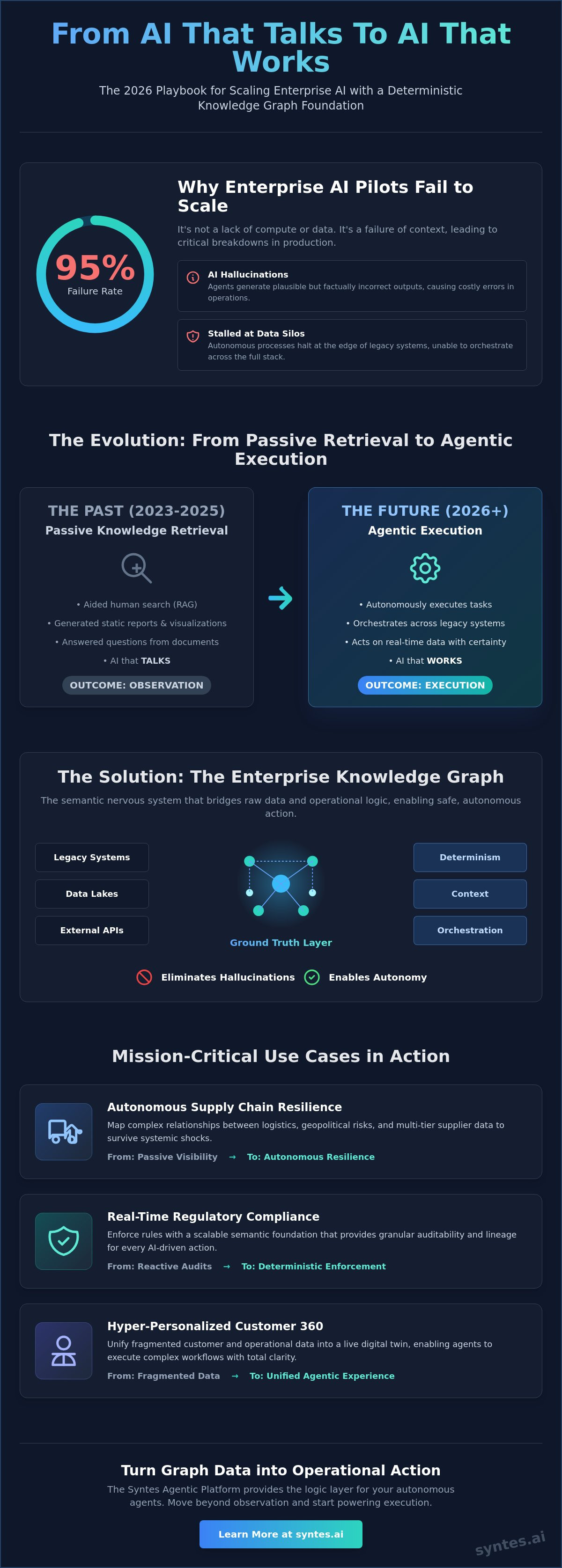
Why do 95% of enterprise AI pilots fail to scale? It isn’t a lack of compute. It’s a failure of context. Most organizations have poured millions into data lakes only to find their AI agents hallucinating in production or stalling at the edge of a data silo. To move from passive chat to autonomous execution, you must bridge the gap between raw data and operational logic. Real-world enterprise knowledge graph use cases in 2026 have shifted. They’re no longer about creating pretty visualizations for analysts; they’re about building the semantic foundation that allows agentic AI to act with deterministic certainty across your entire stack.
You already know that your current AI strategy hits a wall when multi-step processes still require human intervention to fix “creative” errors. It’s frustrating to watch sophisticated models fail at basic cross-system orchestration despite your massive infrastructure investments. This article explores how to architect a live knowledge graph that serves as the definitive logic layer for your autonomous agents. We’ll examine how to eliminate hallucinations, enforce real-time regulatory compliance, and finally automate the complex workflows that legacy systems have held hostage for decades. It’s time to move beyond observation and start powering execution.
Key Takeaways
- Transition from passive knowledge retrieval to active agentic execution by establishing a semantic nervous system across your organization.
- Explore mission-critical enterprise knowledge graph use cases that replace AI hallucinations with deterministic, cross-system orchestration.
- Achieve autonomous supply chain resilience by mapping complex relationships between logistics, geopolitical risks, and multi-tier supplier data.
- Enforce real-time regulatory compliance through a scalable semantic foundation that provides granular auditability and lineage for every AI-driven action.
- Unify fragmented customer and operational data into a live digital twin, enabling the Syntes Agentic Platform to execute complex workflows with total clarity.
The Shift from Search to Execution: Defining 2026 Knowledge Graph Use Cases
Data is a liability if it remains static. In 2026, the Knowledge graph has evolved from a niche research tool into the semantic nervous system of the global enterprise. It’s no longer enough to simply store information; you must activate it. Between 2023 and 2025, organizations focused heavily on Knowledge Retrieval to help employees find documents faster through basic RAG (Retrieval-Augmented Generation). That era was merely a precursor. Today, high-impact enterprise knowledge graph use cases have transitioned to Agentic Execution. This shift marks the move from AI that talks to AI that works. It’s the difference between a chatbot describing a supply chain delay and an autonomous agent re-routing a shipment through a compliant secondary vendor in real-time.
Modern use cases rest on three non-negotiable pillars: Determinism, Context, and Orchestration. Determinism ensures that AI outputs are grounded in hard logic rather than statistical probability. Context provides the deep relational understanding required to interpret complex business rules. Orchestration allows for the seamless movement of data across legacy silos. By serving as the essential ground truth layer, an EKG prevents the hallucinations that typically plague Large Language Models (LLMs) in production. It acts as a logical filter, ensuring every agentic action is verified against reality before execution.
Why Probabilistic AI Requires Deterministic Foundations
LLMs are inherently probabilistic; they predict the most likely next word, not the most accurate business fact. In a high-stakes enterprise environment, this “creativity” is a catastrophic failure point. When you pair an LLM with a graph-based logic gate, you move from guessing to knowing. Agentic AI cannot function safely without a structured semantic layer to define the boundaries of its autonomy. Architecting for Deterministic Truth is the primary 2026 mandate for any organization serious about deploying AI at scale.
The ROI of Connectivity: Beyond Data Discovery
Traditional data lakes failed because they were designed for storage, not intelligence. They became expensive digital graveyards where context went to die. The financial burden of manual data mapping is now unsustainable for the modern firm. Transitioning to automated semantic integration allows businesses to recover thousands of engineering hours while gaining a live view of their operations. For a deeper dive into this transition, consult The Executive Guide to Enterprise Knowledge Graphs. This strategic shift moves the needle from “finding data” to “executing on insight,” transforming the EKG from a cost center into a primary driver of operational ROI.
Supply Chain Orchestration: From Visibility to Autonomous Resilience
Visibility is not resilience. Most global enterprises operate with a dangerous blind spot, maintaining clear sight of Tier 1 suppliers while remaining oblivious to the Tier 3 and Tier 4 dependencies that actually sustain their production lines. When a sub-component manufacturer in a specific geopolitical zone halts operations, the ripple effect often reaches the enterprise too late to mitigate. Traditional supply chain management has focused on predictive analytics, telling leaders what might break. In 2026, the most impactful enterprise knowledge graph use cases have moved beyond prediction into prescriptive, autonomous orchestration. By mapping the intricate relationships between suppliers, components, logistics hubs, and real-time risk factors, the Enterprise Knowledge Graph provides the digital nervous system required to survive systemic shocks.
Mapping the N-Tier Supplier Network
Static spreadsheets cannot capture the volatility of modern commerce. Graph-based multi-hop reasoning allows organizations to identify hidden dependencies that traditional relational databases miss entirely. By integrating real-time external data, such as port delays or regional energy shortages, with internal ERP records, the EKG creates a live model of the entire value chain. This level of connectivity is the only way to effectively start Solving Enterprise Data Silos. It transforms fragmented data points into a unified semantic map, allowing decision-makers to see exactly how a localized disruption affects a global product launch.
Autonomous Remediation Agents
The true value of a sophisticated enterprise knowledge graph plan lies in its ability to power agentic workflows. When the graph identifies a high-probability risk, such as a looming labor strike at a critical transit hub, it doesn’t just send an alert. It triggers autonomous remediation agents. These agents use the EKG as their logic layer to evaluate alternative shipping routes, verify the compliance of secondary vendors, and initiate procurement requests without human intervention. This shift from manual crisis management to autonomous execution significantly reduces the Mean Time to Recovery (MTTR) for supply chain incidents. It replaces frantic meetings with deterministic outcomes. Enterprises looking to harden their operations should explore how Cross-System Integrations can turn these theoretical models into a functional execution layer.
Prescriptive supply chain management is the new standard. Organizations that fail to move beyond passive visibility will find themselves perpetually reacting to a world that moves faster than their manual processes allow. By anchoring your supply chain in a deterministic knowledge graph, you ensure that your AI agents aren’t just guessing. They’re executing based on a comprehensive understanding of your business reality.
Deterministic Compliance: Real-Time Regulatory Monitoring and Enforcement
Compliance is no longer a post-hoc reporting exercise. In 2026, the regulatory environment has shifted from passive oversight to aggressive, real-time enforcement. With new, stringent AI regulatory mandates taking effect, enterprises face a critical challenge: managing high-frequency AI deployments without triggering catastrophic legal or ethical failures. Traditional compliance frameworks, built on manual audits and static documentation, cannot keep pace with autonomous agents that make thousands of decisions per hour. This is where enterprise knowledge graph use cases become indispensable. By acting as the missing link in enterprise AI, the knowledge graph provides a semantic data layer that translates dense legal text into machine-executable logic. It serves as the “Auditor’s Ground Truth,” ensuring that every agentic action is pre-validated against a deterministic set of policy constraints.
The core of this transformation lies in moving from probabilistic “best efforts” to deterministic certainty. When an AI agent executes a transaction or modifies a supply chain route, it must do so within the “fences” of global regulation and internal policy. A knowledge graph doesn’t just store data; it encodes the relationships between data, users, and legal requirements. This creates a live, navigable map of what is permissible. If a proposed action violates a regional privacy law or an internal risk threshold, the graph-based logic gate blocks the execution before it occurs. This proactive enforcement is the only way to scale agentic intelligence safely in a world where over 80% of the global population is covered by modern data privacy legislation.
Algorithmic Accountability and Lineage
Proving why an AI made a specific decision is now a legal mandate, not an IT preference. Knowledge graphs track the exact provenance of every data point, model version, and logic gate used in an autonomous workflow. This granular lineage is essential for How to Prevent AI Hallucination and ensuring algorithmic accountability. By maintaining a temporal record of the graph’s state, organizations can reconstruct the exact context of any past decision, satisfying the most demanding regulatory audit requirements with ease.
Active Guardrails for Agentic Systems
We are entering the era of agentic compliance monitoring. In this model, specialized compliance agents use the Enterprise Knowledge Graph to monitor other operational agents in real-time. These “supervisor agents” verify that semantic boundaries are respected and that all cross-system integrations remain within authorized parameters. This creates a self-correcting ecosystem where the EKG provides the immutable rules of engagement. Automated, real-time audit trails eliminate the need for manual sampling, reducing compliance overhead while providing 100% coverage of all autonomous activities.
Hyper-Personalized Customer 360: Unifying the Agentic Experience
Your customer is currently a ghost in your own machine. Their identity is shattered across Salesforce, SAP, Zendesk, and a dozen marketing tools. This fragmentation isn’t just an IT headache; it’s a strategic failure. When data is trapped in silos, your AI can’t possibly understand the human behind the ticket. One of the most transformative enterprise knowledge graph use cases involves the creation of a “Semantic Digital Twin.” This is not a static profile. It’s a living, relational model that captures every contract nuance, support interaction, and billing event. It transforms the “Fragmented Customer” into a unified operational entity. We’re moving beyond simple personalization. We’re entering the era of anticipatory service.
Cross-System Integration for a Unified View
Connecting disparate systems like Salesforce and SAP requires more than simple APIs. Traditional Master Data Management (MDM) often fails because it’s too rigid to handle the messy complexity of real-world relationships. Entity resolution within a graph structure outperforms traditional methods by identifying connections across inconsistent datasets with mathematical precision. It understands that a user in your billing system is the same individual filing a support ticket. This semantic layer provides the necessary context for agents to act with certainty. For a deeper look at the technical requirements of this architecture, see The 2026 Guide to Enterprise AI Infrastructure. You must architect for connectivity if you expect your agents to perform at scale.
Empowering Autonomous Support Agents
Stop building chatbots that only point to FAQ pages. In 2026, the standard is the “Operational Agent.” These agents possess the “Contextual Memory” required to manage long-term customer relationships autonomously. They don’t just talk; they execute. Consider a scenario where an agent identifies a billing discrepancy. It doesn’t just flag the issue for a human. The agent verifies the discrepancy against the original contract stored in the graph, checks the customer’s lifetime value, and issues a credit immediately. This is execution without human intervention. The graph provides the logic. The agent provides the action. This shift from “talking” to “doing” is the hallmark of a mature agentic strategy. It replaces friction with deterministic resolution. Transitioning from passive observation to active resolution is the only way to maintain a competitive edge in a saturated market. Unify your customer experience with the Syntes Agentic Platform.
Anticipatory service requires a foundation of truth. If your customer data remains siloed, your AI will remain a toy rather than a tool. By anchoring your customer experience in an Enterprise Knowledge Graph, you ensure your agents have the context they need to solve problems before the customer even picks up the phone. It’s time to stop guessing and start executing.
The Syntes Agentic Platform: Turning Graph Data into Operational Action
Static data is dead weight. In the high-velocity markets of 2026, the gap between possessing information and executing on it determines market leadership. While many organizations have experimented with isolated AI pilots, few have successfully moved to industrial-scale automation. The Syntes Agentic Platform serves as the definitive bridge between your Enterprise Knowledge Graph and autonomous execution. It is the engine that converts semantic relationships into deterministic business outcomes. By combining the deep contextual awareness of our knowledge graph with a sophisticated multi-agent orchestration layer, we enable your systems to move beyond passive retrieval. Your data shouldn’t just be searchable. It must be actionable.
Syntes AI specializes in the complex Cross-System Integration required for global enterprise environments. We recognize that your operational truth is buried across hundreds of legacy and cloud-native applications. Our platform doesn’t just connect these systems; it unifies their logic. This synergy allows for the deployment of agents that understand the downstream consequences of every action. Whether it’s adjusting a procurement order or enforcing a new privacy mandate, the platform ensures that every move is grounded in the live reality of your business. We are the partner for organizations that are finished with AI experimentation and ready for systemic transformation.
Architecting for Scale and Security
Accelerating Your Agentic Roadmap
The path from fragmented data silos to a unified agentic knowledge layer is often perceived as daunting. It’s a strategic necessity that requires a methodical approach. Syntes AI simplifies this transition by providing a clear roadmap for consolidating AI grounding, compliance, and orchestration onto a single platform. The ROI is immediate. You eliminate the redundant costs of maintaining disconnected AI tools and reduce the risk of operational errors. By establishing a scalable semantic foundation, you future-proof your organization against the next wave of technological disruption. It’s time to stop managing data and start orchestrating truth. Deploy the Syntes Agentic Platform to Orchestrate Your Enterprise Truth and unlock the full potential of your enterprise knowledge graph use cases.
Mastering the Transition to Autonomous Operational Intelligence
The era of experimental AI is over. Industrial-scale automation requires more than just large models; it demands a semantic foundation that guarantees truth. By moving from passive data discovery to active agentic execution, organizations can finally realize the promise of their digital investments. You have seen how high-impact enterprise knowledge graph use cases solve the fragmented customer experience and harden supply chains against systemic disruption. This is the transition from probabilistic guessing to deterministic certainty. Context is no longer an elective; it is the primary requirement for production-grade AI.
Syntes provides the necessary deterministic Enterprise Knowledge Graph infrastructure to bridge your legacy silos and modern stacks. Our platform delivers the seamless cross-system integration and agentic workflow orchestration required to turn static knowledge into operational intelligence. Don’t let your data remain a liability. Build the semantic nervous system your enterprise deserves. The tools for total operational clarity are within reach.
Architect Your Agentic Future with Syntes AI. The future of autonomous intelligence is ready for deployment.
Frequently Asked Questions
What is the most common starting use case for an enterprise knowledge graph?
Most enterprises begin with unified entity resolution to create a definitive Customer 360 view. This foundational step addresses the fragmented data problem across CRM, billing, and support systems. By establishing a single source of truth for customer identities, organizations immediately improve support efficiency and marketing accuracy. It’s the most logical entry point because it delivers high visibility with lower integration complexity compared to full supply chain orchestration.
How does an enterprise knowledge graph differ from a traditional data warehouse in AI use cases?
Traditional data warehouses store data in rigid, tabular formats that struggle to map complex, non-linear relationships. In contrast, an Enterprise Knowledge Graph prioritizes the connections between data points. This relational structure allows AI to perform multi-hop reasoning, which is essential for understanding the context of a business process. While warehouses are built for historical reporting, knowledge graphs are designed for real-time operational intelligence and agentic execution.
Can an enterprise knowledge graph actually prevent AI hallucinations?
Yes, by providing a deterministic logic layer that grounds LLM outputs in verifiable facts. Hallucinations occur when models lack specific context and resort to statistical probability. By forcing the AI to validate its reasoning against the structured entities and relationships within the graph, you eliminate the “creativity” that leads to errors. This ensures that every agentic action is based on your actual business rules rather than a model’s best guess.
What are the technical requirements for integrating a knowledge graph with legacy ERP systems?
Integration requires a semantic middleware layer capable of mapping legacy schema to a unified ontology. You don’t need to rip and replace your ERP; you need to wrap it. This involves using Cross-System Integrations to ingest metadata and transactional logs into the graph in real-time. The goal is to create a virtualized semantic layer that allows modern AI agents to interact with outdated systems through a standardized, relational interface.
How do you measure the ROI of a knowledge graph implementation in 2026?
ROI is measured by the reduction in Mean Time to Recovery (MTTR) for supply chain disruptions and the automation rate of complex workflows. In 2026, leading firms also track the cost savings from avoided regulatory fines, as deterministic compliance becomes a primary driver for enterprise knowledge graph use cases. You should focus on high-register metrics like decision latency and autonomous resolution percentage to quantify the shift from manual to agentic operations. To effectively communicate this value to stakeholders, you can find out more about creating structured business plans that justify AI infrastructure investments.
Is a knowledge graph necessary if we are already using RAG (Retrieval-Augmented Generation)?
RAG is a starting point, but it’s fundamentally limited by its reliance on vector similarity. While RAG helps with document retrieval, it cannot handle the multi-step reasoning or complex business logic required for autonomous agents. A knowledge graph provides the structured semantic context that RAG lacks. Combining the two allows for GraphRAG, which is the only way to achieve the deterministic accuracy needed for mission-critical enterprise applications.
How does the EU AI Act impact the choice of knowledge graph use cases?
The EU AI Act mandates strict transparency and algorithmic accountability for high-risk AI systems. This shift forces organizations to prioritize enterprise knowledge graph use cases that offer granular data lineage and explainable decision paths. Knowledge graphs are the only technology that can provide a temporal record of how an AI reached a specific conclusion. Consequently, compliance-driven implementations are now a top priority for global enterprises operating within European jurisdictions.
Can agentic AI platforms operate without a structured knowledge graph?
Agentic AI can technically function using raw data, but it will inevitably fail in production due to context collapse. Without a structured knowledge graph, agents lack the common sense or business logic required to navigate complex environments safely. They become unpredictable and difficult to govern. A graph provides the immutable rules of engagement that allow agents to operate with full autonomy while remaining within the boundaries of enterprise policy.