
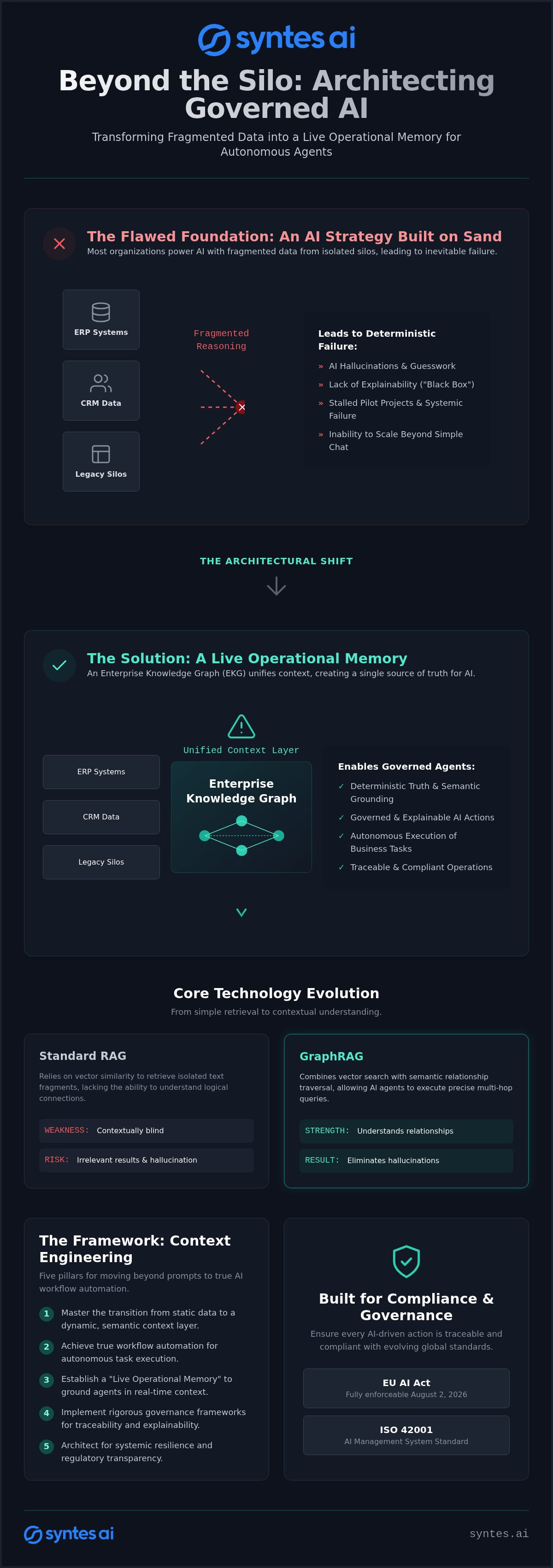
Your AI strategy is likely built on a foundation of sand. Most organizations attempt to power sophisticated agents with fragmented data pulled from isolated ERP and CRM silos. This leads to inevitable hallucinations and systemic failure. It’s a hard truth. You’ve likely realized that basic RAG isn’t enough to scale beyond simple chat interfaces. You need more than just data. You need a live operational memory. By examining high-impact enterprise knowledge graph use cases, you can move beyond these limitations and build a foundation for true operational intelligence.
This article demonstrates how to transform static data into a unified source of truth for agentic AI. You’ll learn how to leverage Context Engineering to build systems that aren’t just intelligent, but are also governed and explainable. We’ll examine the architectural shift required to move from passive observation to active, automated performance. We provide a roadmap for deploying autonomous AI agents that can safely execute business tasks while maintaining strict compliance with evolving global standards like the EU AI Act, which became fully enforceable on August 2, 2026, and ISO 42001.
Key Takeaways
- Master the transition from static data silos to a dynamic context layer that provides the semantic depth required for sophisticated AI reasoning.
- Analyze high-impact enterprise knowledge graph use cases in supply chain and finance to architect systemic resilience and regulatory transparency.
- Implement the five pillars of Context Engineering to move beyond basic prompt engineering and achieve true AI workflow automation.
- Establish a “Live Operational Memory” that grounds autonomous agents in real-time proprietary context and rigorous governance frameworks.
- Leverage GraphRAG architectures to eliminate hallucinations and ensure every AI-driven action is traceable and compliant with global standards.
Beyond Fragmented Data: Why Static Silos Are the Death of Enterprise AI
Enterprise AI is currently hitting a ceiling. Most organizations treat data as a collection of objects stored in isolated ERP, CRM, and legacy silos. They ignore the connections. This is why first-wave AI initiatives often stall at the pilot stage. Large Language Models (LLMs) possess incredible general reasoning capabilities, yet they remain utterly blind to your proprietary operational logic. When you force an AI to reason across fragmented systems, you invite deterministic failure. The system cannot see the invisible threads connecting a supplier’s logistical delay to a high-priority customer’s contract terms. It lacks the context to act with precision.
The “Black Box” problem isn’t an inherent feature of AI; it’s a symptom of missing relational context. Isolated records cannot produce explainable outcomes because the reasoning path is interrupted by data gaps. To scale, organizations must pivot from a data-centric to a relationship-centric intelligence architecture. This transition is the core of high-value enterprise knowledge graph use cases, where passive repositories are transformed into the active, connective tissue of the enterprise. Without this layer, AI remains a speculative tool rather than a reliable operational asset.
The Failure of Isolated Records in Complex Reasoning
LLMs hallucinate when they’re forced to fill in the blanks between disparate data points. If the model doesn’t have an explicit map of how your business processes function, it guesses. It bridges the gap between general linguistic patterns and proprietary logic with plausible fiction. This is a liability in regulated environments. Disconnected data silos actively degrade AI model reliability by stripping away the situational awareness required for accurate, real-time decisioning. When reasoning lacks a foundation of interconnected facts, the resulting “intelligence” is nothing more than a statistical approximation of the truth.
Knowledge Graphs as the Foundation of Deterministic Truth
An Knowledge Graph provides the necessary ground truth for complex systems. Unlike relational databases that rely on rigid, pre-defined tables, a graph schema is fluid and multidimensional. It mirrors the messy, interconnected reality of global business operations. By mapping entities and their intricate relationships, an EKG provides a deterministic anchor for AI agents. This architectural shift is precisely how to prevent ai hallucination in a production environment. You replace probabilistic guesswork with semantic grounding. This foundation allows your AI to move from simply “reading” your data to truly “understanding” the logic of your business, ensuring every output is traceable to a verified relationship.
The Architecture of Intelligence: How Enterprise Knowledge Graphs Unify Context
The Enterprise Knowledge Graph (EKG) is not merely a database. It is the architectural spine of modern intelligence. While traditional systems store data in flat, disconnected tables, an EKG functions as a unified context layer that mirrors the complexity of global operations. It connects disparate entities, including customers, product lifecycles, and internal policies, into a single, coherent operational model. This shift is fundamental. You are moving from passive data retrieval to an active, continuous state of contextualization where the AI understands the “why” behind the “what.” This transition is central to the most effective enterprise knowledge graph use cases being deployed by market leaders today.
From RAG to GraphRAG: Enhancing Retrieval with Semantic Relationships
Standard Retrieval-Augmented Generation (RAG) often fails because it treats information as isolated fragments. It relies on vector similarity, which lacks the ability to understand logical connections. GraphRAG solves this by combining vector search with semantic relationship traversal. This allows AI agents to execute multi-hop queries with precision. For example, an agent can traverse from a specific product to its primary supplier, then to that supplier’s regional risk profile, and finally to the internal policy governing such risks. This level of depth is critical for any successful enterprise knowledge graph initiative. By 2028, Gartner predicts that over 50% of enterprise AI agent systems will be built on these context graph foundations. Without this relational depth, your AI is simply guessing based on proximity rather than reasoning through logic.
Building a Live Operational Memory for Continuous Context
Traditional knowledge bases are static snapshots. They are obsolete the moment they are indexed. A “Live Operational Memory” is different. It is a continuously evolving enterprise brain that unifies structured transaction data with unstructured business rules in real time. It doesn’t just store facts; it captures the logic of your business. This architecture ensures that your AI agents aren’t just reciting old data. They are operating with the most current context available. If you’re ready to see this architecture in action, you can book a demo to explore how a context-first approach transforms your data environment.
Live Operational Memory: A dynamic, graph-based data environment that integrates real-time operational streams with systemic business logic to provide a governed foundation for autonomous AI execution.
This live connectivity is what separates an experimental chatbot from a production-ready agentic system. By integrating structured transactions from your ERP with the unstructured nuances of your contracts and emails, you create a high-fidelity model of your business that is always current, always relevant, and always ready for action.
High-Impact Enterprise Knowledge Graph Use Cases for 2026
The era of AI experimentation has ended. Organizations now demand measurable ROI and systemic reliability. This shift has elevated enterprise knowledge graph use cases from technical curiosities to essential infrastructure for the agentic enterprise. By 2026, the most successful firms won’t just use AI to summarize documents. They’ll use it to navigate the intricate web of relationships that define their global operations, often integrating platforms like Rep AI to handle specialized sales and support workflows. This requires a transition from simple pattern matching to deep, relational reasoning across every vertical.
Modern supply chains are fragile. A single disruption at a tier-three supplier can paralyze a global production line. Traditional ERP systems fail here because they only see direct, linear transactions. An Enterprise Knowledge Graph maps the entire ecosystem. It identifies hidden dependencies and quantifies the ripple effects of regional instability or logistical bottlenecks. This is made possible by a semantic data layer for enterprise that unifies disparate data streams into a single source of truth. When a port closes or a factory loses power, AI agents don’t just alert a manager. They use the live operational context to autonomously reroute shipments, reallocate inventory, and update customer expectations without human intervention. They act with the speed of the market because they understand the logic of the network.
Financial Services: Fraud Detection and Regulatory Governance
Pattern matching is no longer sufficient for modern fraud detection. Sophisticated bad actors operate across multiple accounts, jurisdictions, and shell companies. Financial institutions are pivoting toward relationship-based link analysis to uncover these complex schemes. By using an EKG, banks can trace the flow of capital through seemingly unrelated entities in real time. This architecture also solves the auditability crisis. Every decision made by an AI agent is backed by a clear reasoning path. If a transaction is flagged or a loan is denied, the graph provides a deterministic map of the facts and policies that led to that outcome. This level of transparency is mandatory for compliance with the EU AI Act and ISO 42001 standards. It ensures that internal policies are enforced consistently, transforming “black box” algorithms into governed, explainable systems.
Prompt engineering is a band-aid. It attempts to fix model limitations through clever phrasing, but it fails to address the underlying lack of proprietary context. The evolution of AI requires a more rigorous discipline. We call this Context Engineering. It’s the essential framework for turning high-level enterprise knowledge graph use cases into production-ready systems. This methodology moves beyond manual data engineering toward automated context discovery. It ensures that every agentic action is grounded in the current reality of your business logic.
The Syntes Context Engineering Framework rests on five critical pillars: Connect, Understand, Contextualize, Govern, and Execute. These pillars transform raw data into a functional enterprise ai infrastructure. By following this structured approach, organizations can move from experimental pilots to a state of total operational clarity. It’s the only way to ensure that your AI isn’t just fast, but also accurate and safe. You’re building a system that doesn’t just predict the next word, but understands the next logical step in a complex business process.
Connecting Structured and Unstructured Data Silos
Data exists in two worlds. You have the structured transactions of your ERP and the unstructured wisdom buried in PDF policies, contracts, and emails. Most systems fail to bridge this gap. We use two-way connectors to unify these worlds into a shared intelligence layer. This process involves discovering entities, mapping relationships, and recognizing hierarchies that were previously invisible. Effectively solving enterprise data silos allows your AI to understand that a specific line item in a database is governed by a specific clause in a vendor agreement. This semantic connectivity is the foundation of reliable reasoning.
Governing AI Agents through Semantic Guardrails
Governance cannot be an afterthought. As AI agents gain the ability to execute tasks, the risks of unauthorized action or data leakage escalate. The Context Graph acts as a living governance layer. It enforces granular permissions and business rules directly within the reasoning path of the AI. These semantic guardrails ensure that an agent can only access information or trigger workflows that align with its specific role and current authorization level. Human-in-the-loop systems remain vital here, providing the oversight required by standards like ISO 42001. Semantic guardrails prevent unauthorized AI actions by anchoring every decision in an immutable framework of organizational rules and permissions.
Syntes AI: Transforming Fragmented Knowledge into Governed Agentic Action
Data experimentation is a luxury you can no longer afford. The market is moving fast, and the window for speculative AI pilots is closing. To remain competitive, you must move from passive observation to active, automated performance. The true value of enterprise knowledge graph use cases lies in their ability to bridge the gap between fragmented data silos and operational execution. Syntes AI provides the architectural spine for this transition. We turn static repositories into a live operational memory that powers the next generation of enterprise intelligence.
The Syntes AI Context Graph: Your Enterprise Intelligence Layer
The Syntes AI Context Graph is not a traditional database. It is a unified context layer designed for both human decision-makers and autonomous agents. It unifies your structured ERP transactions with the unstructured wisdom found in your contracts and policies. This creates a “Live Operational Memory” that continuously learns from every event in your business. When a real-time operational event occurs, the graph updates instantly. It maps the ripple effects across your entire organization. This ensures that your AI always reasons from a position of total situational awareness. It is a dynamic model of your business that grows more sophisticated with every transaction.
Deploying Trusted AI Agents with the Syntes Agentic Platform
Passive chatbots are obsolete. Your organization needs governed agents that can execute complex business tasks across disparate systems. Leading agentic ai platforms require a foundation of semantic depth to operate safely in a production environment. The Syntes Agentic Platform leverages the Context Graph to provide this foundation. It allows agents to reason through multi-hop queries and trigger cross-system integrations while adhering to strict governance rules. This is the shift from “chat” to “execution.” By grounding every action in a verified relationship, we eliminate the risk of unauthorized or hallucinated outcomes. You gain an workforce of digital employees that are as compliant as they are capable.
Relationship-based intelligence is the only path to trusted enterprise AI. By 2026, the global market for these systems is projected to reach up to $3.5 billion. This growth is driven by the urgent need for explainable reasoning and systemic integration. When your AI understands the “why” behind every connection, it can act with certainty. This level of clarity is mandatory for navigating complex regulatory landscapes like the EU AI Act. It’s time to stop testing and start deploying. Move from data experimentation to operational execution with Syntes AI. Architect your live operational context today and lead the evolution of the agentic enterprise.
The Evolution of the Agentic Enterprise
The path to 2026 demands a fundamental architectural pivot. Fragmented silos lead to AI failure. Relationship-centric logic is the only way to scale. By mastering high-impact enterprise knowledge graph use cases, you move beyond the limitations of basic RAG and static data. You create a system that doesn’t just process information; it understands the operational reality of your business. This is the foundation of true systemic intelligence.
Syntes AI stands as the definitive partner in this evolution. As pioneers of the Context Engineering Framework, we provide the enterprise-grade security and governance required by Global Fortune 500 leaders. We don’t just build chatbots. We architect live operational memory that empowers autonomous agents to execute tasks with certainty. The transition from data experimentation to agentic intelligence is no longer optional. It’s the standard for the next generation of global enterprise.
Claim your competitive edge by transforming your data into a living asset that drives autonomous action and operational clarity.
Frequently Asked Questions
What are the primary use cases for an enterprise knowledge graph in 2026?
The primary enterprise knowledge graph use cases in 2026 center on supply chain resilience, fraud detection, and the grounding of agentic AI. These systems map multi-tier supplier dependencies and automate risk mitigation. In finance, they enable relationship-based link analysis to uncover complex money laundering schemes. Organizations also use graphs to power digital employees that execute cross-system workflows with high-fidelity context. This shift moves AI from passive chat to active, governed execution across the entire enterprise.
How does an enterprise knowledge graph differ from a traditional data warehouse?
A traditional data warehouse stores information in rigid, pre-defined tables optimized for historical reporting. In contrast, an enterprise knowledge graph models data as an interconnected network of entities and relationships. It prioritizes the context between data points rather than just the objects themselves. This flexible schema allows for real-time traversal of complex hierarchies. While warehouses provide a rearview mirror, knowledge graphs provide a live map for autonomous AI reasoning and decision-making in production environments.
Can an enterprise knowledge graph help prevent AI hallucinations?
Yes, an enterprise knowledge graph prevents hallucinations by providing a deterministic ground truth for Large Language Models. Instead of the model guessing relationships based on linguistic probability, it retrieves verified facts from the graph. This semantic grounding ensures that AI responses are anchored in your proprietary business logic. By replacing probabilistic guesswork with relationship-based evidence, you transform an unpredictable black box into a trusted system capable of explainable and fully auditable reasoning.
What is the role of GraphRAG in enterprise AI applications?
GraphRAG combines vector search with semantic relationship traversal to handle complex, multi-hop queries that standard RAG cannot resolve. It allows an AI to follow logical paths across disparate systems, such as linking a specific product to its tier-three components and their associated environmental risks. This mechanism ensures that the AI retrieves not just similar text, but the precise relational context required for accurate execution. It is the essential bridge between raw data and agentic intelligence.
How do AI agents interact with an enterprise knowledge graph?
AI agents utilize the knowledge graph as their live operational memory to reason, plan, and execute tasks. They query the graph to understand business rules, permissions, and entity relationships before taking action. This interaction is bi-directional; agents can update the graph with new observations or event traces. The graph provides the semantic guardrails that constrain agent behavior, ensuring every automated action remains compliant with internal policies and external regulatory frameworks like the EU AI Act.
Is an enterprise knowledge graph necessary for small data environments?
Complexity, not volume, determines the need for a knowledge graph. Even in smaller data environments, if your business logic involves intricate relationships or high-stakes regulatory requirements, a graph is essential. Traditional relational models fail when forced to handle the multi-dimensional connections required for agentic AI. For organizations aiming to deploy reliable autonomous agents, the graph provides the necessary structural depth that simple databases lack, regardless of the total amount of raw data stored.
How does Syntes AI ensure data governance within its context graph?
Syntes AI enforces governance through semantic guardrails embedded directly within the Context Graph. We map granular permissions and organizational policies as relationships, ensuring that AI agents can only access data or trigger workflows they are explicitly authorized to use. This architecture provides a transparent, auditable reasoning path for every AI-driven decision. By integrating human-in-the-loop oversight and adhering to ISO 42001 standards, we ensure that your AI operations remain secure, compliant, and fully governed.
What is the typical ROI for implementing an enterprise knowledge graph?
ROI manifests through massive gains in operational efficiency and the reduction of AI-related risks. Organizations see immediate value by eliminating the high cost of manual data reconciliation across silos. It enables the deployment of autonomous agents that can execute tasks without human intervention, leading to significant labor savings. By preventing hallucinations and ensuring compliance, the graph also mitigates the legal and reputational costs associated with ungoverned AI, providing a foundation for scalable, trusted intelligence.