

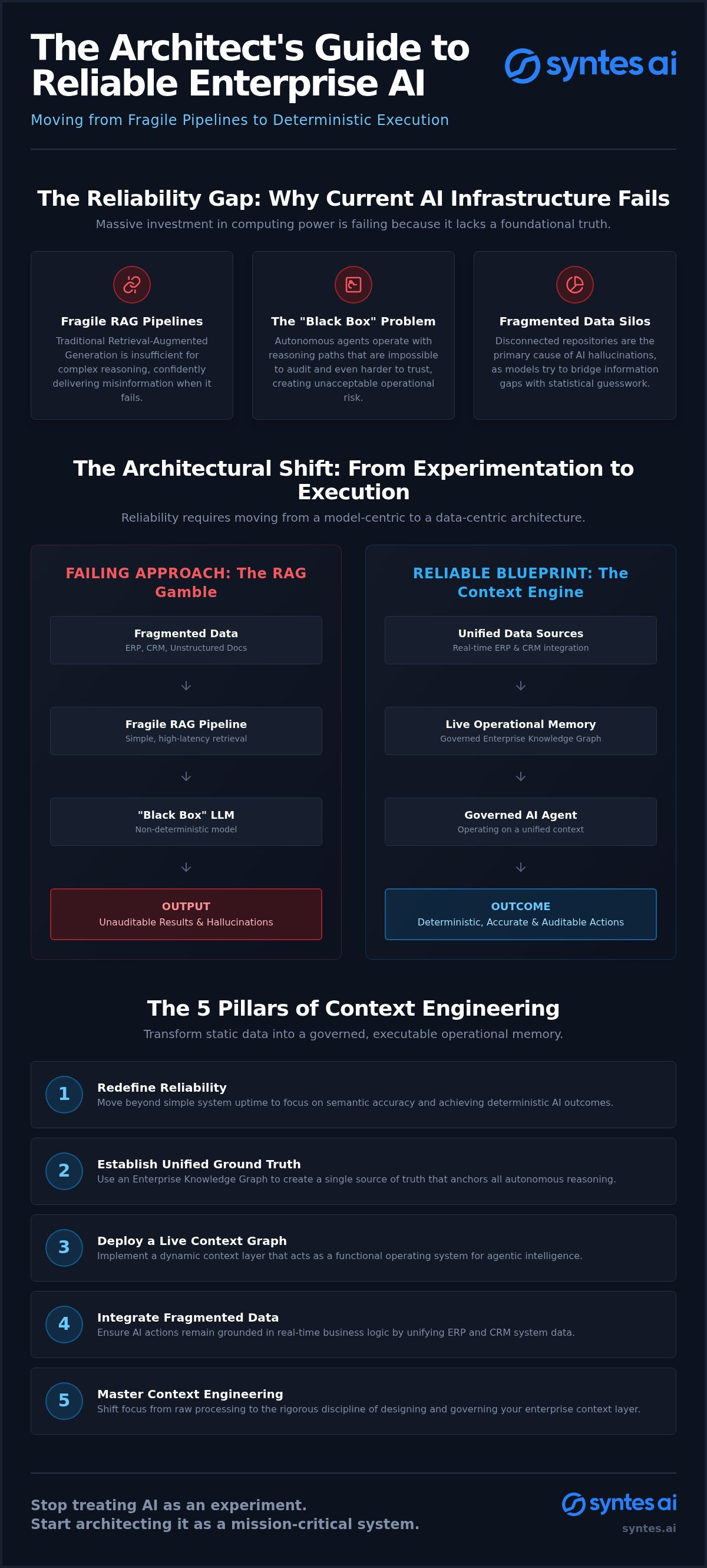
Your massive investment in raw computing power is failing to deliver a return because it lacks a foundational truth. In 2026, the bottleneck for reliable enterprise ai platforms isn’t hardware availability or model size; it’s the absence of a governed context layer. Most organizations are currently gambling their operational integrity on fragile RAG pipelines that fail the moment they encounter complex, cross-system data. You recognize the risk of deploying autonomous agents that operate in a black box, producing results that are impossible to audit and even harder to trust.
This guide provides the architectural blueprint to move beyond experimental AI and toward deterministic execution. We’ll explore why true intelligence requires a live operational memory that unifies your ERP and CRM systems into a single, cohesive context graph. You’ll discover how to eliminate high-latency integrations and reduce operational risk by shifting your focus from raw processing to sophisticated context engineering. It’s time to stop treating AI as a theoretical experiment and start architecting it as a mission-critical system of record.
Key Takeaways
- Redefine reliability by moving beyond simple system uptime toward semantic accuracy and deterministic AI outcomes.
- Establish a unified ground truth across your organization using an Enterprise Knowledge Graph to anchor autonomous reasoning.
- Deploy reliable enterprise ai platforms that utilize a live Context Graph as a functional operating system for agentic intelligence.
- Integrate fragmented data from ERP and CRM systems to ensure AI actions remain grounded in real-time business logic and auditability.
- Master the five pillars of Context Engineering to transform static data into a governed, executable operational memory.
The Reliability Gap: Why Enterprise AI Infrastructure Fails in Production
Reliability is no longer a binary metric of server availability. In the context of AI infrastructure, true reliability is the fusion of system uptime and semantic accuracy. Most organizations fail because they treat these as separate disciplines. They build high-availability clusters only to feed them non-deterministic models that hallucinate under pressure. This is the “Black Box” problem: a fundamental inability to audit or predict the reasoning path of a Large Language Model (LLM). For mission-critical operations, this opacity is an unacceptable risk.
Traditional Retrieval-Augmented Generation (RAG) was a necessary first step, but it’s increasingly insufficient for complex enterprise reasoning. Finding a document is not the same as understanding a business process. When RAG pipelines fail, they don’t just stop; they confidently deliver misinformation. The cost of this unreliability extends far beyond technical debt. It manifests as regulatory fines, eroded customer trust, and the catastrophic failure of automated workflows. To build truly reliable enterprise ai platforms, you must move beyond simple retrieval and toward governed context.
The Limitations of First-Wave AI Infrastructure
First-wave deployments are collapsing under the weight of fragmented data silos. These disconnected repositories are the primary cause of AI hallucinations, as models attempt to bridge gaps in information with statistical guesswork. Simply adding more models doesn’t solve the problem. In fact, increasing model density without a unified ground truth actually decreases overall reliability by introducing more points of failure and conflicting logic. Disconnected documents cannot provide the deep business context required for autonomous execution.
Reliability vs. Speed: The 2026 Performance Paradox
The industry has reached a dangerous crossroads where speed often masks systemic failure. Low-latency hallucinations are far more damaging than slow, accurate reasoning. A fast error at enterprise scale is a liability, not an optimization. We are seeing a decisive shift from model-centric strategies toward data-centric enterprise ai infrastructure. Enterprise AI reliability is the ability to produce deterministic outcomes from non-deterministic models. This transition requires a move away from passive observation toward active, automated performance rooted in a stable, live operational memory.
Context Engineering: The Next Evolution of Infrastructure Reliability
GPU optimization is a distraction. While hardware vendors compete over flops and interconnect speeds, the real failure point in modern intelligence remains the semantic gap between models and business reality. Context Engineering is the rigorous discipline required to bridge this divide. It represents the transition from reactive prompt adjustments to proactive architectural design. Building an Enterprise Knowledge Graph creates a unified ground truth that models can actually rely on. This isn’t just about feeding data to an LLM; it’s about structuring that data so the model understands the specific logic of your business environment.
A reliable data infrastructure is the prerequisite for any functional AI factory. Without it, you are simply accelerating the production of sophisticated errors. To build reliable enterprise ai platforms, you must shift your focus from raw processing power to the continuous governance of your enterprise context layer.
Live Operational Memory: The Heart of Reliable AI
Static databases are the graveyards of enterprise intelligence. They capture what happened, but they fail to explain why it matters in the current moment. A Live Operational Memory solves this by connecting structured transactions with unstructured rules and policies in real time. It’s a dynamic system. It evolves as your business changes. This ensures that every AI interaction is grounded in the current state of your operations rather than a disconnected, week-old document. You need a system that reflects the messy, real-time reality of a global enterprise.
Semantic Grounding: Solving the Hallucination Problem
Hallucinations are the primary symptom of a missing foundation. By implementing a semantic data layer for enterprise, you anchor LLM reasoning in verifiable relationships. Standard vector search often fails because it identifies similar words while missing the business logic that connects them. GraphRAG represents the next stage of evolution. It moves the system from “retrieving facts” to “understanding relationships.” This shift is critical for maintaining consistency across ERP and CRM stacks. If you’re ready to move beyond fragile RAG pipelines, you can explore our framework for Context Engineering to see how we unify fragmented knowledge.
Scaling to Production: An Infrastructure Reliability Checklist
Production scaling is the final filter for enterprise AI. It demands more than just server uptime. It requires a resilient framework capable of executing complex logic across disparate environments. To build truly reliable enterprise ai platforms, architects must prioritize the seamless flow of operational intelligence over simple API connectivity. If your infrastructure can’t maintain semantic consistency at scale, it’s a liability, not an asset.
The Role of Cross-System Integrations
Solving enterprise data silos is a non-negotiable prerequisite for any agentic deployment. Reliability depends on two-way connectors that ensure real-time synchronization between your AI layer and your core ERP or CRM stacks. If the AI reasons on stale CRM data while the ERP has already updated a shipment status, the system is fundamentally broken. Integrate AI directly into your existing business logic. Avoid building sidecars that operate in isolation; they inevitably become the first point of failure during high-concurrency events.
AI Governance and Explainable Reasoning
Governance is the bridge between raw capability and corporate trust. You must be able to answer why an AI took a specific action at any given millisecond. Aligning your deployment with the NIST AI Risk Management Framework provides a standardized baseline for identifying and mitigating these operational hazards. High-stakes decisions still require Human-in-the-Loop systems to maintain accountability and strategic oversight. Understanding how to prevent ai hallucination requires a verifiable audit trail of every data source used in the reasoning process.
Security in agentic systems is about more than just encryption at rest. It involves granular permissioning within the AI workflow itself. You must prevent unauthorized data access by enforcing the same security protocols on your agents that you apply to your human staff. Finally, scalability must be architectural. Your system needs to handle thousands of concurrent agentic tasks without context degradation. If your context layer thins out as the load increases, your reliability will evaporate, leaving you with a fast but fundamentally untrustworthy system.
Governing Agentic AI: Ensuring Deterministic Infrastructure
Chatbots are passive interfaces; agentic ai platforms are active participants in your business logic. This distinction is critical. While a chatbot merely summarizes, an agent executes. This shift from observation to action demands a different reliability model. You can’t rely on probabilistic models to handle deterministic workflows without a rigorous control layer. The Context Graph functions as the “Operating System” for these autonomous agents. It provides a shared memory and a unified logic layer that prevents agents from working at cross-purposes. Reliable enterprise ai platforms must prioritize this shared context to ensure that as you scale from five agents to five thousand, the organization remains a cohesive unit.
Operational Relationship Intelligence is the backbone of this architecture. It isn’t enough to store data points; you must define the connections between them. When an agent understands the relationship between a delayed shipment in the ERP and a priority customer in the CRM, it makes better decisions. This connectivity transforms raw data into actionable intelligence. It allows the system to move from passive observation to active, automated performance.
Governed Execution vs. Unfiltered Generation
Raw AI power is a liability. You must restrict agent actions through predefined business rules and hard-coded policies. A governed context layer acts as a semantic firewall. It prevents agents from “hallucinating” authority they don’t possess. The Syntes Agentic Platform orchestrates these workflows. It ensures that every action is validated against your corporate governance framework before execution. This isn’t about limiting capability; it’s about ensuring safety. Trusted workflows are the only workflows that belong in production.
Live Operational Context for Real-Time Execution
How do agents maintain accuracy in shifting environments? They require a live enterprise memory that updates as fast as the business moves. Stale data is the primary killer of autonomous agents. If an agent relies on information that is even five minutes out of date, its reasoning is flawed. In supply chain or high-frequency retail environments, this lag is catastrophic. Context engineering enables agents to adapt to operational events as they happen. It provides the real-time grounding necessary for agents to navigate complex environments without manual intervention. Reliability in 2026 is measured by the speed of context, not just the speed of inference.
Architect your agentic infrastructure for reliability
Architecting for Reliability with the Syntes AI Platform
Building reliable enterprise ai platforms requires more than a simple model deployment. It demands a specialized enterprise ai infrastructure that unifies fragmented knowledge into a single, executable reality. The Syntes AI platform doesn’t just store data; it transforms it into a live Context Graph. This graph serves as the foundation for explainable reasoning, ensuring that every autonomous decision is grounded in your organization’s specific operational logic. We’ve identified that the bottleneck in 2026 isn’t intelligence. It’s the architecture that supports it.
The Syntes Context Engineering Framework
Our technical methodology is built on five rigorous pillars: Connect, Understand, Contextualize, Govern, and Execute. First, we connect disparate data silos, from legacy ERP systems to modern CRM stacks. We then understand the semantic relationships within that data, moving beyond simple keyword matching. Contextualization follows, where we build a dynamic representation of your business environment. Governance ensures that every AI action adheres to your internal policies and regulatory requirements. Finally, we execute trusted workflows. This framework bridges the gap between general-purpose LLM knowledge and your proprietary data. It creates a unified context layer that supports cross-departmental initiatives with absolute consistency.
Getting Started: From Pilot to Trusted Production
Transitioning from a lab experiment to a mission-critical deployment requires a structured roadmap. Most enterprises fail because they attempt to automate everything at once. We recommend a focused approach. Start by identifying high-value use cases, such as supply chain orchestration or automated financial auditing, where agentic automation can deliver immediate, measurable impact. By implementing a Context Graph in these specific areas first, you establish a template for reliability that can be scaled across the entire enterprise. This isn’t just a technology upgrade; it’s a strategic evolution of your operational capability. You don’t need more models. You need a better foundation for the models you already have.
Request a demo of the Syntes AI Platform
Securing the Future of Operational Intelligence
The transition from experimental prototypes to mission-critical execution requires a fundamental shift in infrastructure strategy. It’s no longer enough to scale compute; you must scale context. By prioritizing a governed context layer over raw model size, organizations can finally eliminate the “black box” risks that have stalled enterprise adoption. True reliability in 2026 stems from a live operational memory that grounds every autonomous agent in verifiable, real-time business logic. Choosing reliable enterprise ai platforms means selecting a foundation that values explainable reasoning and full auditability.
As a leader in Context Engineering and Context Graphs, Syntes AI provides the necessary guardrails for governed AI agents to operate within complex, cross-system environments. This architecture ensures that every decision is traceable and every workflow is deterministic. You have the opportunity to turn fragmented data into a strategic asset. Start building the infrastructure that doesn’t just process information but masters it.
Frequently Asked Questions
What is the difference between AI reliability and AI accuracy?
AI accuracy measures how often a model is correct in a vacuum, but reliability is a broader architectural standard. Reliability encompasses both technical uptime and semantic consistency across thousands of concurrent tasks. For reliable enterprise ai platforms, this means producing deterministic outcomes from non-deterministic models. It’s the difference between a model that is occasionally brilliant and a system that is consistently trustworthy in a mission-critical production environment.
How does a Knowledge Graph improve the reliability of enterprise AI?
An Enterprise Knowledge Graph serves as the operating system for your AI. It unifies fragmented data into a structured, actionable format, providing a single source of truth. By mapping the relationships between customers, products, and business rules, the graph anchors AI reasoning in verifiable logic. This transition from disconnected documents to relationship-based intelligence ensures that your AI agents operate with a deep, live understanding of your entire organization.
Why is RAG alone not enough for high-reliability AI infrastructure?
Traditional RAG was a necessary first step, but it’s insufficient for complex reasoning. Retrieval-Augmented Generation merely finds documents; it doesn’t understand the underlying business logic or real-time operational events. High-reliability infrastructure requires more than simple retrieval. It needs a governed context layer that can reason across ERP and CRM systems simultaneously. Without this, RAG pipelines remain fragile, often failing when they encounter complex, cross-system enterprise data.
What are the key components of a reliable enterprise AI infrastructure in 2026?
The next generation of reliable enterprise ai platforms depends on four critical pillars. First is a live Context Graph that serves as organizational memory. Second is a governed agentic platform for execution. Third is deep cross-system integration across legacy and cloud stacks. Finally, a semantic data layer provides the grounding necessary for explainable reasoning. Together, these components move your infrastructure from passive observation to active, automated performance.
How does Context Engineering prevent AI hallucinations in production?
Context Engineering prevents hallucinations by creating a semantic firewall between the LLM and your business logic. It utilizes a five-pillar framework (Connect, Understand, Contextualize, Govern, Execute) to anchor model reasoning in proprietary data. By restricting agent actions through predefined business rules, you ensure that the AI cannot hallucinate authority or logic that doesn’t exist. This rigorous discipline transforms raw data into a governed, executable operational memory.
Can I achieve AI reliability using only public cloud LLM APIs?
Relying solely on public cloud LLM APIs is a recipe for operational failure. While these models are powerful, they possess no knowledge of your specific business rules, hierarchies, or real-time data. Reliability requires an internal infrastructure layer, such as a Context Graph, to ground those public models in your proprietary reality. Without this specialized context layer, you are simply running a sophisticated black box that lacks the necessary guardrails for enterprise-grade execution.
What role does governance play in the reliability of agentic AI platforms?
Governance is the mechanism that ensures deterministic outcomes in agentic systems. It applies security, permissions, and compliance rules to every action an AI agent takes. In high-reliability environments, governance moves the system from unfiltered generation to governed execution. This framework allows agents to collaborate safely across the organization, providing an audit trail that explains why specific actions were taken. It’s the difference between an experimental chatbot and a mission-critical agent.
How do I measure the ROI of reliable AI infrastructure?
Measuring ROI requires looking beyond simple efficiency gains. You must evaluate the reduction in operational risk, the elimination of manual data reconciliation, and the successful deployment of autonomous agents in high-stakes workflows. Reliable infrastructure reduces the cost of black box errors and regulatory fines. By creating a live operational memory, you enable your organization to act with total clarity, significantly shortening the time between data discovery and automated execution.