

The $22 billion business process automation market is currently built on a foundation of sand. Most enterprise leaders realize too late that their expensive “bot” workflows are inherently brittle, fracturing at the first encounter with a data silo or a non-linear business exception. These business process automation limitations aren’t merely technical glitches; they’re the inevitable result of trying to solve dynamic, high-stakes problems with static, rule-based scripts. You’ve likely experienced the mounting maintenance costs and the operational gravity of AI hallucinations that derail process execution.
It’s clear that the “automate the mess” strategy has failed. You’ve been promised seamless efficiency, yet you’re managing a fragmented architecture that lacks a unified ground truth. This article provides the definitive roadmap for transitioning from fragile RPA to resilient, agentic systems. You’ll discover how Context Engineering replaces the guesswork of prompt engineering to create a live, operational memory. We’ll establish a clear framework for choosing between legacy RPA and Agentic AI, ensuring your automation architecture finally achieves true enterprise scale.
Key Takeaways
- Identify the structural business process automation limitations that cause legacy RPA projects to fail when complexity outpaces system maintainability.
- Recognize the “Context Gap” inherent in fragmented data silos and why it prevents traditional automation from achieving true end-to-end orchestration.
- Move beyond mimicking human clicks by embracing agentic AI, shifting the focus from executing scripts to achieving autonomous business goals.
- Implement the five pillars of Context Engineering to establish a live operational memory that remains resilient across non-linear business exceptions.
- Leverage an Enterprise Knowledge Graph to transform disconnected data points into a unified ground truth for high-stakes operational intelligence.
The Invisible Ceiling: Structural Business Process Automation Limitations
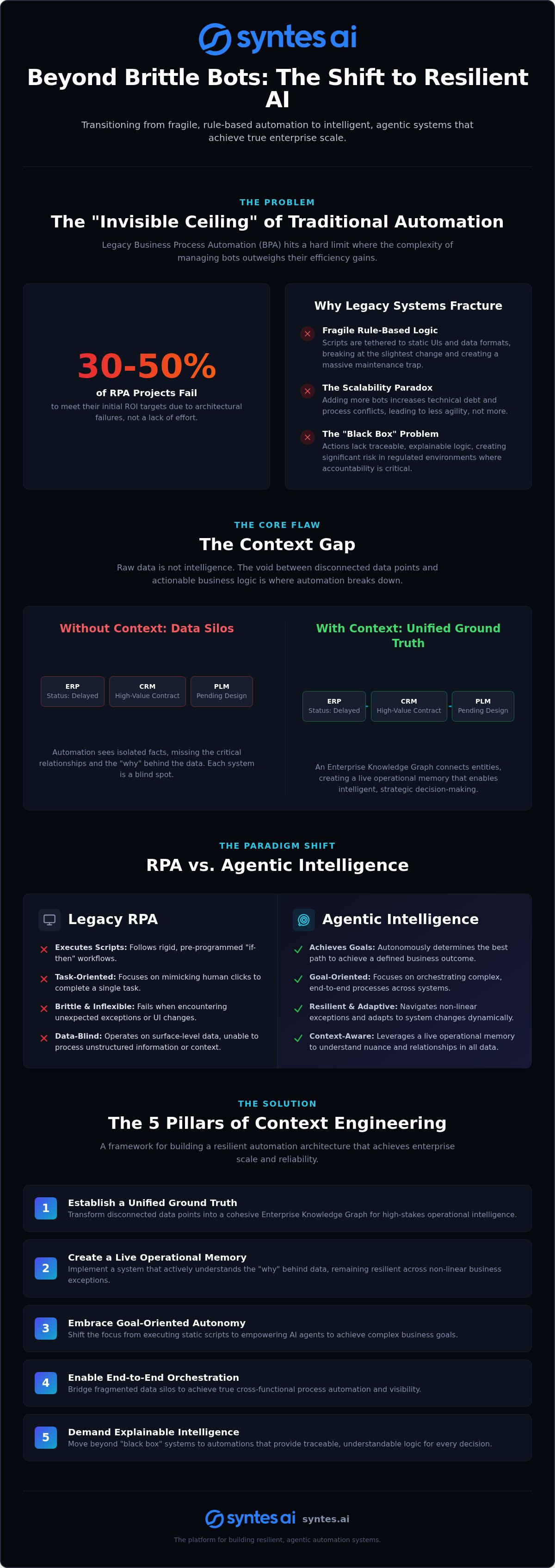
Traditional Business process automation often hits a hard limit at the enterprise level. We call this the “Invisible Ceiling.” It is the precise moment when the complexity of managing an automation fleet begins to cannibalize the efficiency gains those bots were designed to provide. Industry data indicates that between 30% and 50% of RPA projects fail to meet their initial ROI targets. This isn’t a failure of effort; it’s a failure of architecture. These systems are built on rigid, linear scripts that cannot adapt to the messy, non-linear reality of global operations.
Why does traditional automation struggle to scale? The answer lies in the “Black Box” problem. Legacy systems execute actions without providing a traceable, explainable logic for their decisions. This lack of transparency creates significant risk in regulated environments where accountability is non-negotiable. We’re seeing a forced transition. Organizations must move from simple task automation to complex process orchestration. However, the business process automation limitations within current architectures make this shift nearly impossible without a total rethink of data strategy.
The Fragility of Rule-Based Logic
Rule-based logic assumes a static world. It’s wrong. By tethering operational success to the fragile stability of a user interface or a specific data format, enterprises build systems destined to fracture. This is the maintenance trap. IT teams find themselves spending more hours debugging brittle “bot” workflows than the automation saves in human labor. Most legacy systems are effectively blind to unstructured data. Emails, Slack messages, and complex PDFs remain locked away, processed manually because “if-then” logic cannot parse the nuance of human communication.
The Scalability Paradox
Does adding more bots increase efficiency? Usually, the opposite happens. Every new script adds a layer of technical debt, creating a scalability paradox where more automation leads to less agility. Without a central intelligence layer, these automations exist as disconnected silos. One department’s automated workflow might actively conflict with another’s because they lack a shared context. There is no unified “Ground Truth.” This fragmentation prevents end-to-end visibility, leaving leadership with a patchwork of fragile scripts rather than a cohesive, intelligent operational strategy. These business process automation limitations ensure that as you grow, your automation becomes a liability rather than an asset.
The Context Gap: Why Automation Breaks in Complex Data Environments
Raw data is not intelligence. It is noise. Most enterprise leaders overlook the “Context Gap,” which is the critical void between disconnected data points and actionable business logic. These deep-seated business process automation limitations emerge when systems treat information as a series of isolated points. While a traditional script can pull a “Status: Delayed” flag from an ERP, it cannot understand how that delay impacts a specific high-value contract sitting in the CRM or a pending design change in the PLM. Without this connective tissue, automation remains blind to the “why” behind the numbers.
First-wave AI solutions, including basic Retrieval-Augmented Generation (RAG), have failed to bridge this gap. They provide a semblance of intelligence but lack the deterministic truth required for enterprise reliability. Data is merely the record of what happened. Operational context is the living understanding of why it matters, who it affects, and what the next strategic move should be. Transitioning from passive data retrieval to active operational awareness is the only way to ensure automation survives the complexity of a modern enterprise. If your current stack feels disconnected, exploring a live operational memory is often the first step toward resolution.
Disconnected Entities and Relationships
Traditional databases store records in rows and columns. This flat structure is a primary driver of business process automation limitations because it ignores the relationships between entities. When automation treats a customer, an order, and a support ticket as three distinct objects, it loses the narrative of the business process. Achieving true scale requires a semantic layer that maps these interactions in real-time. This is the foundation of understanding how to prevent ai hallucination; by grounding the AI in a relationship-based graph rather than a series of disconnected silos, you create a system that reasons based on facts, not probabilities.
The Hallucination Risk in Process Execution
AI agents become a liability when they operate without governed guardrails. When an agent lacks access to real-time business policies or historical context, it begins to fill the gaps with plausible but incorrect actions. This risk is a significant hurdle in overcoming the limitations of RPA in high-stakes environments. Context Engineering provides the necessary framework to prevent these failures. By architecting a governed context layer, enterprises can ensure that autonomous actions are always aligned with current business rules. This move from “prompting” to “engineering” is what separates experimental chatbots from professional-grade operational intelligence.
RPA vs. Agentic Intelligence: A Comparison of Automation Paradigms
RPA is a mirror. It reflects human actions. It lacks understanding. For years, enterprises have relied on this mimicry to drive efficiency, only to find that these business process automation limitations create a rigid infrastructure. They’re incapable of handling the complexities of business process automation at a global scale. We’re witnessing a fundamental shift in the market. We’re moving from “mimicking clicks” to “executing business intent.” While RPA follows a script, Agentic AI pursues a goal. This is the difference between a puppet and a pilot.
The Syntes Agentic Platform operates on this new paradigm. It doesn’t just stop when it hits an error; it reasons through the exception. By using a Knowledge Graph as its central “brain,” the system maintains a constant awareness of the entire enterprise landscape. It understands that a change in a shipping regulation isn’t just a data update. It’s a trigger for a sequence of autonomous adjustments across the supply chain. This is how you overcome the business process automation limitations that have plagued legacy implementations for a decade.
Linear Workflows vs. Agentic Orchestration
Linear workflows are allergic to change. A single modified field in a UI can bring a dozen bots to a standstill. Agentic systems thrive on change. They use a semantic data layer for enterprise to reason across systems, ensuring that “Task Automation” evolves into true “Enterprise Intelligence.” Instead of hard-coded paths, agents navigate a map of relationships. They choose the most efficient route to the desired outcome in real-time, regardless of system updates or process shifts.
Deterministic vs. Probabilistic Outcomes
The primary critique of AI is its perceived unpredictability. It’s a misconception. While basic LLMs may be probabilistic, agentic systems grounded in an Enterprise Knowledge Graph achieve deterministic truth. You don’t have to choose between flexibility and governance. Legacy BPA is deterministic but inflexible. Agentic AI is flexible and governed. When you analyze the total cost of ownership, the maintenance burden of RPA often exceeds the initial investment of an agentic platform. You aren’t just buying software. You’re investing in a resilient architecture that doesn’t break when the world changes.
Architecting for Resilience: The 5 Pillars of Context Engineering
Prompt engineering is a temporary bridge. Context Engineering is the destination. While prompts attempt to coax performance from a model through clever phrasing, Context Engineering builds the structural foundation that makes intelligence possible. Overcoming business process automation limitations requires more than a faster bot or a better prompt; it demands a fundamental shift in how your systems perceive and process reality. We’ve identified five critical pillars that transform fragile automation into resilient, agentic intelligence.
- Connect: You must unify structured and unstructured data across enterprise data silos. Without this initial integration, your agents are working with half the story.
- Understand: This phase moves beyond simple data ingestion to discover entities and the hidden relationships that govern your business logic.
- Contextualize: Here, we build the Live Operational Memory. It’s a dynamic digital twin of your operational state that evolves as your business moves.
- Govern: Security isn’t an afterthought. You apply business rules, compliance requirements, and security protocols directly at the context layer.
- Execute: Only after these layers are established can agents perform governed actions with total operational clarity.
Building a Live Operational Memory
Static databases are the enemy of real-time automation. They represent a snapshot of the past, not the reality of the present. To move past business process automation limitations, you need a living model of your business. This Live Operational Memory allows for self-healing workflows that adapt as conditions change. By integrating real-time operational events into a comprehensive enterprise knowledge graph, your automation gains the ability to reason through shifts in supply chains, customer behavior, or regulatory requirements without human intervention.
Governance as an Enabler, Not a Barrier
Enterprises often view security as a roadblock to speed. We view it as the engine. By moving security and governance from the application layer to the context layer, you ensure that AI agents operate within strict compliance and auditability frameworks by default. They can’t “hallucinate” a policy violation because the policy is baked into their understanding of the world. High-stakes automation also requires sophisticated Human-in-the-Loop systems. These systems don’t just ask for permission; they provide the reasoning behind their suggestions, allowing experts to validate complex decisions with full visibility into the agent’s logic.
The Syntes AI Approach: Moving Beyond Legacy Automation
Syntes AI doesn’t merely patch existing workflows. It re-architects the foundation of enterprise execution. While traditional vendors focus on the surface level of task repetition, we address the root cause of business process automation limitations: the lack of a unified, relationship-aware intelligence layer. We transform fragmented, siloed information into trusted operational intelligence by moving away from brittle scripts and toward a live, autonomous ecosystem. The era of managing a fleet of “dumb” bots is over. It’s time to deploy systems that understand the gravity of your business logic.
The Syntes Agentic Platform serves as the definitive enterprise ai infrastructure for organizations that demand both agility and absolute control. By grounding autonomous agents in a high-fidelity Context Graph, we ensure that every action taken is rooted in the current state of your global operations. You no longer need to choose between the flexibility of modern AI and the predictability of legacy systems. We provide both. Stop wasting engineering hours fixing broken bots and start engineering the context that makes automation resilient by design.
Operational Relationship Intelligence
How does your system perceive a supply chain disruption? For most, it’s a disconnected alert. Syntes AI identifies the deep-seated connections between products, specific suppliers, and pending transactions in real-time. This relationship-based intelligence allows for “Explainable AI” that doesn’t just provide an answer but demonstrates the logical path it took through your enterprise graph. Context Engineering acts as the definitive bridge between the latent power of Large Language Models and the specific, proprietary logic of your enterprise data. This structural clarity eliminates the guesswork that traditionally defines business process automation limitations at scale.
For a practical look at how Bokapsys applies these principles to AI-powered bookkeeping and financial management, read more.
Scaling Trusted AI Agents
Trust is the only currency that matters in enterprise AI. You can’t scale what you can’t govern. Our platform allows you to deploy governed agents that execute high-stakes actions safely across multiple systems, from ERPs to custom legacy databases. We facilitate the critical transition from passive observation to active, automated performance. These agents don’t just “suggest” improvements; they perform them within the guardrails you’ve established. They adapt to new variables, reason through exceptions, and maintain operational continuity without constant human oversight. Ready to evolve? Explore the Syntes AI Platform and discover the future of autonomous enterprise intelligence.
The Future of Autonomous Enterprise Execution
The era of brittle, script-based automation has reached its natural end. You’ve seen how business process automation limitations aren’t just technical hurdles but the inevitable result of a fragmented data architecture. True operational resilience requires a fundamental shift from mimicking human actions to executing complex business intent. By architecting a Live Operational Memory, your enterprise can finally escape the maintenance trap of legacy bots and achieve true scale.
As pioneers of Context Engineering, we provide the enterprise-grade governance frameworks necessary to deploy trusted AI agents across your global systems. We don’t just automate repetitive tasks; we engineer the systemic intelligence required for autonomous performance. The path forward is clear. Replace your fragmented scripts with a unified Context Graph that adapts to your business in real-time, ensuring every automated action is grounded in truth.
The transition to agentic intelligence is the definitive strategic imperative for the modern enterprise. It’s time to build a future where your operations are as dynamic as the markets you serve. We’re ready to lead that evolution with you.
Frequently Asked Questions
What are the most common business process automation limitations in 2026?
The most pervasive business process automation limitations in 2026 involve the structural fragility of rule-based scripts and their total inability to parse unstructured data like emails or complex PDFs. These systems collapse when they encounter non-linear business exceptions. Maintenance costs frequently skyrocket as IT teams spend more time repairing broken “bot” workflows than the automation saves in labor, creating a hard ceiling on operational scale.
How does a Knowledge Graph solve the problems of traditional BPA?
A Knowledge Graph provides the connective tissue that traditional automation lacks. It maps the complex relationships between disparate data points across ERP, CRM, and PLM systems to create a unified ground truth. This architecture allows agentic systems to reason across the enterprise with full context. Instead of following a blind, linear script, the system understands how a delay in one department impacts a contract in another.
Is Agentic AI more expensive to implement than RPA?
Agentic AI requires a more significant initial architectural shift, but it delivers a vastly superior total cost of ownership. Traditional RPA involves hidden maintenance taxes that accumulate as systems evolve. Every UI change or data shift can break a standard bot. Agentic systems are resilient; they adapt to environmental changes, which drastically reduces the long-term expense of manual debugging and constant script updates.
Can legacy BPA systems be integrated with a Context Graph?
Integration is both possible and strategically necessary for modern enterprises. Legacy systems often act as the initial data ingestion points for a Context Graph. The graph functions as a sophisticated orchestration layer that sits above your existing stack. It ingests the raw output from legacy bots and contextualizes it, transforming stagnant data into a dynamic resource for autonomous agents to execute high-stakes business intent.
What is the difference between Context Engineering and Prompt Engineering?
Prompt engineering is a surface-level exercise in linguistic coaxing. Context Engineering is a deep architectural discipline. While prompt engineering tries to improve model outputs through better phrasing, Context Engineering builds the factual foundation the model uses to reason. It ensures the AI has access to a structured, real-time map of enterprise relationships, moving beyond probabilistic guesses to deterministic execution.
How does Syntes AI prevent AI hallucinations in business processes?
Syntes AI eliminates hallucinations by grounding every autonomous action in a deterministic Knowledge Graph. Our platform doesn’t allow agents to rely on their internal training data for business logic. Instead, they must pull facts from the live Context Graph. This governed environment ensures that every decision complies with real-time business rules and verified operational data, providing a traceable path for every action taken.
What industries benefit most from overcoming BPA limitations?
Industries with high regulatory burdens and complex supply chains see the most immediate impact. Banking, global logistics, and cybersecurity require a level of precision that legacy systems simply cannot provide. These sectors handle massive amounts of unstructured data and non-linear processes. Overcoming business process automation limitations allows these organizations to automate high-stakes decision-making while maintaining the absolute auditability and accuracy required by their frameworks. To further support these efforts, you can discover AITHEA GmbH and their Heliolus AI RegTech Navigator.
How do I measure the ROI of switching to an Agentic AI platform?
ROI is measured by the delta between maintenance-heavy task execution and resilient process orchestration. Track the reduction in “bot downtime” and the decrease in human intervention for non-standard exceptions. Additionally, measure the value of newly automated end-to-end processes that were previously too complex for traditional RPA. The true return lies in moving from fragile task repetition to scalable, intelligent performance.