
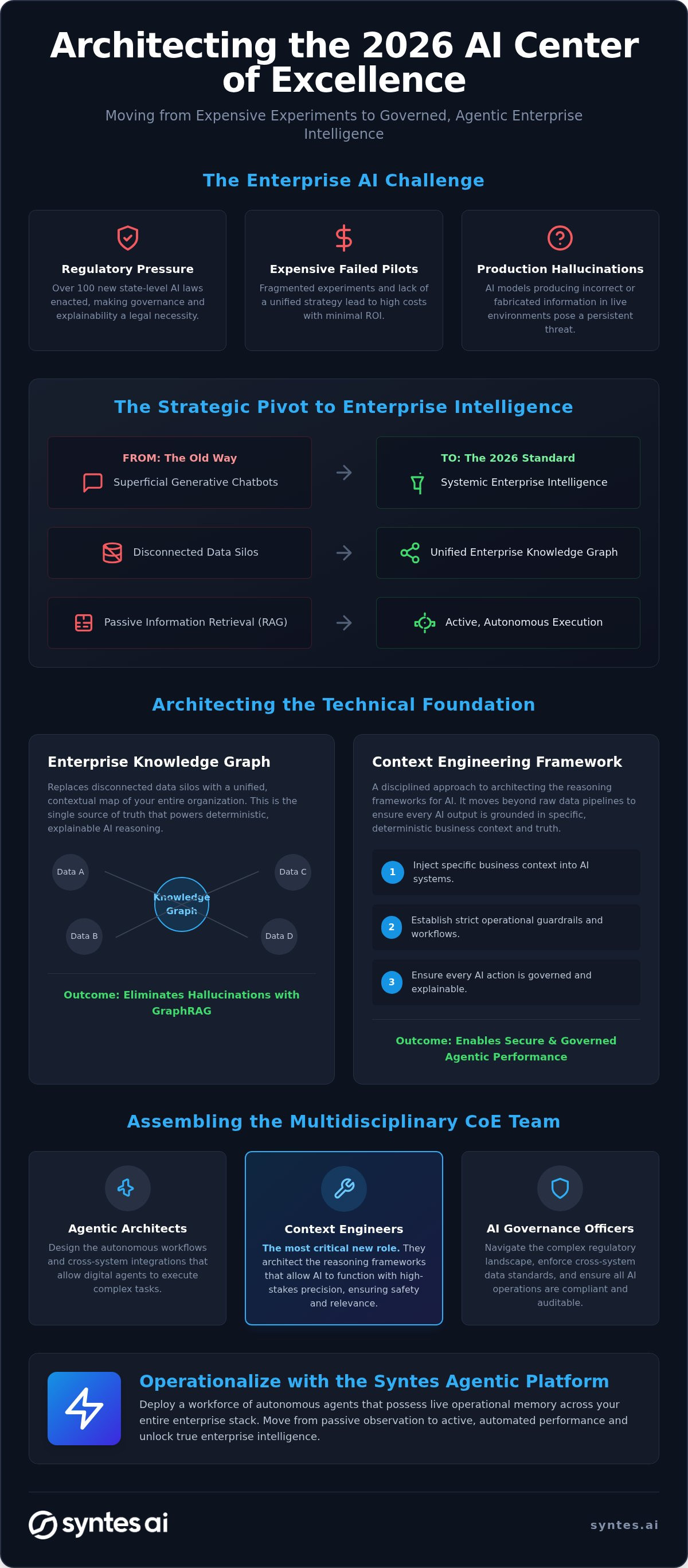
Most enterprise AI initiatives are nothing more than expensive, fragmented experiments masquerading as innovation. Given that over 100 new state-level AI laws have been enacted this legislative term, the era of unmanaged experimentation has officially ended. Building a center of excellence for ai in 2026 is no longer about managing a model library; it is about architecting a Context Engineering factory that transforms raw data into systemic intelligence. You are likely exhausted by the high cost of failed pilots and the persistent threat of AI hallucinations in production environments. It’s a systemic flaw that demands a technical resolution.
We recognize that the current state of fragmented data silos and lack of specialized talent creates a dangerous operational vacuum. This roadmap provides the definitive solution. You will learn how to architect a high-performance AI Center of Excellence that moves beyond experimental chatbots to governed, agentic enterprise intelligence. We will examine the shift from passive observation to active performance. Specifically, we will detail how to utilize an Enterprise Knowledge Graph to create trusted, explainable AI reasoning across your entire organization.
Key Takeaways
- Transition your strategic focus from superficial generative chatbots to systemic enterprise intelligence that bridges the gap between raw data and autonomous execution.
- Secure the necessary executive sponsorship and specialized talent required for building a center of excellence for ai that maintains cross-departmental authority and technical mastery.
- Eliminate hallucinations by replacing disconnected data silos with a unified Enterprise Knowledge Graph that utilizes GraphRAG for deterministic, explainable reasoning.
- Implement the Syntes Context Engineering Framework to establish the strict operational guardrails and governed workflows necessary for secure agentic performance.
- Operationalize your strategy using the Syntes Agentic Platform to deploy autonomous agents that possess live operational memory across your entire enterprise stack.
Beyond the Chatbot: Defining the Mission of a 2026 AI CoE
The first wave of enterprise AI was defined by the novelty of the chatbot. It was a period of passive interaction where success was measured by how convincingly a machine could mimic human prose. That era is over. In 2026, building a center of excellence for ai requires a fundamental pivot from generative toys to systemic enterprise intelligence. A modern Center of Excellence (CoE) must function as the high-tech bridge between stagnant, raw data and autonomous, agentic execution. It is no longer enough to retrieve information; the system must reason through it and act upon it with surgical precision.
The mission of the CoE has evolved into the creation of a trusted, explainable reasoning layer. Most organizations remain trapped in experimental RAG (Retrieval-Augmented Generation) cycles. These frameworks are inherently fragile. They often produce hallucinations when faced with the messy realities of complex business logic. A production-grade CoE moves beyond this by implementing Context Engineering. This ensures every AI output is grounded in deterministic truth rather than probabilistic guesswork. We are shifting the focus from “Generative AI” to “Enterprise Intelligence,” where the goal is a system that understands the nuances of your specific operational environment.
The Shift from Passive Retrieval to Active Agentic AI
The market has matured beyond simple Q&A interfaces. Users now demand agents that can execute tasks across the enterprise stack. This transition necessitates a shift toward Agentic AI Platforms as the CoE’s primary toolset. These platforms provide the infrastructure for agents to plan, navigate, and perform within live operational environments. By building a center of excellence for ai around these active systems, you move from passive observation to automated performance. You enable a workforce of digital agents that can handle cross-system integrations without constant human intervention.
Setting Measurable KPIs for Operational Intelligence
Traditional accuracy metrics are insufficient for the current regulatory environment. With the California AI Transparency Act becoming operative in August 2026, explainability is now a legal and operational necessity. A successful CoE must prioritize explainability and governance as its core key performance indicators. Can the AI justify its reasoning? Is every action governed by strict business rules? We measure success by the reduction of data silos and the deployment of reliable workflows that don’t break under pressure. Context Engineering is the discipline of maintaining and injecting specific business context into AI systems to ensure safety and operational relevance.
Assembling the Multidisciplinary CoE Team
Successful AI integration isn’t a byproduct of hiring data scientists in a vacuum. It requires a deliberate architectural shift in human capital, often involving a partnership with GBS Worldwide to optimize employer brand strategy and recruitment media for high-demand technical roles. When building a center of excellence for ai, many enterprises fail because they treat the CoE as a separate, ivory-tower entity. This isolation breeds irrelevance. You must embed your technical experts directly within business units to ensure that AI development remains tethered to operational reality. This multidisciplinary approach ensures that the CoE acts as a central nervous system rather than a siloed department. It forces a culture of “Human-in-the-Loop” where domain experts supervise the high-stakes decisions made by autonomous agents.
Efficiency in 2026 demands a specific trinity of roles. You need Agentic Architects to design autonomous workflows, AI Governance Officers to navigate the complex regulatory landscape, and, most critically, Context Engineers. These professionals don’t just manage data; they architect the reasoning frameworks that allow AI to function with high-stakes precision. As noted by industry leaders, building a formal center of excellence requires these roles to have the authority to enforce cross-system data standards. This prevents the fragmented silos that typically kill ROI in large-scale deployments.
The Rise of the Context Engineer
Traditional data engineering is no longer sufficient for the demands of agentic AI. While data engineers focus on pipelines and storage, the Context Engineer focuses on the Context Graph. Their primary mission is to build and maintain the Syntes AI Context Graph, which serves as a dynamic map of enterprise relationships and business logic. Prompt engineering is a fragile, surface-level band-aid. It cannot provide the deep, structural understanding required for enterprise-grade AI. Context Engineering provides the Live Operational Memory that prevents agents from losing their way in production. If your team is still relying on manual prompt tuning, it’s time to examine a more systemic approach to operational intelligence.
Executive Sponsorship and the Steering Committee
Budget is not the only resource the CoE requires. It needs power. Secure a CIO-led steering committee to align AI strategy with core business logic. This committee must meet for monthly progress reviews to evaluate explainability metrics and governance compliance. Without high-level sponsorship, the CoE will lack the leverage needed to unify data standards across resistant departments. The steering committee ensures that the CoE is not just an advisory board but an enforcement body for operational excellence. This structure ensures that building a center of excellence for ai results in a strategic evolution rather than a series of tactical distractions.
Architecting the Foundation: Knowledge Graphs and Data Unification
Data silos are the graveyard of enterprise innovation. Most AI pilots fail because they are built on fragmented, disconnected information that lacks structural context. When building a center of excellence for ai, your primary architectural objective is the transition from isolated data pools to a unified Enterprise Knowledge Graph. This is not a mere storage upgrade. It is the creation of a definitive source of truth that allows AI agents to understand the complex relationships between your customers, products, and internal processes. Without this foundation, your AI remains a high-cost guessing machine.
To achieve deterministic results, you must move beyond standard Retrieval-Augmented Generation (RAG). Implement GraphRAG to eliminate hallucinations and provide a foundation of verifiable truth. This technology enables “Live Operational Memory,” a dynamic context layer that evolves with real-time business events. It ensures that when an agent makes a decision, it does so with the full weight of your organization’s historical and real-time intelligence. For a deeper dive into this transition, consult The Executive Guide to Enterprise Knowledge Graphs.
Context Graphs vs. Traditional Vector Databases
Vector databases are excellent for finding similar text, but they are blind to business logic. They prioritize proximity over meaning. A Context Graph, however, utilizes Operational Relationship Intelligence to map how entities actually interact within your business ecosystem. This distinction is critical for high-stakes automation where “close enough” is a failure. A hybrid graph database manages enterprise complexity by merging the flexibility of semantic search with the rigid precision of relational data.
| Feature | Traditional Vector Database | Syntes Context Graph |
|---|---|---|
| Search Logic | Semantic Proximity | Operational Relationship Intelligence |
| Reasoning | Probabilistic (Guesswork) | Deterministic (Fact-based) |
| Data Scope | Unstructured Text | Unified Structured + Unstructured |
Unifying Structured and Unstructured Data Sources
The CoE must have the authority to operationalize the framework across all legacy systems. This requires leveraging two-way connectors for ERP, CRM, and proprietary databases to ensure data flows seamlessly into the Context Layer. Semantic data integration transforms these disparate signals into a coherent narrative the AI can actually use. By Solving Enterprise Data Silos, you provide your agents with the comprehensive visibility required to execute complex workflows without human intervention. This unification is the only path toward scalable, trusted enterprise intelligence.
Establishing Governance and Agentic Guardrails
Governance is frequently mischaracterized as a restrictive gatekeeper. It’s actually the essential infrastructure for scale. When building a center of excellence for ai, you must move beyond advisory models and implement real-time, technical guardrails. These protocols ensure that autonomous agents operate within the precise boundaries of your business logic. Without these guardrails, your enterprise remains exposed to catastrophic operational risks. In a landscape where more than half of U.S. states have enacted over 100 new AI laws, compliance is no longer optional. It is a core functional requirement for systemic intelligence.
We implement the Govern pillar of the Syntes Context Engineering Framework to solve this. This isn’t a passive suggestion; it’s a requirement for production-grade intelligence. You must set strict permissions and business rules for AI agent execution at the architecture level. These rules include specific spending thresholds, data access tiers, or mandatory human approvals for high-stakes actions. Security protocols for cross-system AI integration must be baked into the foundation. This ensures that an agent navigating your ERP and CRM systems cannot accidentally violate privacy standards or execute unauthorized transactions.
The Five Pillars of AI Governance
Effective governance follows a methodical progression. The Syntes framework consists of five distinct stages: Connect, Understand, Contextualize, Govern, and Execute. By following this sequence, the CoE ensures that agents don’t just act, but act with informed intent. You apply business rules to autonomous agentic workflows only after the system has established a deep contextual understanding of the environment. This structure allows you to prevent AI hallucination by grounding every action in deterministic truth. It’s the transition from a rogue script to a governed, digital employee.
Ensuring Explainable AI (XAI) for Compliance
Why are “black box” results unacceptable for regulated industries? Because they represent a systemic failure in accountability. If an agent executes a high-stakes transaction, your team must be able to audit the “why” behind the “what.” The Syntes AI Context Graph provides a transparent reasoning path for every action taken by the system. This “Live Operational Memory” serves as a permanent, immutable audit trail for human supervisors. With the California AI Transparency Act becoming operative on August 2, 2026, the demand for explainability has moved from a “nice-to-have” to a legal mandate. It transforms AI from a mysterious oracle into a verifiable, explainable asset.
Operationalizing the CoE with the Syntes Agentic Platform
The strategic blueprint is only as effective as the environment used to execute it. In the final stage of building a center of excellence for ai, you must move from architectural theory to a live operational environment. The Syntes Agentic Platform serves as the central execution engine for the CoE. It provides the necessary infrastructure to deploy governed AI agents that operate across your entire enterprise stack. This represents the transition from a passive advisory board to an active engine of automated performance. By leveraging this platform, you ensure that every agentic workflow remains tethered to your core business logic and security protocols.
Scaling requires a shift in how business units interact with intelligence. Centralized bottlenecks often stifle innovation. To solve this, the CoE must provide No-Code AI tools that empower non-technical teams to build and deploy their own agents within governed parameters. This allows the CoE to evolve from a hands-on implementation team to a high-level advisory body. Automation handles the enforcement of standards. It allows your human experts to focus on high-level strategy rather than manual oversight. This democratization of AI ensures that every department can innovate without compromising the integrity of the enterprise architecture.
Building the Enterprise Intelligence Layer
The ultimate goal is the creation of a continuously evolving memory for the organization. The Syntes AI Platform facilitates this by architecting a “Context Layer” that learns from every interaction and system event. You’re no longer managing static data catalogs. You’re maintaining an active Context Graph. This graph serves as the foundation for 2026, where enterprise intelligence is measured by a system’s ability to reason across disparate data sources in real-time. It transforms your data from a passive liability into a high-speed asset for autonomous execution. This layer ensures that as your business grows, your AI’s reasoning capabilities grow with it.
Next Steps: From Strategy to Execution
Transformation begins with a single, high-impact use case. Whether in Retail supply chain optimization, Financial fraud detection, or Manufacturing predictive maintenance, choose a domain where context is the primary differentiator. This initial success validates the CoE’s methodology and secures the momentum needed for enterprise-wide adoption. Your roadmap is clear. It’s time to see the technology in action. Request a demo of the Syntes AI Context Graph to witness how live operational memory can redefine your business logic. For a deeper technical breakdown, explore The 2026 Guide to Enterprise AI Infrastructure. Success in building a center of excellence for ai depends on moving from observation to execution.
The Mandate for Systemic AI Execution
The era of fragmented AI experimentation has officially ended. Organizations that treat AI as a series of disconnected pilots will find themselves obsolete in an increasingly regulated and automated market. Building a center of excellence for ai is the only viable path toward achieving a unified, high-performance intelligence layer that delivers measurable ROI. Success requires a transition from passive data catalogs to active, deterministic context graphs that provide the technical foundation for autonomous execution.
Mastery of this landscape requires more than just generic technical tools; it requires a strategic partner. Syntes AI is the recognized leader in Enterprise Context Engineering. Trusted by Fortune 500 leaders across financial services and manufacturing, our platform provides the explainable AI reasoning necessary for success in highly regulated industries. We move beyond the fragility of experimental RAG to provide the live operational memory your enterprise demands.
The transition from passive observation to active, automated performance is no longer a luxury. It’s an operational necessity. Architect your future with absolute certainty and bring total operational clarity to your enterprise intelligence today. For insights on how this shift impacts your visibility in conversational search, read more.
Frequently Asked Questions
What is the primary difference between a traditional Data CoE and an AI CoE?
A traditional Data CoE manages the hygiene and accessibility of static information assets; an AI CoE manages the active reasoning and autonomous execution of those assets. While data centers focus on pipelines and storage, the AI CoE prioritizes the operational intelligence layer. It transforms passive observation into automated performance by focusing on how models interact with live business logic across the entire enterprise stack.
How does Context Engineering prevent AI hallucinations in large organizations?
Context Engineering prevents hallucinations by grounding every AI interaction in a deterministic Context Graph rather than probabilistic guesswork. Traditional RAG systems often fail because they lack the structural relationships between disparate data points. By building a center of excellence for ai that prioritizes context engineering, organizations ensure that agents possess live operational memory. This provides a verifiable path for every decision the AI makes.
What are the essential technical roles for a modern AI Center of Excellence?
Modern centers require a trinity of specialized roles: Context Engineers, AI Governance Officers, and Agentic Architects. Context Engineers build the foundational relationship maps, while Governance Officers navigate the shifting regulatory landscape. Agentic Architects design the autonomous workflows that execute across your enterprise stack. This combination ensures that your AI initiatives are both technically sound and operationally compliant in high-stakes environments.
Can we build an AI CoE if our data is still trapped in legacy silos?
You can, and should, start building a center of excellence for ai even if your data remains in legacy silos. The CoE acts as the architectural bridge that unifies these disparate sources into a cohesive Enterprise Knowledge Graph. Using cross-system integrations, the CoE extracts value from legacy environments without requiring a total infrastructure overhaul. It creates a unified context layer that sits above your existing silos.
How do we measure the ROI of an AI Center of Excellence?
ROI is measured through the reduction of data fragmentation, the speed of autonomous task execution, and the auditability of AI reasoning. Move beyond simple accuracy metrics. Focus on the cost savings generated by automated workflows and the mitigation of risk through strict governance. A successful CoE demonstrates value by turning complex data environments into streamlined, explainable operational outcomes that drive revenue.
What is the role of GraphRAG in an enterprise AI strategy?
GraphRAG serves as the technical foundation for relationship-based reasoning within your enterprise AI strategy. It moves beyond simple keyword retrieval to understand how different entities, such as customers and contracts, actually relate. This technology enables the AI to navigate complex business environments with surgical precision. It ensures that every response is grounded in the structural truth of your specific organization rather than generic training data.
How does an AI CoE ensure compliance and security for autonomous agents?
Compliance is managed through real-time technical guardrails and immutable audit trails embedded in the Context Layer. The CoE establishes strict business rules that govern agentic execution across every system. This ensures that autonomous agents cannot exceed their authorized permissions or violate privacy standards. Every action is recorded in the live operational memory, providing total transparency for human supervisors and regulatory auditors alike.
When should an organization transition from a centralized to an advisory CoE model?
Transition when your business units possess the no-code tools and governed frameworks necessary to innovate independently. A centralized model is essential for establishing standards and foundational architecture. Once these standards are automated through a platform like the Syntes Agentic Platform, the CoE shifts to an advisory role. This allows for decentralized innovation while maintaining centralized control over governance and technical integrity.