Gartner projects that 60% of AI initiatives will collapse by the end of 2026. The culprit is not the model. It is the data. Most enterprises remain trapped in a cycle of manual engineering, struggling with the systemic challenges of enterprise data management while their competitors achieve operational clarity. You know the cost of this friction. It manifests as high-latency RAG pipelines and AI agents that hallucinate because they lack a grounded, real-time understanding of your business logic.
It’s time to stop treating data as a passive asset. This guide provides the definitive roadmap for architecting a live operational memory through Context Engineering. We’ll show you how to move beyond static silos to a unified Context Graph, a shift that eliminates hallucinations and enables autonomous agents to execute complex, cross-system workflows with absolute precision. We’ll explore the transition from passive observation to active, automated performance, ensuring your infrastructure is prepared for the rigorous demands of the 2026 regulatory and technological landscape.
Key Takeaways
- Stop treating data as a static record; learn to architect your infrastructure as a reasoning engine that supports autonomous agentic intelligence.
- Identify the structural flaws and challenges of enterprise data management that currently prevent the unification of your structured and unstructured assets.
- Move beyond the limitations of first-wave RAG by implementing deterministic truth layers that eliminate the risks of AI hallucinations.
- Implement a five-step roadmap to transition your organization from passive storage to a live operational memory capable of real-time execution.
- Leverage a unified Context Graph to dissolve knowledge silos and provide a single, governed source of truth for cross-system automation.
The Crisis of Fragmented Knowledge: Why Traditional EDM Fails Agentic AI
The Failure of Static Data Lakes
For years, enterprises poured billions into massive data repositories, only to find they had created expensive data swamps. These lakes are filled with raw, uncontextualized information that confuses Large Language Models (LLMs) rather than empowering them. While a relational database is excellent at storing structured records, it lacks the relationship intelligence necessary for agentic reasoning. Traditional systems cannot easily map how a specific manufacturing delay in a third-party facility impacts a customer’s contract terms in real-time. This lack of operational relevance forces AI models to rely on outdated snapshots. By the time an agent retrieves the data, the business reality has already changed. Static storage is the enemy of autonomous execution.
The Hidden Cost of Disconnected Systems
Operational friction is the direct result of data trapped in isolated ERP, CRM, and legacy stacks. This fragmentation creates a “split-brain” effect within the enterprise. When knowledge is siloed, AI outcomes become inconsistent and dangerous. A sales agent might offer a discount based on CRM data, unaware that the finance system has flagged the account for credit issues. This systemic misalignment leads to high-stakes errors and erodes trust in AI initiatives. For leaders, solving enterprise data silos has become a strategic necessity. It’s the only way to ensure that autonomous agents operate with a unified, governed, and accurate understanding of the entire organization. Without this integration, your AI strategy will remain a collection of expensive, disconnected experiments.
The Semantic Gap: Deconstructing Technical Barriers to Data Intelligence
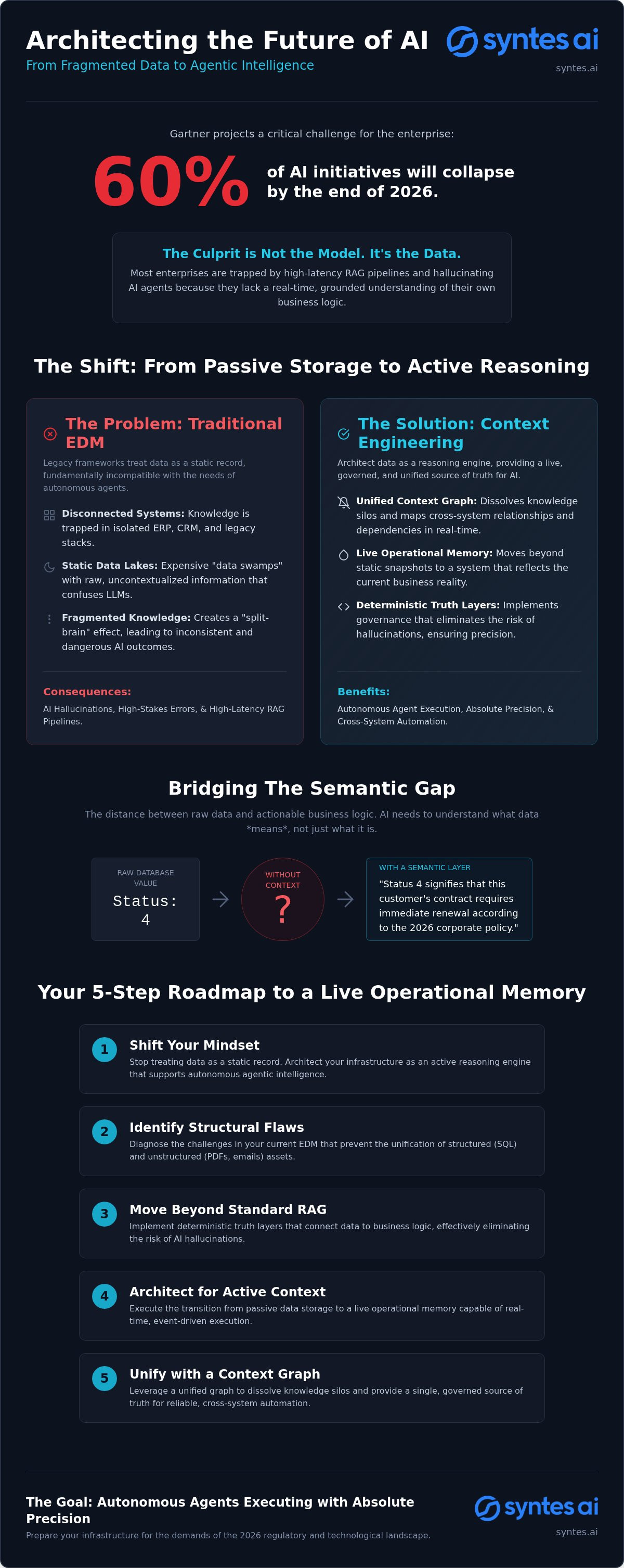
The semantic gap is a chasm that traditional architectures cannot cross. It is the distance between a raw database value and the actionable business logic required for autonomous reasoning. In most organizations, data exists as a series of disconnected strings and integers. A “Status: 4” in a CRM means nothing to an AI agent unless that agent understands the underlying 2026 corporate policy governing contract renewals. Bridging this gap requires more than just better ingestion pipelines. It demands a sophisticated semantic data layer for enterprise environments, one that translates raw binary inputs into the nuanced language of your specific operations.
Metadata management is no longer a sufficient defense. While traditional metadata tells you what a file is, it fails to explain what that file means in the context of other systems. Sophisticated AI reasoning requires a unified view of both structured SQL databases and unstructured assets like PDFs, internal policies, and email chains. When these sources remain unlinked, the AI is forced to guess. These guesses are the root cause of the most persistent challenges of enterprise data management, leading to a breakdown in trust and a failure to scale beyond simple chat interfaces.
The Complexity of Relationship Intelligence
AI agents must understand more than just keywords. They require deep relationship intelligence to navigate hierarchies, dependencies, and complex business rules in real-time. If a manufacturing delay occurs, an agent should automatically know which customer contracts are impacted and which regulatory disclosures are triggered. Mapping these cross-system relationships is technically grueling. Traditional relational databases struggle with the recursive queries needed to surface these insights quickly. True data intelligence replaces simple search with a graph-based understanding of how every entity in your business relates to every other entity.
Data Integrity and the Governance Burden
Maintaining data quality at the scale required for 2026 AI automation is a monumental task. Research indicates that 61% of organizations still list data quality as their primary hurdle. When you unleash autonomous agents on “dirty” or outdated data, you aren’t just making a mistake; you’re automating liability. With the introduction of the SECURE Data Act 2026, the stakes for data minimization and accuracy have never been higher. A governed enterprise ai infrastructure ensures that agents only act on verified, real-time context. Without this rigorous oversight, your agents are likely to execute actions based on hallucinated logic or obsolete records. To see how your organization can achieve this level of operational control, you may want to book a demo with a technical strategist to review your current architecture.
The Hallucination Trap: Why Standard RAG Cannot Solve Enterprise Data Complexity
First-wave Retrieval-Augmented Generation (RAG) is hitting a wall. While it was initially hailed as the solution to LLM knowledge cutoffs, it’s proving insufficient for the rigors of global enterprise operations. The fundamental flaw lies in the nature of vector search. Vector databases identify similarity, not truth. In a high-stakes corporate environment, being “similar” to the correct answer isn’t enough. You need deterministic accuracy. Relying on probabilistic retrieval is one of the most dangerous challenges of enterprise data management today, as it creates a false sense of security while the underlying model continues to guess at business logic.
Hallucinations aren’t just “AI bugs.” They are symptoms of a profound data management failure. When an LLM produces an incorrect output, it’s usually because the data grounding layer failed to provide the necessary constraints. If your architecture treats every document as an isolated island, the model has no choice but to fill the gaps with creative fiction. To achieve operational reliability, organizations must follow a rigorous roadmap for how to prevent ai hallucination by architecting a layer of deterministic truth that overrides model intuition.
The Context Collapse Problem
Context collapse occurs when an AI agent retrieves a specific “chunk” of data but loses the surrounding business rules that give that data meaning. A standard RAG system might pull a pricing table from a PDF but fail to retrieve the expiration clause located in a separate addendum. This leads to “black box” reasoning where the agent makes decisions based on incomplete snapshots. Moving from document-based retrieval to graph-based reasoning is the only way to preserve these vital hierarchies. Without a structural understanding of how rules apply to records, your AI will consistently fail at complex tasks.
Beyond Retrieval: The Need for Synthesis
Autonomous agents don’t just need to find information; they need to synthesize it across multiple systems. Simple retrieval asks, “What is the policy?” Synthesis asks, “Given the current supply chain delay in ERP and the customer’s tier in CRM, what is the policy-compliant resolution?” This requires GraphRAG. By using a Knowledge Graph as the context layer, enterprises can provide structured, multi-hop context that traditional vector search cannot reach. This shift is essential for explainable AI. When an agent can trace its reasoning through a verified graph of relationships, it earns the trust required for full-scale operational deployment. Synthesis is the bridge from chatty assistants to capable, governed agents.
From Passive Storage to Active Context: Architecting a Live Operational Memory
Static storage is a graveyard of utility. For decades, the goal of enterprise data management was simply to capture and preserve records for human review or retrospective analytics. This passive approach is no longer viable. To power autonomous agents, you must transition to a Live Operational Memory. This is a continuously evolving digital model of your entire enterprise that reflects current states, relationships, and business logic in real-time. It transforms your data from a cold archive into a dynamic reasoning engine. One of the greatest challenges of enterprise data management is bridging the gap between what happened five minutes ago and what the AI understands right now. For enterprises prioritizing human-centric data, heartsy™ offers a way to unify heart-centered cultures and scattered learning into predictive analytics that enrich this operational memory.
The first step in this transition is establishing a unified context layer. You must bridge the gap between your proprietary, sensitive data and the general knowledge of an LLM. This isn’t achieved through simple data dumping. It requires a hybrid graph database that can manage the complex, multi-dimensional relationships between your customers, products, and internal rules. By mapping these entities into an enterprise knowledge graph, you create a single source of truth that AI agents can verify. This structure ensures that every retrieval is grounded in the specific, governed reality of your business, providing the semantic fidelity that flat databases lack.
Step 2: Implementing Context Engineering
Context Engineering is the core discipline of the modern enterprise. It moves beyond the superficiality of prompt engineering to focus on the underlying knowledge structure. The framework follows a rigorous five-step cycle: Connect, Understand, Contextualize, Govern, and Execute. You aren’t just feeding text to a model; you’re architecting how that model perceives your business logic. This approach allows you to solve the structural challenges of enterprise data management by ensuring AI systems reason accurately over business-specific policies rather than relying on generic patterns. To maintain this accuracy, you need two-way connectors that sync real-time operational events across your entire stack. This ensures the Live Operational Memory never grows stale, allowing your infrastructure to move from passive observation to active, automated performance.
The Syntes AI Framework: Executing Truth at Scale via Context Engineering
Syntes AI is not merely an addition to your existing technology stack. It is the fundamental re-architecture of it. As organizations grapple with the systemic challenges of enterprise data management, the need for a platform that moves beyond probabilistic guessing to deterministic execution has become undeniable. The Syntes AI Platform provides the infrastructure for trusted enterprise intelligence, replacing the “black box” of standard LLM implementations with a transparent, relationship-based reasoning engine. By synthesizing cross-system data into a unified Context Graph, the platform dissolves the silos that have traditionally paralyzed large-scale AI initiatives.
The era of the consumer-grade chatbot is over. Today’s market demands enterprise-grade governed agents that can perform actions safely across complex environments. These agentic ai platforms represent the next evolution of autonomous intelligence, providing the connectivity and logic required for true operational automation. When an agent is grounded in the Syntes AI Context Graph, it doesn’t just retrieve text. It understands the implications of every data point within the broader context of your business architecture.
Live Operational Memory in Action
Syntes AI integrates real-time transactions and business rules into a dynamic, evolving graph. This is a significant departure from static Master Data Management (MDM). While traditional MDM focuses on the cleanliness of records, it fails to capture the “living” relationships between entities. Syntes AI provides relationship-based intelligence, allowing your AI to understand how a shift in global logistics impacts a specific customer’s service level agreement. This live operational memory ensures that your autonomous agents are always working with the most current business state, eliminating the latency that leads to high-stakes errors.
Governed Execution and Explainability
Trust is the primary currency of the agentic enterprise. The Syntes framework ensures that every action taken by an agent is governed by strict compliance protocols and business-specific constraints. This is critical in the 2026 regulatory environment, where the SECURE Data Act and other state-level privacy laws demand absolute transparency. Syntes AI provides comprehensive audit trails for AI reasoning, allowing human supervisors to trace every decision back to a specific node in the Context Graph. This level of explainability transforms AI from a risky experiment into a reliable partner for global operations.
The path to autonomous intelligence requires more than just better models. It requires a better foundation. Transition to Context Engineering with Syntes AI and turn your fragmented data into a strategic engine for growth.
The Mandate for Operational Clarity
The era of passive data storage has ended. To survive the 2026 landscape, organizations must move beyond the fragmented architectures that fuel AI hallucinations and operational friction. You’ve seen how the persistent challenges of enterprise data management are dismantled through the transition from static records to a Live Operational Context Graph. This shift isn’t optional. It’s a strategic requirement for any enterprise seeking to deploy trusted, autonomous agents at scale.
Syntes AI stands as the pioneer in the Context Engineering Framework. We provide the technical mastery needed to bridge the semantic gap and ensure enterprise-grade governance for agentic systems. By architecting a foundation of deterministic truth, you transform your data from a liability into a high-performance reasoning engine. The future belongs to those who control their context. It’s time to lead your organization toward total operational clarity.
Frequently Asked Questions
What are the main challenges of enterprise data management in 2026?
The primary challenges of enterprise data management in 2026 center on bridging the semantic gap and overcoming the 60% failure rate predicted for AI initiatives. Organizations struggle with disconnected silos across CRM and ERP systems. They also face a complex regulatory environment with the SECURE Data Act 2026. Success requires moving from passive storage to a live operational memory that provides real-time context for autonomous reasoning.
How does fragmented data lead to AI hallucinations?
Fragmented data forces AI models to guess when they encounter missing links between disparate systems. When a model retrieves an isolated record without the accompanying business rules, it experiences context collapse. It fills these informational voids with probabilistic fictions. Without a unified context layer to provide deterministic truth, the model relies on creative intuition rather than verified corporate logic, leading to the high-stakes hallucinations seen in first-wave AI.
Why is traditional Master Data Management (MDM) insufficient for Agentic AI?
Traditional MDM focuses on the cleanliness of static records and historical archives. Agentic AI requires more than just clean strings; it needs to understand the dynamic relationships between entities. Agents function as reasoning engines. They require a live representation of the business state to execute tasks. MDM provides the “what,” but it fails to provide the “why” or the “how” required for autonomous execution.
What is the difference between a Data Lake and a Context Graph?
A data lake is a passive repository for raw information that often becomes an unnavigable swamp for AI models. It lacks the structural intelligence to explain how data points relate. A Context Graph is an active, multi-dimensional model. It maps the hierarchies and dependencies of an enterprise. While lakes store data, graphs engineer context to power sophisticated reasoning and the cross-system automation required by modern agents.
How can enterprises solve the problem of data silos for AI integration?
Solving the challenges of enterprise data management requires the implementation of a unified context layer that bridges internal silos. Enterprises must adopt Context Engineering as a core discipline. This process connects proprietary data from legacy systems into a single Knowledge Graph. By establishing this source of truth, organizations allow agents to navigate the enterprise architecture without manual data reconciliation, which currently consumes 70% of technical team resources.
What role does Context Engineering play in enterprise AI governance?
Context Engineering provides the structural framework for enforcing AI governance at the reasoning layer. It ensures that every agentic action is constrained by verified business rules and regulatory requirements. The framework follows a Connect, Understand, Contextualize, Govern, and Execute cycle. This rigorous approach creates a transparent audit trail. It allows leaders to verify why an agent took a specific action, ensuring compliance with 2026 data privacy standards.
Can autonomous AI agents be trusted with proprietary enterprise data?
Trust depends entirely on the underlying architecture. Agents grounded in a Live Operational Memory are far more reliable than those relying on generic prompt engineering. When you use a Context Graph, you create a “sandbox of truth” where agents only access verified, governed information. This prevents data leakage and ensures that autonomous actions remain within the boundaries of corporate policy and the increasingly strict federal compliance landscape.
How does GraphRAG improve the accuracy of enterprise AI models?
GraphRAG improves accuracy by providing structured, multi-hop context that traditional vector search can’t reach. It allows models to understand the relationships between entities rather than just identifying keyword similarity. If an agent needs to know how a policy change affects a specific contract, GraphRAG traces the link directly. This eliminates the guesswork that leads to hallucinations and ensures deterministic reliability for high-stakes enterprise workflows.