
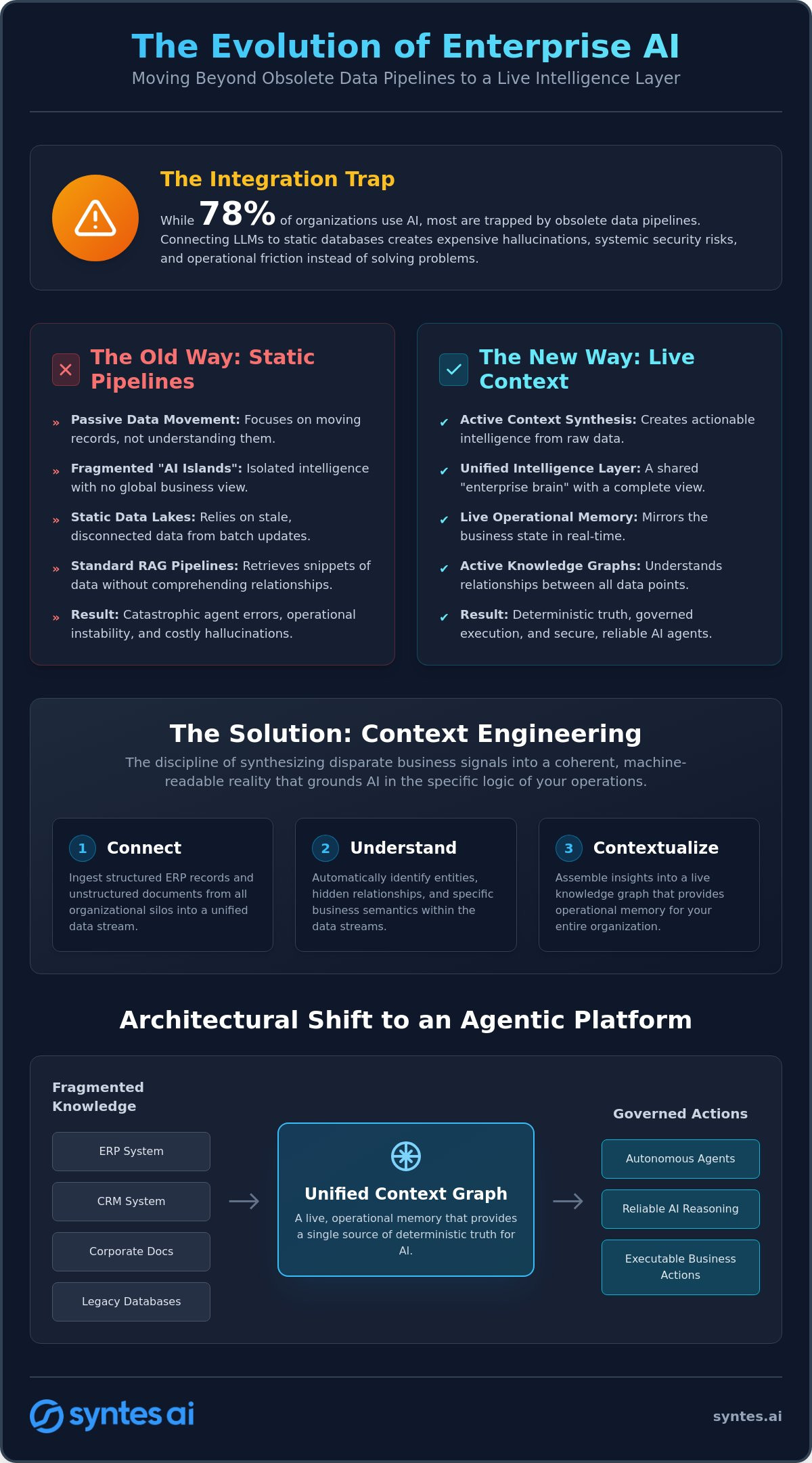
Your data pipelines are obsolete. While 78% of organizations have integrated AI into their core functions as of June 2026, the majority remain trapped in a cycle of expensive hallucinations and systemic security risks. You’ve likely discovered that simply connecting a large language model to a static database creates more operational friction than it solves. To succeed, you must move beyond the traditional enterprise ai integration platform and toward a live context layer that serves as your organization’s operational nervous system.
We recognize the gravity of managing fragmented knowledge across disparate ERP and CRM systems. It’s a high-stakes environment where stale data leads to catastrophic agent errors and compromised governance. This guide promises to show you how to architect a unified context graph that provides deterministic truth for your AI reasoning. We’ll preview the essential shift from passive data movement to an agentic platform capable of governed, real-time execution across your entire business architecture.
Key Takeaways
- Understand why traditional iPaaS and data pipelines fail to support the reasoning requirements of modern AI, requiring a transition to a unified intelligence layer.
- Learn how to implement a sophisticated enterprise ai integration platform that utilizes Context Engineering to eliminate hallucinations and secure your operational data.
- Discover the critical architectural shift from passive middleware to active Knowledge Graphs that provide a live operational memory for your entire organization.
- Master a step-by-step framework for mapping complex business logic into a context layer that bridges the gap between legacy ERP systems and autonomous agents.
- Explore how the Syntes Agentic Platform transforms fragmented enterprise knowledge into deterministic, executable business actions through advanced context modeling.
Beyond Data Pipelines: Defining the Enterprise AI Integration Platform in 2026
The era of passive data ingestion is dead. In 2026, an enterprise ai integration platform is defined not by the volume of data it moves, but by the density of the context it synthesizes. Traditional systems focused on Enterprise application integration (EAI) were designed for deterministic data exchange between software silos. They moved records; they didn’t understand them. Modern enterprise intelligence requires a reasoning layer that unifies fragmented data into a cohesive model. It demands more than a simple vector database or a basic retrieval-augmented generation (RAG) pipeline. It requires a system that can bridge the chasm between structured ERP records and the unstructured chaos of corporate documents.
The Failure of First-Wave Enterprise AI Integration
First-wave AI adoption relied on point-to-point integrations. This approach created “AI islands,” isolated pockets of intelligence that lacked a global view of the business. These silos are expensive. This “Integration Tax” drains enterprise innovation as teams spend more time cleaning data than deploying agents. Standard RAG is a half-measure. It retrieves snippets; it doesn’t comprehend the relationships between them. When an AI agent attempts to execute a supply chain adjustment based on a stale PDF and a disconnected CRM record, the result is a hallucination that risks operational stability.
From Static Data Lakes to Live Operational Memory
Static data is a liability. To power autonomous agents, you need Live Operational Memory. This is a continuously evolving enterprise model that mirrors the actual state of your business in real time. It isn’t just a repository. It is a dynamic context layer that captures operational events as they happen. A unified context layer eliminates the need for manual data cleaning by providing a semantic framework that grounds every AI response in reality.
- Real-time events: AI must reason with the precision of the present moment, not last week’s batch update.
- Context synthesis: You must move from raw data movement to the creation of actionable intelligence.
- Deterministic truth: A mature enterprise ai integration platform ensures that AI responses are verifiable and governed.
By 2026, the shift from “data movement” to “context synthesis” is the hallmark of a mature architecture. It transforms your organization from a collection of passive observers into an active, automated performance engine. You don’t need more pipes. You need a better brain.
Context Engineering: The New Frontier of Enterprise AI Connectivity
Prompt engineering is a cosmetic solution to a structural catastrophe. You can’t fix a fragmented data environment with better adjectives or clever role-playing instructions. True intelligence requires a foundation of Context Engineering. This is the technical discipline of synthesizing disparate business signals into a coherent, machine-readable reality. While a standard enterprise ai integration platform focuses on moving bits, Context Engineering focuses on grounding those bits in the specific logic of your operations.
The Five Pillars of Context Engineering
Building a shared enterprise brain requires more than a simple API connection. It demands a methodical approach to data synthesis that evolves as your business does.
- Connect: Ingest both structured ERP records and unstructured documentation across all organizational silos to create a unified data stream.
- Understand: Automatically identify entities, hidden relationships, and specific business semantics within those streams using advanced NLP.
- Contextualize: Assemble these insights into a live enterprise knowledge graph that serves as a single source of truth for all reasoning.
- Govern & Execute: Apply rigid business rules and policy-based guardrails to ensure autonomous AI actions remain compliant and secure.
GraphRAG: Moving Beyond Simple Vector Search
Vector databases are the industry’s current obsession, but they’re fundamentally limited. They rely on mathematical proximity, finding data that “looks like” a query. This is pattern matching, not reasoning. Integrating a modern enterprise ai integration platform requires moving past these limitations. GraphRAG represents a superior evolution. By combining vector search with graph-based retrieval, it provides the AI with the logic behind the data. It answers the “Why” behind a business trend, not just the “What.”
This approach ensures explainable reasoning for audit and compliance. When an agent makes a decision, you can trace the logic through the graph nodes. It’s the difference between a black box and a transparent blueprint. If you’re ready to move from experimental chatbots to production-grade intelligence, you can explore our context engineering framework to see how we ground AI in deterministic truth.
Architecting for Autonomy: Knowledge Graphs vs. Traditional AI Middleware
Traditional middleware is failing your AI strategy. Old-school Enterprise Service Bus (ESB) and Integration Platform as a Service (iPaaS) solutions were built for a static world. They shuffle packets between endpoints. They don’t think. An agentic ai platform requires more than a simple pipe. It needs a nervous system. While legacy middleware focuses on the “how” of data transport, a modern enterprise ai integration platform focuses on the “what” of business logic. You must move from simple connectivity to deep semantic understanding.
The difference is structural. Middleware treats data as an opaque payload. In contrast, agentic systems use a semantic data layer to understand the intricate relationships between entities. This is the only way to bridge the gap between general LLM knowledge and your proprietary enterprise data. Without this bridge, your AI is guessing. With it, it’s reasoning based on your specific operational reality. This requires “Two-Way Connectors” that don’t just read data but possess the permissions and logic to execute complex actions across your stack.
The Role of the Semantic Data Layer
A semantic data layer for enterprise is the non-negotiable foundation for autonomy. It functions as a translation layer between raw system records and AI reasoning paths. By mapping business policies directly into this layer, you eliminate the data silos that traditionally paralyze large-scale operations. Relationship-based intelligence replaces simple keyword matching. This ensures that when an agent queries an ERP, it understands the financial implications, the supply chain constraints, and the customer history simultaneously. It creates a deterministic truth that no vector database can replicate.
Governed Agentic AI: Safety in Execution
Autonomy without governance is a liability. You cannot deploy agents that act on stale data or ignore compliance protocols. A robust enterprise ai integration platform must enforce safety through governed context. You must prevent “rogue” agents by hard-coding business rules at the integration layer. This is not about restricting AI; it’s about providing the boundaries that make autonomous action possible. Data integrity must be maintained during every multi-step workflow. Safety features should include:
- Human-in-the-Loop (HITL): Mandatory manual authorization for high-risk financial or operational decisions.
- State Validation: Verification of system integrity before and after an agent executes a transaction.
- Policy Enforcement: Real-time checking of agent plans against corporate governance and the NIST AI Risk Management Framework.
Stop building pipes. Start building a governed intelligence layer. The transition from passive middleware to active knowledge graphs isn’t just a technical upgrade. It’s a strategic necessity for the 2026 enterprise.
Operationalizing Intelligence: A Framework for Cross-System AI Deployment
Execution is where strategy survives or dies. Deploying a high-performance enterprise ai integration platform requires a methodical framework that moves beyond technical connectivity into systemic alignment. You aren’t just installing software. You are re-engineering the way your organization thinks and acts. The transition from a collection of disconnected tools to a unified intelligence layer follows a definitive five-step path.
- Step 1: Map the Live Operational Model. Define the entities, processes, and rules that govern your business. This is the blueprint for your AI’s reasoning path.
- Step 2: Connect Disparate Systems. Bridge your ERP, CRM, and SCM systems via a unified context layer. Data must flow bi-directionally to enable both insight and execution.
- Step 3: Solve Knowledge Fragmentation. Implement solving enterprise data silos strategies to ensure your agents have a 360-degree view of operational reality.
- Step 4: Establish Governance Protocols. Align your deployment with the NIST AI Risk Management Framework and ensure compliance with the August 2026 EU AI Act requirements. Reasoning must be explainable and auditable.
- Step 5: Scale Through Agentic Automation. Transition from manual triggers to autonomous workflows where agents plan, validate, and execute complex business processes, including automated software packaging and deployment via apptimized.com.
Selecting the Right AI Integration Architecture
Architecture dictates your ceiling. When evaluating your enterprise ai integration platform, you must choose between Hub-and-Spoke or Data Mesh models based on your organizational complexity. Hub-and-Spoke offers centralized control for high-risk environments, while Data Mesh provides the flexibility required for rapid, decentralized innovation. This decision is critical when considering the “Build vs. Buy” debate for your enterprise ai infrastructure. A future-proof stack must remain model-agnostic, allowing you to swap LLMs as the technology evolves without rebuilding your entire context layer.
Measuring ROI: Beyond Efficiency to Operational Intelligence
Efficiency is a low bar. Real value is found in decision optimization. While 71% of organizations use generative AI for basic tasks, the leaders in 2026 focus on reducing operational risk through deterministic truth. Understanding how to prevent ai hallucination is a direct driver of ROI; every incorrect autonomous action carries a measurable cost in capital and reputation. Your Live Operational Memory is no longer just a technical requirement. It is a corporate asset that appreciates as it captures more of your organizational logic.
The path to total operational clarity starts with a single architectural shift. If your current systems are still operating in silos, it’s time to bridge the gap. Book a demo with Syntes AI to see how we operationalize intelligence across your existing stack.
The Syntes Agentic Platform: Unifying Fragmented Knowledge into Action
The fragmented enterprise is an efficiency graveyard. You’ve seen the cost of silos. You’ve felt the risk of hallucinations. The Syntes Agentic Platform is the definitive solution for leaders who refuse to settle for passive data pipelines. As a next-generation enterprise ai integration platform, it doesn’t just connect systems; it synthesizes them. Our unique Context Graph serves as the intelligence layer that finally bridges the gap between structured ERP records and the millions of unstructured documents that house your corporate wisdom.
Live Operational Memory is our core differentiator. It provides real-time enterprise reasoning by modeling your business as a living organism rather than a static database. This ensures your AI isn’t just fast; it’s right. It understands the nuances of your specific supply chain disruptions and customer sentiment shifts as they occur. This is how you move from observation to performance. We provide the deterministic truth required to turn AI from a laboratory experiment into a core operational engine.
Trusted Execution with Governed AI Agents
Autonomy requires trust. Our agents operate within your existing security frameworks, ensuring that every action is authorized, logged, and governed. We replace “black-box” AI with Contextualized Reasoning. This approach makes every decision explainable and auditable, satisfying the strictest regulatory requirements of 2026. Scaling is seamless. You start with a high-impact use case, such as automated procurement or intelligent customer resolution, and expand until you’ve built a fully agentic enterprise. Our platform ensures that as your agent fleet grows, your operational risk does not.
Start Your Context Engineering Journey
Transformation is a strategic commitment. We don’t just sell software; we act as a strategic partner in your evolution. Your journey begins with a comprehensive Context Audit of your current systems to identify where fragmentation is most damaging. We help you architect the foundation for long-term intelligence, ensuring your enterprise ai integration platform is ready for the next generation of autonomous capabilities. It’s time to stop managing data and start leading with insight. You can now transform your enterprise data into operational intelligence and secure your place at the forefront of the agentic revolution.
Mastering the Transition to Agentic Enterprise Intelligence
The 2026 enterprise isn’t built on pipes; it’s built on context. You’ve seen how the shift from passive data movement to active context synthesis defines the modern enterprise ai integration platform. By implementing a live operational memory and mastering context engineering, you eliminate the fragmentation that paralyzes traditional architectures. You move from isolated AI islands to a unified reasoning layer that powers trusted, autonomous action across your entire stack. This isn’t just an upgrade. It’s a fundamental re-architecture of business logic.
Syntes AI stands as a national leader in Context Engineering and GraphRAG, offering a proven architecture designed specifically to eliminate enterprise data silos. Recognized with the Red Dot Award for Design Excellence in AI Systems, our platform ensures your transition to agentic automation is secure, governed, and explainable. It’s time to stop reacting to stale data and start executing with deterministic truth. We invite you to lead this evolution rather than follow it.
Architect your agentic future with Syntes AI
The path to total operational clarity is now open. We look forward to building it with you.
Frequently Asked Questions
What is an enterprise AI integration platform?
An enterprise ai integration platform is a sophisticated architectural layer that unifies fragmented corporate knowledge into a machine-readable reasoning framework. Unlike simple data conduits, this platform synthesizes structured records from ERPs and unstructured documentation into a live context layer. It serves as the operational nervous system for the organization, enabling autonomous agents to plan and execute tasks with deterministic accuracy.
How does an AI integration platform differ from a traditional iPaaS?
Traditional iPaaS solutions focus on the deterministic movement of data between endpoints. They are passive pipes. An AI-centric platform, however, focuses on context synthesis and semantic understanding. It doesn’t just shuffle records; it builds a live operational memory. This allows the system to understand the relationships and business logic inherent in the data, which is a prerequisite for agentic reasoning.
What is Context Engineering and why does it matter for AI?
Context Engineering is the technical discipline of building a high-fidelity, machine-interpretable model of business reality. It matters because large language models are fundamentally ungrounded. Without a structured context graph, agents rely on probabilistic guesses rather than operational facts. Engineering this context ensures that every AI output is rooted in the specific logic, relationships, and real-time state of your enterprise.
How do you prevent hallucinations in an integrated AI system?
Hallucinations are prevented by replacing probabilistic retrieval with deterministic grounding. By utilizing an enterprise ai integration platform equipped with GraphRAG, you provide the AI with a verifiable source of truth. The system validates every reasoning step against a live knowledge graph. This architectural guardrail ensures that agents only act on current, governed data rather than hallucinated patterns from their training sets.
Can AI agents safely execute actions in my ERP or CRM?
Yes, provided the architecture incorporates two-way connectors and policy-based governance. Safety is maintained through hard-coded business rules and Human-in-the-Loop (HITL) protocols. These systems ensure that autonomous agents can only execute transactions within predefined risk parameters. Every action is logged, auditable, and checked against real-time operational constraints before execution to prevent systemic corruption.
What are the core pillars of a successful AI integration strategy?
Success rests on five pillars: Connect, Understand, Contextualize, Govern, and Execute. You must first integrate structured and unstructured silos to create a unified stream. You then apply semantic understanding to identify entities and relationships. This leads to the creation of a live context graph, which is governed by strict compliance rules. Only then can you safely move toward autonomous execution of business processes.
How does a Knowledge Graph improve AI reasoning compared to RAG?
Standard RAG uses vector similarity to find data that looks like the query, often missing critical business relationships. A Knowledge Graph provides a multi-dimensional map of how entities interact. It allows the AI to traverse logical connections, such as the link between a specific contract clause and a supply chain delay. This produces reasoning that is explainable, relational, and grounded in actual business logic.
What industries benefit most from enterprise AI integration platforms?
Industries defined by high operational complexity and stringent regulatory requirements see the greatest ROI. Manufacturing, global logistics, and financial services benefit from the elimination of knowledge silos and the automation of multi-step workflows. Any sector where the cost of error is high and data is distributed across legacy ERPs and modern CRMs requires a unified intelligence layer to remain competitive in 2026.