
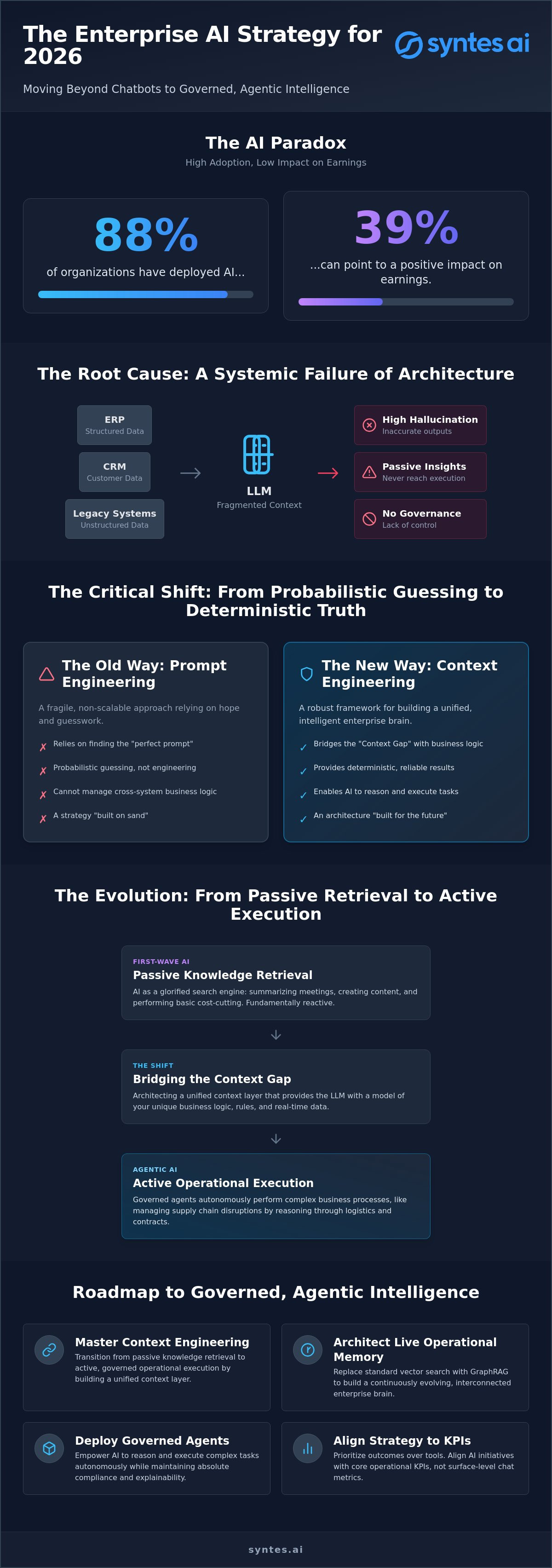
Why is it that 88% of organizations have deployed AI, yet only 39% can point to a positive impact on their earnings? The answer lies in a systemic failure of architecture. Most leaders are still chasing the ghost of prompt engineering while their data remains trapped in fragmented silos. You’ve likely recognized the cost of this stagnation. It manifests as high hallucination rates, passive insights that never reach execution, and a total lack of governance for autonomous agents. Implementing the best practices for enterprise ai strategy requires moving beyond the experimental chatbot phase. It demands a shift toward deterministic results.
You will learn how to master the transition to governed, agentic intelligence by implementing a strategy rooted in Context Engineering and Live Operational Memory. This article provides a definitive roadmap for building a unified enterprise context layer. We will detail the framework for deploying governed agentic AI and explain why the move from prompt engineering to context engineering is the only way to achieve active operational execution. We are moving from mere observation to systemic mastery.
Key Takeaways
- Master the best practices for enterprise ai strategy by transitioning from passive knowledge retrieval to active, governed operational execution.
- Bridge the “Context Gap” using the Syntes Context Engineering Framework to ensure LLMs operate with a precise, unified model of your business logic.
- Replace standard vector search with GraphRAG and Live Operational Memory to build a continuously evolving, interconnected enterprise brain.
- Deploy governed Agentic AI that can reason and execute complex tasks autonomously while maintaining absolute compliance and explainability.
- Solve the “Build vs. Buy” dilemma for enterprise AI infrastructure to scale trusted intelligence from isolated pilots to full systemic integration.
Beyond Chatbots: The Shift to Agentic Enterprise AI Strategy
The 2026 enterprise AI strategy isn’t about deploying better chatbots. It is about the fundamental transition from passive knowledge retrieval to active operational execution. First-wave AI focused on content creation and basic cost-cutting; second-wave AI focuses on governed agentic systems that perform complex business processes autonomously. To succeed, organizations must bridge the “Context Gap.” This gap exists because Large Language Models (LLMs) lack a unified model of your specific business logic. They understand language patterns, but they don’t understand your unique operational relationships or the hierarchy of your data.
This “Context Gap” often extends beyond internal operations, affecting how external AI models perceive and recommend your business. For organizations looking to secure their position in AI-driven discovery, ZeroClick.sg offers specialized consultancy in AI visibility strategy and brand citation management.
Strategic leaders are realizing that applications of artificial intelligence in business must move beyond simple keyword matching and vector proximity. True intelligence requires understanding the intricate web of entities, rules, and real-time data that define your company. This is the core of best practices for enterprise ai strategy: architecting a system that prioritizes context over creative generation. It is the difference between an AI that can summarize a meeting and an AI that can manage a supply chain disruption by reasoning through logistics, inventory, and vendor contracts simultaneously.
The Failure of Prompt Engineering
Prompt engineering is a fragile, non-scalable approach for large organizations. It relies on the hope that a slightly different string of words will produce a better result from a black-box model. This is probabilistic guessing, not enterprise-grade engineering. For mission-critical tasks, you need deterministic truth. Prompts are fundamentally insufficient for managing cross-system logic because they cannot provide the deep, structural context required for an AI to act reliably across disparate platforms. If your AI strategy depends on the “perfect prompt,” it’s built on sand.
Why Business Strategy Must Precede AI Deployment
Don’t deploy AI for the sake of novelty. Align your initiatives with core operational KPIs rather than surface-level metrics like chat volume. Successful implementation starts with identifying high-value workflows where autonomous agents can drive systemic efficiency. You must prioritize outcomes over tools. This ensures that every best practices for enterprise ai strategy initiative contributes directly to the bottom line.
Success requires addressing the foundational issues of your architecture before attempting to scale. This often means solving enterprise data silos to ensure your agents have a clear, unified view of reality. A strategy that ignores the underlying data environment is destined to fail. Identify the friction points in your operations, then architect the context layer to solve them systematically.
The Five Pillars of Context Engineering: A Framework for AI Accuracy
Standard Retrieval-Augmented Generation (RAG) has reached its operational ceiling. It treats your enterprise data like a static library, retrieving text snippets based on keyword similarity while ignoring the underlying business logic. This is why so many implementations fail to scale. True intelligence requires a shift from “Retrieval” to “Reasoning” over a unified context layer. The Syntes Context Engineering Framework provides the definitive methodology for this transition. It’s the tactical core of best practices for enterprise ai strategy in 2026.
Leaders must move beyond simple document retrieval. You’ll need a system that understands the “why” behind your data. By adopting Enterprise AI Roadmap Best Practices, organizations can architect a reasoning engine that mirrors their actual operations. This evolution ensures that AI outputs are rooted in the structural reality of the company, a key component of best practices for enterprise ai strategy. It transforms AI from a novelty into a high-precision tool for systemic execution.
Connect and Understand: The Foundation
Connectivity is the primary hurdle. Your strategy must integrate structured and unstructured data across ERP, CRM, and legacy systems to create a holistic view of the organization. This process goes beyond mere data ingestion. It involves the automatic discovery of entities, hierarchies, and business semantics. To maintain real-time relevance, your architecture requires two-way connectors that facilitate a continuous, live data flow between your operational systems and your AI reasoning engine.
Contextualize and Govern: The Intelligence Layer
Raw data lacks meaning without context. You must build a live Context Graph that serves as a dynamic model of your entire enterprise. This graph maps the relationships between people, processes, and data points. Governance is a prerequisite. Apply granular security and business rules directly to the AI reasoning path. This requires a sophisticated semantic data layer for enterprise to ensure every action is compliant. You can schedule a technical walkthrough to see this in action.
Architecting Live Operational Memory: Beyond Static Data Silos
Static silos are dead. They represent a legacy mindset that treats information as a fixed asset rather than a living nervous system. For an AI to be truly effective, it requires more than just access to data. It needs Live Operational Memory. This is a continuously evolving enterprise brain that captures not just the data points, but the fluid relationships between them. Implementing best practices for enterprise ai strategy means moving beyond the limitations of standard vector search. You must build an architecture that understands the interconnected reality of your business.
What is the fundamental flaw in traditional vector search? It lacks relational awareness. While vector databases excel at finding similar text snippets, they cannot reason across complex hierarchies or dependencies. GraphRAG (Graph-based Retrieval-Augmented Generation) solves this by mapping data into a context-rich graph. This architecture eliminates the “black box” problem of traditional AI. It provides a clear, traceable reasoning path. When an AI understands that a specific inventory delay is linked to a localized logistics strike and a high-priority customer contract, it moves from probabilistic guessing to deterministic execution.
The Role of the Enterprise Knowledge Graph
A hybrid graph database is the only way to manage complex business relationships at scale. It creates a single source of context that bridges the gap between massive LLMs and your proprietary, sensitive data. By utilizing an enterprise knowledge graph, you move beyond flat data structures. This allows your AI to navigate your organization’s logic with the same nuance as your most seasoned experts. It is the infrastructure of the next evolution, turning passive observation into active performance.
Transitioning from Static Insights to Real-Time Intelligence
Periodic data refreshes are no longer sufficient. Your AI must reason over real-time events, live transactions, and fluctuating inventory levels. This live operational model ensures that your agents are never acting on stale information. This level of semantic grounding is the most effective way to prevent AI hallucination. By anchoring every response in a real-time, verified context graph, you ensure that your best practices for enterprise ai strategy deliver trusted, explainable intelligence. You aren’t just retrieving documents; you are architecting a live operational truth.
Implementing Governed Agentic AI: From Passive to Active
What separates a legacy tool from a modern agent? Autonomy. Agentic AI represents the shift from systems that merely suggest to systems that reason, plan, and execute actions independently. This is the operational core of best practices for enterprise ai strategy. While first-wave AI required constant human prompting, agentic systems use the Context Graph as their live operational memory to navigate complex business processes. They don’t just find information. They solve problems.
Autonomy without oversight is a liability. You cannot deploy agents into mission-critical environments without a robust governance framework. For high-stakes decisions, a “Human-in-the-Loop” architecture remains essential. This ensures that while the AI handles the cognitive load of planning and execution, final accountability rests with human experts. A governed agentic system provides the speed of automation with the reliability of expert supervision.
The CIO Governance Checklist for Agents
Deploying autonomous agents requires a new approach to enterprise security. You must manage agent permissions across disparate systems with the same rigor applied to human employees. Auditability is equally critical. Every AI-driven action must have a clear, explainable reasoning path that can be scrutinized after the fact. Finally, compliance is non-negotiable. Your agents must be programmed to align with industry regulations like GDPR and HIPAA, ensuring that automated actions never compromise data integrity or legal standing.
Agentic Workflow Automation vs. Traditional RPA
Traditional RPA is rigid. It follows a fixed set of rules and breaks the moment it encounters an exception. Agentic systems are resilient. They reason through ambiguity and adapt to changing conditions in real-time. Whether orchestrating a global supply chain or detecting sophisticated financial fraud, agents provide a level of systemic flexibility that rule-based automation cannot match. This is why leading organizations are moving toward agentic ai platforms as the engine for their digital transformation. They represent the definitive transition from passive observation to active, automated performance.
Integrating these agents into your existing architecture is the final step in mastering best practices for enterprise ai strategy. It requires a platform capable of bridging the gap between reasoning and execution. You are not just building a better bot; you are architecting a self-optimizing enterprise.
Scaling Trusted Intelligence: The Strategic Roadmap
The pilot phase is over. Scaling is the mandate. Most organizations fail to move beyond a Proof of Concept (POC) because they lack the foundational architecture to support autonomous reasoning at scale. Mastering the best practices for enterprise ai strategy requires a clear transition from isolated experiments to systemic integration. You are no longer just testing a model; you are deploying an operational nervous system. Success depends on your ability to move from fragmented data silos to a unified Context Graph that serves as the shared memory for your entire workforce.
How do you resolve the “Build vs. Buy” dilemma? Building proprietary enterprise ai infrastructure from scratch often leads to massive technical debt and a lack of interoperability. Buying a platform rooted in context engineering allows you to bypass the architectural hurdles and focus on execution. You need a solution that integrates with your existing stack while providing the governance and reasoning layers necessary for agentic AI. The goal is speed without the sacrifice of control.
Measuring ROI requires a shift in perspective. Standard LLM implementations are often judged by creative output or token efficiency, which are novelty metrics. Context-aware AI must be measured by operational impact. This includes the reduction of hallucination-driven errors, the decrease in manual data reconciliation, and the speed of autonomous task completion. High-fidelity reasoning leads to deterministic results. That is where the true financial value resides.
Phased Implementation: Connect to Execute
The Future of Enterprise Intelligence
The “Contextual Enterprise” is the inevitable destination. In this future, AI and humans share a unified memory, eliminating the information asymmetry that plagues modern corporations. Organizations that fail to build a context layer will face systemic obsolescence. They will be too slow to adapt and too prone to error in a market defined by autonomous speed. Syntes AI provides the turnkey infrastructure to prevent this decline, offering the tools to turn fragmented data into a competitive advantage.
The evolution of your business depends on the intelligence of your architecture. You have the roadmap. Now, you must execute.
Transform your fragmented data into trusted intelligence with Syntes AI
Mastering the Contextual Shift
The window for experimentation has closed. Organizations that continue to rely on fragile prompt engineering and static data silos will find themselves unable to compete in an agentic economy. You now have the architectural blueprint to move from passive observation to active, automated performance. Implementing these best practices for enterprise ai strategy ensures your organization bridges the “Context Gap” to achieve deterministic results.
Syntes AI transforms fragmented enterprise data into a live Context Graph, providing the essential infrastructure for this evolution. By leveraging the Five Pillars of Context Engineering, you secure trusted AI execution across every business function. We deliver explainable reasoning for governed agentic workflows, ensuring that autonomy never comes at the expense of accountability. The transition from a document-centric past to a context-centric future isn’t just a technological upgrade; it’s a strategic necessity.
Take the first step toward total operational clarity. Your agentic future starts today.
Frequently Asked Questions
What are the best practices for enterprise AI strategy in 2026?
The best practices for enterprise ai strategy prioritize the transition from passive knowledge retrieval to active operational execution. You must move beyond experimental chatbots to architect a unified context layer that grounds AI in your specific business logic. This requires implementing a framework that focuses on connectivity, governance, and the deployment of autonomous agents capable of performing complex tasks with deterministic accuracy.
How does Context Engineering differ from Prompt Engineering?
Prompt engineering is a fragile, probabilistic approach that relies on tweaking word strings to influence model output. Context Engineering is a structural discipline that provides the AI with a precise, unified model of enterprise reality. It replaces guessing with a deterministic truth layer. While prompts are temporary and non-scalable, context engineering builds a permanent infrastructure for reliable reasoning across all corporate systems.
Why is a Knowledge Graph essential for an AI strategy?
A Knowledge Graph is the only way to map the intricate relationships between fragmented data points across your organization. LLMs lack an inherent understanding of your business hierarchy or operational rules. By utilizing an Enterprise Knowledge Graph, you provide the AI with a relational map that enables it to reason through silos. It transforms flat data into a navigable, interconnected source of truth.
How do you prevent hallucinations in enterprise AI agents?
Hallucinations occur when an AI lacks sufficient grounding in reality. You prevent them by anchoring every reasoning path in Live Operational Memory and a verified Context Graph. This semantic grounding ensures the agent acts on real-time, accurate information rather than probabilistic patterns. When an agent’s reasoning is tied to a structured data layer, it produces explainable, fact-based outcomes instead of creative fabrications.
What is the difference between RAG and GraphRAG?
Standard RAG relies on vector similarity to retrieve isolated text snippets, which often lacks the necessary context for complex reasoning. GraphRAG utilizes a Knowledge Graph to understand the relationships between entities and data points. This allows the AI to navigate dependencies and hierarchies that simple vector search misses. It is the difference between finding a document and understanding the systemic logic of an entire process.
How do you govern autonomous AI agents in a large organization?
Governance requires a combination of granular permissions, explainable reasoning paths, and “Human-in-the-Loop” checkpoints. You must manage agent access with the same rigor as human employees. Every action taken by an agentic system must be traceable and auditable. This ensures that autonomous performance never bypasses regulatory compliance or corporate security standards, maintaining absolute control over every automated execution.
What are the key pillars of the Syntes Context Engineering Framework?
The framework consists of five critical stages: Connect, Understand, Contextualize, Govern, and Execute. It begins by integrating disparate data sources and automatically discovering business semantics. Once the context is established and governed by strict rules, the system moves to the execution phase. This methodology is central to best practices for enterprise ai strategy, ensuring a seamless transition from raw data to trusted intelligence.
How do we measure the ROI of an agentic AI platform?
ROI should be measured by operational impact and execution speed rather than novelty metrics like chat volume. Focus on the reduction of manual errors, the acceleration of complex workflows, and the decrease in data reconciliation costs. When agents autonomously manage supply chains or detect fraud with high precision, the financial value is found in systemic efficiency and the successful completion of mission-critical tasks.