
Your prompt library isn’t a strategic asset; it’s a cage. While proprietary models like GPT-5.5 and Claude Fable 5 offer undeniable reasoning power, they’ve simultaneously introduced a sophisticated form of technical debt. Many organizations now find their most critical business logic trapped in model-specific prompts and black-box agents. Avoiding vendor lock-in ai platform strategies is no longer a theoretical preference. It’s a survival requirement for the enterprise. You’re likely already feeling the friction of high egress costs and the inability to audit how these agents actually “think.”
It’s a valid concern. You need the freedom to swap providers as performance benchmarks shift or as new regulations like the EU AI Act take full effect in August 2026. This article provides the blueprint for architecting for AI platform sovereignty. You’ll learn how to decouple your business logic from underlying LLMs, ensuring your data remains under your control. We’ll detail the transition to a model-agnostic architecture and explain why owning your “Enterprise Memory” through a Knowledge Graph is the only way to achieve seamless, cost-effective switching between providers.
Key Takeaways
- Identify the “Prompt Trap” where mission-critical business logic is buried in model-specific instructions, creating invisible and costly dependencies.
- Execute a definitive strategy for avoiding vendor lock-in ai platform constraints by decoupling your enterprise intelligence from the underlying inference layer.
- Replace fragile point-to-point integrations with a unified Context Graph to establish a permanent, portable, and live operational memory.
- Transition from proprietary vector-only RAG to open-standard GraphRAG to maintain full auditability and control over your agentic reasoning processes.
- Leverage the Syntes Agentic Platform to orchestrate model-agnostic workflows that adapt seamlessly to shifting performance benchmarks and new regulatory requirements.
The Hidden Trap of Model-Centric AI Architectures
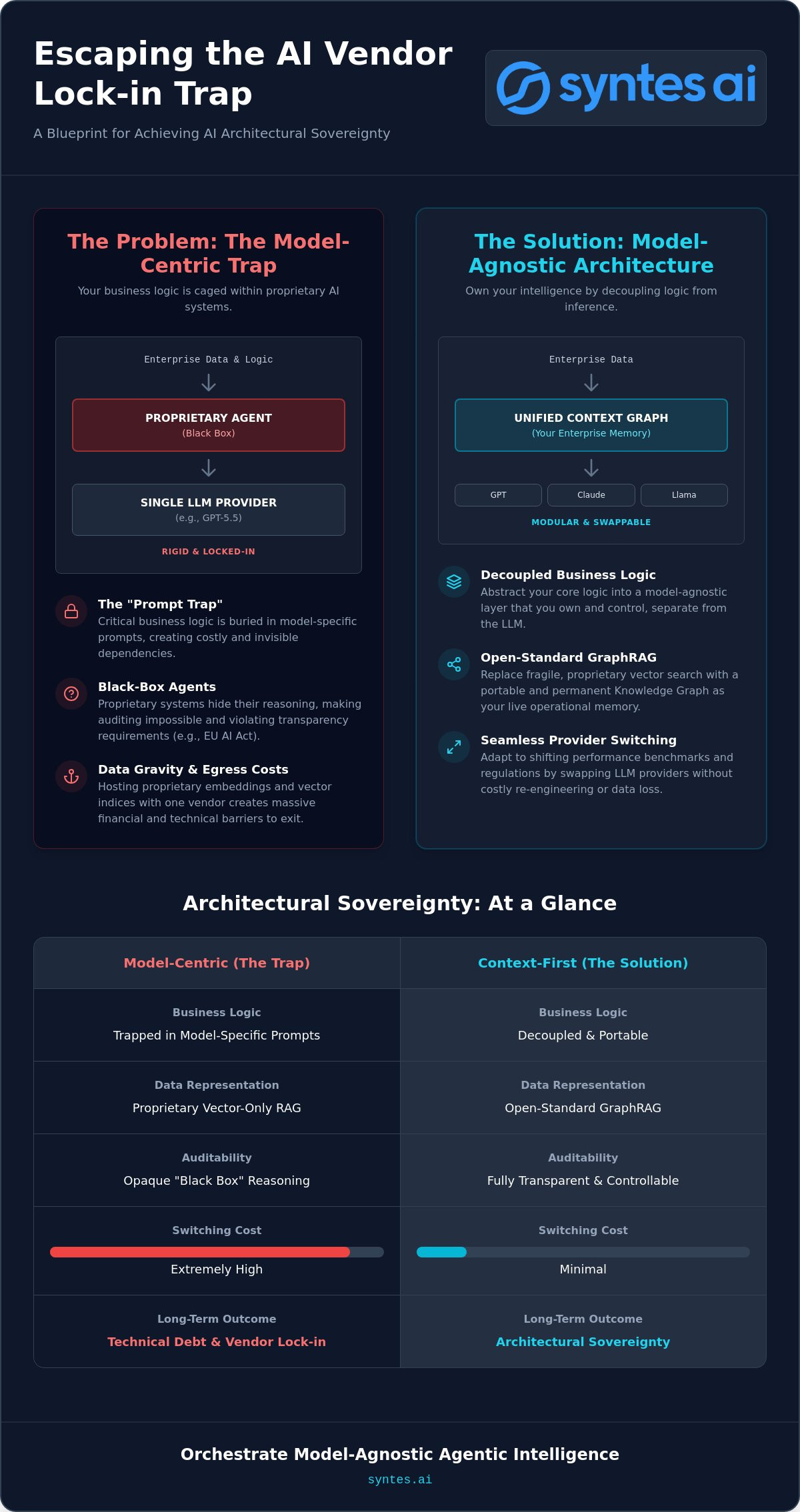
Many enterprise leaders believe they’ve achieved independence by integrating multiple LLM providers via a simple gateway. This is a dangerous misconception. Swapping an API key is a surface-level change. It ignores the deep-rooted dependencies buried within your orchestration layer. True vendor lock-in occurs when your business logic, data structures, and reasoning paths are inextricably tied to a specific provider’s idiosyncrasies. Avoiding vendor lock-in ai platform strategies requires looking past the interface to the underlying architecture. You aren’t truly independent if your entire workflow collapses the moment you switch from one proprietary model to another.
Data gravity further cements this entrapment. Letting a single provider host your proprietary embeddings and vector indices creates a massive barrier to exit. If you decide to migrate, you must re-calculate and re-index millions of vectors. This process is both time-consuming and expensive. It’s an intentional friction point designed to keep you within a specific ecosystem. You must own the data representations that drive your AI, or you’ll find yourself paying a “migration tax” that makes switching models financially unviable.
Beyond API Switching: The Depth of Dependency
Proprietary agent frameworks are the new silos. They promise speed but hide hard-coded logic within the vendor’s exclusive ecosystem. If your “reasoning” logic exists only as a series of instructions inside a black-box service, you’ve lost control. You face massive hidden costs when migrating context window optimizations or proprietary embeddings between disparate models. Architectural Sovereignty is the ability to move the entire intelligence stack without data loss. Without it, you’re merely renting intelligence on the vendor’s terms. You need a system where the logic is portable, not proprietary.
The Cost of Proprietary Prompt Engineering
Prompts are not universal code. They are highly sensitive to the specific weights and biases of a model. A prompt engineered for GPT-4.1 will likely fail or produce hallucinations when executed by Claude Sonnet 4.6 or a local Llama instance. The labor cost of “re-grounding” agents every time a provider updates their model is staggering. This creates a state of constant instability. Avoiding vendor lock-in ai platform issues necessitates a deterministic layer that exists outside the LLM inference cycle. This layer must govern the logic, leaving the model to handle only the linguistic translation. Relying on model-specific prompt engineering is a recipe for long-term technical debt.
The black-box nature of proprietary agents prevents you from auditing the “reasoning” steps. You cannot verify why an agent reached a specific conclusion or where its logic failed. This lack of transparency is the ultimate form of enterprise lock-in. It prevents you from establishing true AI governance and meeting the transparency requirements of the EU AI Act. To maintain sovereignty, you must own the reasoning engine, not just the model output.
Decoupling Intelligence from Inference: The Role of Context Engineering
The Large Language Model is not your product. It’s a calculation engine. Treating the model as the center of your universe is the primary reason organizations fail to implement effective strategies for avoiding vendor lock-in ai platform traps. In 2026, architectural sovereignty demands a shift from model-first to context-first design. This is where Context Engineering becomes the decisive factor in enterprise AI success. It is the discipline of building model-agnostic business logic that remains your property, regardless of which inference provider you use.
How do you achieve true model agnosticism? You build a unified context layer. This layer acts as a sophisticated buffer between your proprietary enterprise data and the AI models. Instead of sending raw data to a black box, you send a highly structured, semantically enriched packet of information. This ensures that the model provides the “how” of language processing while you retain the “what” of business intelligence. To mitigate AI vendor lock-in, you must own the reasoning pathways that guide your agents.
Abstracting Business Logic from LLM Providers
Hard-coding business rules into model-specific prompts is a legacy mistake. You should store your policies and operational constraints in a format that any LLM can interpret. By utilizing a semantic data layer for enterprise, you decouple the reasoning process from the inference cycle. This approach uses Context Graphs to provide the necessary grounding for autonomous agents. These graphs translate complex data relationships into a universal language, allowing you to swap a proprietary model for an open-source alternative without rewriting a single line of business logic.
Live Operational Memory as a Neutral Asset
Static RAG (Retrieval-Augmented Generation) is no longer sufficient for high-stakes enterprise operations. You need Live Operational Memory. This is a dynamic, evolving record of enterprise context that exists independently of any model provider. Adopting a solving enterprise data silos strategy ensures total data portability. Real-time operational events are captured, structured, and stored within your own infrastructure. This allows your agents to maintain a continuous “train of thought” across different platforms, ensuring that your avoiding vendor lock-in ai platform goals are realized through technical ownership rather than just contractual clauses.
The transition to a context-first architecture isn’t just a technical upgrade; it’s a strategic necessity. It moves your organization from being a consumer of AI services to being an owner of AI intelligence. If you’re ready to secure your architectural sovereignty, you can explore our platform to see how we automate this decoupling process.
Architectural Sovereignty: Evaluating Proprietary vs. Open Frameworks
Frameworks are the new battleground. They are either bridges to flexibility or anchors to a single ecosystem. In your pursuit of avoiding vendor lock-in ai platform constraints, the choice between proprietary and open standards determines your long-term operational costs. Most enterprises mistakenly prioritize the model’s reasoning capabilities while ignoring the fragility of the “Point-to-Point” integrations connecting that model to their data. These direct, hard-coded links are a death sentence for agility. When a provider updates their API or shifts their pricing tier, your entire pipeline risks obsolescence.
True sovereignty requires an abstraction layer that treats the LLM as a replaceable utility. This is achieved through interoperability. The industry is rapidly gravitating toward the OpenAI API specification as the new “SQL” for model communication. By adhering to these emerging standards and utilizing open protocols like the Model Context Protocol (MCP), you ensure that your infrastructure remains model-agnostic. You don’t just want to use AI; you want to own the framework that orchestrates it.
The Fragility of Vector-Only RAG
Vector databases are often sold as the ultimate retrieval solution, but they harbor a hidden dependency. Vector embeddings are tied to the specific latent space of the model that generated them. If you migrate from GPT-5.5 to a local Llama instance, you must often re-index your entire dataset. This creates massive friction. Contrast this with an enterprise knowledge graph. A graph-based approach uses human-readable semantic relationships that exist independently of any specific model. It serves as a neutral “Ground Truth” that any agent can query.
| Feature | Vector-Only RAG | Graph-Augmented (GraphRAG) |
|---|---|---|
| Portability | Low (Model-specific embeddings) | High (Semantic, model-agnostic) |
| Auditability | Black-box retrieval | Transparent reasoning paths |
| Data Structure | Unstructured clusters | Structured entity relationships |
| Migration Cost | High (Full re-indexing required) | Low (Plug-and-play model support) |
Interoperability through Semantic Standards
Your enterprise ai infrastructure should prioritize “Connectors” over “Hard-coding.” This means moving away from custom scripts and toward standardized RDF formats or two-way connectors that synchronize structured and unstructured data in real-time. This modularity is essential for avoiding vendor lock-in ai platform traps. By establishing a vendor-neutral stance through AI Governance, you ensure that your business logic remains portable. You aren’t just building for today’s leader; you’re building for the inevitable market shifts of 2027 and beyond. Use standards to turn your AI stack into a pluggable architecture rather than a monolithic cage.
Strategic Implementation: A Roadmap for Vendor-Agnostic AI
Transitioning from a model-centric cage to a sovereign architecture requires more than just intent. It demands a rigorous execution plan. Avoiding vendor lock-in ai platform risks is achieved through a multi-stage migration of your business logic out of the inference layer and into a governed, enterprise-owned environment. You must treat your AI strategy as a systems architecture problem, not a procurement exercise. The following roadmap provides the necessary steps to reclaim control over your operational intelligence.
- Step 1: Audit your Context Debt. Identify every mission-critical process where business logic is currently hard-coded into model-specific prompts or proprietary vendor frameworks.
- Step 2: Establish a unified Context Graph. Centralize your enterprise knowledge into a single, semantic memory that exists independently of any LLM.
- Step 3: Deploy an Agentic Orchestration layer. Implement a routing system that can direct tasks to different models based on cost, latency, or reasoning requirements.
- Step 4: Standardize on Context Engineering. Shift your development focus from tweaking prompts to structuring the data packets that ground your agents.
- Step 5: Enforce AI Governance. Ensure every agentic action is logged, explainable, and auditable to meet the transparency standards of 2026.
Establishing a Unified Context Layer
Isolation is the enemy of intelligence. You must integrate data from your ERP, CRM, and unstructured document repositories into a single, live operational graph. This isn’t just about storage; it’s about creating a deterministic anchor for your AI. By using the graph as a source of truth, you can effectively how to prevent ai hallucination by forcing agents to reason over structured facts rather than statistical probabilities. This transition from simple “Retrieval” to complex “Reasoning” over structured context is what separates legacy RAG from modern, sovereign AI.
Future-Proofing with Agentic Orchestration
The ability to swap models at the task level is no longer a luxury. Modern agentic ai platforms allow you to treat the LLM as a replaceable component within a larger, portable workflow. This “Agentic Workflow” becomes a permanent asset of your organization, capable of being executed by GPT-5.4 today and an open-source Llama instance tomorrow. To maintain vendor-neutral governance, you must also incorporate human-in-the-loop systems that allow for real-time oversight of autonomous decisions. This ensures your avoiding vendor lock-in ai platform strategy remains resilient against both market shifts and model degradation.
Ready to break free from proprietary silos and build a truly sovereign AI stack? Book a demo of the Syntes Agentic Platform to see how we automate the roadmap to architectural independence.
Syntes AI: Orchestrating Model-Agnostic Agentic Intelligence
The pursuit of architectural sovereignty concludes with a fundamental choice: will you continue to rent intelligence, or will you own the systems that generate it? The Syntes Agentic Platform is the definitive solution for avoiding vendor lock-in ai platform constraints. We provide the technical infrastructure that allows enterprises to reclaim their business logic from proprietary black boxes. By shifting the center of gravity from the model to the context, we ensure that your operational intelligence remains a permanent, portable asset of your organization. We don’t just facilitate connectivity; we enforce independence.
Similarly, for teams who want to ensure their codebase remains clean and independent during these architectural shifts, you can learn more about CodeMouse and its automated AI-powered code reviews for every GitHub pull request.
The Syntes Agentic Platform Advantage
The core of our innovation lies in the absolute abstraction of the “Reasoning” layer from the “Inference” layer. While others focus on simple API gateways, we focus on Context Engineering. This ensures that the instructions, policies, and constraints governing your agents are stored in a model-agnostic format. Our platform utilizes advanced Two-way Connectors to synchronize data across your entire stack without creating new silos. This architecture provides several critical benefits:
- Logic Ownership: Your business rules are defined within the Syntes environment, not buried in model-specific system prompts.
- Deterministic Truth: We use the Syntes Context Graph to ground every agentic decision in your specific enterprise data.
- Architectural Flexibility: Swap models at the task level based on real-time cost and performance benchmarks.
- Data Sovereignty: Your embeddings and semantic relationships stay within your control, eliminating the “migration tax” of proprietary vector stores.
Scaling with Enterprise-Grade Governance
Scaling AI across a global enterprise requires more than just raw compute; it requires rigorous AI Governance. Syntes AI provides the oversight necessary to manage complex agentic workflows across disparate software stacks. Every decision made by an agent is traceable, auditable, and explainable. This transparency is not an optional feature; it’s a prerequisite for operating within the regulatory frameworks of the EU AI Act and emerging US state laws.
Your “Live Operational Memory” is the most valuable asset your business will ever own. It is a continuously evolving Knowledge Graph that captures every interaction, event, and relationship within your ecosystem. As your agents operate, this memory grows more sophisticated, increasing the value of your AI stack over time without deepening your dependency on a single provider. It’s time to stop building on borrowed ground. We invite you to explore the Syntes AI Platform and secure your architectural sovereignty today.
Securing Architectural Sovereignty in the Age of Agentic AI
The era of model-centric dependency is over. You’ve identified how hidden dependencies and proprietary data formats create invisible silos that threaten operational agility. To lead in 2026, you must pivot toward a context-first architecture. This transition requires more than simple API gateways; it demands a unified Context Graph that serves as your permanent enterprise memory. This is the only definitive path for avoiding vendor lock-in ai platform risks while maintaining the flexibility to swap LLMs as the market fluctuates.
Syntes AI delivers the enterprise-grade Context Engineering framework needed to move from passive observation to active performance. Our platform abstracts your business logic into a portable, semantic layer, ensuring your intelligence remains a permanent asset. With Live Operational Memory, your agents operate with a trusted, deterministic source of truth that stays under your control. It’s time to reclaim your technical independence and build a stack that serves your business, not your provider.
Frequently Asked Questions
What is the biggest cause of vendor lock-in in AI platforms today?
The primary driver of lock-in is the burial of mission-critical business logic within model-specific prompts and proprietary agent frameworks. When your decision-making rules are hard-coded for a specific provider’s weights and biases, you cannot migrate without a total operational rebuild. This “Prompt Trap” creates invisible technical debt that forces you to accept price hikes or performance degradation simply to avoid the cost of re-engineering your entire logic stack.
How does an Enterprise Knowledge Graph help avoid AI vendor lock-in?
An Enterprise Knowledge Graph acts as a model-agnostic semantic layer that stores your business facts and relationships independently of any LLM. By using this graph as a source of truth, you ensure that avoiding vendor lock-in ai platform constraints is a functional reality. The graph provides the “what” of your business, while the LLM merely provides the “how” of language processing, allowing you to swap inference providers without re-indexing your entire data ecosystem.
Can I swap LLM providers without losing my AI agent’s learned context?
Yes, provided you own the Live Operational Memory of your agents rather than renting it from a proprietary service. By storing agent context in a standardized Context Graph, you maintain a portable record of interactions and reasoning paths. This allows you to point a new model at the existing graph, ensuring continuity in agent performance and institutional knowledge across different infrastructure providers without data loss.
Is it better to build a custom AI gateway or buy an existing platform?
Building a simple gateway only solves the connection problem; it doesn’t address the underlying semantic dependency problem. Buying an Enterprise AI Platform ensures you have the necessary Context Engineering tools to decouple logic from inference. Custom gateways often lead to internal technical debt, whereas a dedicated platform provides the standardized connectors and governance required for long-term architectural sovereignty and multi-model orchestration.
How do proprietary “Agent” frameworks create hidden dependencies?
Proprietary frameworks often wrap agentic reasoning in black-box code that is not auditable or portable. These systems frequently use vendor-specific data formats for memory and model-specific optimizations that break when moved to another environment. This creates a state of “Agent Lock-in,” where your autonomous workflows are functionally hostage to the vendor’s roadmap, making avoiding vendor lock-in ai platform issues nearly impossible without a full platform replacement.
What role do open standards like MCP play in avoiding AI lock-in?
Open protocols like the Model Context Protocol (MCP) establish a universal language for how models interact with data and tools. Standardizing on these protocols ensures that your connectors and integrations remain functional across different LLM providers. By prioritizing interoperability over proprietary integrations, you build a modular stack where any component can be replaced without disrupting the broader systemic integration or losing operational momentum.
How much does it cost to re-architect for model-agnosticism?
The cost of re-architecting is primarily measured in the effort required to audit and migrate your existing Context Debt. While initial implementation involves an investment in a semantic data layer, it eliminates the recurring migration tax associated with vendor-specific vector indices. Organizations typically find that the long-term savings in egress fees and model-swapping flexibility far outweigh the upfront structural changes needed to achieve architectural sovereignty.
Does avoiding vendor lock-in impact the performance of my AI agents?
Decoupling your architecture actually improves performance by providing agents with superior grounding via a Knowledge Graph. Instead of relying on the statistical probabilities of a model to recall facts, agents query a deterministic source of truth. This reduces hallucinations and increases reasoning accuracy. Performance is no longer tied to the smartest model available, but to the quality and structure of the context you provide.