
Why are you still treating regulatory oversight as a document problem when it’s clearly a context problem? For most global enterprises, the “compliance tax” on operational speed has become unsustainable. Fragmented data across legacy ERPs and CRMs makes manual verification a relic of the past. With the EU AI Act now in full effect as of 2026 and Colorado’s SB24-205 requiring rigorous documentation by June 30, 2026, the stakes have never been higher. You need a way of automating compliance checks with ai that doesn’t rely on the unstable whims of generative models or the gaps in your existing data silos.
It’s time to shift from passive observation to active, automated performance. You deserve a framework where AI hallucinations are replaced by deterministic logic and explainable outcomes. In this article, we’ll demonstrate how the Syntes AI Context Graph transforms disparate data into a live operational memory. You’ll learn how to deploy autonomous agents that execute checks across your entire architecture, ensuring real-time audit readiness without sacrificing velocity. We’re moving toward a state of total operational clarity; it’s time your compliance strategy caught up.
Key Takeaways
- Eliminate the “compliance tax” by transitioning from static, manual monitoring to a live operational memory that scales with regulatory volatility.
- Discover why automating compliance checks with ai requires a shift from standard RAG to Context Engineering to ensure deterministic, hallucination-free results.
- Unify fragmented data silos across ERP and CRM systems into a single Enterprise Knowledge Graph for comprehensive, cross-system assurance.
- Deploy governed AI agents that move beyond passive observation to execute autonomous audits and maintain real-time readiness for high-stakes filings.
- Architect a resilient compliance framework using the Syntes AI Context Graph to achieve total operational clarity and systemic integration.
The Compliance Crisis: Why Static Monitoring Fails in 2026
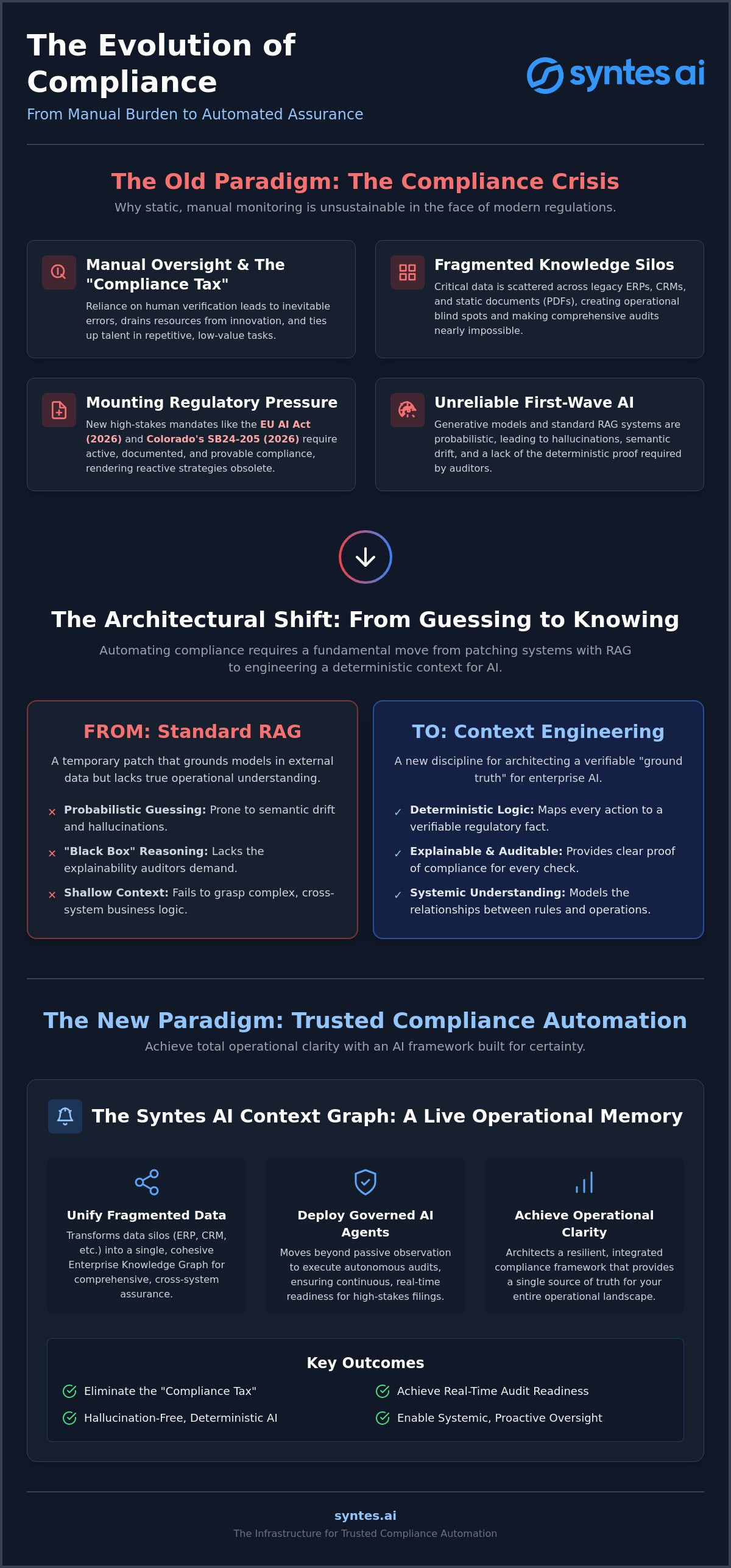
Regulatory volatility is no longer a peripheral risk. It is a systemic reality. In 2026, the global enterprise landscape faces a convergence of high-stakes mandates that have rendered traditional oversight obsolete. The EU AI Act is now in full effect. Colorado’s SB24-205 requires active risk management programs by June 30, 2026. These are not mere suggestions; they are codified requirements for documentation, record-keeping, and human oversight. Organizations still relying on static monitoring or manual “checkbox” activities are facing an operational bottleneck that threatens both their legal standing and their market velocity. The era of reactive compliance has ended.
First-wave AI solutions have largely failed to bridge this gap. General-purpose chatbots and basic LLM wrappers lack the precision required for high-stakes regulatory nuance. They hallucinate. They lose track of versioning. They cannot provide the deterministic proof that auditors demand. Automation in this context must be more than just a faster version of manual work; it must be a fundamentally different architecture. Successfully automating compliance checks with ai requires a shift toward systems that prioritize data integrity over conversational flair.
The Limitations of Manual Oversight
Human error is the inevitable byproduct of complexity. When your compliance team must cross-reference disparate system logs against evolving policies, mistakes happen. This creates a “compliance tax” that drains resources from innovation and forces your best talent into repetitive, low-value verification tasks. Reactive strategies cannot keep pace with the real-time requirements of 2026. If your audit readiness depends on a human catching a discrepancy in a legacy log, you aren’t compliant; you’re lucky. That luck eventually runs out.
Fragmented Knowledge: The Silent Killer of Compliance
Data fragmentation remains the primary obstacle to automated assurance. Legal requirements live in PDFs, while operational execution happens in ERP and CRM systems. These silos create blind spots that make manual checks impossible at scale. Relying on “stale” data for regulatory filings is a high-risk gamble that most enterprises can no longer afford. Without a unified layer of intelligence, the disconnect between what is required and what is actually happening on the floor remains invisible until an audit failure occurs. Automating compliance checks with ai is only possible when you solve the context problem first. You don’t just need more data; you need connected, real-time intelligence that understands your entire operational architecture.
While solving the context problem for your systems, you can also visit Spacewize to transform those static legal PDFs into interactive e-learning courses, ensuring your team stays as updated as your data.
From RAG to Context Engineering: Architecting Deterministic Compliance
Standard Retrieval-Augmented Generation (RAG) is a patch. It isn’t a solution. While RAG attempts to ground models in external data, it often suffers from semantic drift where the AI loses the broader business logic. For a global enterprise, this isn’t just a technical glitch; it’s a liability. Automating compliance checks with ai requires a shift from probabilistic guessing to deterministic certainty. You don’t need an AI that predicts the next likely word; you need a system that maps every decision to a verifiable regulatory truth.
Context Engineering represents the next evolution beyond simple prompt engineering. It’s the technical discipline of architecting the data environment so the AI doesn’t just “see” information but understands its systemic relevance. By moving toward a model of semantic grounding, you eliminate the ambiguity that leads to non-compliance. This is the only viable path for automating compliance checks with ai at scale without risking the integrity of your regulatory filings.
Why Context Engineering is the New Standard
Context Engineering is about governance. It is the practice of building a “ground truth” for enterprise reasoning by explicitly defining the relationships between legal mandates and operational data. This transition moves AI out of the black box and into an explainable, auditable framework. When your AI understands the specific business context of a transaction, its accuracy isn’t a matter of probability; it’s a result of execution. If your current infrastructure lacks this level of rigor, it’s time to explore our deterministic AI platform and see how context changes the game.
Eliminating Hallucinations in Regulatory Reporting
How do you stop a model from inventing facts? You link its reasoning to a structured framework designed to how to prevent ai hallucination. By utilizing a Live Operational Memory, every claim the AI makes is backed by a verifiable citation from your own architecture. This creates a system of “guardrails” where AI agents operate strictly within enterprise policy. Hallucinations occur when an AI lacks context; Context Engineering ensures your agents always have the full picture, providing the audit trails necessary for 2026’s aggressive regulatory landscape.
The Role of the Context Graph in Cross-System Assurance
Compliance is not a document search problem. It is a relationship problem. Most legacy systems fail because they treat regulatory requirements and operational data as separate entities. To achieve true assurance, you must unify structured transactions from your ERP with the unstructured nuances of legal documents into a single, navigable layer. This requires a sophisticated enterprise knowledge graph. This architecture doesn’t just store data; it maps the systemic dependencies that define your regulatory posture.
Static databases are insufficient for the speed of 2026. You need a Live Operational Graph that represents real-time relationships across the entire business. Automating compliance checks with ai becomes a reality only when your AI can traverse these connections to verify intent, action, and outcome. By moving beyond passive storage to a continuously evolving enterprise memory, you ensure that every check is performed against the most current version of your operational truth. This is the difference between a system that records history and one that governs the present.
Unifying Disparate Data Sources
Fragmented data is the enemy of certainty. Integrating ERP, CRM, and collaboration tools into a single semantic data layer for enterprise allows you to map business rules directly to operational events. This isn’t simple data ingestion. It is the discovery of hierarchies and semantics through a context graph. When business logic is embedded into the data layer, the system can automatically flag deviations the moment they occur. This creates the visibility required for automating compliance checks with ai at a global scale, ensuring no silo remains a blind spot.
Operational Relationship Intelligence
Why does the relationship between a specific product and a new regulation matter? Because without that link, your AI is guessing. The context graph enables complex cross-system reasoning, allowing agents to understand how a change in one jurisdiction impacts processes in another. You are essentially creating a “digital twin” of your organization’s compliance posture. This model provides the visibility needed to defend your operations during high-stakes audits. It transforms compliance from a reactive burden into a strategic advantage driven by informed, real-time action. You aren’t just checking boxes; you’re mastering the logic of your enterprise.
Deploying Governed AI Agents for Autonomous Audit Readiness
Passive monitoring is a half-measure. It identifies failures after they occur, leaving the enterprise in a perpetual state of damage control. To achieve true resilience, you must transition to agentic ai platforms capable of execution. These are not simple scripts. They are governed AI agents that leverage your Live Operational Memory to verify compliance in real-time. By automating compliance checks with ai through an agentic framework, you move from observation to active enforcement.
The power of these agents lies in their connection to the context graph. Unlike standard AI that operates in a vacuum, governed agents record every decision, citation, and reasoning path within the graph itself. This creates a permanent, immutable record of systemic integrity. For high-sensitivity approvals, we implement “Human-in-the-Loop” systems. This ensures that while the AI handles the heavy lifting of cross-system verification, strategic oversight remains firmly in human hands. It’s a balance of machine speed and human judgment.
The Architecture of a Governed Agent
A governed agent is only as effective as its boundaries. Security and permissioning are foundational; agents must only access the context relevant to their specific mandate. They execute actions based on real-time business rules, not probabilistic guesses. This is where “Explainable AI” becomes your primary defense. When a regulator asks why a specific transaction was flagged or cleared, you don’t offer a black-box excuse. You provide a deterministic map of the agent’s logic. If you’re ready to see this architecture in action, schedule a platform walkthrough with our engineering team.
Achieving Continuous Audit Readiness
The annual audit is an antiquated ritual. It’s expensive, disruptive, and often misses the “stale” data risks discussed earlier. Real-time compliance telemetry is the new requirement. By solving enterprise data silos, you allow agents to generate certified audit reports on demand. This removes the friction typically associated with regulatory inquiries. You no longer scramble to find documents; you simply query the graph. This shift toward autonomous audit readiness ensures that your organization is always prepared, regardless of when the regulator knocks. You aren’t just automating compliance checks with ai; you’re building a self-defending enterprise.
Syntes AI: The Infrastructure for Trusted Compliance Automation
Syntes AI provides the definitive enterprise ai infrastructure required to move from theoretical experimentation to systemic execution. While many organizations struggle with fragmented tools, we offer a unified platform anchored by the Syntes AI Context Graph. This isn’t just a database. It is a live operational model that captures the intricate web of your business logic in real time. Automating compliance checks with ai at this level ensures that your regulatory posture is proactive and unshakeable. You cannot scale high-stakes enterprise initiatives using consumer-grade chatbots or isolated LLM wrappers. You need a system that prioritizes data integrity and systemic connectivity above all else.
Compliance has long been viewed as a necessary cost center. We are changing that narrative. By architecting for deterministic truth, you transform regulatory assurance into a strategic advantage. Operational speed increases as the “compliance tax” disappears. Audit readiness becomes a continuous, automated state rather than a seasonal crisis. This represents the necessary evolution from passive observation to active, automated performance. It’s time to stop managing documents and start engineering context.
The Syntes AI Enterprise Platform
Our platform utilizes sophisticated two-way connectors to bridge the gap between your disparate systems. This seamless cross-system integration allows governed agents to reason over a trusted enterprise context. We don’t settle for probabilistic outputs. Our architecture ensures that every agentic action is grounded in your specific business rules and legal requirements. This level of enterprise-grade governance is the only way to maintain total data integrity in a volatile regulatory environment. You aren’t just deploying AI; you’re installing a layer of operational intelligence that defends your enterprise architecture from the inside out.
Next Steps for Enterprise Intelligence
How do you begin the transition? It starts with a fundamental reevaluation of your data architecture. You must move away from isolated silos and toward a unified knowledge layer. The long-term ROI of autonomous, deterministic regulatory assurance is undeniable. You gain the ability to execute at the speed of the market without the friction of manual oversight. Are you ready to lead this strategic shift? The path to total operational clarity is clear. Partner with Syntes AI today to build the future of your enterprise governance and secure your competitive edge.
The Mandate for Deterministic Assurance
The era of reactive compliance has reached its expiration date. You’ve seen why static monitoring fails to meet the demands of 2026 and why standard RAG cannot support the weight of global enterprise mandates. Successfully automating compliance checks with ai requires more than just a faster search; it demands a fundamental architectural shift to Context Engineering. By unifying your disparate data silos into a single Context Graph, you establish a Live Operational Memory that serves as the definitive source of truth for every regulatory action.
This is not a theoretical experiment. It is a strategic evolution toward a self-defending enterprise. Through our platform, you achieve deterministic, hallucination-free reasoning and enterprise-grade governance for agentic execution. You no longer have to choose between operational speed and regulatory safety. You can finally have both. The tools to bring order to your complex data landscape are here. It’s time to move toward total operational clarity. You possess the vision; we provide the infrastructure to execute it.
Architect your deterministic compliance framework with the Syntes AI Platform and secure your strategic advantage today.
Frequently Asked Questions
What is the difference between RAG and Context Engineering for compliance?
Retrieval-Augmented Generation relies on finding similar documents, which often results in semantic drift and lost logic. Context Engineering architects the entire data environment to provide a grounded, deterministic logic layer. It ensures that every decision maps to a specific business rule rather than a probabilistic guess. This shift is essential for automating compliance checks with ai where precision is the only acceptable standard.
How does a Context Graph prevent AI hallucinations in regulatory filings?
Hallucinations occur when models lack grounded, structured data to anchor their reasoning. A Context Graph eliminates this risk by linking AI outputs to a verifiable network of enterprise facts. Every claim made by the system is backed by a specific citation within the graph. This creates a closed-loop environment where the AI only reasons over confirmed, real-time operational data, ensuring total accuracy in filings.
Can AI agents autonomously execute compliance checks across legacy ERP systems?
Yes. By deploying a semantic data layer, we bridge the gap between modern intelligence and legacy ERP architectures. The Syntes Agentic Platform uses two-way connectors to extract and verify data across disparate, fragmented systems. It transforms isolated logs into a unified stream of actionable intelligence, allowing governed agents to perform complex cross-system verification without requiring manual data preparation or migration.
Is AI-automated compliance explainable enough for regulatory audits?
Absolutely. We replace the “black-box” nature of standard AI with a deterministic decision path. Every action taken by a governed agent is recorded within the enterprise knowledge graph as a permanent audit trail. This provides regulators with a transparent, step-by-step map of how the AI reached its conclusion. You gain the ability to defend every automated decision with verifiable logic and systemic proof.
What are the security risks of deploying agentic AI for compliance?
The primary risk involves agents accessing sensitive data without proper authorization or oversight. We mitigate this through rigorous AI Governance and strict permissioning frameworks. Our agents only interact with the context relevant to their specific mandate. They operate within secure, governed boundaries that prevent unauthorized data exposure, ensuring that autonomous execution never results in a compromise of systemic security.
How does Syntes AI handle both structured and unstructured data for compliance?
Syntes AI uses an Enterprise Knowledge Graph to unify structured transactions and unstructured legal text into a single layer of intelligence. It maps the relationship between a specific line item in an ERP and a corresponding clause in a regulatory document. This integration allows for comprehensive assurance that traditional databases cannot provide, ensuring that no regulatory nuance is lost in the data silo.
What is “Live Operational Memory” in the context of regulatory assurance?
Live Operational Memory is a continuously evolving digital twin of your organization’s actions. It captures every transaction and decision as it occurs, rather than relying on periodic snapshots. For regulatory assurance, this means your compliance posture is never based on stale or outdated information. You maintain a real-time, auditable record of your entire operational history that is always ready for immediate inquiry.
How do governed AI agents differ from traditional RPA in compliance?
Traditional RPA is a rigid script that breaks the moment a process or regulation changes. Governed AI agents are intelligent executors that use reasoning and context to handle complexity and volatility. While RPA follows a fixed path, our agents use the Context Graph to adapt to new mandates and nuanced data environments. They provide a level of sophisticated, autonomous performance that RPA cannot match.