
Most enterprise AI initiatives are failing because they are built on a foundation of systemic fragmentation. You’ve likely seen the symptoms; chatbots that hallucinate under pressure and agents that cannot bridge the gap between your ERP and CRM. Effective data integration for ai applications is no longer a matter of simple connectivity. It is a requirement for operational survival. If your data remains trapped in disconnected legacy silos, your AI will remain a high-cost experiment rather than a tool for execution.
The solution is not more data, but superior context. This 2026 guide reveals how to evolve beyond static retrieval into the realm of Context Engineering. We will show you how to construct a live operational memory that powers deterministic, explainable reasoning for agentic workflows. You’ll discover the specific framework needed to replace fragile pipelines with a unified context layer, transforming your entire enterprise into a single, intelligent nervous system capable of autonomous, trusted performance.
Key Takeaways
- Traditional ETL methods fail to provide the semantic ground truth required for machine reasoning; you must bridge the “Context Gap” to make siloed data truly useful for LLMs.
- Establish an Enterprise Knowledge Graph to serve as a live operational memory, mapping the intricate relationships between disparate systems like ERP and CRM.
- Transition from probabilistic vector search to deterministic GraphRAG to eliminate hallucinations and achieve explainable, audit-ready AI outcomes.
- Modern data integration for ai applications requires a strategic framework focused on real-time synchronization and automated entity discovery across the enterprise.
- Utilize the Syntes Agentic Platform as a governed execution layer to transform fragmented data into scalable, high-performance enterprise intelligence.
Beyond ETL: Why Traditional Data Integration Fails AI Applications
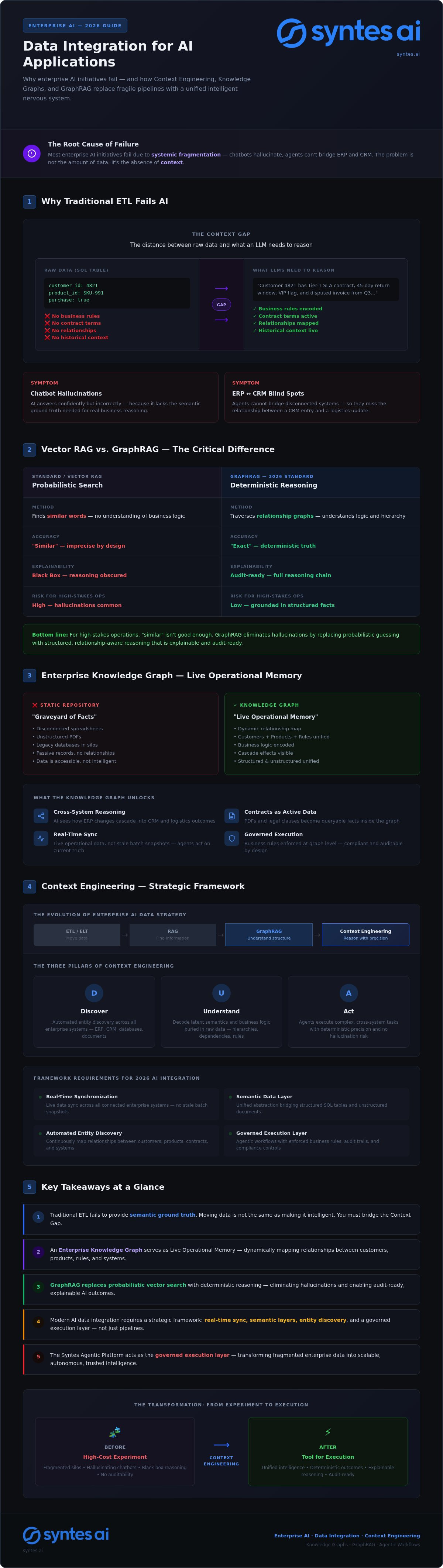
Traditional ETL processes were built for a world of static reporting and human analysts. They are fundamentally ill-equipped for the era of autonomous agents. For data integration for ai applications to provide value, it must do more than move data. It must create a semantic ground truth for machine reasoning. Moving data from an ERP to a cloud warehouse doesn’t make it intelligent; it just makes it accessible. Intelligence requires context, and context is exactly what traditional pipelines lack.
The “Context Gap” is the distance between raw data sitting in a database and the nuanced understanding an LLM needs to solve a problem. A row in a SQL table might tell the AI that a customer bought a product, but it doesn’t explain the business rules, the contract terms, or the historical relationship. Without this connective tissue, your AI is effectively flying blind. We must stop viewing integration as a plumbing problem and start viewing it as an engineering challenge.
The Fragmentation Crisis in Enterprise AI
Large organizations are currently paralyzed by a landscape of disconnected spreadsheets, unstructured PDFs, and legacy databases. These silos are the absolute barrier to agentic AI adoption. When data is treated merely as a record, it remains passive. To power agentic workflows, data must be treated as context. This shift transforms your systems from a graveyard of facts into a live operational memory. If your AI cannot see the relationship between a CRM entry and a logistics update, it will never move beyond the level of a simple chatbot.
Why RAG is No Longer Enough for 2026 Operations
Standard Retrieval-Augmented Generation has hit a ceiling. It relies on probabilistic vector search, which is inherently imprecise. This creates a “Black Box” problem where reasoning is obscured and hallucinations are common. Solving enterprise data silos in 2026 requires a move toward deterministic truth. Simple vector search identifies similar words, but it doesn’t understand the underlying business logic. For high-stakes operations, “similar” isn’t good enough. You need precision.
This is why we are seeing a shift toward Context Engineering. It is the discipline of building a structured, relational foundation that allows AI to reason with the same clarity as your best human experts. It’s about moving from “finding” information to “understanding” it. By creating a unified context layer, you provide the AI with the logical scaffolding it needs to execute complex, cross-system tasks without the risk of hallucination.
Architecting the Foundation: The Role of Enterprise Knowledge Graphs
Static repositories are liabilities. In the high-stakes environment of 2026, relying on disconnected records is a recipe for operational failure. True data integration for ai applications requires an enterprise knowledge graph to serve as the “Live Operational Memory” of the organization. This isn’t a mere database. It is a dynamic map that encodes the intricate relationships between customers, products, and the specific business rules that govern your industry. By moving beyond flat tables, you enable your AI to transition from basic search to sophisticated reasoning.
This structural shift is driven by the “Understand” pillar of context engineering. It involves discovering the latent semantics and business logic buried within raw data. When an AI understands hierarchies, it doesn’t just find information; it comprehends how a change in one system triggers a cascade of consequences in another. This is the difference between a chatbot that quotes a manual and an agent that manages a supply chain. To achieve this level of performance, you can explore our context engineering framework to see these relationships in action.
Unifying Structured and Unstructured Data
Most enterprises struggle to bridge the gap between SQL tables and unstructured documentation. A semantic data layer for enterprise solves this by creating a unified abstraction. It allows business rules, often trapped in PDFs or legal contracts, to be treated as active data points within the graph. This integration ensures that an agentic workflow can consult a specific contract clause while simultaneously checking real-time inventory levels. It replaces fragmented silos with a single, coherent source of truth.
Live Operational Memory vs. Static Databases
Data lakes are graveyards of information. They record what happened in the past, but they fail to provide the “now” required for autonomous execution. A Context Graph is different because it is inherently live, evolving with every operational event and system update. While traditional databases are snapshots, this architecture is a living nervous system. Live Operational Memory is a continuously evolving model of business relationships. Without this real-time relevance, agentic AI cannot make reliable decisions in fast-moving environments. It’s time to stop storing data and start engineering context.
GraphRAG vs. Vector RAG: Achieving Deterministic AI Outcomes
Standard Vector RAG is a probabilistic gamble. It identifies similarity, not truth. In the context of data integration for ai applications, relying solely on semantic proximity leads to the “near-miss” phenomenon where an AI retrieves related information that is factually incorrect. GraphRAG (Graph-based Retrieval-Augmented Generation) eliminates this uncertainty by utilizing explicit, deterministic paths within the Context Graph. It replaces “maybe” with “definitely.”
The ‘Govern’ pillar of our framework ensures that this intelligence remains within the bounds of enterprise safety. By applying security, permissions, and compliance protocols directly at the graph level, we ensure that AI agents only access the nodes they are authorized to see. This architecture creates a traceable path from every answer back to the source data. Explainable AI isn’t a luxury; it’s a requirement for high-stakes decision-making where accountability is non-negotiable. You don’t just need an answer; you need the proof behind it.
Eliminating Hallucinations with Semantic Grounding
Hallucinations occur when an LLM lacks a solid foundation of facts. Understanding how to prevent ai hallucination requires grounding the model in a structured Enterprise Context Graph. This process provides a “Reasoning Trace” for every action the AI takes. When an executive asks for a justification, the system doesn’t offer a vague guess. It presents the specific chain of logic derived from your live operational memory. This transparency is the primary driver of executive trust and the catalyst for wider AI adoption across the organization.
The Multi-System Integration Advantage
Traditional data joins are brittle and slow. They struggle to bridge the gap between a CRM’s customer data and an ERP’s inventory levels in real time. Graph technology utilizes “Operational Relationship Intelligence” to navigate these connections effortlessly. It treats the relationship between a customer and an order as a first-class citizen, allowing for complex cross-system queries that would cripple a standard SQL database. This level of connectivity is the fundamental prerequisite for high-performance agentic ai platforms. Without a graph-based foundation, your agents will remain siloed, unable to execute the multi-step workflows that define true enterprise intelligence.
A Strategic Framework for Cross-System AI Integration
Successful data integration for ai applications requires a shift from passive observation to active execution. It’s not enough to simply ingest data; you must engineer a framework that allows AI to navigate the enterprise landscape with the same agility as a human operator. This strategic framework is built on four critical pillars: Connect, Understand, Contextualize, and Govern. By systematically addressing each, you transform fragmented systems into a cohesive intelligence engine.
The “Understand” pillar utilizes machine learning to discover latent entities and relationships across disparate systems. It identifies that a “Client ID” in your CRM is the same “Account Name” in your billing software, creating a unified identity. Meanwhile, the “Contextualize” pillar builds the dynamic model representing your specific business logic. This ensures the AI isn’t just seeing isolated data points; it’s seeing a map of your operational reality. When these pillars work in concert, your AI gains the ability to reason across the entire organization.
Step 1: Connecting the Enterprise Stack
Step 2: Designing for AI Execution
The ultimate goal of enterprise AI is not just to answer questions but to execute tasks. This requires moving beyond “Read-Only” access. Your integration strategy must support “Execute” capabilities, allowing agents to trigger workflows and update systems autonomously. Preparing your data for sophisticated enterprise ai infrastructure is the only way to ensure these agents operate within safe parameters. It transforms the AI from a passive observer into an active participant in your business processes.
Governance is the final, non-negotiable step. As AI moves from observation to action, human-in-the-loop systems become essential for overseeing automated decisions. You must layer permissions and business rules directly onto the unified context, ensuring that every agentic workflow adheres to corporate policy and regulatory requirements. This isn’t just about safety; it’s about building a scalable foundation for true autonomous performance. By integrating governance into the context layer, you ensure that every action is both authorized and explainable.
Scaling Agentic Intelligence with the Syntes AI Platform
The Syntes Agentic Platform represents the final, critical layer in the context engineering hierarchy. It serves as the execution engine for the Context Graph, turning the semantic ground truth we’ve established into actionable, high-performance intelligence. While other platforms struggle with the complexities of data integration for ai applications, Syntes AI abstracts these technical hurdles. It allows organizations to transform fragmented, siloed knowledge into a unified, operational nervous system. By providing a governed environment for autonomous agents, the platform ensures that every automated action is rooted in your specific business reality.
From Context to Execution
The shift from a reactive chatbot to an autonomous enterprise agent is powered by Live Operational Memory. Syntes AI agents don’t just “retrieve” data; they inhabit the context of your entire operation. In regulated sectors such as Finance and Healthcare, this capability is revolutionary. It enables Explainable Reasoning, where every decision an agent makes is backed by a deterministic trace through the knowledge graph. This level of transparency satisfies the most stringent audit requirements while allowing agents to perform complex, multi-step tasks that were previously reserved for human experts. You’re no longer just asking questions; you’re delegating execution.
The Future of Enterprise Intelligence
This architecture ensures that data integration for ai applications is not a one-time project but a continuous, evolving asset. As your business grows, the Context Graph grows with it, capturing new relationships and refining its understanding of your logic. To secure your AI infrastructure and witness how these systems operate in real-time, you must move beyond theoretical experimentation. True operational clarity is within reach for those who prioritize structural intelligence over simple data storage.
Dominating the Era of Operational Intelligence
The era of passive data storage is over. To achieve operational excellence in 2026, organizations must master data integration for ai applications by prioritizing context over raw ingestion. By architecting a live Context Graph, you move beyond the limitations of standard RAG into a world of deterministic truth and explainable reasoning. Syntes AI eliminates the “Black Box” of enterprise AI, integrating structured and unstructured data in real-time to power trusted, governed agentic workflows. This structural shift transforms fragmented silos into a high-performance nervous system capable of autonomous action.
Success now depends on your ability to bridge the “Context Gap” with precision and speed. Organizations that continue to rely on static pipelines will find themselves outpaced by those who treat their data as a live operational memory. You have the opportunity to lead this transition, replacing uncertainty with a scalable foundation for agentic intelligence. It’s time to stop experimenting and start executing with a platform built for the complexities of the modern global enterprise.
Secure your competitive advantage by turning your enterprise data into a live operational memory that executes with absolute precision.
Frequently Asked Questions
What is the difference between data integration and context engineering?
Data integration is the physical movement of data; context engineering is the structural creation of meaning. While traditional integration focuses on moving records between systems, context engineering builds the semantic relationships and business logic required for machine reasoning. It transforms fragmented data into a live operational memory, ensuring that your AI understands the “why” behind the records it processes.
How does a knowledge graph prevent AI hallucinations?
Knowledge graphs prevent hallucinations by providing a deterministic ground truth for AI reasoning. Unlike probabilistic vector searches that identify similarity, a graph uses explicit, verified paths between entities. This structural constraint ensures that the AI is grounded in factual relationships rather than statistical guesses. It creates an explainable reasoning trace, allowing every output to be verified against the organization’s actual business data.
Can Syntes AI integrate with legacy ERP and CRM systems?
Syntes AI is specifically designed to integrate with legacy ERP and CRM systems through high-performance two-way connectors. We bridge the gap between rigid legacy architectures and modern agentic workflows by synchronizing operational data in real-time. This process transforms static records into a unified context layer, enabling autonomous agents to execute complex tasks across your entire enterprise stack without requiring a total system replacement.
What is GraphRAG and why is it better than standard RAG?
GraphRAG is a retrieval architecture that utilizes graph structures to provide LLMs with deep, relational context. Standard RAG relies on simple semantic similarity, which often fails to capture complex business logic. GraphRAG is superior because it understands hierarchies and multi-hop relationships, making it essential for data integration for ai applications. It ensures that AI agents can reason through complicated, cross-system queries with absolute precision.
How do you govern AI agents across multiple data systems?
We govern AI agents by embedding permissions and business rules directly into the unified context graph. The Syntes Agentic Platform acts as a control layer, enforcing security protocols at the relationship level rather than just at the database level. This ensures that every agentic workflow remains compliant with corporate policy, providing a transparent and audit-ready record of all autonomous actions across disparate systems.
Is a Context Graph different from a traditional graph database?
A Context Graph is a dynamic, real-time evolution of a traditional graph database. While traditional databases often serve as static repositories, a Context Graph functions as a “Live Operational Memory” that updates with every business event. It is purposefully engineered for AI execution, encoding the semantics and business logic necessary for agents to navigate complex enterprise environments rather than just performing simple data lookups.
What are the first steps in building an enterprise AI data strategy?
Begin by mapping the semantic relationships that drive your core business logic rather than focusing solely on data storage. You must identify where fragmentation is causing reasoning failures in your current AI pilots. Prioritizing data integration for ai applications through a knowledge graph foundation allows you to build a scalable strategy. This shift ensures that your AI initiatives move from simple retrieval to sophisticated, autonomous execution.
How does Syntes AI ensure data security and permissions within the graph?
Syntes AI ensures security through granular permission mapping within the Context Graph itself. We apply security protocols to individual nodes and edges, ensuring that AI agents only reason with data they are authorized to access. This architecture maintains strict data sovereignty by inheriting existing enterprise permissions. It prevents unauthorized information leakage while providing a governed environment for agents to perform complex tasks without compromising your underlying systems.