

Legacy automation is failing the modern enterprise. Static RPA scripts and disconnected chatbots are no longer sufficient for a landscape that demands real-time, cross-system decision-making. You’re likely already witnessing the failure points. AI hallucinations compromise production reliability. Fragmented data silos blind your agents to the full business context. Security risks turn autonomous potential into a strategic liability. The promise of agentic workflow automation remains unfulfilled because most organizations treat AI as a bolt-on tool rather than a core architectural evolution.
It’s time to bridge the gap between passive observation and active performance. This guide provides a definitive framework for architecting autonomous intelligence that is both powerful and governed. You’ll master the transition from brittle, manual workflows to resilient, context-aware systems that eliminate constant task-switching. We’ll detail how to leverage a Live Operational Memory to ensure every automated action is grounded in reality, providing the explainable reasoning required for true enterprise-grade execution.
Key Takeaways
- Architect a transition from brittle “If-Then” RPA scripts toward goal-oriented reasoning. It’s the necessary evolution for genuine autonomous performance.
- Master the deployment of agentic workflow automation by closing the context gap between Large Language Models and your live enterprise data.
- Implement a rigorous AI Governance framework to define the boundaries of autonomous action. Control is the prerequisite for scale.
- Utilize the Syntes Context Engineering framework to unify fragmented data into a Live Operational Memory for real-time relevance.
- Eliminate AI hallucinations through deterministic grounding. This provides a clear audit trail of explainable reasoning for every automated decision.
Beyond Static RPA: Defining Agentic Workflow Automation in 2026
Robotic Process Automation (RPA) was a necessary first step, but it’s reached its ceiling. It excels at mindless repetition but collapses under the weight of ambiguity. Entering 2026, the paradigm has shifted toward agentic workflow automation. This isn’t just about faster scripts; it’s the deployment of autonomous AI agents capable of planning, executing, and refining complex business processes without constant human intervention. We’ve moved beyond the era of digital mimics into the era of digital architects.
Traditional Business process automation (BPA) relies on rigid “If-Then” logic. If a field is missing, the process stops. If an API response changes format, the system breaks. Agentic workflows replace these fragile sequences with goal-oriented reasoning. You define the outcome; the agent determines the path. It selects the necessary tools, queries the relevant databases, and adjusts its strategy based on real-time environmental changes. This level of autonomy is the definitive requirement for modern enterprise intelligence.
Why is 2026 the definitive tipping point? The technical barriers have dissolved. We’ve moved past experimental Large Language Models (LLMs) into a mature era of multi-agent orchestration and standardized cross-system connectors. The infrastructure now exists to support agents that don’t just suggest actions but execute them across the entire enterprise stack. This maturity allows for agentic workflow automation to move from the laboratory to the production floor with confidence.
Agents vs. Traditional Workflows: The Core Differences
The distinction lies in dynamism. Traditional workflows are static maps. Agentic systems are GPS units that recalculate when they hit a roadblock. These agents possess autonomous tool-use capabilities. They don’t wait for a human to fetch data from a CRM; they authenticate, query, and synthesize that data themselves. Most critically, they operate within a feedback loop. They learn from previous outcomes, refining their internal logic to handle edge cases that would have previously required a support ticket. They don’t just run; they improve.
The Enterprise Need for Agentic Autonomy
Modern operations are plagued by “manual glue”—the human labor required to move data between ERP, CRM, and PLM systems. This friction creates operational latency that kills competitive advantage. Agentic autonomy dissolves these silos. By enabling real-time decision-making at the edge of the process, organizations can scale their operational intelligence without a linear increase in headcount. It’s the only way to manage the complexity of a global supply chain or a multi-channel customer experience at speed. Logic must be decentralized to be effective.
The Context Gap: Why LLM-Only Workflows Fail at Scale
The primary reason agentic workflow automation fails in production isn’t a lack of model intelligence. It’s a lack of context. Large Language Models (LLMs) are probabilistic engines, not factual databases. When an agent attempts to execute a complex procurement task or resolve a customer dispute without the full business context, it doesn’t just fail. It hallucinates with confidence. This hallucination problem turns autonomous agents into liabilities that can inadvertently leak data, violate compliance, or authorize incorrect transactions. Relying on an LLM as your sole source of truth is a recipe for operational disaster.
Enterprise knowledge is rarely found in a single, clean document. It’s fragmented across ERPs, CRMs, and hidden legacy databases. If an agent only sees a partial slice of this reality, its reasoning is fundamentally flawed. Standard Retrieval-Augmented Generation (RAG) attempts to fix this by “stuffing” relevant text into a prompt, but this is a reactive patch, not a structural solution. True intelligence requires Context Engineering. This is the deliberate discipline of architecting a unified, live environment where AI can reason accurately across every system in your stack.
The Limits of Retrieval-Augmented Generation (RAG)
Standard RAG relies on vector similarity. It assumes that if two pieces of text look similar, they are logically related. In complex business logic, this assumption is often false. An agent might find a general “Return Policy” but miss a specific “Exception Clause” hidden in a separate contract because the keywords don’t match. This creates a “Black Box” problem where the logic is obscured and unauditable. GraphRAG is the necessary successor to standard RAG because it maps the complex, interconnected relationships of enterprise data rather than just retrieving isolated text snippets.
Live Operational Memory as the Ground Truth
Static databases are snapshots of the past. To power reliable agentic workflow automation, your agents need a Live Operational Memory. This is a continuously evolving system that captures not just data, but the shifting relationships between data points. This is known as Operational Relationship Intelligence. By implementing a semantic data layer for enterprise, you provide a deterministic foundation that anchors agents in reality. It ensures they see the whole board, not just the nearest piece. If you’re ready to see how this architecture functions in practice, you can explore our platform capabilities to understand the difference between simple prompts and true operational intelligence.
Orchestration vs. Autonomy: Mapping the Automation Framework
Autonomy without governance is operational suicide. While the potential of a self-correcting system is high, the reality of enterprise risk requires a structured hierarchy that balances agentic freedom with deterministic business rules. The “sweet spot” for agentic workflow automation isn’t found in a single setting; it’s a dynamic calibration. You must map your automation strategy to the specific risk profile of each business process. High-stakes financial approvals require rigid orchestration, while creative content synthesis or logistical route optimization can thrive under higher levels of autonomy.
Human-in-the-Loop (HITL) remains a non-negotiable requirement for high-stakes enterprise decisions. An agent can plan the entire procurement cycle, but it shouldn’t execute a million-dollar transaction without a verified human signature. This isn’t a limitation of the AI; it’s a fundamental principle of AI Governance. By defining clear boundaries, you transform a volatile experiment into a reliable engine of production.
The Agentic Orchestration Hierarchy
We define the progression of autonomous capability through three distinct levels. Clarity in these definitions prevents the over-extension of AI capabilities into sensitive operational areas. Every process must be categorized before it’s automated.
- Level 1: Assisted Workflows. The AI acts as a sophisticated copilot. It handles data extraction and summarization, but a human remains the primary driver of every sequential step.
- Level 2: Managed Agents. The AI executes complex steps within a predefined graph. It can make local decisions, such as choosing between two vendors based on price, but its overall path is constrained by the architect’s logic.
- Level 3: Full Agentic Autonomy. The agent is given a high-level goal, such as “optimize the Q3 supply chain for cost reduction.” It identifies the problems, selects its own tools, and executes adjustments across multiple systems.
Governed AI Execution: Security for Agentic Systems
How do you ensure an autonomous agent doesn’t overstep its bounds? The answer lies in systemic integration. Every agent must operate within the same enterprise permission structures and business rules as your human employees. If a user doesn’t have access to payroll data, their agent shouldn’t either. This is where agentic workflow automation moves from a standalone tool to a core component of your security architecture.
Auditability is the final pillar. Every automated action must be explainable and traceable back to the enterprise knowledge graph. This provides a deterministic trail of reasoning that proves why a specific action was taken. By grounding agentic logic in a semantic layer, you prevent unauthorized tool use and ensure that every decision is backed by the full weight of your corporate intelligence. Trust is built through transparency, not just performance.
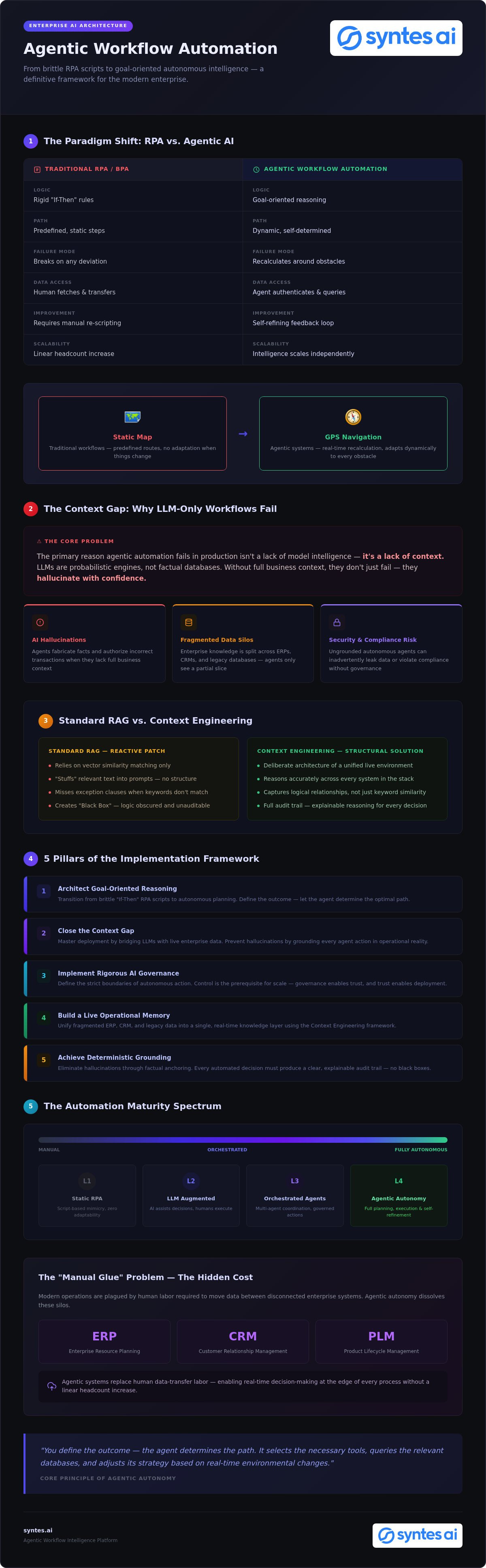
Implementing Agentic Automation: The 5 Pillars of Context Engineering
How do you move from experimental pilot programs to a resilient, production-grade intelligence? You don’t build better prompts; you build better context. The Syntes Context Engineering framework is the definitive architecture for agentic workflow automation. It’s a methodical progression that transforms raw data into a live, actionable intelligence. Without this foundation, your agents are merely sophisticated guessers. With it, they become autonomous executors grounded in the deterministic reality of your business.
- Pillar 1: Connect. Break the isolation. Integrate structured data from ERPs and CRMs with the unstructured intelligence buried in PDFs, emails, and contracts across your entire enterprise stack.
- Pillar 2: Understand. Raw data is noise. This stage involves discovering the specific entities, relationships, and hierarchies that define your unique business logic and operational environment.
- Pillar 3: Contextualize. Construct the Live Context Graph. This serves as the agent’s brain, providing the real-time situational awareness required to move from simple retrieval to complex reasoning.
- Pillar 4: Govern. Autonomy requires boundaries. Apply compliance, security, and business rules at the data level to ensure all AI operations remain within your organizational risk profile.
- Pillar 5: Execute. The final deployment. Agents reason over the established context to perform cross-system actions, resolving complex workflows with minimal human intervention.
From Data Silos to a Unified Context Layer
Success is impossible if your data remains trapped. For most organizations, solving enterprise data silos is the critical first step toward agentic maturity. You need two-way connectors that don’t just pull data, but maintain a “Live” operational memory that evolves as your business does. This connectivity allows you to contextualize business rules, teaching your agents the specific “Policies” of the organization rather than relying on generic model training. If the agent doesn’t know the rule, it cannot follow it.
Scaling Agentic AI Platforms
The goal isn’t a single “super-agent.” It’s a multi-agent ecosystem where specialized entities collaborate to solve high-level objectives. Modern agentic ai platforms must manage this Agent-to-Agent communication with the same rigor used for human teams. Evaluating the ROI of these systems requires looking beyond simple speed. You must measure the reduction in operational latency and the elimination of manual task-switching. True efficiency gains come from the systemic removal of friction, allowing your human capital to focus on strategy while agentic workflow automation handles the execution.
As these autonomous systems take over repetitive tasks, the focus shifts to the health and alignment of the workforce. For organizations scaling these technologies, Kaika AI provides a platform to connect employee purpose with organizational goals, ensuring that increased automation doesn’t lead to disconnection or burnout.
The Syntes Agentic Platform: Turning Context into Operational Intelligence
The Syntes AI Enterprise AI Platform represents the final piece of the architectural puzzle. While the market remains obsessed with model parameters, we focus on the environment in which those models operate. True agentic workflow automation requires more than a clever prompt; it requires a deterministic foundation that eliminates the margin for error. Our platform leverages the Syntes AI Context Graph to provide this grounding. By mapping the specific business logic of your organization, we ensure that agents don’t just guess at the next step. They execute based on a verifiable, real-time map of your operational reality. We don’t just provide a tool; we provide the brain.
Moving from “Chat” to “Action” is the ultimate goal of the modern enterprise. It’s one thing for an AI to summarize a contract; it’s quite another for it to identify a breach, notify stakeholders, and pause a procurement cycle across three different systems. This transition is powered by our Live Operational Memory. This memory supports long-running, complex business processes that span days or weeks, maintaining state and context across every interaction. It transforms AI from a passive assistant into an active participant in your business strategy. Autonomy is no longer a theoretical concept. It’s a functional reality.
Context Graph vs. Knowledge Graph: The Syntes Difference
Why does the distinction matter? Most traditional knowledge graphs are static repositories of facts. They are taxonomies of “what is.” In contrast, the Syntes Context Graph is a dynamic engine of “what is happening.” It utilizes Operational Relationship Intelligence to understand how customers, products, and internal rules interact in real-time. This isn’t just about data; it’s about the logic of the data. This architecture enables Explainable AI. When an agent takes an action, it provides the definitive “Why” behind that decision, citing the specific relationships within the graph that justified the execution. Transparency is the bedrock of trust.
Getting Started with Agentic Transformation
The roadmap to autonomy begins with identifying high-impact use cases. In Retail, this might mean autonomous inventory rebalancing. In Finance, it’s the automated resolution of complex compliance anomalies. In Manufacturing, it’s the real-time optimization of supply chain logistics based on shifting environmental data. To support these outcomes, you must deploy enterprise ai infrastructure designed for high-concurrency, context-aware reasoning. The transition to agentic workflow automation is not a single leap but a strategic build-out of these capabilities. If you’re ready to move beyond experimental chatbots and toward governed, operational intelligence, request a demo of the Syntes Agentic Platform today.
Architecting the Future of Autonomous Intelligence
The era of brittle, static automation has reached its natural conclusion. Success in the modern enterprise demands a structural shift from digital mimicry toward genuine goal-oriented reasoning. We’ve detailed how bridging the context gap and implementing the five pillars of Context Engineering transforms fragmented data silos into a unified, actionable intelligence. As a pioneer in Context Engineering, Syntes AI is redefining GraphRAG for enterprise accuracy; we provide the deterministic grounding required for high-stakes execution.
True agentic workflow automation is not a plug-and-play tool; it’s a strategic architecture. It requires a Live Operational Memory that evolves in real-time and a governed multi-agent orchestration framework that maintains safety at scale. You possess the blueprint. Now, you must choose to build. Operational excellence is no longer about human speed. It’s about systemic intelligence.
The path to total operational clarity is open. Take the first step toward architecting a truly autonomous enterprise today.
Frequently Asked Questions
What is the difference between agentic workflows and standard AI automation?
Agentic workflows differ from standard AI automation by replacing rigid “if-then” logic with goal-oriented reasoning. While traditional systems execute a pre-defined sequence of steps, agentic systems analyze a high-level objective and autonomously determine the most efficient path to reach it. They possess the agency to select tools, query databases, and adjust their strategy based on real-time feedback. This shift moves your enterprise from simple task execution to sophisticated problem-solving.
How does agentic workflow automation prevent AI hallucinations?
Hallucinations are prevented through deterministic grounding in a Live Operational Memory. By anchoring AI reasoning in a Syntes AI Context Graph, agents verify every claim against your actual business data rather than relying on probabilistic model training. This ensures that every action taken by agentic workflow automation is rooted in verifiable fact. It eliminates the creative guesswork that often plagues consumer-grade AI models in production environments.
Can agentic workflows integrate with legacy ERP and CRM systems?
Integration with legacy ERP and CRM systems is a core requirement for autonomous performance. Our platform utilizes sophisticated cross-system integrations to bridge the gap between modern AI and legacy infrastructure. These two-way connectors allow agents to read from and write to your existing systems of record. This ensures that autonomous actions are synchronized across your entire enterprise stack, maintaining data integrity across disparate environments.
What is the role of a Knowledge Graph in agentic AI?
A Knowledge Graph serves as the definitive semantic layer that provides agents with situational awareness. It maps the complex relationships between your products, customers, and business rules, transforming isolated data points into a unified logic map. This structural foundation allows agents to understand the “why” behind their actions. Reasoning becomes consistent and explainable, providing a clear audit trail for every decision made by the system.
Is agentic automation secure for highly regulated industries like Finance?
Security is maintained through a rigorous AI Governance framework that mirrors your existing enterprise permission structures. We apply strict business rules at the data level, ensuring that agents cannot access or act upon information beyond their authorized scope. In highly regulated sectors like Finance, this provides a deterministic audit trail that satisfies compliance requirements. You gain the speed of autonomous execution without compromising your security posture or regulatory standing.
Do I need to replace my existing RPA tools to implement agentic workflows?
You don’t need to replace your existing RPA tools to implement agentic workflows. Instead, you should view agentic workflow automation as the orchestrator that sits above your current scripts. While RPA handles repetitive, low-variance tasks, agentic AI manages the complex decision-making and cross-system logic that previously required human intervention. It’s a necessary evolution that maximizes the value of your existing automation investments.
How do I measure the success of an agentic workflow implementation?
Success is measured by the reduction in operational latency and the elimination of manual task-switching. You should track the decrease in time-to-resolution for complex processes and the reduction in human touchpoints required to complete a workflow. Ultimately, the metric that matters is the increase in operational capacity without a corresponding increase in headcount. True ROI is found in the systemic removal of friction from your core business cycles.