

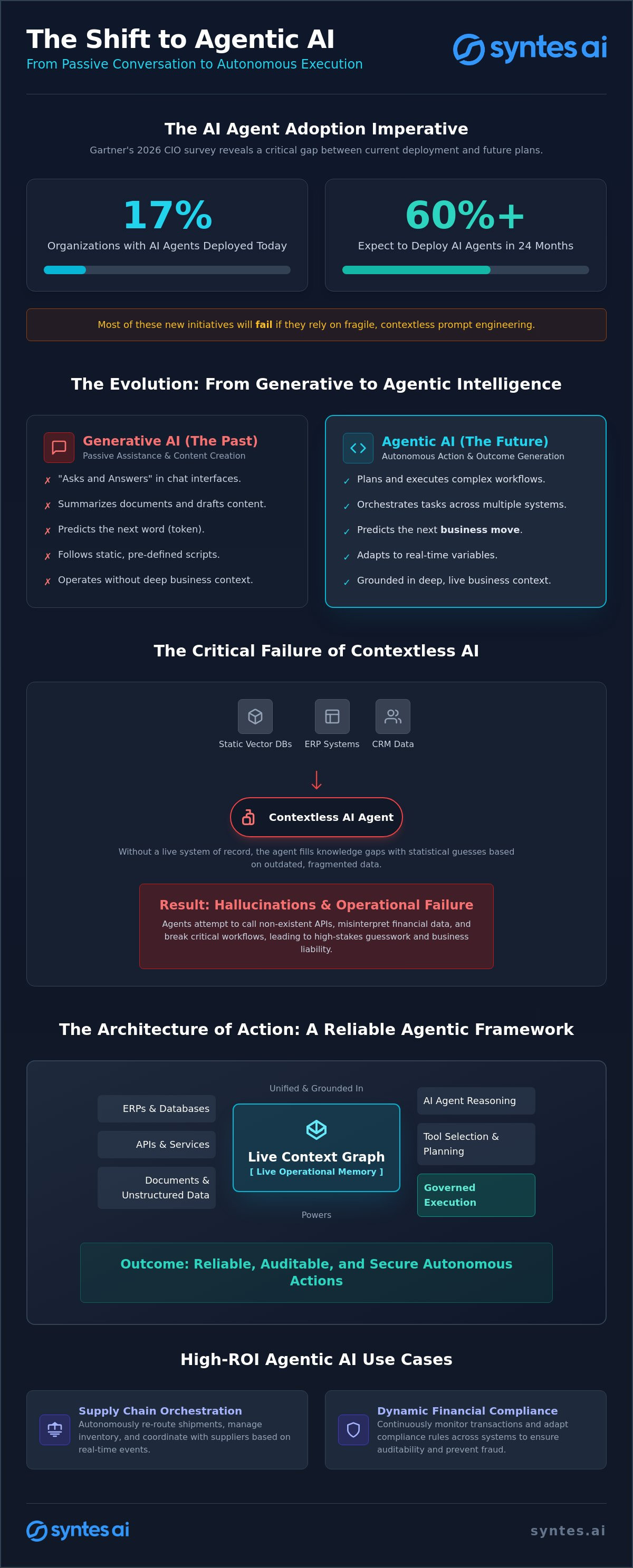
Gartner’s 2026 CIO survey reveals a stark reality: while only 17% of organizations have deployed AI agents, over 60% expect to do so within the next twenty four months. Most of these initiatives will fail if they continue to rely on fragile prompt engineering. To move from passive chat to active execution, your organization requires a sophisticated agentic ai framework built on a foundation of Live Operational Memory. You’ve likely experienced the current limitations first hand. Hallucinations in production environments, disconnected data silos, and a total lack of auditability make autonomous action feel like a liability rather than an asset.
We agree that the era of theoretical AI experimentation must end. High level enterprise decision makers need systems that don’t just talk, but act with precision. This article provides a clear roadmap for high ROI agentic use cases powered by Enterprise Knowledge Graphs. You’ll discover how to architect the infrastructure required for total reliability and implement proven frameworks for governing autonomous AI actions. We’ll examine the transition from passive observation to systemic integration, ensuring your 2026 enterprise operates with unprecedented clarity and speed.
Key Takeaways
- Transition from passive chat interfaces to an autonomous operational standard where AI agents plan and execute complex, cross-system workflows.
- Architect a reliable agentic ai framework by utilizing a Live Context Graph to provide agents with the “Operational Memory” necessary to eliminate hallucinations.
- Identify high-ROI use cases such as supply chain orchestration and dynamic financial compliance that move beyond observation to active, governed execution.
- Adopt a Context Engineering roadmap to unify fragmented data silos and ground autonomous agents in deep business semantics and hierarchies.
- Implement a governed execution layer that ensures every autonomous action is auditable, secure, and aligned with global enterprise standards.
Beyond the Chatbot: Why Agentic AI is the New Operational Standard
The “ask and answer” era of enterprise AI is obsolete. Static chatbots that merely summarize documents or draft emails no longer meet the operational demands of the 2026 enterprise. Modern leaders are moving toward an AI agent architecture that prioritizes execution over conversation. This shift represents the transition from generative assistance to autonomous performance. While traditional LLMs are impressive at predicting the next token, they fail at predicting the next business move. They lack the deterministic logic required to interact with an ERP system or manage a global supply chain. Why settle for a summary when you can have a solution? The answer lies in the architecture of your agentic ai framework.
The urgency is real. Gartner’s 2026 CIO survey highlights that over 60% of organizations expect to deploy AI agents within the next two years. However, early adopters are discovering that standard generative tools are insufficient for the messy realities of large-scale operations. They are finding that the transition from passive observation to active performance requires a fundamental rethink of their technical stack. The landscape is consolidating. With the release of the Microsoft Agent Framework 1.0 in April 2026, the industry has signaled a move toward unified SDKs that prioritize autonomous action. This isn’t just another tech trend; it’s a necessary evolution for survival in a data-saturated market.
The reasoning gap is the primary obstacle to true autonomy. Standard LLMs are predictive, not logical. They can mimic the structure of a plan without understanding the consequences of its execution. In a production environment, this leads to broken workflows where the AI attempts to call an API that doesn’t exist or misinterprets a financial threshold. A robust agentic ai framework bridges this gap by integrating deterministic business logic with the flexible reasoning of modern models. Autonomous execution requires a system of record, not just a generative model. You need a platform that understands business semantics and hierarchies to ensure every action is auditable and governed. To see how these semantic principles are applied to voice-driven interactions, you can explore AIspeaker 語音對話機器人 to learn more about advanced dialogue systems.
The Shift from Generative to Agentic Intelligence
Generative AI creates content. Agentic AI creates measurable business outcomes. The distinction is critical. An agentic ai framework allows a system to engage in multi-step reasoning, selecting the appropriate tools to complete a high-level goal. These digital workers don’t just follow scripts; they adapt to changing variables in real time. Modern agentic ai platforms empower these agents to orchestrate complex sequences of tasks that were previously reserved for human operators. We are seeing the replacement of fragile automation scripts with robust, reasoning-capable entities. This is the new operational standard.
The Critical Failure of Contextless AI
Hallucinations are not a model error. They are a grounding error. When an agent lacks access to a live system of record, it fills the gaps with statistical probability. Static vector databases cannot keep pace with the velocity of enterprise data. They are snapshots of the past in a world that moves in milliseconds. Relying on outdated snapshots leads to catastrophic operational failures. Understanding how to prevent ai hallucination requires more than better prompts; it requires a Live Context Graph that serves as the agent’s deterministic truth. Without this foundation, autonomous execution is nothing more than high-stakes guesswork. You cannot build a reliable agent on a foundation of shifting sand.
The Architecture of Action: How Context Graphs Power Reliable AI Frameworks
Reliable autonomy isn’t a model feature; it’s an architectural achievement. While many enterprises focus on the intelligence of the LLM, the true bottleneck is the data grounding. To move beyond simple retrieval, your agentic ai framework must utilize an enterprise knowledge graph as its Live Operational Memory. This is not a static repository. It is a dynamic map of your organization’s logic, entities, and real-time state. By mapping relationships rather than just storing files, a Context Graph eliminates the silos that prevent autonomous action. It provides the “ground truth” that turns a generic model into a specialized digital worker.
Traditional Retrieval-Augmented Generation (RAG) is reaching its limit. RAG excels at finding relevant text snippets but fails to grasp the complex dependencies of enterprise operations. The transition to GraphRAG allows agents to traverse structured relationships, understanding that a delay in a specific shipping port directly impacts a specific customer’s quarterly contract. This level of reasoning is essential for high-scale environments. How do we ensure explainability? By enabling agents to audit their own reasoning paths through the Context Graph. This transparency is a core requirement of any robust agentic ai framework and aligns with the Readiness Framework for autonomous intelligence.
Building a Live Operational Memory
Connect structured ERP data with unstructured policy documents in real-time. A “Live” graph is superior to static data lakes because it reflects the current reality of the business, not a snapshot from twenty four hours ago. This architecture enables:
- Real-time Synchronization: Agents act on the most recent inventory and financial data.
- Cross-System Reasoning: Agents understand how a change in one system triggers a requirement in another.
- Deterministic Guardrails: Agents are bounded by actual business rules, not statistical guesses.
Operational Relationship Intelligence allows agents to understand that “Part A” isn’t just a serial number; it’s a critical component in a assembly currently facing a supply shortage. This deep understanding is what allows for governed execution across fragmented systems. If you want to see this connectivity in action, you can book a demo to explore how live data powers autonomous reasoning.
Context Engineering vs. Prompt Engineering
Prompt engineering is a temporary band-aid for a structural problem. The next evolution of AI expertise is architecting the semantic data layer for enterprise. This is known as Context Engineering. While prompts try to coax better answers from a model, Context Engineering provides the structural guardrails for autonomous tool-calling. It ensures the agent understands the boundaries of its authority and the logic of the systems it touches. Context Engineering is the discipline of building business context for AI safety.
Strategic Agentic AI Use Cases for High-Scale Enterprise Operations
Theory must yield to execution. While the market discusses potential, leading enterprises are already deploying agentic AI frameworks to solve high-stakes operational bottlenecks. These aren’t experimental pilots. They are systemic integrations that link disparate business units into a unified, responsive organism. By moving beyond simple automation, these agents handle exceptions that previously required human intervention. They reason through complexity. They act with authority. They deliver measurable ROI by closing the gap between data insight and operational action.
- Supply Chain Orchestration: Agents predict disruptions and autonomously re-route inventory across global ERP systems.
- Dynamic Financial Compliance: Real-time auditing agents cross-reference millions of transactions against shifting global regulations.
- Automated Customer Lifecycle Management: Systems execute retention strategies by connecting CRM data with real-time product usage metrics.
- Predictive Maintenance: Agents manage physical assets through digital twin integration, triggering autonomous work orders before failure occurs.
The transition from observation to action requires more than a model; it requires a brain. A generic agent cannot manage a global supply chain because it lacks the specific context of your contracts, logistics, and inventory levels. Success depends on the quality of the underlying architecture. When you move beyond the surface level, you find that the most effective digital workers are those grounded in a live system of record. They don’t just suggest a path forward. They navigate it.
Case Study: Autonomous Supply Chain Resilience
Consider the impact of a sudden port strike. A traditional system sends an alert; a human investigates; a decision is delayed. In a sophisticated agentic ai framework, the agent uses a Context Graph to immediately understand the relationship between that specific strike and a thousand pending orders. It doesn’t just alert. It resolves. By accessing two-way connectors for SAP, Oracle, and live logistics APIs, the agent calculates alternative routes, verifies warehouse capacity, and updates the ERP records. This is the transition from “Alerting” to “Resolving” without human friction.
Intelligent Financial Operations and Governance
Financial transparency is often crippled by fragmented architectures. Agents solve this by performing Master Data Management (MDM) at scale, ensuring a single version of truth across global banking systems. They automate complex reconciliations that once took weeks, completing them in minutes with perfect accuracy. This level of operational intelligence is only possible by solving enterprise data silos. When your agents possess a unified view of the financial landscape, they become the primary mechanism for real-time auditing and regulatory compliance. Stop managing data. Start governing execution.
From Use Case to Execution: The Context Engineering Roadmap
Moving from a compelling use case to production execution is where most enterprise projects stall. The industry is littered with fragile prototypes built on prompt engineering that fail the moment they encounter real world data messiness. You don’t need better prompts; you need a methodical roadmap. Success depends on a agentic ai framework that prioritizes the structural integrity of your data over the superficial cleverness of a model. We define this transition through four critical phases: Connect, Understand, Govern, and Execute.
- Connect: Unify fragmented data sources. Use robust, two-way connectors to bridge the gap between structured ERP fields and the unstructured chaos of policy PDFs.
- Understand: Discover business semantics. The Syntes Context Graph maps hierarchies, ensuring the agent recognizes that a “VIP client” in your CRM is the same “legal entity” in your billing system.
- Govern: Security belongs at the data layer. Apply permissions and business rules before the agent ever receives a token, ensuring total compliance.
- Execute: Deploy agents that reason. These digital workers must act over trusted context to perform governed actions across systems without human friction.
How do you move from a visionary concept to a functional digital worker? You replace trial-and-error coding with a structured agentic ai framework. This approach ensures that your autonomous agents are grounded in deterministic truth rather than statistical probability. It is the only way to achieve the reliability required for 2026 enterprise operations.
Step 1: Architecting the Foundation
Identifying high-value silos is your first priority. These are the data graveyards where traditional automation goes to die. By mapping the intricate relationships between customers, products, and internal policies, you create the “Operational Memory” required for reasoning. Don’t guess on your technical stack. Consulting the enterprise ai infrastructure guide is essential for selecting the components that support high-scale autonomy. Build for the future, not for a pilot.
Step 2: Implementing the Governance Layer
Defining “Safe Operating Envelopes” is non-negotiable for autonomous agents. For high-stakes actions, such as shifting six-figure inventory or altering financial records, you must implement Human-in-the-loop (HITL) configurations. This isn’t a lack of trust; it’s a commitment to governed execution. Ensure every agent action is logged, timestamped, and explainable for future compliance audits. If you are ready to architect your foundation and see this roadmap in action, book a demo with our strategic experts today.
Deploying Governed Agentic Intelligence with Syntes AI
The market is saturated with consumer-grade experiments that masquerade as enterprise solutions. Most organizations are still struggling with chatbots that hallucinate under pressure or fail to access the data required for meaningful action. Syntes Agentic Platform represents a fundamental departure from this mediocrity. It is the only agentic ai framework engineered from the ground up on a foundation of Live Operational Memory. By unifying fragmented data into a single, responsive context layer, we enable your organization to move beyond passive observation to a state of total operational clarity and autonomous execution.
Efficiency at scale requires a centralized intelligence strategy. Rather than building siloed agents for every individual task, our architecture provides one “brain” for a thousand specialized agents. This unified context layer ensures that every digital worker operates from the same version of truth, whether it’s managing a supply chain disruption or reconciling global financial accounts. This is the power of a mature agentic ai framework. It reduces technical debt, eliminates redundant data processing, and provides a scalable path for the 2026 enterprise to automate its most complex business logic.
The Syntes Advantage: Trust and Transparency
We deliver deterministic outcomes in a world of probabilistic models. While generic LLMs guess the next step, our Hybrid Graph Database ensures that every agent action is grounded in the actual relationships and rules of your business. This architectural choice allows you to scale AI initiatives without compromising on security or data integrity. We prioritize:
- Deterministic Logic: Agents follow your specific business semantics, not statistical probabilities.
- Systemic Integration: Real-time connectivity across ERP, CRM, and legacy systems via the Syntes Context Graph.
- Governed Autonomy: Comprehensive audit trails and “Safe Operating Envelopes” that satisfy even the most stringent CIO safety concerns.
Next Steps for Enterprise Leaders
Transitioning to true agentic intelligence is not an overnight event; it is a strategic migration. We recommend beginning with a Context Engineering pilot to identify and unify your high-value data silos. This process allows you to assess your organization’s “Context Maturity” via our proprietary discovery framework, ensuring that your infrastructure is ready for autonomous operations. The era of theoretical AI experimentation has ended. It is time to deploy systems that act with authority and precision. To see the future of governed execution, you can Request a demo of the Syntes AI Context Graph and join the next evolution of autonomous enterprise intelligence.
The Future of Autonomous Execution is Grounded in Context
The transition to autonomous enterprise operations isn’t a matter of if; it’s a matter of when. We’ve established that the shift from generative assistance to agentic execution requires a fundamental rethink of your technical architecture. By replacing fragile prompt engineering with enterprise-grade Context Engineering, you provide your digital workers with the deterministic truth they need to act without hallucination. A robust agentic ai framework must be anchored by Live Operational Memory technology to bridge the gap between fragmented data silos and real-time business outcomes. This connectivity is the prerequisite for systemic integration.
Governance remains the final frontier for high-scale implementation. Implementing “Safe Operating Envelopes” ensures that every autonomous action is auditable, secure, and perfectly aligned with global regulations. You possess the strategic roadmap. Now you require the platform to execute it. Don’t let your AI initiatives remain trapped in the experimental phase while the market moves toward total operational clarity. Use the tools that bring order to the messy realities of large-scale operations.
Scale your autonomous operations with the Syntes Agentic Platform and transform your 2026 enterprise into a responsive, intelligent organism. The era of the autonomous digital worker is here, and your success depends on the foundation you build today.
Frequently Asked Questions
What is the difference between an AI agent and a standard chatbot?
AI agents are defined by their ability to plan and execute tasks autonomously, whereas standard chatbots are limited to retrieval and response. While a chatbot provides a summary of a document, an agent interacts with your ERP system to update inventory or initiate a shipping order. This transition from passive observation to active performance is the hallmark of the agentic era.
How do AI agents access live enterprise data without compromising security?
Agents access live data through a governed semantic layer that enforces enterprise permissions at the data source. They don’t have unrestricted access to raw files; instead, they interact with a Context Graph that filters information based on the agent’s specific authority. This ensures that autonomous actions remain within a “Safe Operating Envelope” while maintaining a complete audit trail for compliance.
Can an agentic ai framework work with legacy ERP systems?
A sophisticated agentic ai framework is designed specifically to bridge the gap between modern reasoning models and legacy ERP systems. By using two-way connectors and Cross-System Integrations, agents can read from and write to older databases that lack modern AI native interfaces. This allows you to leverage existing infrastructure while deploying cutting edge autonomous intelligence.
What are the most common risks associated with deploying autonomous agents?
The most significant risks include model hallucinations in production and a lack of deterministic logic in high-stakes workflows. Without a structured foundation, agents may attempt to execute actions based on probabilistic guesses rather than business facts. Implementing a governed execution layer is the only way to mitigate these risks and ensure operational reliability at scale.
How does a Knowledge Graph improve the performance of AI agents?
A Knowledge Graph serves as the agent’s “Live Operational Memory” by mapping the complex relationships between organizational entities. Unlike static vector databases, a graph allows an agent to understand dependencies, such as how a delay in one department affects a specific client contract. This deep relationship intelligence is what prevents the reasoning gap common in simpler AI architectures.
What is Context Engineering, and why is it replacing Prompt Engineering?
Prompt Engineering focuses on manipulating the model’s output through text instructions, while Context Engineering focuses on architecting the data environment the model inhabits. Context Engineering is replacing prompting because it provides a more stable, deterministic foundation for AI safety. It’s the difference between asking a model to be careful and building an environment where it cannot fail.
How do you measure the ROI of an agentic AI implementation?
Measuring ROI involves tracking the reduction in manual intervention and the speed of resolution for complex, cross-system tasks. According to 2026 research from Landbase, enterprises report an average ROI of 171% from deployed agents. Focus on measurable business outcomes, such as inventory accuracy or compliance speed, rather than just engagement metrics or token consumption.
Is human oversight still necessary in a fully agentic workflow?
Human oversight remains essential for high-stakes autonomous actions that fall outside of predefined safety parameters. While agents can handle the majority of routine execution, Human-in-the-loop (HITL) configurations provide the necessary check for decisions involving significant financial or legal risk. This ensures that your agentic ai framework maintains accountability while maximizing operational efficiency.