

Your legacy RPA bots aren’t scaling. They’re brittle artifacts of a previous era of automation that is rapidly becoming obsolete. You’ve likely felt the operational friction when a minor UI update shatters months of scripted workflow development, or when a bot fails because it encountered a single piece of unstructured data. It’s the hidden tax of “simple” automation: high maintenance costs and an inability to handle dynamic decision-making. The industry is reaching a breaking point where the cage of rules no longer suffices for the complexity of global operations.
The strategic debate regarding agentic ai platforms vs rpa isn’t about incremental upgrades; it’s about a total shift from executing tasks to orchestrating outcomes. This article provides the definitive blueprint for moving beyond fragile macros toward autonomous, goal-oriented intelligence. You’ll discover a clear framework for allocating your 2026 budget between legacy systems and the Syntes Agentic Platform. We’ll examine how grounding these agents in an Enterprise Knowledge Graph eliminates hallucinations and bridges the data silos that currently paralyze your end-to-end automation efforts. It’s time to transition from passive observation to active, automated performance.
Key Takeaways
- Stop maintaining brittle bots. Learn why deterministic task execution is failing and why it’s time for an autonomous reasoning pivot.
- Decipher the architectural debate of agentic ai platforms vs rpa. Understand the transition from centralized scripting to distributed, goal-oriented intelligence.
- Eliminate the “RPA killer” of unstructured data. Discover how vision and language models allow agents to navigate contracts and logs with human-level context.
- Apply a definitive 2026 decision framework to your automation stack. Don’t waste budget on scripts when a workflow demands strategic delegation.
- Secure your automation with the Syntes Agentic Platform. See how an Enterprise Knowledge Graph ensures every autonomous action is grounded in your business logic.
Beyond Robotic Macros: The Evolution from Scripted Tasks to Autonomous Reasoning
The era of the “dumb bot” has reached its natural conclusion. Most enterprises built their initial automation foundations on Robotic Process Automation (RPA), a technology designed for the deterministic execution of high-volume, repetitive tasks. It served a purpose. It moved data between static fields and cleared backlogs of manual entry. But it lacks a brain. RPA is a legacy layer, a collection of scripted macros that follow rigid, pre-defined paths. When we evaluate agentic ai platforms vs rpa, we aren’t simply comparing two software categories; we’re witnessing a fundamental paradigm shift from scripted execution to autonomous reasoning.
RPA operates in a world of certainty. It requires structured data and predictable environments to function. Agentic AI, by contrast, represents the cognitive layer of the modern enterprise. It utilizes probabilistic reasoning to align with high-level business goals rather than just checking off a sequence of clicks. This is the transition to agentic orchestration, where systems don’t just follow instructions; they solve problems.
The Scripted Ceiling: Why RPA Is Not Enough
RPA is inherently brittle. A single pixel shift in a web interface or a minor field update in a legacy ERP system can paralyze an entire workflow. This fragility creates an unsustainable “maintenance tax” that drains engineering resources and inflates total cost of ownership. These bots live within the narrow confines of “if-then-else” logic. They can’t handle the nuance of a semi-structured vendor email or the ambiguity of a complex legal contract. They lack the cognitive depth required to manage edge cases. If the path isn’t perfectly mapped, the bot fails. In the face of 2026 data complexity, this rigid approach is an operational liability.
The Agentic Shift: Goal-Oriented vs. Task-Oriented
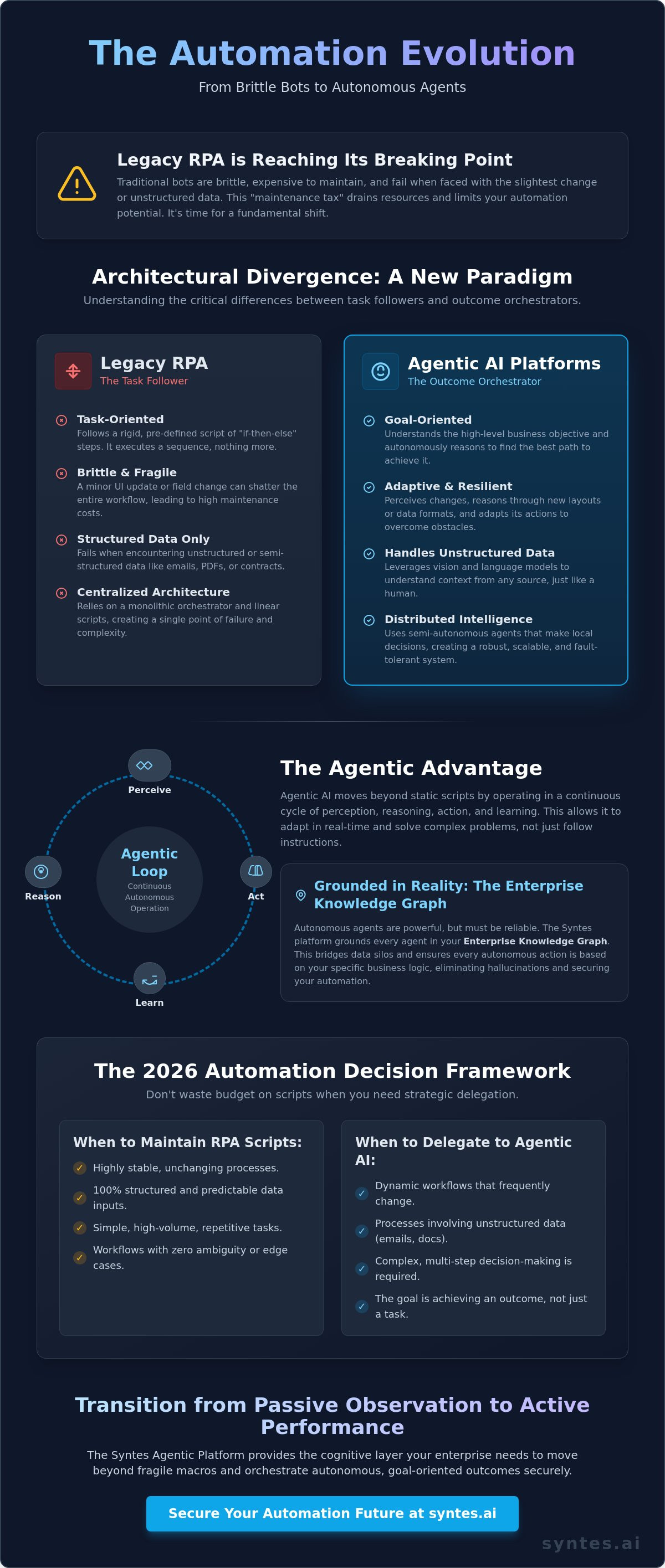
The core distinction lies in the objective. RPA is task-oriented; it performs a sequence. Agentic AI is goal-oriented; it achieves a result. This shift is powered by the “Agentic Loop,” a continuous cycle of perception, reasoning, action, and learning. While an RPA bot would stop if a login screen changed, an agentic system perceives the change, reasons through the new layout, and takes the necessary action to bypass the obstacle. It adapts. It doesn’t require a developer to rewrite a script every time a third-party API updates its schema. This level of autonomy allows enterprises to delegate strategic objectives to AI, moving beyond the mechanical limitations of the previous decade.
Structural Divergence: How Agentic AI Platforms Differ from Traditional RPA
Architecture dictates the ceiling of your operational potential. Traditional RPA relies on centralized, linear scripts stored in a rigid orchestrator. It’s a monolithic design. In contrast, agentic AI platforms utilize distributed intelligence where each agent functions as a semi-autonomous node capable of local decision-making. This structural divergence is the primary reason why the debate of agentic ai platforms vs rpa is the most critical architectural decision for CIOs in 2026. One system follows a map; the other navigates a landscape.
The interaction with data is where this gap becomes undeniable. RPA is a surface-level technology. It scrapes the user interface, mimicking human clicks but understanding nothing of the underlying logic. Agents query semantic layers. They don’t just see a text field; they recognize the entity “Customer” and its complex relationship to “Outstanding Debt.” This shift is fundamental to Transforming Enterprise Automation from mere task execution to a robust, data-driven strategy. Large Language Models (LLMs) serve as the core reasoning engines here, evaluating context and selecting the optimal path forward in real-time.
Semantic Grounding: The Knowledge Graph Advantage
Autonomous agents are only as reliable as the data they consume. Without a structured foundation, LLM-based agents are prone to hallucinations, inventing facts when they encounter data gaps. To prevent this, leading platforms integrate an enterprise knowledge graph. This graph acts as the “Ground Truth,” providing a semantic layer that defines relationships between disparate data points. While RPA moves “dumb” data from point A to point B, an agent uses this semantic grounding to interpret data. It understands context, ensuring that every action is logically sound and business-aligned.
Integration Depth: Moving Beyond the UI Layer
Legacy automation is obsessed with the UI. It’s a fragile approach that breaks when a button moves. Agentic platforms prioritize deep Cross-System Integrations, moving from screen scraping to semantic API orchestration. This backend-first methodology ensures that agents interact directly with the logic of your software stack. It’s more secure, significantly faster, and far more reliable than mimicking human mouse movements. Enterprises seeking this level of structural integrity should evaluate how the Syntes Agentic Platform redefines the automation stack by bridging these technical gaps with sophisticated, multi-layered connectivity.
The Operational Ceiling: Why RPA Struggles with Unstructured Data and Dynamic Workflows
Unstructured data is the silent killer of enterprise automation ROI. Most organizations realize too late that their expensive RPA deployments are effectively blind to the vast majority of corporate information stored in emails, contracts, and system logs. This is the operational ceiling. When we analyze agentic ai platforms vs rpa, we’re looking at the difference between a system that follows coordinates and a system that understands context. RPA requires a map; agents require a mission.
Legacy bots are deterministic. They fail the moment they encounter a non-standard input. This “Exception Handling” paradox means that as your automation scales, your manual workload often increases to manage the resulting errors. Agents break this cycle. They use advanced vision and language models to “see” and “read” like a human operator, but at machine speed. Thomson Reuters explores this evolution in their guide on AI agents versus RPA, emphasizing that agents are built to manage the very ambiguity that paralyzes traditional bots. In high-volume environments, this ability to reason through chaos is the only way to maintain architectural integrity.
Contextual Intelligence in Action
Consider a standard procurement scenario. A vendor submits a non-standard invoice where the tax ID is missing or located in an unexpected footer. An RPA bot, trained on a specific template, triggers an immediate “Error” and halts the process. It’s a binary failure. An agentic platform initiates an “Investigation” response instead. It cross-references the vendor name against the Enterprise Knowledge Graph, retrieves the tax ID from a previous contract, and validates the amount against a historical log. It doesn’t just move the data. It interprets the intent and resolves the ambiguity autonomously. This isn’t just speed; it’s operational intelligence. Exploring real-world agentic ai use cases across enterprise operations reveals just how broadly this contextual reasoning capability is transforming industries in 2026.
Dynamic Workflow Orchestration
Modern business doesn’t happen in a straight line. Workflows in 2026 require multi-step reasoning across three or more platforms simultaneously, often involving real-time data shifts. Hard-coded RPA paths are too brittle to handle this volatility. They can’t pivot. Agents, however, orchestrate outcomes by dynamically selecting the best tool or API for the current state of the environment. Maintaining these fluid paths requires a sophisticated approach to ai agent lifecycle management. You aren’t just deploying a script; you’re managing a digital workforce that evolves alongside your operational reality. This is the only way to achieve true scalability in high-volume enterprise environments where change is the only constant.
The 2026 Automation Decision Framework: When to Script and When to Delegate
The framework for 2026 demands a shift in how we view ROI. Traditional RPA calculations often ignore the “maintenance tax” of brittle bots. While the initial setup of an agentic platform involves a more sophisticated architectural alignment, the reduction in operational friction pays dividends as the system scales. You must decide if you are solving for a repeatable click-path or a strategic business goal. One requires a set of instructions; the other requires a reasoning engine.
The RPA Sweet Spot: High-Volume, Zero-Variance
RPA remains the definitive solution for legacy system data entry where API access is strictly prohibited or non-existent. This is “Bridge Automation.” It is ideal for high-volume, zero-variance tasks where the data is perfectly structured and the underlying application remains static. However, you must guard against “RPA Sprawl.” Deploying hundreds of bots to handle minor variations creates a technical debt nightmare that will eventually collapse under its own weight. Use RPA as a tactical patch, not a strategic foundation.
The Agentic Sweet Spot: Cross-Functional Operational Intelligence
Complex domains like supply chain orchestration and customer lifecycle management are the exclusive territory of agentic platforms. These workflows demand multi-step reasoning across fragmented data silos. In these environments, deploying ai agents at scale is the only viable path to managing 2026 data volumes without hiring an army of human overseers. CIOs should prioritize agentic delegation for any process that meets these criteria:
- Chaotic Data: The process relies on semi-structured or unstructured inputs like emails and logs.
- High Volatility: The underlying software interfaces or business rules change frequently.
- Strategic Impact: The outcome requires real-time adjustment based on fluctuating market conditions.
Stop patching failing scripts and start orchestrating outcomes. If your automation stack is struggling to handle the complexity of your global operations, it is time to move beyond the macro. Discover how the Syntes Agentic Platform provides the reasoning layer your enterprise requires to achieve total operational clarity.
Syntes: Unifying Agentic Orchestration with Enterprise Knowledge Graphs
The market is currently flooded with consumer-grade chatbots masquerading as enterprise solutions. They lack the systemic depth required for true orchestration. The Syntes Agentic Platform is the definitive alternative to the brittle bots of the previous decade. By unifying autonomous reasoning with an Enterprise Knowledge Graph, we provide the structural foundation that general AI platforms lack. In the strategic comparison of agentic ai platforms vs rpa, the winner isn’t the system that clicks the fastest. It’s the one that understands your business logic most deeply.
Our platform doesn’t just process data; it executes within a framework of “Ground Truth.” While traditional RPA moves blind data, Syntes uses its semantic layer to ensure every autonomous action is contextually accurate. This eliminates the risk of hallucinations and ensures that Cross-System Integrations are performed with total operational clarity. We’ve moved beyond the “dumb” data movement of the past to create a system that interprets intent and anticipates operational needs.
Architectural Integrity: The Syntes Difference
We reject the UI-mimicry that makes legacy automation so fragile. Our backend-first approach prioritizes direct system connectivity. This ensures your workflows don’t break when a software vendor updates a button or a field label. We combine sophisticated reasoning models with a structured semantic layer to provide a level of reliability previously impossible in autonomous systems. Security isn’t an afterthought here. Every agentic deployment includes enterprise-grade governance, ensuring your autonomous workforce operates within the strict boundaries of your compliance requirements and security protocols.
Next Steps: From RPA Migration to Agentic Maturity
You don’t need to rip and replace your entire stack overnight. We offer a clear roadmap for integrating agentic capabilities into your existing RPA environments. This allows you to offload high-complexity tasks to agents while maintaining your legacy scripts where they still provide value. It’s a transition from task automation to true operational intelligence. Explore the Syntes Agentic Platform today to begin your tailored consultation. Stop automating the past; start orchestrating the future.
Architecting the Autonomous Enterprise
The transition from deterministic scripts to probabilistic reasoning is no longer a theoretical debate. It’s a survival imperative. Enterprises that continue to rely on the brittle architecture of legacy bots will find themselves trapped by rising maintenance costs and stagnant operational capabilities. You’ve seen how the structural shift of agentic ai platforms vs rpa enables a new era of goal-oriented orchestration. By grounding autonomous agents in a robust semantic layer, you eliminate the risks of hallucinations and bridge the data silos that have long hindered end-to-end automation. It’s time to move from passive task execution to active operational intelligence.
Upgrade your automation strategy with the Syntes Agentic Platform. Our infrastructure specializes in enterprise-grade Knowledge Graph integration and seamless cross-system orchestration. We provide the semantic grounding necessary to ensure your agents remain reliable and results-oriented in the most chaotic data environments. The blueprint for 2026 is clear. Don’t let legacy limitations define your future performance. Take the decisive step toward total operational clarity today.
Frequently Asked Questions
Will Agentic AI platforms completely replace RPA by 2027?
Agentic AI platforms won’t completely replace RPA by 2027; they’ll relegate it to a niche tactical role. RPA remains the definitive choice for legacy “bridge” tasks where APIs are non-existent. However, for any process involving unstructured data or dynamic reasoning, the transition to agentic orchestration is already the standard for enterprise maturity. Expect a hybrid environment where agents manage the cognitive strategy while bots handle static data entry.
How does an agentic AI platform handle data security compared to RPA bots?
Agentic platforms offer superior security by prioritizing backend-first Cross-System Integrations over fragile UI-mimicry. While RPA bots often require high-level user permissions to “see” screens, agents interact via secure APIs and semantic governance layers. This reduces the attack surface and ensures that autonomous actions remain within encrypted, logged environments. It’s a shift from mimicking human access to utilizing structured, machine-to-machine security protocols.
What is the primary difference between an AI agent and an RPA bot?
The primary difference lies in the shift from task-oriented execution to goal-oriented reasoning. An RPA bot follows a hard-coded script to perform specific clicks. An AI agent perceives its environment, reasons through obstacles, and takes action to achieve a broad objective. This distinction is the core of the agentic ai platforms vs rpa evolution. One follows a map; the other navigates the terrain.
Can I integrate my existing RPA workflows into an agentic AI platform?
You can absolutely integrate existing RPA workflows into an agentic framework. Leading platforms allow agents to act as the cognitive “brain” that triggers legacy bots as specialized tools for specific, deterministic tasks. This hybrid approach protects your existing investments while adding a layer of autonomous intelligence to manage exceptions and cross-system handoffs. It’s about turning your “dumb” bots into a coordinated digital workforce.
How do agentic platforms prevent hallucinations in enterprise workflows?
Hallucinations are prevented through the integration of an Enterprise Knowledge Graph. This provides a “Ground Truth” semantic layer that constrains the AI’s reasoning to verifiable corporate data. By grounding the agent’s logic in a structured map of your business entities, the system ensures that every decision is factually sound and business-aligned. It’s the difference between a chatbot guessing an answer and an agent querying a factual ledger.
What are the infrastructure requirements for deploying an agentic AI platform?
Deploying an agentic platform requires a cloud-native, API-first infrastructure capable of supporting large-scale data ingestion. Unlike the local desktop environments often used for RPA, agentic systems demand a centralized semantic data layer and high-bandwidth connectivity to cross-system endpoints. This architecture supports the real-time reasoning loops necessary for autonomous performance. You aren’t just installing software; you’re building a connected intelligence environment.
How do I measure the ROI of switching from RPA to an agentic platform?
ROI measurement must shift from “bot speed” to “operational friction reduction.” Factor in the significant decrease in maintenance costs associated with brittle scripts. Evaluate the success rate of complex outcomes that RPA simply cannot handle, such as processing unstructured vendor logs or managing dynamic supply chain shifts. True ROI is found in the scalability of decision-making rather than the mere volume of automated clicks.
What role does a Knowledge Graph play in an agentic AI framework?
A Knowledge Graph serves as the cognitive map for the agentic framework. It defines the relationships between disparate data points, allowing agents to understand context rather than just reading fields. This semantic depth is what enables the Syntes Agentic Platform to orchestrate complex, cross-functional workflows without manual intervention. It provides the necessary “informed” interpretation that distinguishes autonomous agents from the “dumb” data movement of traditional RPA.