

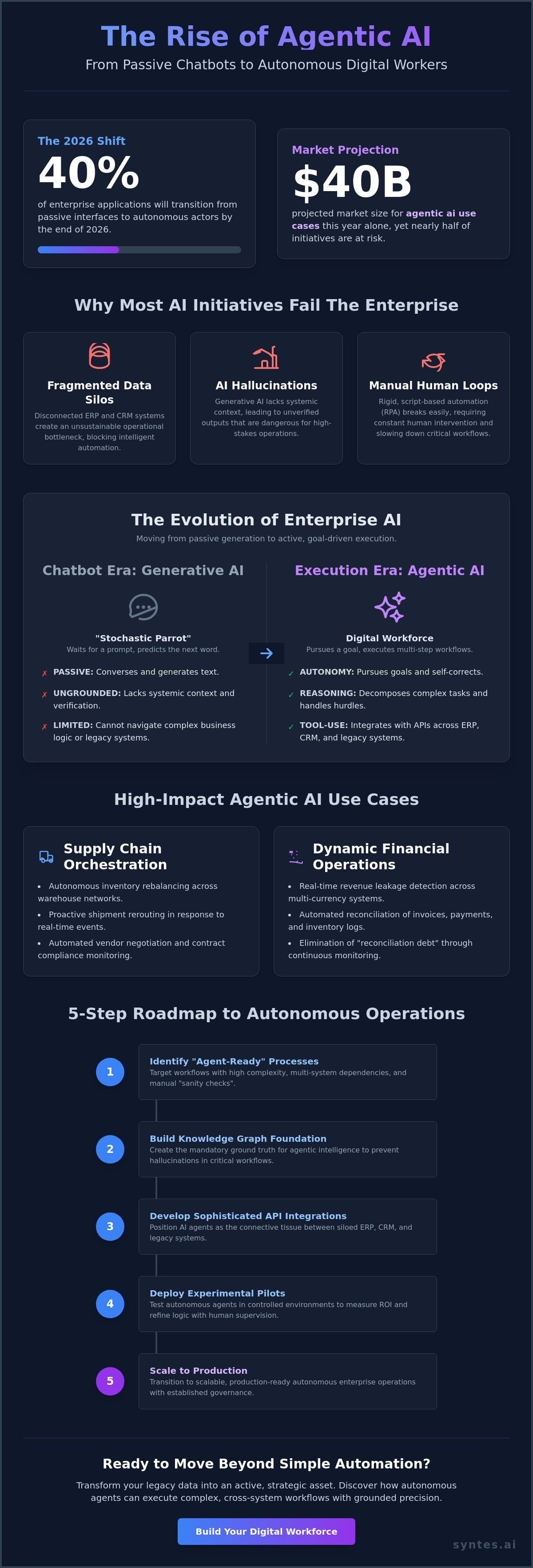
By the end of 2026, 40% of enterprise applications will transition from passive interfaces to autonomous actors. Yet, nearly half of these initiatives are destined to fail because they lack the structural integrity to handle real-world complexity. While the market for agentic ai use cases is projected to reach $40 billion this year, most organizations remain paralyzed by fragmented data silos and the persistent threat of AI hallucinations. You’ve likely felt the friction of manual human-in-the-loop requirements slowing down every critical workflow. It’s an operational bottleneck that modern enterprise architecture can no longer afford.
True operational intelligence requires agents that don’t just converse, but execute. We agree that the current reliance on disconnected ERP and CRM systems is unsustainable for a high-velocity business. This article provides the definitive roadmap to move beyond simple automation. You’ll discover how autonomous agents execute complex, cross-system workflows with grounded precision and measurable ROI. We’ll preview a framework for reliable AI agency that transforms your legacy data into an active, strategic asset through precise, cross-system orchestration.
Key Takeaways
- Understand the fundamental shift from passive conversational chatbots to autonomous digital workers capable of independent reasoning and goal execution.
- Identify high-stakes agentic ai use cases where adaptive reasoning replaces rigid, script-based automation to drive operational excellence.
- Learn how to position AI agents as the essential connective tissue between siloed ERP, CRM, and legacy systems through sophisticated API integration.
- Discover why enterprise knowledge graphs are the mandatory foundation for grounding agentic intelligence and preventing hallucinations in critical workflows.
- Master a strategic 5-step deployment roadmap to transition from experimental pilots to scalable, production-ready autonomous enterprise operations.
From Passive Generation to Active Agency: The 2026 Shift
The era of the digital assistant is over. Enterprises have spent the last three years experimenting with large language models that generate text but struggle to generate results. 2026 marks a definitive pivot. We’ve moved from the “Chatbot Era” into the “Execution Era.” This transition is fueled by the rise of the autonomous agent, a system designed not to converse, but to act. Gartner predicts that by the end of 2026, 40% of enterprise applications will be integrated with these agents. This isn’t just a marginal improvement. It’s a structural overhaul of how work gets done.
Agentic AI differs from standard generative AI through three core pillars: autonomy, reasoning, and tool-use. While a chatbot waits for a prompt, an agent pursues a goal. It reasons through hurdles, selects the appropriate software tools from its repertoire, and executes multi-step workflows across fragmented systems. Understanding these agentic ai use cases requires a shift in perspective. You aren’t just deploying a new interface; you’re hiring a digital workforce that operates without constant human hand-holding.
As organizations move toward this new paradigm, many are finding success by first upgrading their customer engagement tools. You can discover Chatterbots to see how advanced AI-driven chatbots are being used to automate service and lead generation in this evolving landscape.
The Architecture of Autonomy
How does an agent manage complexity? It begins with goal decomposition. An agent breaks a high-level objective, such as “reconcile supply chain discrepancies,” into sequential sub-tasks. It checks inventory logs, queries shipping APIs, and cross-references invoices. Through continuous feedback loops, the system monitors its own progress. If an API call fails, the agent doesn’t stop. It self-corrects. It finds an alternative path or adjusts its logic in real-time. This level of autonomy defines the new boundary of human oversight. Humans act as supervisors, not operators.
Why Generative AI Alone Fails the Enterprise
Generative AI is often a “stochastic parrot.” It predicts the next likely word but lacks systemic context or the ability to verify its own output. Simple prompting is insufficient for high-stakes operations. It can’t navigate the messy logic of a legacy ERP or ensure data integrity across a CRM. To move from “text out” to “action out,” the architecture must be grounded in reality. Without a framework that connects reasoning to execution, AI remains a novelty. Enterprise-grade agency demands a system that understands business logic as deeply as it understands language.
High-Impact Agentic AI Use Cases for Operational Excellence
The limits of Robotic Process Automation (RPA) have become painfully obvious. RPA relies on rigid, “if-this-then-that” scripts that shatter the moment a system interface updates or a data format shifts. In contrast, agentic ai use cases leverage adaptive reasoning to handle the unpredictable nature of global business. This represents the next evolution of generative AI, where the focus shifts from generating content to orchestrating outcomes. To scale these capabilities, organizations are turning to agentic ai platforms that provide the necessary governance and integration layers.
Identifying “Agent-Ready” processes requires a specific lens. Look for workflows characterized by high multi-variable complexity, a need for near-instantaneous execution, and a dependency on data trapped across multiple legacy systems. If a task requires a human to “sanity check” data between three different screens, it’s a prime candidate for agency. The goal is to replace manual data shuffling with intelligent, goal-oriented execution.
Supply Chain & Logistics Orchestration
Global logistics is too volatile for static automation. Agentic AI excels here by performing autonomous inventory rebalancing across warehouse networks. When a port strike or weather event occurs, agents don’t wait for a human to run a report. They proactively reroute shipments in real-time, calculating the cost-benefit of alternative routes against delivery SLAs. These systems also manage vendor negotiation by monitoring contract compliance and automatically triggering re-orders when performance thresholds aren’t met. This level of active management is why early adopters are seeing radical productivity gains in multi-variable environments.
Dynamic Financial Operations
Finance departments are often buried in “reconciliation debt.” Agentic AI resolves this by providing real-time revenue leakage detection across multi-currency billing systems. Instead of waiting for monthly audits, agents perform continuous oversight. They autonomously flag anomalies in ledger entries and prepare audit-ready documentation without manual intervention. By integrating live market data with internal performance metrics, these agents offer strategic cash flow forecasting that is predictive rather than reactive. If your organization is struggling to unify these disparate data streams, exploring the Syntes Agentic Platform can provide the architectural foundation needed to turn these use cases into operational reality.
The Orchestrator Role: Cross-System Integration Use Cases
Enterprise data is currently trapped. It resides in disconnected silos, guarded by incompatible protocols and legacy architectures. Most organizations view enterprise AI agents as standalone assistants, but their true power lies in orchestration. They act as the connective tissue between your ERP, CRM, and bespoke databases. These systems don’t just talk; they execute. By translating natural language intent into precise system commands, agents bypass the need for manual data entry and brittle middleware. This is the core of high-value agentic ai use cases: moving from observation to systemic performance.
Integration at this level requires technical sophistication. Agents must interact directly with REST APIs and query legacy databases using structured logic. This isn’t a simple hand-off. It involves a secure translation layer where business goals become actionable code. Security remains paramount. Granting an autonomous system write-access to core records requires robust protocols, including runtime controls and identity-based permissions. Without these safeguards, agency becomes a liability. With them, it becomes a competitive engine.
Bridging ERP and CRM Silos
Consider the typical support-to-fulfillment cycle. A customer requests an order change via a CRM ticket. Historically, a human must verify the request, log into the ERP, and manually update the shipping status. Agents automate this entire loop. They reconcile data across disparate environments without the need for manual ETL processes. Early implementations show that this autonomous reconciliation reduces “data swivel-chairing” by 90%, allowing teams to focus on strategy rather than clerical synchronization. It transforms static records into a unified, living operational stream.
Autonomous IT and DevOps Management
IT operations represent some of the most critical agentic ai use cases in the modern enterprise. Agents now manage self-healing infrastructure by detecting and patching system vulnerabilities before they are exploited. They provision resources based on real-time application demand, optimizing cloud spend with surgical precision. Streamlining the process of deploying ai agents at scale requires these same agents to oversee CI/CD pipelines. They ensure that every deployment is grounded, verified, and secure, removing the friction from rapid technological evolution.
The Ground Truth: Knowledge Graphs as the Foundation for Agency
Most enterprises are currently building on sand. They rely on vector databases and similarity searches to ground their AI, yet they wonder why their systems still hallucinate. High-value agentic ai use cases demand more than just finding related text; they require structural certainty. An enterprise knowledge graph provides the semantic context necessary for an agent to move from guessing to knowing. It transforms raw data into a map of interconnected entities and business logic. Search is a shallow exercise. Knowledge is a structural one. Understanding the relationships between a SKU, a regional tax law, and a specific customer contract is what enables an agent to act with precision.
The difference between simple retrieval and semantic understanding is the difference between a chatbot and a digital worker. When an agent understands relationships, it doesn’t just retrieve a document. It navigates the business environment. It recognizes that a change in a supplier’s status impacts specific production lines and downstream orders. This level of systemic awareness is only possible when your data architecture reflects the complexity of your actual operations. Without this foundation, agents remain untethered from reality.
Eliminating Hallucinations in Autonomous Workflows
Probabilistic models like LLMs are inherently prone to fabrication. They prioritize plausibility over accuracy. Knowledge Graphs solve this by providing a deterministic safe harbor for these probabilistic systems. Before an agent executes a command, it validates its plan against the immutable business rules stored in the graph. Semantic grounding is the rigorous verification of AI intent against enterprise reality. By forcing the AI to cross-reference its reasoning with a verified data model, you eliminate the risk of autonomous errors. The system no longer “thinks” it knows the answer; it verifies it against the ground truth.
Contextual Reasoning at Scale
Scaling agency across a global organization requires a unified truth. Agents must navigate complex hierarchies and dependencies that change in real-time. Knowledge graphs enable this by allowing for real-time updates that are immediately visible to every agent in the ecosystem. This ensures that a digital worker in procurement is acting on the same information as an agent in finance. You maintain a unified data model while allowing for decentralized action. It’s the only way to ensure that as you deploy more agentic ai use cases, your systems don’t become a new generation of disconnected silos.
Is your data infrastructure ready for the execution era? Deploy the Syntes Enterprise Knowledge Graph to provide the foundation your autonomous agents require.
Strategic Implementation: Moving from Pilot to Production
Execution is a strategic choice. The transition from experimental pilots to production-grade autonomous operations requires more than just technical curiosity; it demands a disciplined architectural shift. Organizations that treat agentic ai use cases as isolated experiments will inevitably fail to capture their systemic value. Success in 2026 belongs to the leaders who view agents as a persistent digital workforce that requires the same level of oversight, governance, and infrastructure as their human counterparts. Stop experimenting with chatbots. Start architecting for agency.
The Agentic AI Roadmap
Deploying at scale is a methodical progression. Follow this 5-step blueprint to ensure operational reliability:
- Step 1: Process Audit & Complexity Mapping. Identify high-friction workflows where data is trapped and manual intervention is the current norm.
- Step 2: Knowledge Graph Foundation & Data Unification. Establish the semantic ground truth required for agents to reason without hallucinating.
- Step 3: Pilot Deployment in Low-Risk/High-Value Workflows. Prove the ROI in contained environments, such as autonomous inventory rebalancing or revenue leakage detection.
- Step 4: Governance & Security Hardening. Implement runtime controls and identity-based permissions to manage autonomous system access.
- Step 5: Full-Scale Autonomous Orchestration. Expand agentic ai use cases across the enterprise, linking siloed departments into a unified, self-optimizing ecosystem.
Choosing Your Agentic Platform
The “Build vs. Buy” dilemma is a critical fork in the road. While custom wrappers around LLMs may seem attractive, they lack the structural integrity required for cross-system orchestration. Understanding the distinction between agentic ai platforms vs rpa is vital. RPA is a tool for tasks; agentic platforms are systems for goals. Your platform must offer deep integration capabilities, deterministic grounding reliability, and the scalability to manage hundreds of specialized agents simultaneously.
The era of passive generation is over. The era of autonomous execution has arrived. Syntes AI provides the essential infrastructure for grounded, reliable AI agency that transforms your legacy environment into a high-velocity operation. Don’t let your data remain a liability. Contact Syntes AI to architect your autonomous enterprise today and lead the shift toward total operational clarity.
Mastering the Execution Era
The transition from passive observation to active, automated performance is no longer a theoretical debate. It’s a competitive mandate. Identifying the most impactful agentic ai use cases is only the first step toward total operational clarity. Success requires an architecture that prioritizes structural grounding over simple probability. By anchoring your digital workforce with a robust Knowledge Graph, you ensure that every autonomous action is verified against the ground truth of your enterprise.
You have the roadmap to move beyond the limitations of the chatbot era. Now, you must deploy the infrastructure that enables agents to bridge silos and execute outcomes with certainty. Scale your autonomous operations with the Syntes Agentic Platform to leverage enterprise-grade Knowledge Graph infrastructure and seamless cross-system integration. This is the definitive path to eliminating hallucinations and achieving systemic efficiency. The era of the autonomous enterprise is here. Build with confidence.
Enterprise Intelligence: Frequently Asked Questions
What is the difference between an AI agent and a standard chatbot?
How do agentic AI use cases differ from traditional RPA?
Traditional RPA relies on rigid, “if-this-then-that” scripts that fail when a system interface or data format changes. Agentic AI uses adaptive reasoning to navigate these variations. High-value agentic ai use cases involve dynamic environments where the system must interpret new information and adjust its path in real-time. It replaces brittle automation with resilient, intelligent orchestration that learns from feedback loops.
Can AI agents safely interact with legacy enterprise systems?
AI agents safely interact with legacy systems by utilizing secure API connectors and structured query layers. They don’t just “read” the screen; they translate business intent into precise system commands. By implementing robust identity-based permissions and runtime controls, enterprises ensure that autonomous write-access remains within strict compliance boundaries. This allows modern intelligence to breathe new life into older, siloed architectures without compromising security.
How do you prevent AI agents from hallucinating in critical business processes?
Preventing hallucinations requires semantic grounding in a deterministic data structure like a Knowledge Graph. Instead of relying solely on probabilistic language models, the agent validates its reasoning against an immutable map of enterprise facts and business logic. This ensures that every autonomous decision is verified against reality before execution. You move from a system that guesses the next word to one that verifies the next action.
What industries are seeing the highest ROI from agentic AI deployment?
Financial services and global logistics are seeing the highest ROI from early adoption. Banks using agents for KYC and AML workflows report productivity gains between 200% and 2,000% according to McKinsey research. Similarly, supply chain organizations utilize agentic ai use cases to manage real-time disruption and inventory rebalancing. These sectors benefit most because they handle high volumes of multi-variable data across disconnected systems.
What is the role of a Knowledge Graph in an agentic AI framework?
The Knowledge Graph serves as the foundational “brain” for the agentic framework. It provides the semantic context and relationship mapping that raw databases lack. While a database stores rows of data, a graph defines how those rows relate to business outcomes. This structure allows agents to understand complex dependencies and ensures that their actions are grounded in the actual logic of the organization.
How do I measure the success of an agentic AI implementation?
Success is measured by quantifiable productivity gains and the reduction of manual “swivel-chair” tasks. Organizations typically achieve positive ROI within 4-6 weeks through a 60-80% reduction in labor costs for specific automated workflows. Beyond cost, you should track the accuracy of autonomous execution and the speed of process completion compared to previous human-led baselines. Total operational clarity is the ultimate metric.
Is agentic AI ready for full autonomy in 2026?
Agentic AI is ready for autonomous execution in 2026, provided it’s deployed within a “human-as-supervisor” framework. Gartner predicts that 40% of enterprise applications will feature agentic integration by the end of this year. While the systems can plan and act independently, human oversight remains critical for high-risk strategic decisions. The technology is mature enough for execution; the focus now is on scaling governance and reliability.