

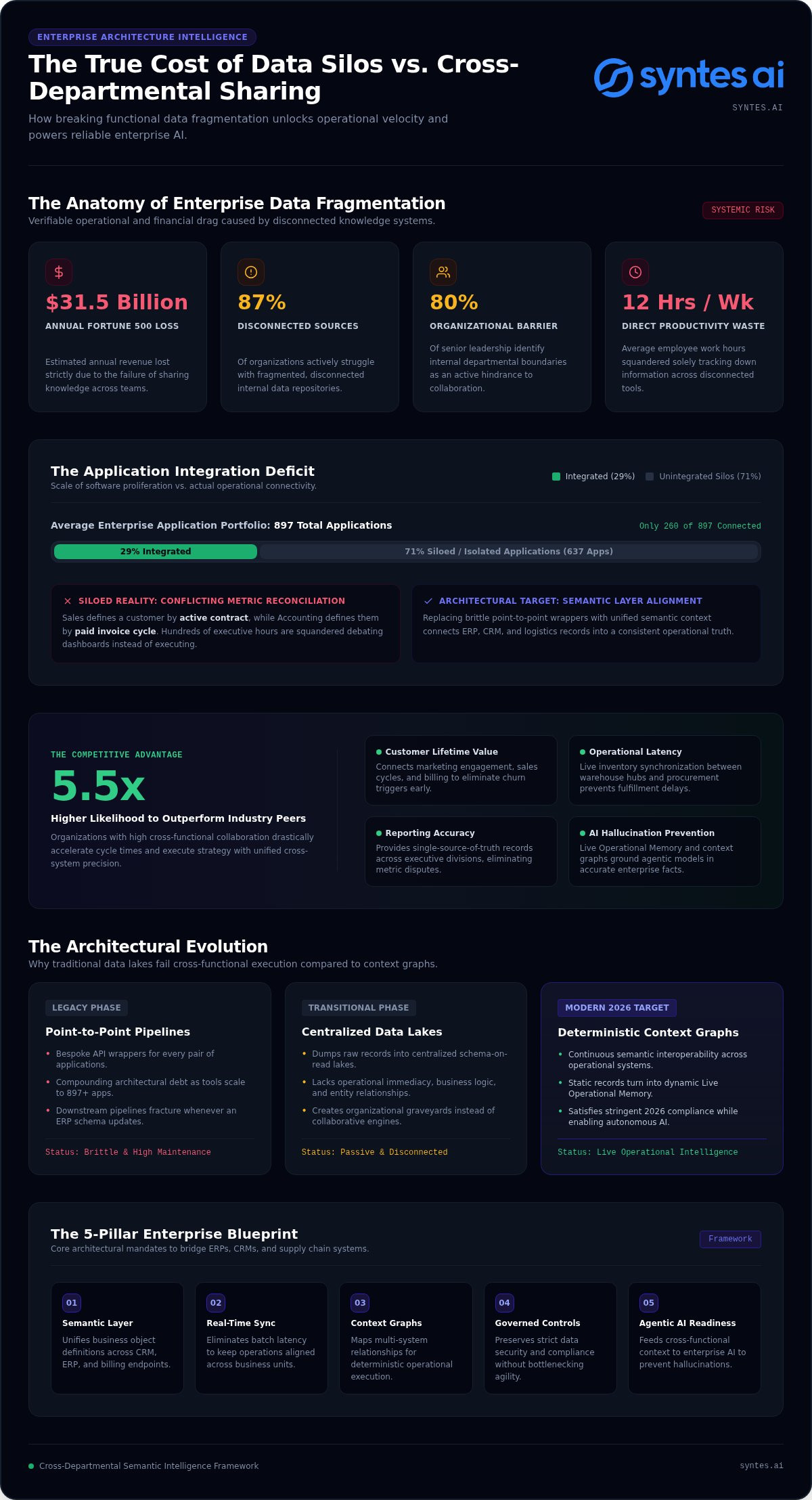
Enterprise data pipelines aren’t connecting your business; they’re fracturing it. Fortune 500 organizations lose an estimated $31.5 billion every year failing to share knowledge across teams, and 87% of companies still struggle with disconnected data sources. Capitalizing on tangible cross-departmental data sharing benefits is no longer a routine IT priority. It’s an urgent executive mandate for competitive survival.
You already live the operational friction. Siloed departments duplicate effort with conflicting metrics, brittle point-to-point integrations fracture under operational stress, and ambitious generative AI pilots stall because algorithms lack cross-functional enterprise context. It’s an expensive status quo that actively drains momentum from every strategic initiative.
This guide shows you how to break that cycle. You’ll discover how unified cross-departmental data sharing unlocks operational velocity, eliminates costly organizational silos, and powers reliable enterprise AI. We examine the verifiable ROI of cross-system interoperability, robust governance frameworks that preserve data security, and the structural shifts turning fragmented records into live operational intelligence in 2026.
Key Takeaways
- Explore how proven cross-departmental data sharing benefits eliminate operational drag and recover millions lost to uncoordinated business units.
- Discover why traditional data warehouses and schema-on-read lakes fail cross-functional teams by isolating context from live execution.
- Learn the 5-pillar blueprint required to bridge ERPs, CRMs, and supply chain records into an integrated enterprise architecture.
- Unpack how deterministic context graphs turn static business records into Live Operational Memory that prevents agentic AI hallucinations.
- Establish governed access controls that satisfy stringent 2026 data compliance mandates without compromising operational agility.
The Strategic Imperative: Why Cross-Departmental Data Sharing Defines Modern Enterprise Velocity
Enterprise velocity stalls when data remains locked in isolation. Cross-departmental data sharing isn’t an exercise in building more passive pipelines or holding team alignment workshops. It requires continuous semantic interoperability across operational systems. When enterprise tools speak different functional languages, business execution grinds to a halt. True cross-departmental data sharing benefits emerge only when information transforms from static records into dynamic, real-time context that flows across software boundaries.
Passive data lakes promised to fix this fracture. They failed. Dumping raw data into centralized repositories creates organizational graveyards rather than collaborative engines. Data lakes lack business logic, entity relationships, and operational immediacy. As a result, 80% of senior leaders identify internal boundaries as an active barrier to collaboration. To unlock tangible cross-departmental data sharing benefits, enterprise architecture must shift away from disconnected point-to-point transfers and move toward a shared operational foundation.
Deconstructing the Enterprise Cost of Departmental Silos
Knowledge fragmentation inflicts severe financial damage across the enterprise value chain. When customer success records, ERP billing tables, and supply chain schedules operate as an isolated information silo, systemic revenue leakage is inevitable. These disconnects directly impact corporate balance sheets:
- Direct productivity drain: Employees waste an average of 12 hours per week searching for information across disconnected systems, driving up operational overhead.
- Conflicting metric reconciliation: Finance and sales teams squander hundreds of executive hours each quarter debating which dashboard reflects truth rather than executing strategy.
- Compromised executive forecasting: Blind spots across departmental boundaries distort demand modeling, resulting in costly inventory misallocations and delayed product rollouts.
From Point-to-Point Pipelines to Unified Operational Intelligence
Brittle point-to-point integrations cannot sustain modern digital scale. The average enterprise runs 897 applications, but only 29% are integrated. Writing bespoke API wrappers for every pair of systems creates compounding architectural debt. The moment an ERP schema updates, downstream CRM pipelines fracture, blinding cross-functional teams.
Fragmented schema definitions actively distort executive decisions across business divisions. One department defines a customer by active platform contract, while accounting defines them by paid invoicing cycle. Bridging this systemic operational gap requires solving enterprise data silos at the semantic layer. Without a shared semantic context that unifies meaning across all operational endpoints, point-to-point connections simply deliver bad information faster.
7 High-Impact Cross-Departmental Data Sharing Benefits Across the Enterprise Value Chain
Organizations with high cross-functional collaboration are 5.5 times more likely to outperform their industry competitors. Yet, many executives still view data integration as an internal plumbing exercise rather than a commercial lever. Realizing genuine cross-departmental data sharing benefits requires linking operational actions directly across lines of business. When data moves freely between departments, business friction drops, margins expand, and cross-functional teams execute with precision.
The measurable advantages span four foundational operational pillars:
- Accelerated customer lifetime value: Connecting marketing engagement data, sales cycles, and downstream accounting eliminates churn triggers early.
- Compressed operational latency: Live inventory synchronization between warehouse hubs and procurement prevents fulfillment delays.
- Definitive reporting accuracy: Single-source-of-truth records eliminate board-level audit disputes and streamline multi-jurisdiction compliance.
- Autonomous agentic orchestration: Cross-functional software agents trigger actions across ERP, CRM, and support desks without manual intervention.
Optimizing Revenue Operations and Customer Experience
Fragmented customer journeys cost deals. Sales teams frequently pitch renewals without seeing critical support tickets lodged in customer service platforms. Synchronizing frontline CRM opportunities with ERP billing tables stops invoicing disputes before they impact cash collections. When every customer touchpoint draws from the full multi-departmental history, tailored interventions replace generic outreach, protecting expansion revenue across high-value accounts.
Accelerating Operational Agility and Supply Chain Resilience
Real-time supply chain execution demands dynamic alignment between raw inventory, warehouse capacities, and live sales velocity. Disconnected supply networks leave businesses guessing. By synchronizing manufacturing logistics directly with regional sales forecasts, supply chain leaders replace reactive crisis management with proactive procurement adjustments, mitigating vendor bottlenecks before production schedules collapse.
Establishing the Foundation for Trusted Enterprise AI
Generative AI initiatives fail without connected enterprise context. In fact, Gartner predicts that through 2026, 60% of enterprise AI projects will be abandoned due to insufficient data quality or lack of AI-ready architectures. Disconnected data lakes starve large language models of necessary context, inducing costly operational hallucinations.
Grounding AI models in verified cross-system records turns generative potential into dependable business execution. Integrating unstructured documentation like contracts alongside structured ERP databases is central to preventing AI hallucination across autonomous workflows. To see this operational layer deployed across your live enterprise architecture, you can book a platform demonstration with our systems engineering team.
Architectural Pitfalls: Why Traditional Data Lakes and Warehouses Fail Cross-Functional Teams
Centralized data warehouses were engineered for backward-looking aggregate reports, not real-time operational execution. Staging multi-departmental data into static storage tables inevitably strips away the temporal and semantic context that gives information its operational value. Schema-on-read data lakes compound the issue: they allow organizations to dump petabytes of unstructured text, telemetry, and transactional rows into isolated storage buckets without establishing how those records relate. The result is a sluggish archive that cannot power cross-functional workflows.
Copying raw departmental data across these staging repositories also introduces acute governance exposure. Enterprise security boundaries shatter when raw records are duplicated into uncontrolled analytics sandboxes. To capture real cross-departmental data sharing benefits, enterprise architecture must move beyond passive analytical storage. Operational teams need live context, not stale copies of tables extracted twelve hours after a business event occurred.
The Context Deficit in Modern Data Warehousing
Relational databases flatten rich business realities into rows and columns. In that translation, complex multi-entity relationships disappear. Standard batch ETL jobs extract records from source applications, strip their real-time state, and transform them to fit rigid warehouse schemas. Cross-functional analysts then spend weeks attempting to reconstruct lost business relationships from unfamiliar divisional tables, producing delays that paralyze daily execution.
Semantic Drift: The Silent Killer of Cross-System Accuracy
Semantic drift occurs when distinct business units apply conflicting definitions to identical operational terminology. The resulting disconnect ripples across every executive reporting dashboard:
- Conflicting entity metrics: Sales defines a “customer” the day a contract is digitally signed; finance records them only after initial cash clearance; customer support counts any user with a provisioned seat.
- Metric misalignment: Marketing evaluates churn based on account subscription tier downgrades, while operations calculates churn strictly around product usage cessation.
- Cascading analytical errors: These unaligned enterprise dictionaries compound across departments, causing automated workflows to trigger contradictory actions across transactional platforms.
Resolving this systemic architectural failure requires implementing an active semantic data layer. Without an authoritative context layer that resolves structural discrepancies dynamically across connected source tools, your organization simply automates the distribution of flawed interpretations.
The 5-Pillar Blueprint for Scalable Cross-Departmental Data Sharing
Ad hoc data sharing initiatives collapse under governance bureaucracy or brittle code. Sustainable cross-departmental data sharing benefits require a systematic architecture, not committee meetings or temporary sprint rituals. Enterprises need a deterministic operational framework that preserves security postures while enabling seamless data mobility between business units.
Executing scalable enterprise interoperability relies on a cohesive five-pillar operational lifecycle:
- Connect: Ingest structured relational databases and unstructured document stores across systems without disruptive lift-and-shift operations.
- Understand: Automatically extract business entities, corporate hierarchies, and operational linkages across functional divisions.
- Contextualize: Construct an interconnected semantic graph that maps how accounts, inventory, and transactions relate in real time.
- Govern: Enforce zero-trust, role-based access policies, query-level lineage, and compliance guardrails across all touchpoints.
- Execute: Orchestrate automated cross-system actions that trigger operational decisions without human latency.
Pillars 1 to 3: From Data Ingestion to Deep Semantic Understanding
Modern enterprises cannot afford multi-year migration overhauls. The first three pillars extract value directly in place. Ingestion connectors tap ERP, CRM, and cloud applications where records live. Advanced models parse latent entities buried inside PDF contracts, email threads, and compliance documentation. The system then maps explicit operational relationships, resolving disparate divisional records into a unified, queryable context.
Pillars 4 and 5: Strict Governance and Governed Operational Execution
True operational velocity requires continuous risk mitigation. With new compliance mandates such as the EU AI Act enforcement in August 2026 and shifting state-level privacy standards, governed data sharing is an absolute board-level priority. Granular role-based controls ensure customer success agents view contract terms without accessing restricted payroll ledgers.
Every operational query and automated handoff maintains immutable audit logs. Governed agentic workflows execute multi-system transactions, updating ERP line items and triggering supply chain orders, while embedding human-in-the-loop checkpoints for threshold-exceeding actions. This operational discipline is what unlocks resilient cross-departmental data sharing benefits across the enterprise.
Unifying Enterprise Knowledge: How Context Graphs Power Autonomous Cross-Functional Operations
Static data pipelines can’t keep pace with the realities of modern business. Capturing lasting cross-departmental data sharing benefits demands an architecture that comprehends operational relationships in real time. The live Context Graph provides that definitive semantic foundation. By dynamically mapping dependencies across departmental software boundaries, organizations transform isolated operational records into an interconnected, executable web of enterprise intelligence.
This graph layer doesn’t duplicate existing data stores. It interprets them. As operational events unfold, business logic and entity relationships update continuously, bridging corporate history with frontline activities to power reliable, enterprise-wide execution.
Moving Beyond Traditional Retrieval with Live Operational Memory
Traditional vector databases retrieve information based on statistical word similarity, completely ignoring business logic. That’s why naive retrieval systems stumble over complex enterprise questions. GraphRAG replaces probabilistic guessing with deterministic, relationship-aware retrieval. It grounds queries within verified corporate ontologies, establishing a Live Operational Memory that links past contract terms, current billing statuses, and pending shipments. For a detailed breakdown of this infrastructure, consult the executive guide to knowledge graphs.
Empowering Governed Agentic AI Across Enterprise Workflows
Autonomous multi-step execution becomes possible only when AI agents navigate a mathematically sound context layer. Governed agents leverage this shared context to execute complex operational workflows across separate ERP and CRM platforms without manual bridging. Strict context engineering frameworks enforce guardrails that prevent unauthorized transactions or rogue database writes. See how forward-looking companies deploy these systems using agentic AI platforms.
Transform Your Enterprise Data Architecture
Maximizing cross-departmental data sharing benefits requires moving away from fragile point-to-point integrations and passive analytical lakes. Evaluating your organizational data maturity reveals exactly where operational latency drains resources. Unifying your systems through an active semantic context layer eliminates coordination overhead, preserves data security, and positions your business for reliable autonomous operations. To architect a live operational foundation across your stack, Book a demo with the Syntes AI team.
Architecting the Unified Enterprise: Your Next Strategic Move
Treating data integration as a passive storage problem guarantees operational stagnation. Moving past static lakes toward an active Context Graph transforms disconnected business records into Live Operational Memory. By applying a structured framework to connect, understand, contextualize, govern, and execute across systems, your enterprise replaces brittle pipelines with deterministic precision.
Capturing sustainable cross-departmental data sharing benefits requires systemic integration that safeguards enterprise governance while eliminating cross-functional friction. When you bridge ERP, CRM, and operational workflows at the semantic layer, your organization establishes the verified ground truth necessary to scale reliable agentic AI without risk.
Total operational clarity is within reach. By unifying your enterprise architecture around live business context, you position your organization to eliminate legacy overhead and lead the shift toward autonomous enterprise execution.
Frequently Asked Questions
What are the primary operational benefits of cross-departmental data sharing?
The primary operational benefits center on compressing execution cycles, eliminating manual data reconciliation, and enabling cross-system workflow automation. Capturing real cross-departmental data sharing benefits allows supply chain, revenue, and customer success teams to operate from synchronized operational truth. This interoperability stops internal disputes over conflicting records, accelerates customer fulfillment, and provides clean data feeds required for autonomous enterprise operations.
How does cross-departmental data sharing differ from traditional data warehousing?
Traditional data warehousing aggregates historical records into centralized tables for retrospective reporting, whereas modern cross-departmental data sharing provides live operational interoperability between active systems. Warehouses rely on scheduled batch ETL pipelines that strip away real-time context and dynamic business relationships. Modern data sharing leverages an active semantic layer, leaving core records in their source platforms while creating a real-time graph of enterprise logic for daily execution.
Can enterprises share data across departments without violating data privacy regulations?
Yes, organizations can share data seamlessly across business units by enforcing dynamic, attribute-based access controls and strict governance frameworks. Compliance standards like the EU Data Act and state consumer privacy laws require granular authorization rather than total isolation. Implementing a governed semantic layer lets enterprises share operational insights across teams while cryptographically masking sensitive personal details, enforcing zero-trust policies, and logging automated audit trails for regulatory reporting.
What role does a knowledge graph play in facilitating cross-departmental data collaboration?
A knowledge graph acts as an enterprise-wide semantic translation engine, dynamically linking entities and business logic across disparate departmental applications. Instead of forcing every division into a rigid database schema, a knowledge graph maps real-world relationships between customers, supply chains, and financial transactions. This unified structure delivers definitive context across systems, allowing disparate applications to communicate intelligently without brittle point-to-point integrations.
How does ungrounded departmental data cause enterprise AI models to hallucinate?
Enterprise AI models hallucinate when they lack deterministic business context and are forced to predict answers using isolated statistical probabilities. If an AI cannot cross-reference contradictory sales notes against ERP invoices or operational inventory, it bridges information gaps by generating plausible falsehoods. Grounding models within verified enterprise knowledge structures prevents these errors, ensuring AI outputs match audited transactional reality.
What are the first steps to eliminate data silos between sales, finance, and operations?
The first step is standardizing business entity definitions across departments rather than attempting massive data consolidation projects. Leadership must align how distinct teams define fundamental terms like accounts, revenue recognition, and active inventory. Establishing this semantic baseline clarifies how cross-departmental data sharing benefits each unit, paving the way to deploy non-disruptive connectors that unify records into an operational context layer without ripping out legacy tools.
What happens if an organization attempts to deploy agentic AI without cross-system data context?
Deploying agentic AI without cross-system context triggers catastrophic operational failures, unauthorized database modifications, and flawed business decisions. Autonomous agents require comprehensive enterprise visibility to evaluate the downstream consequences of their actions. Without a governed context layer bridging CRM, ERP, and operational software, agents execute commands based on incomplete information, generating cascading errors that derail supply chains and distort customer accounts.