

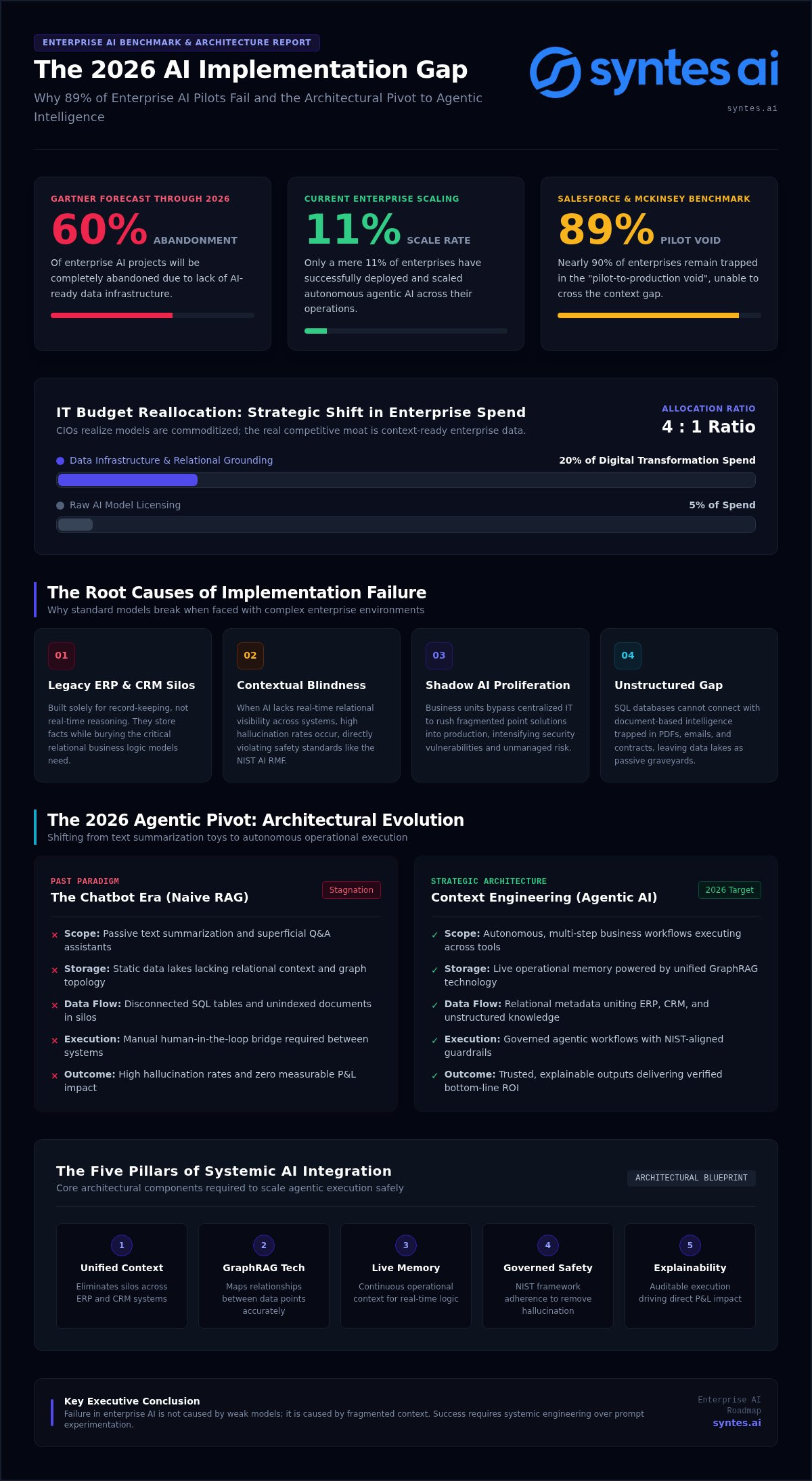
Gartner reports that through 2026, organizations will abandon 60% of AI projects unsupported by AI-ready data. Currently, a mere 11% of enterprises have successfully scaled agentic AI across their operations. You’ve likely felt this stagnation. Your teams launch RAG-based pilots only to face high hallucination rates and fragmented data silos across legacy ERP and CRM systems. These cio challenges with ai implementation aren’t a failure of the models. They’re a failure of architecture.
You recognize that unrealistic stakeholder expectations regarding ROI timelines only compound the pressure to deliver. Discover why enterprise AI initiatives stall and how to bridge the gap between fragmented data and autonomous agentic execution. We’ll provide a roadmap for building trusted, explainable AI that moves beyond passive chatbots toward autonomous agentic workflows. It’s time to stop experimenting. It’s time to execute with systemic precision.
Key Takeaways
- Understand why 89% of enterprise AI pilots fail and how the “Context Gap” prevents the transition from experimental chat to operational execution.
- Identify data fragmentation across legacy ERP and CRM systems as the primary blocker to real-time AI reasoning and reliable ROI.
- Discover the framework of Context Engineering, moving beyond naive RAG to create a live operational memory for your enterprise.
- Solve critical cio challenges with ai implementation by deploying governed agentic workflows that eliminate hallucinations through GraphRAG technology.
- Learn the five pillars of systemic AI integration to move from passive assistants to autonomous, explainable agents that drive measurable P&L impact.
The 2026 AI Implementation Gap: Why Only 11% of CIOs Succeed
The 11% success rate isn’t an indictment of AI technology. It’s an indictment of the enterprise foundation. According to industry benchmarks from Salesforce and McKinsey, nearly 90% of enterprises remain trapped in the “pilot-to-production void,” unable to scale generative or agentic systems beyond isolated silos. This Implementation Gap represents a fundamental failure of context rather than a failure of intelligence. CIOs aren’t lacking powerful models. They’re lacking the architectural bridge between static data and autonomous reasoning.
Traditional IT budgets are shifting to reflect this hard truth. Strategic leaders are now allocating 20% of their digital transformation spend to data infrastructure, compared to just 5% on raw AI model licensing. They’ve realized that a model is only as effective as the data it can reason across. The psychological toll on leadership is immense. CIOs face relentless pressure to deliver “Agentic ROI” while simultaneously wrestling with decades of technical debt and unintegrated legacy systems. These cio challenges with ai implementation require more than a better prompt; they require a systemic evolution.
Stakeholder Pressure vs. Technical Reality
The C-suite’s patience is thinning. After years of generative AI hype, executives demand measurable P&L impact, not “interesting” demos. This pressure creates a dangerous environment where department-specific use cases are rushed into production without enterprise-grade readiness. When centralized IT cannot deliver at the speed of business demand, business units often turn to “Shadow AI.” This creates a fragmented ecosystem of ungoverned tools that exacerbate security risks and further isolate critical data. Managing this hype cycle fatigue while maintaining architectural integrity is the defining struggle for the modern technology leader.
The Shift from Experimentation to Operationalization
We’ve reached the end of the “Chatbot Era.” Passive assistants that simply summarize text are no longer sufficient for global enterprise needs. 2026 marks the year of the “Agentic Pivot,” where the focus shifts toward autonomous business workflows that execute tasks across systems. To succeed, organizations must move beyond simple Retrieval-Augmented Generation (RAG) and prioritize a unified enterprise AI infrastructure. Without this structural shift, agents lack the live operational memory required to perform safely and accurately. Transitioning from experimental pilots to hardened operational systems is no longer optional; it’s a prerequisite for enterprise survival.
Data Fragmentation: The ‘Original Sin’ of Stalled AI Projects
Data silos are the primary reason AI initiatives fail. Solving enterprise data silos is not merely a cleanup project; it’s the absolute prerequisite for agentic success. Most organizations are trapped in “Data Debt.” Legacy ERP and CRM architectures were designed for record-keeping, not real-time reasoning. They store facts but bury relationships. This structural deficit makes it impossible for an AI model to understand the complex business logic required for autonomous action. When your data is fragmented, your AI is effectively blind.
Unifying business rules with document-based knowledge remains a monumental hurdle. Structured data in SQL databases rarely talks to the unstructured intelligence trapped in PDFs, emails, and contracts. Simple data lakes are insufficient for grounding agentic AI workflows because they lack the relational metadata necessary for complex reasoning. You don’t need more storage. You need more context. Without a unified view of the enterprise, your AI remains a series of disconnected experiments rather than a cohesive operational force.
The Failure of Disconnected Systems
Fragmented knowledge leads to “Contextual Blindness.” When an AI model lacks access to the interconnected reality of your operations, it hallucinates or stalls. This creates a massive trust gap. Manual data orchestration, where humans must bridge the gap between systems, negates the speed of AI. Legacy middleware cannot provide the “Live Operational Memory” these systems require. Without a unified layer, you risk violating safety protocols outlined in the NIST AI Risk Management Framework. These cio challenges with ai implementation won’t be solved by better algorithms, but by better connectivity.
From Data Lakes to Contextual Graphs
Data lakes often become data graveyards. They store massive volumes of information but lack the relational structure needed for reasoning. A flat data structure cannot represent the nuance of a supply chain or a complex customer lifecycle. This is where the semantic data layer for enterprise becomes essential. It transforms isolated records into a living web of intelligence. Relationship-based intelligence outperforms isolated data records by providing the semantic context required for models to understand the “why” behind a transaction rather than just the “what” of the record.
If your AI strategy is hitting a wall of fragmented data, it’s time to rearchitect your foundation. You can book a demo to see how a unified context graph eliminates these barriers and enables true operational clarity.
The Trust Deficit: Hallucinations and the Governance Barrier
Hallucinations aren’t a minor glitch; they’re a structural liability. In a high-stakes enterprise environment, a probabilistic guess is a legal and operational risk that few can afford. A Stanford HAI study on model trustworthiness confirms that foundation models often lack the reliability required for mission-critical deployment. By 2026, standard Retrieval-Augmented Generation (RAG) has hit a performance ceiling. It retrieves text based on similarity, but it lacks the relational depth to verify truth. For leadership, this creates a trust gap that halts production-grade scaling before it even starts.
Regulated industries like Finance, Healthcare, and Government demand explainable reasoning. You can’t tell a regulator or a patient that the “model just thought so.” Without a robust context layer, autonomous agents risk “Agentic Drift,” where small reasoning errors compound into catastrophic operational failures. These cio challenges with ai implementation won’t be solved by simply adding more guardrails. They require a fundamental shift in how truth is anchored within your system. Solving these cio challenges with ai implementation requires a transition from probabilistic outputs to deterministic certainty.
Architecting Deterministic Truth
Move from probabilistic guesses to deterministic business outcomes. Probabilistic systems are inherently unstable and difficult to audit. To achieve true enterprise scale, you must ground your AI in enterprise knowledge graphs. These graphs provide a verifiable ground truth, allowing the model to traverse actual business relationships rather than just predicting the next likely word. Don’t rely on “Human-in-the-Loop” as a permanent scaling strategy; it’s a temporary bridge that creates an expensive performance bottleneck and prevents the very efficiency AI is designed to deliver.
Governance as an Enabler, Not a Blocker
Shift your perspective on governance. It isn’t a set of restrictive policies; it’s a technical enabler for autonomous action. When you implement semantic grounding, you eliminate the “Black Box” problem by providing a clear, auditable trail of reasoning for every decision the AI makes. This allows for the safe deployment of governed agents that can execute complex tasks without constant manual oversight. The transition from policy-based governance to architecture-embedded governance ensures that compliance is a functional property of the system rather than a manual, reactive task.
Beyond RAG: The Strategic Pivot to Context Engineering
Basic Retrieval-Augmented Generation (RAG) is no longer sufficient for the demands of the 2026 enterprise. While RAG allowed models to “look up” information, it failed to provide the deep relational understanding required for autonomous reasoning. We’ve moved into the era of Context Engineering. This discipline represents the next evolution after prompt engineering; it’s the systematic process of building, governing, and operationalizing enterprise context. AI is only as intelligent as the context it understands. Without this layer, your models are simply guessing based on proximity rather than reasoning based on reality.
The Syntes Context Engineering Framework is built on five critical pillars. These pillars transform raw data into a live operational model:
- Connect: Integrating structured and unstructured data across fragmented silos.
- Understand: Discovering entities, hierarchies, and semantic relationships automatically.
- Contextualize: Building a dynamic model that reflects the current state of the business.
- Govern: Applying security, permissions, and compliance rules at the architecture level.
- Execute: Enabling agents to perform multi-step tasks with deterministic accuracy.
This strategic pivot addresses the core cio challenges with ai implementation by moving beyond static data retrieval. Instead of feeding a model a “chunk” of text, you’re providing it with a living map of your business operations. This transition from passive observation to active, automated performance is what separates market leaders from those stuck in the pilot phase.
The Architecture of a Context Graph
A standard Knowledge Graph is often a static repository of facts. In contrast, a Syntes AI Context Graph is a live operational memory that integrates business rules, internal policies, and real-time events into a unified reasoning layer. It doesn’t just store data; it understands how a change in a supply chain contract affects a customer’s pricing logic. This real-time connectivity is the essential engine for agentic ai platforms, allowing agents to make informed decisions without human intervention.
Operational Relationship Intelligence
In the enterprise, relationships between data points matter more than the data points themselves. Knowing a customer’s name is a commodity; understanding their relationship to a specific contract, a pending support ticket, and a shifting discount threshold is intelligence. Building an “Enterprise Memory” that evolves with your operations ensures that your AI doesn’t become obsolete as your business changes. Context Engineering provides the proprietary edge by transforming generic model intelligence into a specialized system that understands the unique logic and operational DNA of your specific enterprise.
The Roadmap to Agentic Intelligence: Operationalizing with Syntes AI
Operationalizing AI is no longer a matter of choosing the right model. It’s a matter of architecting the right environment. To overcome the persistent cio challenges with ai implementation, leadership must follow a rigorous, four-step roadmap that prioritizes context over raw compute. This journey transforms fragmented data into a strategic asset capable of driving autonomous action.
- Step 1: Unify the Context Layer. You must connect structured data from ERPs and CRMs with the unstructured intelligence buried in your document repositories. This creates a single, coherent reasoning layer that reflects the totality of your business logic.
- Step 2: Deploy GraphRAG. Moving beyond simple vector searches, GraphRAG enables deeper reasoning by traversing the relationships between entities. This architectural shift effectively eliminates hallucinations by grounding model outputs in verifiable, interconnected facts.
- Step 3: Orchestrate Governed AI Agents. Once the foundation is set, you can deploy agents to execute complex, cross-system workflows. These agents don’t just answer questions; they perform actions across your enterprise stack under strict governance protocols.
- Step 4: Integrate Live Operational Memory. Your AI must evolve at the speed of your business. By integrating a live operational memory, your system continuously updates its understanding based on real-time events and transactional shifts.
The Syntes Agentic Platform Advantage
The Syntes AI Context Graph serves as the essential brain for autonomous agents. Unlike generic models that rely on probabilistic patterns, our platform provides a deterministic framework for execution. We achieve trusted AI execution through explainable reasoning paths, allowing your compliance teams to audit exactly why an agent took a specific action. This level of transparency is impossible with consumer-grade chatbot tools. By focusing on systemic integration rather than isolated prompts, we enable you to scale AI initiatives across the entire enterprise without compromising on safety or accuracy.
Future-Proofing Your AI Strategy
Models will change. Architecture must endure. By building a foundation centered on Context Engineering, you create a system that survives the next wave of model evolution. Whether you’re running GPT-4o or the next generation of open-source LLMs, the underlying context graph remains your proprietary edge. The ROI of moving from passive insights to active, automated performance is clear: it represents the transition from a cost center to an operational engine. Ready to solve your AI implementation challenges? Book a Demo with Syntes AI.
Architecting for the Agentic Era
The 11% success rate seen in 2026 isn’t a limitation of AI intelligence; it’s a structural deficit in enterprise context. To overcome the most persistent cio challenges with ai implementation, leadership must move beyond the “Chatbot Era” and embrace a unified architectural foundation. This requires a strategic pivot from simple retrieval to a Live Operational Memory that grounds every decision in real-time business reality. You don’t need more models. You need a better bridge between data and reasoning.
Success demands a Governed Agentic AI framework that prioritizes explainable AI reasoning over probabilistic guesses. By building a robust context graph, you transform fragmented data silos into a cohesive engine for autonomous action. This architectural shift ensures your AI initiatives move from isolated pilots to hardened, revenue-driving operations that survive the next wave of technological evolution. Transitioning from passive observation to active, automated performance is the only path to sustainable ROI.
The future of the enterprise belongs to those who bridge the context gap. Your roadmap to trusted, agentic intelligence starts with a foundation built for execution and operational clarity.
Frequently Asked Questions
What are the biggest CIO challenges with AI implementation in 2026?
The primary cio challenges with ai implementation involve bridging the “Context Gap” between foundation models and proprietary business logic. Most organizations struggle with fragmented data silos across legacy ERP and CRM systems, leading to a mere 11% success rate in enterprise-wide scaling. Leaders must move beyond experimental chatbots to architect systems that integrate live operational memory and governed execution frameworks to meet rising stakeholder expectations for measurable P&L impact.
Why is data quality still the primary barrier to AI success?
Data quality in 2026 isn’t just about cleanliness; it’s about relational accessibility. Legacy architectures often store facts as isolated records, burying the complex relationships between customers, contracts, and inventory. Without a unified semantic layer, AI models lack the necessary context to reason accurately. Stalled projects often result from “Data Debt,” where disconnected systems prevent the model from understanding the “why” behind a transaction, leading to unreliable outputs.
What is the difference between RAG and Context Engineering?
Traditional RAG is a passive retrieval mechanism that pulls text chunks based on similarity, often missing deeper business logic. Context Engineering is a proactive architectural discipline focused on building and maintaining a live Context Graph. While RAG treats data as static documents, Context Engineering creates a continuously evolving operational model. This shift enables AI systems to understand complex hierarchies and multi-step workflows rather than simply summarizing search results.
How can CIOs prevent AI hallucinations in enterprise environments?
Preventing hallucinations requires moving from probabilistic guesses to deterministic truth. By implementing GraphRAG and semantic grounding, organizations anchor AI reasoning in a verifiable Knowledge Graph. This ensures the model traverses actual business relationships instead of predicting the next likely word based on proximity. Providing a governed context layer allows the system to verify facts against live operational data, effectively eliminating the “black box” problem common in standard LLMs.
What role does a Knowledge Graph play in AI implementation?
An Enterprise Knowledge Graph serves as the unified context layer and “Enterprise Memory” for AI agents. It integrates structured and unstructured data into a structured format that models can interpret with high precision. This graph acts as the proprietary edge, connecting disparate systems like ERPs and digital assets into a single reasoning layer. It provides the structural foundation required for agents to perform complex, cross-functional tasks with explainable reasoning paths.
How do you measure the ROI of Agentic AI platforms?
ROI for agentic systems is measured by the transition from passive insights to active, automated performance. Organizations should track the reduction in manual data orchestration and the acceleration of cross-system workflows. Successful implementation results in measurable P&L impact through increased operational efficiency and the ability to execute complex tasks without human intervention. Moving beyond simple cost-per-query metrics to “task completion value” provides a clearer picture of agentic intelligence benefits.
Why is AI governance critical for autonomous agents?
Governance is the essential enabler for autonomous action, preventing “Agentic Drift” where compounding reasoning errors lead to operational failure. A robust framework ensures that AI agents operate within defined business rules, security permissions, and compliance mandates. By embedding governance into the architecture through a Context Graph, CIOs can provide an auditable trail of reasoning. This transparency is vital for regulated industries requiring explainable AI and human-in-the-loop oversight for high-risk processes.
Can AI agents safely execute business processes across legacy systems?
Yes, provided they are supported by a platform capable of deep cross-system integrations and two-way connectors. These agents interact with legacy ERP and CRM systems by using a live operational memory to understand current states and constraints. When built on a governed framework like the Syntes Agentic Platform, agents can safely perform multi-step tasks across fragmented stacks. This ensures that legacy debt doesn’t block innovation while maintaining the integrity of core business records.