
Your enterprise AI is only as intelligent as the context it can actually process. Most organizations are attempting to deploy autonomous agents on top of rigid, fragmented silos, essentially asking a high-performance engine to run on sludge. If your AI lacks a coherent understanding of how your ERP and CRM data intersect, it isn’t an agent; it’s a liability waiting to hallucinate.
You understand that raw data volume is no longer the competitive moat. The challenge lies in the structural disconnect between static records and real-time operational shifts. This article provides the definitive blueprint to master the knowledge graph data model, transforming disconnected information into a governed, live operational memory. We’ll move beyond traditional RAG to explore Context Engineering, which is the methodology required to architect a scalable semantic data model. You’ll learn how to integrate structured and unstructured data to provide the explainable reasoning your agents need to execute with total certainty.
Key Takeaways
- Shift from rigid relational tables to a dynamic semantic representation that captures the complex interdependencies of your business entities.
- Architect a robust knowledge graph data model that treats relationships as first-class citizens, enabling autonomous agents to navigate the “verbs” of your enterprise operations.
- Adopt Context Engineering as the necessary evolution beyond RAG to ensure AI outcomes are grounded in governed, real-time operational context.
- Define a clear “Action Space” within your graph to map business rules directly to agent behavior, ensuring compliant and explainable AI reasoning.
- Transform fragmented data silos into a live operational memory that bridges the gap between general-purpose LLMs and your proprietary enterprise intelligence.
What is a Knowledge Graph Data Model in the Enterprise Context?
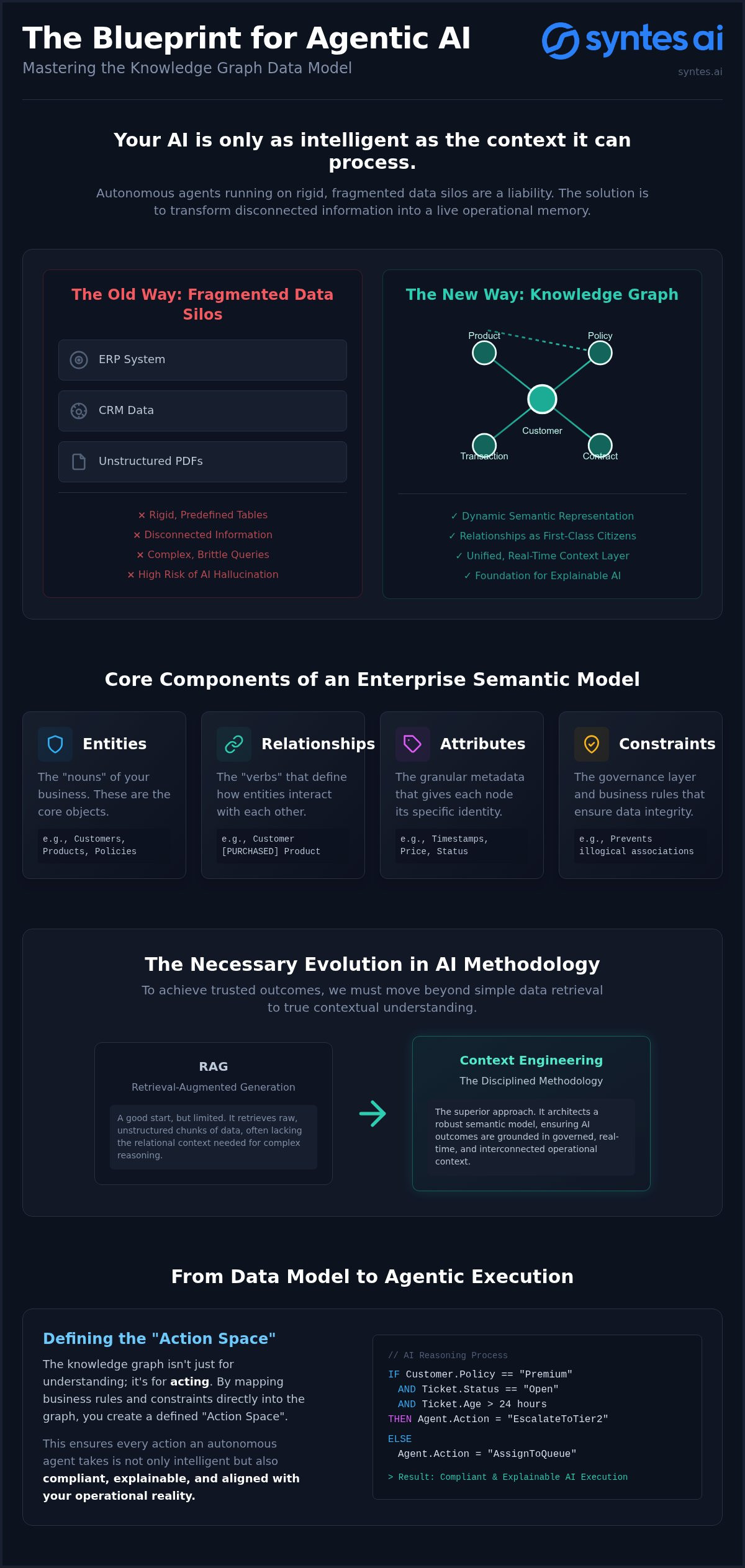
Static data is dead weight. For an enterprise to survive the transition to agentic AI, it must move beyond the spreadsheet and the isolated silo. A Knowledge Graph is not just a database; it is a semantic map of your business’s reality. Specifically, a knowledge graph data model represents entities and their relationships as an interconnected web rather than isolated rows. It captures the “how” and “how much” behind every data point, providing a foundation for reasoning that relational systems cannot match.
By 2026, the competitive advantage will belong to those who treat data as a live operational memory. Static records from last quarter are insufficient for autonomous agents that must make split-second decisions. The Syntes AI Context Graph addresses this by creating a unified, real-time context layer that evolves alongside your business. It transforms passive information into an active intelligence asset, ensuring that agents don’t just see data, but understand its significance within your specific operational environment.
From Relational Databases to Semantic Graphs
Relational databases are rigid by design. They demand that data fits into predefined boxes, often severing the vital connections between an ERP system and a CRM. Semantic graphs ignore these artificial boundaries. Instead of joining tables through complex queries, they link nodes through edges that define clear, machine-readable relationships. This flexibility is the core of a semantic data layer for enterprise. It bridges the gap between disparate data sources. It allows your AI to understand that a “client” in your sales ledger is the same “purchaser” in your logistics portal, creating a single, coherent source of truth.
The Role of Ontologies and Taxonomies
Building a knowledge graph data model requires more than just connecting dots. It requires an ontological framework. Ontologies act as the business logic, defining the rules of engagement between entities. If a customer has a specific policy, the ontology dictates what actions an agent can legally or operationally take. Taxonomies complement this by categorizing data into hierarchical structures, ensuring that enterprise search is both lightning-fast and contextually accurate. Context Engineering is the disciplined methodology of designing and maintaining this business context to ensure every AI interaction is grounded in truth.
Core Components of an Enterprise-Grade Semantic Model
Architecture dictates intelligence. To move from simple chatbots to autonomous agents, you must build a knowledge graph data model that functions as a sophisticated skeletal system for your enterprise logic. This isn’t a passive storage exercise. It’s an active mapping of your operational reality. A high-performance model consists of four fundamental layers that provide the structural context necessary for trusted AI outcomes.
- Entities: The business “nouns.” These are your customers, products, legal policies, and specific transactions.
- Relationships: The business “verbs.” They define how entities interact, such as a Customer [PURCHASED] a Product or a Product [VIOLATES] a Policy.
- Attributes: Granular metadata. This includes timestamps, price points, and status indicators that give each node its specific identity.
- Constraints: The governance layer. These rules ensure data integrity and prevent AI agents from making illogical or uncompliant associations.
Modeling Structured vs. Unstructured Data
The gap between structured ERP records and unstructured PDF contracts is where enterprise AI usually dies. You can’t expect an agent to make informed decisions when it’s blind to half your data. Integration requires two-way connectors that ingest records and documents simultaneously. This is the definitive path for solving enterprise data silos. By converting unstructured assets into semantic nodes, you provide the agent with a complete operational picture, allowing it to reason across contracts and ledgers with equal fluency.
Temporal and Operational Relationships
Time is a critical dimension of context. Most data models are snapshots; they represent the business as it exists right now. Agentic AI requires a Live Operational Memory to understand the sequence of events. It needs to know if a support ticket was opened before or after a renewal attempt. Dynamic context graphs track these temporal shifts in real time. If you’re ready to see how these components unify your operations, you might want to explore a live context architecture in action. This shift from static snapshots to live streams is what separates legacy knowledge graphs from modern enterprise intelligence.
Context Engineering: The Methodology for Knowledge Graph Design
Prompt engineering is an amateur’s game. RAG was a necessary first step, but it remains a retrieval tool rather than a reasoning engine. To achieve genuine autonomy, enterprises must adopt Context Engineering. This is the strategic methodology for designing a knowledge graph data model that supports the full Connect-Understand-Contextualize-Govern-Execute framework. It moves the needle from simple text matching to a deep, structural understanding of business logic. This methodology ensures that data is not just stored, but is actively participating in the AI’s decision-making process.
Hallucinations occur when AI lacks a deterministic ground truth. Without semantic grounding, an LLM fills gaps with probabilistic guesses that lead to operational errors. Context Engineering eliminates this risk by providing a governed layer of facts that the AI cannot ignore. You can effectively learn how to prevent ai hallucination by enforcing semantic constraints that ground every agentic action in reality. This creates a “safety rail” for autonomous agents, ensuring they operate within the bounds of your specific business rules.
Beyond RAG: The Rise of GraphRAG
Vector search is inherently limited by its reliance on mathematical similarity. It finds similar text snippets but misses the logical threads that connect a product defect in one system to a specific supplier contract in another. GraphRAG solves this. It enables multi-hop reasoning, allowing the AI to traverse the knowledge graph data model to find non-obvious connections that a standard search would overlook. GraphRAG is advanced retrieval using graph structures that provides the deep context vector databases simply cannot reach. This approach allows agents to synthesize information from across the entire enterprise architecture, finding the “why” behind the data.
Operational Relationship Intelligence
Data points are useless in isolation. The value exists in the relationships. This intelligence layer focuses on the “verbs” of your business, defining how entities interact and impact one another. It tracks these interactions over time, creating a foundation for trusted execution in high-stakes environments. This is the core of a modern enterprise knowledge graph. By prioritizing relationship intelligence, you ensure that every decision made by your agents is both explainable and operationally sound, moving your AI from a passive observer to an active, reliable participant in your workflows.
Building a Data Model for Agentic AI Execution
Execution is the ultimate metric of enterprise AI. A knowledge graph data model must do more than represent facts; it must define the boundaries of what an AI agent can actually do. This is the “Action Space.” In an enterprise environment, unconstrained AI is an operational liability. By mapping business rules directly onto graph edges, you ensure that every autonomous step follows corporate policy and compliance standards. It’s the difference between an AI that simply suggests an answer and one that safely executes a multi-step procurement workflow.
How do you transition from a passive database to an active agentic environment? You define the Action Space within the graph itself. This involves identifying the specific systems an agent can access and the specific functions it’s permitted to trigger. Within this model, Human-in-the-Loop (HITL) checkpoints aren’t afterthoughts; they’re integrated nodes. High-stakes decisions require explicit human validation before the agent proceeds, ensuring that Live Operational Memory remains accurate and governed. This architectural choice allows for continuous learning without sacrificing the safety of your core operations.
Modeling Agentic Workflows
Linear workflows are too brittle for modern enterprise complexity. Instead, represent business processes as graph-based workflows where nodes represent tasks and edges represent the logic of progression. Modern agentic ai platforms use these models to navigate complex decision trees in real time. This approach ensures total explainability. Because every agent action is traceable back to a specific path in the graph, you possess a clear audit trail for every automated decision, satisfying both technical and regulatory requirements.
Governance and Safety in Agentic Models
Security cannot be a wrapper; it must be part of the data’s DNA. Modeling permissions at the node and edge level ensures that an agent only “sees” and “acts” upon data it’s authorized to handle. This granular control prevents unauthorized actions by providing a governed context that the AI cannot bypass. To sustain this, you need enterprise ai infrastructure designed for agentic intelligence. This infrastructure supports the governance layer of your knowledge graph data model, making it impossible for agents to violate data privacy or operational boundaries, even when operating at scale.
Syntes AI: Transforming Static Models into Live Operational Memory
Legacy knowledge graphs are museum pieces. They capture a moment in time, but they fail to capture the momentum of a live business. The Syntes AI Context Graph represents the definitive evolution of the knowledge graph data model, functioning as a unified enterprise context layer that powers autonomous performance. It doesn’t just archive facts; it synthesizes them into a live operational memory. This is the structural foundation that allows your AI to move from passive observation to active, governed execution.
General-purpose LLMs possess raw reasoning capability but suffer from a total lack of enterprise-specific sight. Syntes AI bridges this critical gap. By grounding these models in a sophisticated semantic layer, we transform the “black box” of AI into a transparent, high-performance engine. This integration is the core of the Syntes Agentic Platform. It ensures that your agents aren’t just guessing based on probability; they’re executing based on the deterministic truth found in your cross-system data.
The Syntes AI Advantage
Intelligence requires a pulse. Our Context Graph evolves in real time, ingesting operational shifts as they happen to ensure your agents never act on stale information. It forces a seamless integration between your ERP, CRM, and unstructured assets, creating a single, coherent intelligence fabric. This architecture delivers explainable reasoning by design. Because every agentic decision is mapped to a specific path within the knowledge graph data model, your team can audit, verify, and trust every automated outcome with absolute certainty.
Next Steps for Enterprise Intelligence
The transition to agentic AI is not a future project; it’s a current strategic necessity. You must embrace Context Engineering now to architect the “Enterprise Memory” that will define your competitive moat. Scaling these initiatives requires moving beyond consumer-grade tools and experimental scripts. It demands a professional-grade platform built for the complexities of global business logic. Stop managing data and start engineering context. Contact Syntes AI today for a comprehensive platform demonstration and take the first step toward total operational clarity.
Architecting the Future of Enterprise Intelligence
The era of passive data management is over. Organizations that continue to rely on fragmented silos and static records will find their AI initiatives stalled by hallucinations and operational blind spots. You’ve seen how a robust knowledge graph data model serves as the essential reasoning engine, connecting disparate systems into a single, governed truth. By embracing Context Engineering, you provide your autonomous agents with the structural foundation they need to execute complex workflows with total certainty.
Syntes AI stands as a pioneer in this space, offering the only platform designed to transform raw data into a Live Operational Memory. Our approach ensures enterprise-grade governance for Agentic AI, replacing black-box uncertainty with trusted, auditable execution. It’s time to bridge the gap between general intelligence and proprietary operational reality.
Take the lead in the next evolution of autonomous performance. Your enterprise context is your most valuable asset; it’s time you started engineering it.
Frequently Asked Questions
What is the difference between a knowledge graph and a property graph?
A knowledge graph prioritizes semantic meaning and ontological rules to ensure data is machine-understandable across systems. Property graphs focus on the storage of nodes and edges with specific attributes. Syntes AI leverages a hybrid approach to combine the flexibility of property graphs with the governed reasoning of a semantic knowledge graph. This architecture ensures that your data isn’t just connected; it’s logically coherent for autonomous agents.
How does a knowledge graph data model improve AI accuracy?
Accuracy improves through deterministic grounding. By utilizing a knowledge graph data model, you replace the probabilistic guessing of LLMs with a structured map of business reality. This semantic grounding forces agents to follow established relationships and rules. It eliminates the “black box” effect, ensuring every AI outcome is grounded in your enterprise’s specific truth rather than general training data.
Can a knowledge graph data model integrate with existing ERP and CRM systems?
Absolute integration is a core requirement for enterprise intelligence. Syntes AI utilizes two-way connectors to ingest data from ERP and CRM systems, alongside unstructured documents. This process creates a unified context layer that synchronizes your entire software stack. It allows AI agents to reason across sales ledgers and legal contracts simultaneously, providing a complete picture of your operations in real time.
What is the role of ontologies in a knowledge graph data model?
Ontologies function as the “business logic” layer of your knowledge graph data model. They define the formal rules and constraints that govern how entities interact within your enterprise. Without an ontology, a graph is just a collection of links. With it, the graph becomes a reasoning engine capable of enforcing compliance and ensuring that autonomous agents act within your specific operational boundaries.
How do I scale a knowledge graph across a large enterprise?
Enterprise scaling requires a methodical Context Engineering framework. You must move away from isolated experiments toward a federated architecture that connects disparate data silos. By building an enterprise memory through incremental system integration, you create a scalable intelligence layer. This approach allows the graph to expand across departments while maintaining the centralized governance necessary for trusted AI execution.
Is a knowledge graph necessary if I already use a vector database for RAG?
Vector databases are insufficient for complex reasoning. While they excel at finding similar text snippets, they cannot navigate logical relationships or perform multi-hop reasoning. A knowledge graph provides the structural context that vector RAG lacks. It moves your AI strategy beyond simple retrieval toward GraphRAG, enabling agents to synthesize information and execute tasks based on logical connections rather than just mathematical similarity.
What are the security implications of an agentic AI data model?
Security in an agentic model must be granular and governed. By modeling permissions at the node and edge level, you define exactly what an agent can see and do. This prevents unauthorized access to sensitive data and ensures that AI actions remain compliant with corporate policy. It’s a fundamental shift from general network security to context-aware governance within the data layer itself.
How does ‘Live Operational Memory’ differ from a traditional data warehouse?
Traditional data warehouses are built for historical reporting and passive analysis. Live Operational Memory is designed for active, real-time reasoning. It continuously ingests operational events, allowing the Syntes AI Context Graph to evolve alongside your business. This ensures that agents are always working with the most current context, enabling them to make informed decisions and execute workflows as they happen.