

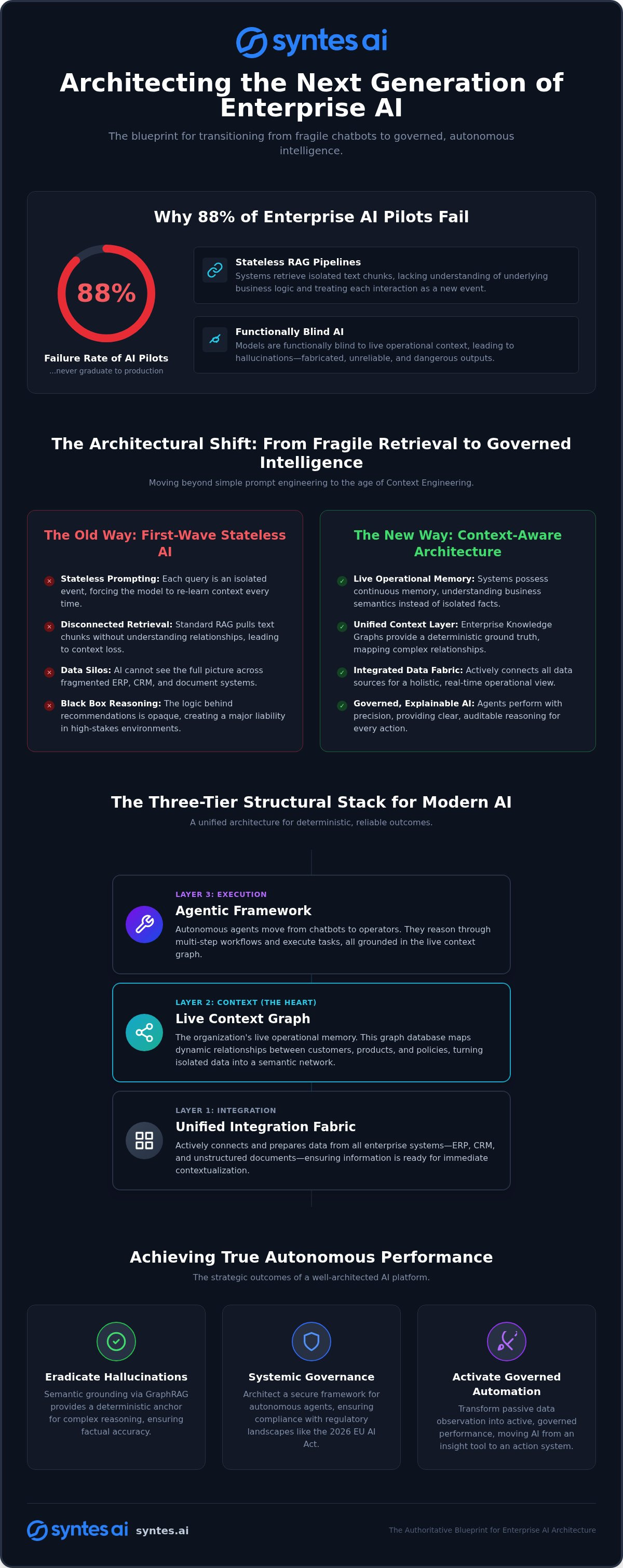
Forrester reports that 88% of enterprise AI agent pilots never graduate to production. This staggering failure rate signals a structural deficiency in current enterprise ai platform architecture. Most organizations remain trapped in the limitations of stateless RAG pipelines that retrieve isolated text chunks without grasping the underlying business logic. These systems lack the vital connective tissue required for reliable reasoning. They hallucinate because they are functionally blind to the live operational context of the business.
You understand the gravity of this gap as the August 2026 EU AI Act enforcement looms. The era of experimental, ungrounded chatbots has reached its expiration date. This guide delivers the authoritative blueprint to master the architectural shift from passive retrieval to governed agentic intelligence. We will detail the transition to live operational context graphs and unified context layers. You will learn to integrate fragmented data silos into a cohesive system that provides the explainability and precision required for true autonomous performance.
Key Takeaways
- Shift from fragile, stateless RAG pipelines to a robust enterprise ai platform architecture designed for continuous operational memory and precision.
- Bridge the gap between siloed enterprise data and AI reasoning by deploying a unified integration fabric that connects ERP, CRM, and unstructured sources.
- Eradicate model hallucinations through semantic grounding and GraphRAG, providing your agents with a deterministic anchor for complex, multi-step reasoning.
- Architect a governance framework that secures autonomous agentic intelligence, ensuring systemic compliance with the 2026 regulatory landscape.
- Execute a strategic roadmap to build a Live Context Graph, transforming passive data observation into active, governed automated performance.
The Evolution of AI Architecture: Why Stateless RAG is No Longer Enough
Modern enterprise ai platform architecture is no longer a simple matter of selecting a high-performing model. It is the deliberate, structural orchestration of data, models, and agents. Most current systems fail because they rely on stateless prompting. This architecture treats every interaction as an isolated event, forcing the model to re-learn your business logic every time you hit enter. The result is predictable. Models lose context. They forget the nuances of your supply chain or the specific governance rules of your industry. We are moving beyond the era of simple prompt engineering into the age of Context Engineering. Context Engineering is the discipline of building and governing business context for AI safety.
The Limitations of First-Wave Enterprise AI
First-wave solutions prioritized speed over precision. They relied on standard Retrieval-Augmented Generation (RAG) to pull text chunks from a vector database. This approach is fundamentally flawed for high-stakes operations. Disconnected document retrieval leads to hallucinations because the model lacks the connective tissue between data points. It sees words, but not relationships. In a high-stakes environment, black box reasoning is a liability. If an AI agent recommends a major procurement shift, you need to know the logic behind it. Data silos exacerbate this problem. When your AI cannot see the full picture across ERP and CRM systems, its reasoning is inherently compromised.
Transitioning to Context-Aware Systems
The 2026 landscape demands a shift from retrieving isolated facts to understanding business semantics. Static data approaches are obsolete. Your business is live; your enterprise ai platform architecture must be too. This requires a transition to systems that possess a Live Operational Memory. Central to this evolution is the deployment of enterprise knowledge graphs. These graphs provide a deterministic ground truth by mapping the complex relationships between entities, products, and policies. By grounding AI infrastructure in a structured context layer, organizations move from passive observation to active, governed performance.
Core Components of a Modern Enterprise AI Platform Architecture
A fragmented tech stack is a failed stack. To move beyond the fragility of experimental pilots, your enterprise ai platform architecture must transition into a unified, three-tier structural stack: Integration, Context, and Execution. This is not a theoretical suggestion. It is a functional necessity for organizations that require deterministic outcomes. Unlike the passive data lakes of the previous decade, which often became stagnant graveyards of information, modern architecture relies on an Integration Fabric. This fabric actively connects ERP, CRM, and unstructured document repositories, ensuring that data is not just stored, but is ready for immediate contextualization. This approach aligns with the emerging layered reference architecture for government and education, which emphasizes the need for structured data orchestration and rigorous governance layers.
The Live Context Graph: The Heart of Enterprise Memory
The middle layer of this architecture is the Syntes AI Context Graph. This is your organization’s live operational memory. While traditional master data management (MDM) focuses on static records, a hybrid graph database captures the dynamic relationships between customers, products, and shifting policies. It transforms isolated data points into a semantic network. When an agent queries the system, it doesn’t just find a keyword; it understands how a specific contract clause impacts a supply chain node in real time. This connectivity is the difference between a model that guesses and a system that knows.
The Agentic Framework: Moving from Chatbots to Operators
Execution is the final frontier. We are seeing a definitive shift toward agentic ai platforms that operate as autonomous functional units. These agents don’t just talk; they execute. By leveraging the context graph, agents can reason through multi-step workflows, such as identifying a logistics bottleneck and automatically triggering a re-routing request in the ERP. This level of autonomy requires deep cross-system integration. Without it, your agents are merely sophisticated talkers. With it, they become the high-performance operators of your digital enterprise. If you are ready to see how these layers integrate within your own environment, you can book a demo to explore the Syntes AI framework in action.
Eliminating Hallucinations via Semantic Grounding and GraphRAG
Hallucinations are the terminal disease of ungrounded AI. In a probabilistic model, “truth” is merely the most likely next token. This is a liability for any enterprise ai platform architecture designed for production. We must move from probability to certainty. Semantic grounding provides the deterministic anchor required to keep Large Language Models (LLMs) within the guardrails of business reality. It replaces statistical guesswork with relationship-based intelligence. This is the only path to achieving Explainable AI. Decision-makers don’t need a “best guess” from a model; they require a validated response that cites its logical origin within the enterprise context.
GraphRAG: Advanced Retrieval for Complex Reasoning
Why do vector-only systems fail? They retrieve isolated data points based on mathematical similarity, not logical relevance. GraphRAG solves this by mapping the missing links between disparate data points. By treating business rules, regulatory policies, and operational constraints as nodes within a graph, the system enforces logic at the retrieval stage. The model doesn’t just find information. It understands how that information connects to your specific operational constraints. This transition ensures that AI outcomes are governed by logic rather than statistical likelihood. It provides the structural certainty that first-wave RAG pipelines lacked.
Achieving Deterministic Outcomes in Non-Deterministic Models
How do you secure a non-deterministic model? You build a “Truth Layer”. This architectural component intercepts and validates AI responses against the Syntes AI Context Graph before they reach the end user or trigger an action. This layer acts as a live audit trail for AI reasoning. It allows you to trace exactly which nodes in the graph influenced a specific decision, turning the “black box” into a transparent glass one. To ensure total operational clarity, the architecture incorporates Human-in-the-Loop (HITL) checkpoints for high-variance or high-risk outputs. This is exactly how to prevent ai hallucination while maintaining the speed of automated workflows. It ensures every action is explainable, auditable, and firmly rooted in your enterprise’s unique semantic reality. This rigorous validation is the hallmark of a mature enterprise ai platform architecture.
The Governance Framework: Securing Agentic Intelligence
Traditional IT security fails the moment an AI agent takes an autonomous action. Standard IAM roles define what a user can access, but they cannot govern what an autonomous agent should do with that information. This is why the “Govern” pillar is the non-negotiable core of our Context Engineering framework. To achieve a secure enterprise ai platform architecture, governance must move from static perimeter defense to active, semantic policy enforcement. It requires a system that understands the intent and the consequence of every agentic transaction. Without this, your agents are liabilities. You don’t need more guardrails; you need better intelligence.
Can Traditional Security Handle Autonomous Agents? No.
Agents require more than binary access. They need “Operational Relationship Intelligence”. By architecting your system so that agents understand business boundaries, you prevent the catastrophic leakage of sensitive logic. The Syntes AI Context Graph encodes these boundaries directly into the data layer. Instead of a simple “yes/no” on file access, the architecture performs real-time policy checks. It asks: does this agent’s current task align with the data it’s requesting? If a procurement agent attempts to access HR payroll data to “optimize costs,” the system identifies the semantic mismatch and halts the execution. This is the definitive shift from passive oversight to active business logic enforcement. It ensures your enterprise ai platform architecture remains resilient against both external threats and internal reasoning errors.
Auditability and Explainability in Autonomous Workflows
Compliance in 2026 is a data-intensive requirement. As the EU AI Act and California’s SB 53 take effect, the ability to reconstruct AI decisions is a legal necessity. Your enterprise ai infrastructure must maintain a continuous log of reasoning, not just a log of API calls. This is where Live Operational Memory becomes a strategic asset. It provides the audit trail needed to prove that an agent followed specific regulatory guardrails. Governance shouldn’t be viewed as a restriction that slows you down. It is the facilitator of scale. When you can trust the reasoning, you can deploy more agents across more functions without increasing your risk profile. Total operational clarity is the only way to move from pilot to production.
Implementing the Syntes AI Architecture: A Strategic Roadmap
Execution is the ultimate differentiator. To build a resilient enterprise ai platform architecture, you must move beyond the fragmented experimentation that characterizes failed pilots. Implementation requires a methodical, five-step progression designed to turn static data into a high-performance semantic network. This roadmap ensures that your AI systems are not just clever interfaces, but governed operational assets.
- Connect: Establish two-way connectors across structured and unstructured data sources. This ensures a continuous flow of information between legacy systems and the AI core.
- Understand: Build the semantic data layer for enterprise. Use the Context Graph to map the relationships between entities, ensuring the model understands the “why” behind the data.
- Contextualize: Define agentic workflows for high-value operational tasks. Map your business logic into the graph to provide agents with the necessary reasoning boundaries.
- Govern: Deploy governed AI agents with integrated reasoning layers. These agents operate within the semantic permissions established in the context layer.
- Execute and Evolve: Continuously refine the operational memory through feedback loops. As agents perform tasks, the system captures outcomes to improve future reasoning accuracy.
Solving Enterprise Data Silos: The First Mile
Data migration is a 20th-century solution to a 21st-century problem. You don’t need to move your data; you need to map it. The strategic shift for enterprise ai platform architecture involves solving enterprise data silos through metadata discovery. By mapping the enterprise knowledge surface, you create a live context layer that sits above your legacy ERP and CRM systems. This approach allows agents to access the “Full Picture” without the cost and risk of massive data consolidation projects. It transforms your existing infrastructure into a live operational memory.
Scaling from Pilot to Platform
Isolated pilots are where AI goes to die. To prevent technical debt, you must adopt a Platform-First approach from day one. This means building a foundation that can support hundreds of agents across diverse functions, rather than a single chatbot for a single department. Leveraging No-Code AI apps allows you to democratize agent deployment, enabling business leaders to automate workflows without deep technical expertise. ROI is no longer measured by engagement metrics, but by operational efficiency and the trusted execution of complex tasks. Scale is the natural result of a governed, architected system that values clarity over experimentation.
Securing Operational Clarity in the Agentic Era
The transition from experimental pilots to production-grade intelligence requires a fundamental reimagining of your enterprise ai platform architecture. We’ve moved beyond the fragility of stateless RAG. Success in 2026 depends on the structural integration of a Live Operational Memory. This context layer provides the semantic grounding necessary for trusted, explainable reasoning. It ensures every decision is auditable. It ensures every action is governed by the specific logic of your business. You cannot scale on guesswork.
By deploying governed agentic AI, you transform passive data silos into active operational assets. Syntes AI stands as the definitive leader in Enterprise Context Engineering. We provide the sophisticated tools required to bring order to messy, large-scale operations. It’s time to move from theoretical experimentation to informed, automated performance. Secure the architectural foundation that turns technological capability into decisive business results. Your operational future demands nothing less than total clarity.
Frequently Asked Questions
What is the difference between a traditional Knowledge Graph and a Context Graph?
Traditional knowledge graphs are static repositories of facts. A Syntes AI Context Graph is a live, operational model that captures real-time relationships across enterprise data. It evolves continuously with operational events. This connectivity transforms passive data into an active layer for AI reasoning. It doesn’t just store information; it maintains the logic and dependencies of business operations in a dynamic, high-performance environment.
How does an enterprise AI platform architecture prevent hallucinations?
A robust enterprise ai platform architecture prevents hallucinations by replacing probabilistic guesswork with semantic grounding. It uses GraphRAG to anchor model reasoning in a deterministic context graph. This architecture validates every AI response against established business rules and live operational memory before delivery. By enforcing relationship-based intelligence, the system ensures that AI outcomes are rooted in verifiable enterprise truth rather than statistical likelihood.
Why is Context Engineering considered superior to Retrieval-Augmented Generation (RAG)?
Context Engineering is a comprehensive methodology that builds, governs, and maintains the entire business context layer. While standard RAG merely retrieves isolated text chunks, Context Engineering creates a unified semantic model of the organization. It moves beyond simple prompt engineering to provide a Live Operational Memory. This ensures AI agents understand hierarchies and complex dependencies that stateless retrieval pipelines inherently overlook.
Can an enterprise AI architecture integrate with legacy ERP systems?
Yes, modern architectures utilize two-way connectors to bridge the gap between AI and legacy ERP or CRM systems. These integrations allow the platform to ingest structured data like inventory levels and transaction histories into the context graph. This connectivity enables AI agents to operate across existing software stacks without requiring massive data migrations. It transforms fragmented legacy silos into a cohesive, actionable intelligence layer.
What are the core security requirements for an agentic AI platform?
Security for agentic platforms requires active semantic policy enforcement rather than binary access controls. You must implement Operational Relationship Intelligence to ensure agents understand business boundaries in real time. This involves continuous auditability and the application of granular permissions directly at the context layer. Traditional IAM is insufficient for autonomous agents that execute multi-step workflows across disparate enterprise systems.
How does a live operational memory differ from a standard data warehouse?
Standard data warehouses are passive repositories designed for historical reporting. In contrast, a live operational memory is a dynamic, relationship-based model that reflects the current state of the business. It integrates real-time events, business rules, and unstructured documents into a unified context layer. This allows for immediate AI reasoning and autonomous execution, whereas a data warehouse remains a static graveyard of past information.
What role does explainable AI play in enterprise architecture?
Explainable AI is a critical requirement for production-grade enterprise ai platform architecture. It provides a transparent reasoning trail that decision-makers can audit and trust. By leveraging the context graph, the system can demonstrate exactly which nodes and business rules influenced a specific outcome. This transparency eliminates the black box problem, ensuring that AI-driven actions are compliant with internal policies and global regulatory frameworks.
How do you govern AI agents that have autonomous execution capabilities?
Governance of autonomous agents is achieved through the Govern pillar of the Context Engineering framework. This involves embedding security, compliance, and business rules directly into the context graph. The architecture intercepts agent reasoning to perform real-time policy checks before any action is executed. By maintaining a continuous log of agent intent and data access, organizations ensure that autonomous workflows remain safe, predictable, and fully auditable.