

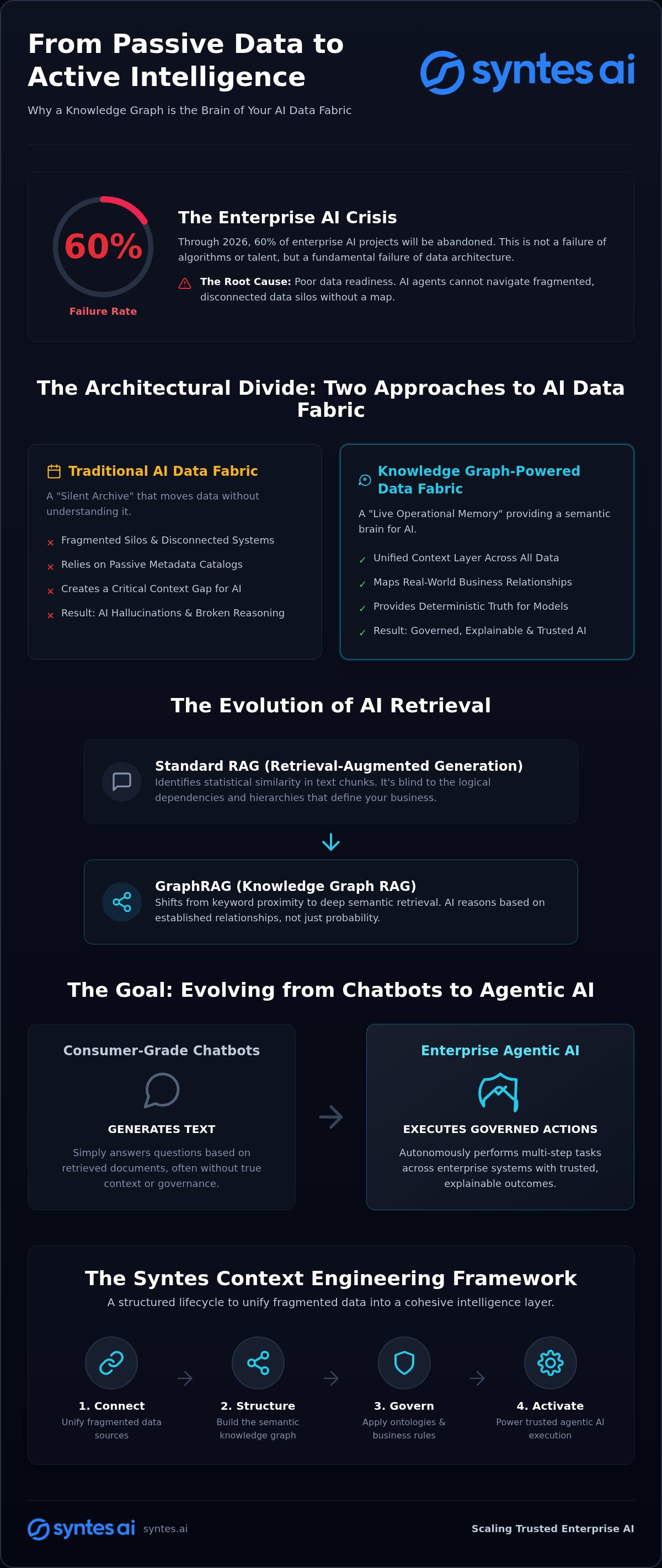
Through 2026, 60% of enterprise AI projects will be abandoned due to poor data readiness. This isn’t a failure of compute or talent; it’s a fundamental failure of architecture. Most organizations treat their data fabric as a passive reservoir, expecting LLMs to navigate fragmented silos without a map. The result is predictable. Hallucinations persist. Reasoning breaks. Scalability remains a distant promise. To bridge this gap, sophisticated leaders are integrating a knowledge graph for ai data fabric to provide the semantic foundation that autonomous agents demand.
You’ve likely watched your RAG systems struggle with context or seen agents fail when faced with disconnected enterprise systems. It’s time to stop treating data as a static collection of files and start treating it as a live operational memory. This guide outlines how a knowledge graph transforms your infrastructure from a silent archive into a strategic engine for agentic AI. We’ll explore the roadmap to building a unified context layer that ensures every AI outcome is governed, explainable, and fundamentally trusted. By the end of this analysis, you’ll understand how to move from passive observation to active, automated performance.
Key Takeaways
- Identify why a knowledge graph for ai data fabric is the critical semantic engine that transforms a passive data architecture into a live operational memory.
- Master the transition from standard vector-based RAG to GraphRAG to ensure your AI agents reason with structural precision rather than mere statistical proximity.
- Recognize the necessity of a Context Graph for Agentic AI, which enables systems to execute governed actions across disparate enterprise systems instead of simply generating text.
- Deploy the Syntes Context Engineering Framework to unify fragmented data into a cohesive intelligence layer through a structured lifecycle of connection and governance.
- Evolve beyond consumer-grade chatbot experiments by implementing a professional enterprise AI platform built for trusted, explainable, and governed execution.
Beyond the Buzzword: Knowledge Graph as the Brain of the AI Data Fabric
An AI Data Fabric is the architectural framework designed to weave together disparate enterprise data sources into a unified, accessible layer. It serves as the nervous system of the modern organization. However, a nervous system without a brain is merely a collection of reactive circuits. Without a Knowledge Graph, your data fabric remains a passive pipeline. It moves data, but it doesn’t understand it. Integrating a knowledge graph for ai data fabric is no longer optional; it’s the only way to provide the semantic layer required for autonomous reasoning.
By 2026, the enterprise standard has bifurcated. We no longer build data structures solely for humans. While Business Intelligence (BI) tools prioritize visual dashboards and isolated metrics, Agentic AI requires semantic graphs. Humans can infer meaning from a column header; AI cannot. A Knowledge Graph provides that missing meaning, transforming raw data strings into interconnected entities that represent the actual logic of your business operations. It’s the transition from data accessibility to data comprehension.
The Limitations of Traditional AI Data Fabrics
Traditional data fabrics rely heavily on metadata catalogs. These catalogs tell you where data is, but they don’t explain what it means in context. This creates a dangerous context gap. When an AI agent attempts to execute a multi-step task, it retrieves fragments of data that lack a unifying structure. These fragmented silos break the reasoning chain. The cost of this failure is high. It manifests as persistent AI hallucinations and the inability to scale agents safely across complex systems. Metadata alone cannot bridge the distance between raw retrieval and autonomous execution.
The Knowledge Graph Advantage
The shift toward a relationship-based intelligence model changes the fundamental utility of your data. Instead of isolated records, a knowledge graph maps the complex web of connections between products, customers, and operational processes. This architecture allows you to establish a deterministic truth for your enterprise models. It creates a unified context layer that seamlessly connects structured ERP records with unstructured data like PDFs or meeting transcripts. By implementing a knowledge graph for ai data fabric, you move from a state of passive data collection to a live, active intelligence that empowers agents to act with certainty.
Architecting Semantic Grounding: How Knowledge Graphs Power GraphRAG
Standard Retrieval-Augmented Generation (RAG) is reaching its limits. While vector search identifies statistical similarity between text chunks, it remains fundamentally blind to the logical dependencies that define corporate governance. The evolution to GraphRAG represents a shift from simple keyword proximity to deep semantic retrieval. By integrating a knowledge graph for ai data fabric, enterprises provide Large Language Models (LLMs) with a structured map of reality. This grounding ensures that AI doesn’t just guess based on probability; it reasons based on established relationships.
Ontologies and taxonomies serve as the essential guardrails for this reasoning. They define the business rules, hierarchies, and constraints that govern your operations. At Syntes AI, we believe context is significantly more valuable than raw data. Data is a commodity, but context is the proprietary intelligence that allows an agent to understand why a specific contract clause overrides a general policy. Without this semantic foundation, your AI is merely a sophisticated autocomplete tool.
Beyond Vector Search: Why Entities Matter
Vector databases struggle with complex business hierarchies. They treat a document as a collection of “chunks,” often losing the connective tissue that links a subsidiary to its parent company or a SKU to its regional pricing logic. Entity discovery and relationship mapping eliminate these “black box” results by forcing the AI to navigate explicit nodes. Operational Relationship Intelligence is the ability to map real-time business events to their semantic consequences. This approach ensures that every retrieved fact is anchored to a verified entity, preventing the logical drift that characterizes consumer-grade AI experiments.
Implementing GraphRAG in Your AI Data Fabric
Modernizing your infrastructure requires a move toward an intelligent data fabric that prioritizes meaning over location. The first step involves deploying a semantic data layer for enterprise to sit atop your existing pipelines. This layer optimizes token usage by filtering out the “noise” of irrelevant data, sending only high-density, contextually relevant graph paths to the LLM. This architecture doesn’t just improve accuracy; it ensures explainability. Every decision an agent makes becomes traceable through the graph, providing the audit trail necessary for high-stakes enterprise execution. If you are ready to move beyond basic RAG, you can explore our context engineering framework to see how we ground autonomous agents in deterministic truth.
From Passive Data to Active Intelligence: Why Agentic AI Requires a Context Graph
Agentic AI marks the end of the “chat” era. We’re moving from systems that merely answer questions to those that execute complex, multi-step workflows. By the end of 2026, Gartner projects that 40% of business applications will embed AI agents capable of autonomous tasks. However, these agents cannot operate in a vacuum. A intelligent data fabric provides the connectivity, but it lacks the active reasoning layer necessary for execution. Integrating a knowledge graph for ai data fabric creates a live operational memory, transforming static records into a dynamic guide for autonomous behavior.
Syntes AI differentiates itself by moving beyond passive observation. We provide a governed agentic AI framework that prioritizes execution over conversation. This shift is critical. If your agents rely on isolated prompts, they’ll fail the moment operational reality changes. They need a system that understands how a shift in inventory levels affects a procurement contract. They need active intelligence.
The Role of Live Operational Memory
A knowledge graph serves as the agent’s long-term memory. It doesn’t just store facts; it evolves alongside your business. By integrating real-time operational events, such as transactions or inventory shifts, the graph provides a continuous context layer. This bridges the gap between the general knowledge of an LLM and the proprietary logic of your enterprise. It’s the difference between an agent that knows how to write an email and one that knows which specific client deserves a priority refund based on their lifetime value and current contract status.
Governing Agent Actions through Semantic Rules
Governance is the primary barrier to agentic adoption. To scale safely, you must embed business policies directly into your enterprise AI infrastructure. By utilizing a knowledge graph for ai data fabric, you enforce these policies at the data layer rather than relying on fragile prompt engineering. Semantic rules act as immutable guardrails. They ensure agents never bypass compliance or exceed their authority. When an action carries high risk, the system triggers human-in-the-loop protocols. This ensures that while agents are autonomous, they remain fundamentally governed and reliable.
Building a Live Operational Memory: Steps to Unify Structured and Unstructured Context
Enterprise data is inherently chaotic. It lives in buried PDFs, transient Slack threads, and rigid ERP records. Most organizations attempt to solve this by dumping everything into a lake, hoping an LLM will sort it out. This is a strategic error. You need a system that handles these disparate sources with surgical precision. The Syntes Context Engineering Framework: Connect, Understand, Contextualize, Govern, and Execute, provides the necessary structure. It transforms a standard knowledge graph for ai data fabric from a passive archive into a high-fidelity operational memory that actually understands your business logic.
Step 1-2: Connect and Understand
The first challenge is integration. You must bridge the gap between structured CRM systems and unstructured document repositories. We use automated machine learning to perform entity and relationship discovery, identifying the hidden links between a customer’s complaint in a messaging channel and their recent transaction history. Context Engineering is the next evolution beyond prompt engineering, shifting the focus from how we talk to AI to how we structure the world for AI.
Step 3-5: Contextualize, Govern, and Execute
Contextualization requires a hybrid graph database capable of managing multi-dimensional enterprise relationships. Unlike traditional systems, this architecture allows you to apply security permissions and business rules at the semantic level. This means governance is baked into the data itself. When you deploy governed agents to perform cross-system integrations, they operate within strict, pre-defined parameters. They don’t just act; they execute within a framework of trusted intelligence that mirrors your corporate policy.
We are witnessing a fundamental shift from static enterprise knowledge graphs to live context graphs. A static graph is a snapshot. A context graph is a living entity. By utilizing two-way connectors, we ensure live system synchronization that keeps your operational memory current to the millisecond. This ensures your knowledge graph for ai data fabric serves as a reliable foundation for real-time decision-making, moving your organization from reactive analysis to proactive, automated performance.
Scaling Trusted Enterprise AI with the Syntes Agentic Platform
The market is currently flooded with “agent washing.” Many vendors simply rebrand basic chatbots as autonomous agents without addressing the underlying data fragmentation. True enterprise intelligence requires a move away from these consumer-grade experiments toward professional operational tools. The Syntes Agentic Platform provides the infrastructure for this shift. By centering your strategy on a knowledge graph for ai data fabric, you ensure that every autonomous action is grounded in verified business logic. This isn’t just another layer of software; it’s the necessary evolution for organizations that demand precision.
Why Enterprise-Grade Infrastructure Matters
High-stakes industries like Finance and Healthcare cannot tolerate “Black Box” logic. In these sectors, an AI error isn’t just a nuisance; it’s a regulatory liability. Transparent, graph-based reasoning provides the explainability required for high-stakes decision-making. Every step an agent takes is traceable through the semantic graph, creating a definitive audit trail. The ROI of solving enterprise data silos through semantic unification is undeniable. It allows you to scale AI initiatives across the entire global organization without compromising data integrity or governance. You gain a system that doesn’t just predict; it knows.
Getting Started with Context Engineering
How do you begin this transition? It starts with an honest assessment of your organization’s “Context Maturity.” Most enterprises possess vast amounts of data but lack the connective tissue to make it actionable for AI. Building the business case for a live operational context graph involves moving from passive data storage to active intelligence execution. This is the hallmark of a mature AI strategy. We invite you to explore the Syntes Agentic Platform to see how we ground autonomous systems in your proprietary reality. It’s time to stop experimenting with isolated prompts and start building a knowledge graph for ai data fabric that serves as your live enterprise memory.
The era of passive data collection is over. Organizations that fail to build a unified context layer will find their AI agents trapped in silos, unable to reason across the enterprise. Don’t let your AI strategy become another abandoned project. Transform your fragmented data into a trusted, governed, and live operational memory today.
Activating the Semantic Engine for Autonomous Execution
The transition from passive data retrieval to active intelligence execution is the defining challenge of 2026. You’ve seen how standard RAG fails without structural grounding. By implementing a knowledge graph for ai data fabric, you move beyond simple text generation to governed, cross-system action. This architecture provides the Live Operational Memory necessary to ensure your AI agents reason with certainty and act with authority. It’s the difference between a system that talks and a system that performs.
Trusted by leaders in Financial Services and Manufacturing, our Red Dot-level technical vision sets a new standard for enterprise context. We don’t just solve data silos; we engineer a semantic reality where every decision is explainable and every workflow is automated. The future of enterprise intelligence isn’t found in larger models, but in deeper, more integrated context. Secure your competitive advantage by turning fragmented data into a strategic engine of trusted execution.
The roadmap to autonomous enterprise intelligence is now clear. Start building your semantic foundation today and lead the next evolution of operational clarity.
Frequently Asked Questions
What is the difference between a Data Fabric and a Knowledge Graph for AI?
A Data Fabric is the architectural framework designed to unify disparate data sources across your organization. It serves as the connective nervous system. In contrast, the Knowledge Graph is the semantic layer that provides meaning to that data. Implementing a knowledge graph for ai data fabric acts as the brain of the system. It transforms raw data strings into interconnected entities that AI agents can actually understand and reason over.
How does a Knowledge Graph help prevent AI hallucinations in an enterprise setting?
Knowledge Graphs provide a deterministic truth by mapping explicit relationships between data points. Instead of relying on the statistical probability of the next word, the AI retrieves facts from a verified graph structure. This structural grounding ensures that the agent’s reasoning is based on your specific business logic rather than general training data. It effectively eliminates the logical drift that causes hallucinations in standard RAG systems.
What is Context Engineering, and why is it replacing prompt engineering?
Context Engineering is the systematic discipline of building and governing the business context required for AI systems to reason accurately. Prompt engineering focuses on how we talk to AI, but it’s often fragile and inconsistent. Context Engineering focuses on how we structure the enterprise world for AI. It moves the burden of understanding from text instructions to a robust, governed semantic layer that provides reliable, repeatable outcomes.
Can I build a Knowledge Graph using my existing structured and unstructured data?
Yes, you can integrate data from ERP systems, CRM platforms, and unstructured repositories like PDFs or Slack messages. Syntes AI uses machine learning for automated entity and relationship discovery to unify these fragments. This process creates a cohesive knowledge graph for ai data fabric that serves as a single source of truth. It bridges the gap between your isolated records and the proprietary logic needed for agentic execution.
How does a Live Operational Memory differ from a traditional database?
Traditional databases store static records in isolated tables that require manual querying. Live Operational Memory is a continuously evolving graph that integrates real-time business events, such as inventory shifts or transactions. It functions as a long-term memory that understands the semantic consequences of every update. This ensures AI agents always operate on the most current version of your proprietary logic instead of relying on outdated snapshots.
What industries benefit most from an Agentic AI Platform powered by a Knowledge Graph?
High-stakes industries like Financial Services, Healthcare, and Manufacturing see the greatest ROI. These sectors require explainable reasoning and trusted execution where black box outcomes are unacceptable. Retail and construction also benefit from managing complex supply chains and project hierarchies. Any organization struggling with massive data silos and requiring governed automation is a primary candidate for this infrastructure. It provides the clarity needed for high-scale operations.
Is GraphRAG necessary if I already have a vector database for my AI?
Vector databases identify statistical similarity, but they often fail at understanding logical hierarchies or complex business rules. GraphRAG adds a structural layer of grounding. It allows AI to navigate explicit nodes and relationships, providing a much higher degree of accuracy for multi-step reasoning. Without it, your agents lack the connective tissue needed to understand the why behind your data. It’s the difference between proximity and true comprehension.
How does Syntes AI ensure that AI agents execute actions safely and according to business rules?
We apply security permissions and business rules at the semantic level within the Context Graph. This means governance is baked into the data layer itself. Our framework includes human-in-the-loop protocols for high-risk decisions, ensuring that agents never exceed their authority. Every action is traceable and audited. This provides the safety and reliability required for true enterprise-scale automation, moving beyond simple chatbots to professional operational tools.