

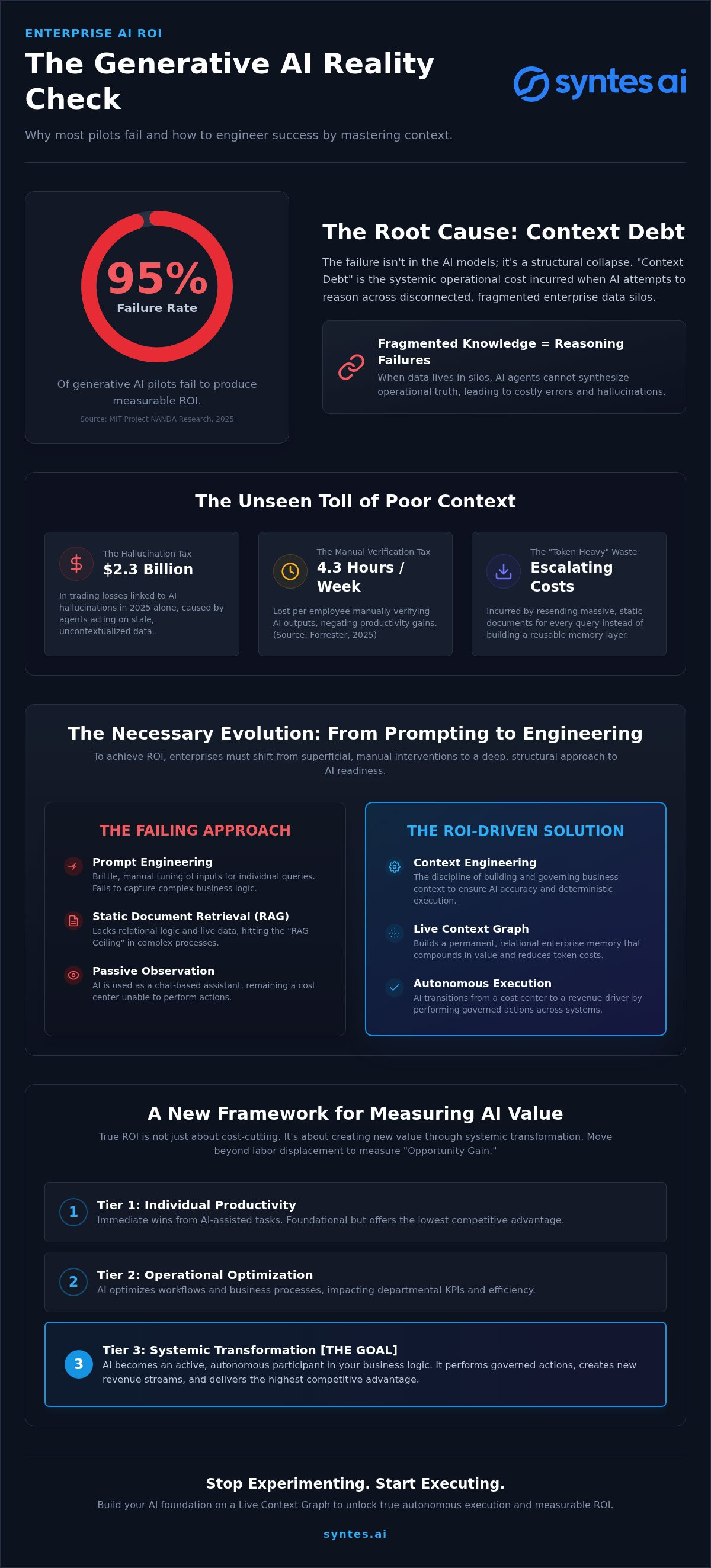
Why are 95% of generative AI pilots failing to produce a measurable return on investment? According to MIT Project NANDA research from 2025, most enterprises remain trapped in a cycle of experimental stagnation. They focus on superficial chat interfaces while ignoring the structural decay of context debt. Calculating the true total cost of ownership for enterprise ai requires a ruthless examination of fragmented data silos and the unpredictable scaling costs of token-heavy agentic workflows. You already know that static retrieval is insufficient for the demands of 2026. You see the reasoning failures caused by disconnected systems and the $2.3 billion in trading losses already linked to AI hallucinations this year.
We will help you master the metrics required to justify a shift from document retrieval to autonomous execution. This article delivers a repeatable ROI calculation framework that aligns your AI spend with live operational memory. You will learn to eliminate hidden integration costs by deploying a Live Context Graph. We provide the definitive roadmap to move from passive observation to active, governed performance through Context Engineering. It’s time to stop experimenting and start executing.
Key Takeaways
- Identify the systemic costs of Context Debt and why fragmented data silos cause 95% of AI pilots to fail before reaching production.
- Master a repeatable framework to quantify the total cost of ownership for enterprise ai, accounting for hidden integration, token-heavy workflows, and specialized talent.
- Shift your strategy from passive document retrieval to autonomous execution by aligning AI spend with the Execute pillar of operational intelligence.
- Calculate the Hallucination Tax to justify investments in deterministic truth and risk mitigation through architected context layers.
- Replace static databases with a Live Context Graph to build enduring enterprise memory that compounds ROI as your agentic workflows scale.
The Context Gap: Why 95% of Enterprise AI Pilots Fail to Deliver ROI
Ninety-five percent of generative AI pilots fail to reach production. This isn’t a failure of the models; it’s a structural failure of the underlying architecture. Most organizations currently suffer from “Context Debt,” the systemic operational cost incurred when AI attempts to reason across disconnected enterprise data. When you calculate the Total Cost of Ownership (TCO) for these initiatives, the weight of this debt often exceeds the initial software investment. First-wave pilots hit the “RAG ceiling” because document retrieval lacks the relational logic required for complex business processes. Static databases cannot provide the live operational memory needed for agents to perform reliably.
The industry is moving from experimental GenAI to operational Agentic AI. This shift demands a transition from passive observation to autonomous execution. To scale trusted AI, leaders must adopt the Syntes Context Engineering Framework. This framework provides the roadmap to connect, understand, and govern data before an agent ever attempts to execute a workflow. It is the necessary foundation to stabilize the total cost of ownership for enterprise ai in a landscape of unpredictable token costs and reasoning failures. By focusing on the “Execute” pillar, organizations transition AI from a cost-center to a primary revenue-driver.
The Hidden Cost of Fragmented Knowledge
Employees lose an average of 4.3 hours per week verifying AI outputs, according to 2025 Forrester research. This manual verification tax is the direct result of fragmented knowledge. When data exists in silos, AI agents cannot synthesize the operational truth. They hallucinate because they lack real-time relevance. These reasoning failures create significant risk when agents act on stale or uncontextualized data, leading to operational errors that far outweigh the cost of the AI license itself. Without a unified context layer, the labor required to police the AI negates the productivity gains it was supposed to provide.
Prompt Engineering vs. Context Engineering
Context Engineering is the technical discipline of building and governing business context to ensure AI accuracy and deterministic execution. Unlike prompt engineering, which relies on brittle, manual tuning, a semantic data layer for enterprise provides automated resilience. Moving context from the prompt into a Live Context Graph reduces recurring token costs. It stops the “token-heavy” waste of resending the same massive documents to the LLM for every query. You build a permanent memory layer that compounds in value, rather than a series of expensive, one-off prompts that fail to capture the complexity of your business logic.
Quantifying Hard ROI: From Efficiency to Autonomous Execution
How do you measure the success of an AI investment that goes beyond simple headcount reduction? Many organizations fail because they view ROI through the narrow lens of labor displacement. To master the total cost of ownership for enterprise ai, leaders must categorize returns into three distinct tiers: individual productivity, operational optimization, and systemic transformation. While the first tier offers immediate wins, the third tier creates the most significant competitive advantage. This is where AI moves from a passive assistant to an active participant in your business logic. It is the transition from “Chat” to “Execute.”
The “Execute” pillar represents the point where AI agents perform governed actions across systems without constant manual prompting. By deploying agentic ai platforms, enterprises can drastically reduce decision latency in high-stakes environments. This shift directly impacts core KPIs like order-to-cash cycles and supply chain resilience. Understanding the true costs of AI deployment requires looking past the initial API fees and evaluating the systemic value of autonomous execution. If your AI cannot act, it remains a cost center rather than a revenue driver.
Measuring Value-Add vs. Labor Displacement
The real ROI of agentic intelligence is “Opportunity Gain.” This is the value realized when you redirect senior staff from manual data hunting to strategic execution. By solving enterprise data silos through a unified context layer, you eliminate the cognitive load of information synthesis. We establish a baseline for “Human-in-the-Loop” efficiency where the human role shifts from creator to governor. This transition ensures that your highest-paid talent is focused on high-leverage decisions rather than administrative verification.
The Revenue Impact of Live Operational Memory
Static data is dead data. A Live Context Graph provides the operational memory required to accelerate time-to-market for new products and services. In retail and manufacturing, real-time operational context prevents missed revenue opportunities by identifying supply chain bottlenecks before they occur. Relationship-based intelligence also compounds customer lifetime value (CLV) by enabling agents to understand the deep history of every account. This level of systemic integration is what transforms a standard AI implementation into a high-yield asset. To see how these frameworks apply to your specific architecture, you can book a demo with our strategy team.
Calculating the Hallucination Tax and Risk Mitigation ROI
What is the true price of an ungrounded inference? We define the “Hallucination Tax” as the aggregate financial burden of rework, legal liability, and brand erosion caused by stochastic AI outputs. In the first quarter of 2026 alone, AI hallucinations in financial analysis were linked to $2.3 billion in avoidable trading losses. When you evaluate the total cost of ownership for enterprise ai, you must treat these errors as hard liabilities rather than technical glitches. Investing in frameworks that show how to prevent ai hallucination provides a direct, quantifiable return by architecting deterministic truth into your system.
The TCO of “Shadow AI” tools often appears lower on paper but carries catastrophic tail risks. Ungoverned tools lack the Explainable AI (XAI) capabilities required in highly regulated sectors like Finance and Healthcare. Without a clear reasoning path, a single autonomous error can trigger regulatory penalties that reach up to 7% of global annual turnover under the EU AI Act provisions effective August 2, 2026. Governed Agentic AI eliminates this volatility. It ensures that every automated action is anchored in verified enterprise logic, transforming your AI from a liability into a defensible asset.
The Auditability Premium
Transparency isn’t just a compliance requirement; it’s a cost-saving strategy. By utilizing a Context Graph, organizations create a live, immutable audit trail for every AI action and reasoning step. This visibility drastically reduces the labor hours required for legal and compliance reviews. When your AI operates with deterministic truth, you eliminate the need for expensive, manual output verification. You stop paying senior staff to police the machine and start allowing them to scale its output. This “Auditability Premium” is a core component of a sustainable total cost of ownership for enterprise ai framework.
Risk Avoidance in Governed Agentic Workflows
An ungoverned autonomous transaction is a ticking financial time bomb. Contrast this with a governed workflow where an enterprise knowledge graph serves as the “Ground Truth” engine for every decision. This architecture ensures that agents only execute actions within pre-defined, governed parameters. This level of control provides significant insurance and regulatory benefits, as it demonstrates proactive risk management. By centering your architecture on a unified context layer, you mitigate the systemic flaws that lead to expensive operational failures.
A 5-Step Framework for Measuring Agentic AI Integration Returns
Calculating the total cost of ownership for enterprise ai requires moving beyond project-specific silos. You must evaluate the platform as a systemic asset. Most CIOs fail because they treat AI as a series of disconnected experiments rather than a unified architectural evolution. To secure a defensible ROI, follow this five-step framework designed for the 2026 operational environment.
- Step 1: Baseline Context Debt. Quantify the “As-Is” cost of fragmented data silos. This includes the 4.3 hours per week each employee spends verifying AI outputs and the systemic reasoning failures that stall production.
- Step 2: Calculate Context Engineering and Integration Costs. Establish your investment base. This covers the technical labor to connect disparate systems and the deployment of a unified context layer.
- Step 3: Model Operational Gain from Autonomous Execution. Calculate the revenue impact of moving from passive assistants to active agents. Measure the reduction in decision latency and the acceleration of core business cycles.
- Step 4: Factor in Compound Interest. Unlike static databases, a Live Context Graph becomes more valuable as it integrates more data points. Account for the accelerating efficiency of your Live Operational Memory.
- Step 5: Compare against the Cost of Inaction (COI). Evaluate the competitive risk of falling behind. S&P Global Market Intelligence reports a sharp increase in AI initiative abandonment; don’t let your organization become a statistic of stagnation.
Defining the Investment Base
Your investment base must account for more than just software licenses. It includes cross-system integration, data engineering, and the specific enterprise ai infrastructure required to support agentic reasoning. You must also identify the hidden human capital needed for ongoing context maintenance and governance. Before deployment, assess the “Data Debt” clearance required. If your underlying data architecture is broken, your agentic workflows will fail, regardless of the model’s sophistication. It’s a hard reality: you can’t automate chaos.
Long-Term TCO: The Network Effects of Context
The total cost of ownership for enterprise ai shifts dramatically as you move from brittle RAG architectures to a Context Graph. ROI accelerates through network effects; as more systems connect, the cost per successful inference drops because the context is already architected. When evaluating “Build vs. Buy,” consider the 3-year TCO of maintaining custom context infrastructure. Brittle, first-wave RAG systems carry a high risk of technical obsolescence and recurring maintenance costs. A governed, scalable platform provides the automated resilience required to outpace competitors who remain trapped in pilot purgatory.
Beyond RAG: Building Long-Term Value with the Syntes AI Context Graph
RAG is a crude patch on a systemic problem. While document retrieval provides a temporary facade of utility, it fails to capture the relational complexity of a global enterprise. To stabilize the total cost of ownership for enterprise ai, you must move beyond the RAG ceiling. The Syntes AI Context Graph serves as your permanent Enterprise Memory. It compounds value with every interaction. Unlike static retrieval systems that incur fresh costs for every query, a graph-based architecture understands the specific business logic that governs your workflows. It doesn’t just find documents; it understands the deep connections between your data points.
This shift enables Operational Relationship Intelligence. It outperforms disconnected retrieval by providing the sophisticated reasoning path required for autonomous action. The Syntes platform transforms context from an overhead burden into a high-yield strategic asset. You stop paying for the same context repeatedly through redundant prompt engineering. You start building a foundation for automated enterprise intelligence that scales without an exponential increase in token waste or compute overruns. This transition is essential for any organization looking to maintain a competitive total cost of ownership for enterprise ai in an environment of rising infrastructure costs.
Live Operational Memory as a Strategic Asset
A Live Context Graph evolves alongside your business. It reduces the technical friction of future AI integrations by maintaining a “Single Source of Context” across the organization. This architecture acts as a force multiplier for all subsequent agentic deployments. Syntes AI bridges the critical gap between general-purpose LLMs and your proprietary enterprise logic, ensuring that your models aren’t just guessing based on training data. They’re executing based on a persistent, real-time understanding of your current operations. This Live Operational Memory ensures that as your business scales, your AI systems become more accurate and more cost-effective.
The Architecture of Trusted ROI
The Syntes Context Engineering Framework is built on five functional pillars: Connect, Understand, Contextualize, Govern, and Execute. These pillars provide the structural integrity required to move from pilot purgatory to high-performance production. By architecting a governed context layer, you eliminate the volatility of ungrounded AI and the “Hallucination Tax” discussed earlier. You replace “Shadow AI” risks with a defensible, explainable system that delivers deterministic results at scale. The era of theoretical experimentation is over. It’s time to deploy the infrastructure of the autonomous enterprise and secure your organization’s future.
Architecting the Autonomous Enterprise
The era of experimental pilot purgatory is over. You’ve seen why 95% of initiatives fail when they lack a unified context layer. True mastery of the total cost of ownership for enterprise ai requires a fundamental architectural shift. You must eliminate the Hallucination Tax by deploying governed context graphs that anchor AI in deterministic truth. This isn’t just about accuracy; it’s about financial liability and operational resilience.
Transform your static data silos into a Live Operational Memory. This transition allows you to deploy agents that execute complex business logic rather than merely generating text. By adopting the Syntes Context Engineering Framework, you turn context from a recurring expense into a compounding strategic asset. You move from passive observation to active, automated performance. The roadmap to 2026 demands operational clarity and technical mastery. It’s time to build an infrastructure that delivers defensible, long-term value for the modern enterprise.
Frequently Asked Questions
What is the average ROI for enterprise AI integration projects in 2026?
Average ROI varies wildly across the market. While MIT research indicates that 95% of generative AI pilots fail to produce measurable returns, successful implementations focusing on autonomous execution see significant gains. Organizations that move beyond simple chatbots to agentic workflows often realize returns through reduced operational friction. The key is shifting from experimental spend to strategic infrastructure that supports long-term growth and systemic integration across all business units.
How does Context Engineering improve TCO compared to standard prompt engineering?
Context Engineering significantly lowers the total cost of ownership for enterprise ai by automating the delivery of relevant data. Unlike prompt engineering, which requires brittle and manual tuning for every interaction, a Context Graph provides a resilient and reusable context layer. This architecture reduces recurring token costs and eliminates the human labor required to constantly refine prompts for accuracy. It moves the intelligence from the message to the system.
Can I calculate ROI for AI projects before the pilot phase is complete?
You can calculate potential ROI by baselining your current “Context Debt.” This involves quantifying the labor hours lost to manual data synthesis and the cost of reasoning failures in existing processes. By modeling the “Opportunity Gain” of redirecting senior talent toward strategic execution, you create a defensible financial roadmap. This proactive approach ensures that your AI spend aligns with specific autonomous execution KPIs before you commit to a full pilot.
What are the hidden costs of AI integration that most CFOs overlook?
CFOs often overlook the “verification tax” and the unpredictable scaling costs of token-heavy workflows. According to 2025 Forrester data, employees spend over four hours per week verifying AI outputs. Other hidden factors include specialized AI/ML talent salaries, which often exceed $250,000 for senior roles, and the massive cloud compute overruns associated with unoptimized retrieval systems. These indirect expenses can be three to eight times higher than initial software quotes.
How do AI hallucinations impact the financial return of agentic workflows?
AI hallucinations act as a direct financial liability, often referred to as the “Hallucination Tax.” In early 2026, ungrounded financial analysis led to $2.3 billion in avoidable trading losses. For agentic workflows, an error doesn’t just produce a wrong word; it executes a wrong action. This increases the total cost of ownership for enterprise ai through necessary rework, legal liability, and potential regulatory penalties under the EU AI Act provisions.
Is it better to build or buy enterprise AI infrastructure for maximum ROI?
Buying core infrastructure like a Context Graph is generally more cost-effective for maximizing ROI. Building proprietary context layers from scratch leads to high technical debt and maintenance overhead. Most enterprises achieve the best results by purchasing a governed platform for the context layer while building custom agents that reflect their unique business logic. This strategy ensures you don’t waste capital reinventing the architectural wheel while maintaining control over your proprietary intelligence.
What metrics should I use to measure the success of autonomous AI agents?
Success metrics should focus on “Execute” pillar outcomes rather than simple engagement stats. Key performance indicators include decision latency reduction, execution accuracy rates, and improvements in order-to-cash cycles. You should also measure the “Auditability Premium,” which quantifies the reduction in compliance and legal review costs. These metrics provide a clear picture of how autonomous agents contribute to the bottom line by replacing passive observation with active performance.
How does a Live Context Graph reduce the long-term TCO of AI systems?
A Live Context Graph reduces long-term TCO by creating a reusable “Enterprise Memory.” As you connect more systems, the cost of deploying each subsequent AI agent drops because the context is already architected and governed. This network effect prevents the exponential cost growth seen in fragmented RAG systems. It transforms your data into a strategic asset that compounds in value over time, ensuring your infrastructure remains relevant as your operational needs evolve.